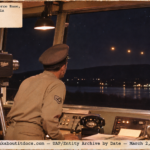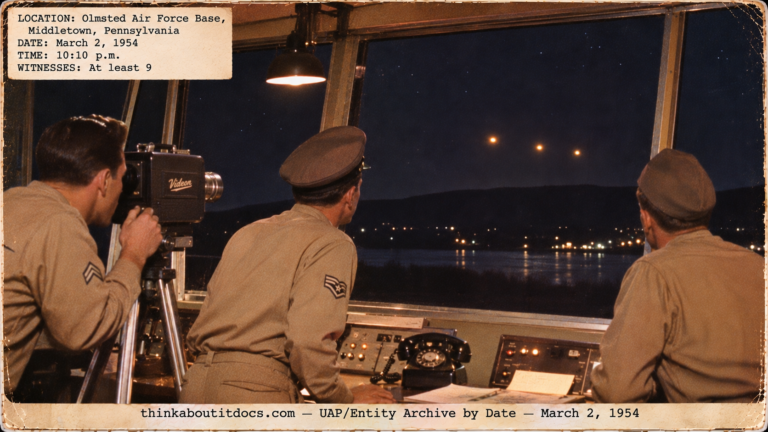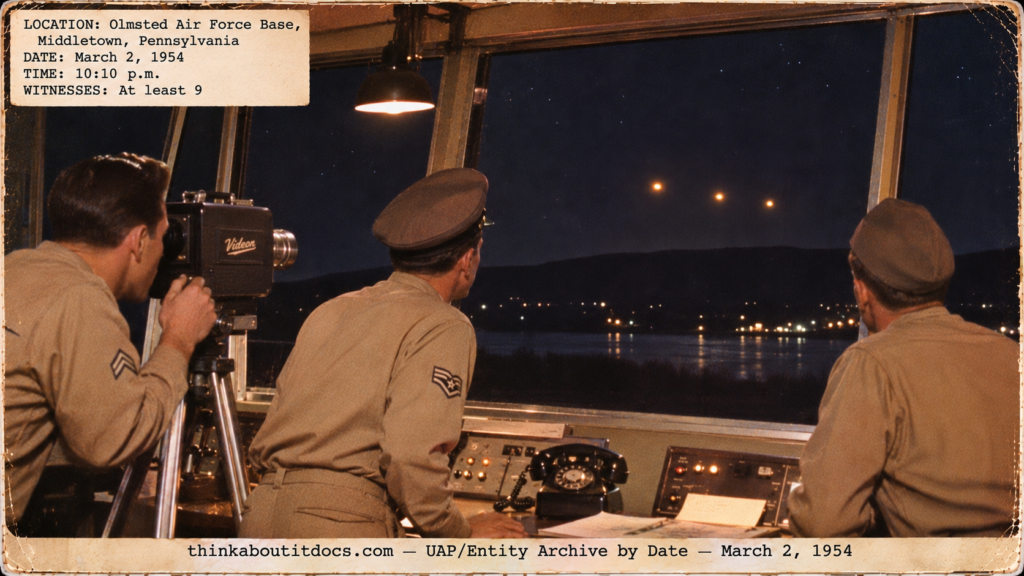
March 2, 1954: tower airmen at Olmsted AFB watch three amber lights drift over the Susquehanna ridge.
THINK ABOUTIT UFO|UAP SIGHTINGS REPORT
1954: The Olmsted AFB, Harrisburg and York Three Lights, Pennsylvania
At about ten o’clock on the night of March 2, 1954, an engineer in York, Pennsylvania, looked up at three amber lights, each many times brighter than the brightest star, moving silently north at an even pace. He telephoned the control tower at Olmsted Air Force Base in Middletown, and the airmen there walked outside and found three lights of their own.
By the time the sightings ended, tower operators at Olmsted and at Harrisburg State Airport, flight-line crewmen, a mechanic and the engineer himself had described the lights from three different places, in three slightly different patterns. Project Blue Book’s record card calls them “Unidentified,” and its comment ties them to Dr. J. Allen Hynek’s category of nocturnal meandering lights.
Date: March 2, 1954
Sighting Time: About 10:00-10:10 p.m. EST (card: local 2210, GMT 03/0300Z)
Day/Night: Night
Location: York, Middletown (Olmsted AFB) and Harrisburg State Airport, New Cumberland, Pennsylvania
Urban or Rural: Rural/suburban
No. of Entity(‘s): Not Applicable
Entity Type: Not Applicable
Entity Description: Not Applicable
Hynek Classification: NL (Nocturnal Light)
Duration: About 19-30 minutes (the intelligence report gives about 19 minutes; the card gives 30)
No. of Object(s): 3
Description of the Object(s): Three bright amber lights, each appearing as one light at first and later as two, with the brightest in the lead
Shape/Size/Color of Object(s): Amber to reddish or faded yellowish-white; about the size of a pea at arm’s length; seen as three separate objects from York, as one object with three lights in a line from Olmsted AFB, and as one object with three lights in a triangle from Harrisburg State Airport
Distance to Object(s): Not determined because of darkness; one Olmsted tower airman put the lights about 700 ft above the ground
Height & Speed: Estimated 80-100 mph at 2,000-3,000 ft by the York witness; the Olmsted tower airman put them at about 700 ft; the card records the course as erratic
Number of Witnesses: At least nine witnesses at three locations: the York engineer, two Olmsted tower airmen, two flight-line alert crewmen, an aircraft mechanic and three Harrisburg State Airport tower personnel (names blacked out in the file)
Special Features/Characteristics: The lights flew north in line, reversed course and returned in the opposite direction; the spacing stayed constant and no sound was heard; an Olmsted airman tried to photograph them with a Videon camera; the card’s photo box is marked Yes; no aircraft were in the area
Case Status: Unidentified (Blue Book card: Other — Unidentified)
Source: Project Blue Book record card and Air Intelligence Information Report (Olmsted AFB, March 1954); Berliner; FUFOR Index (BBU)
Summary/Description: On March 2, 1954, a York engineer reported three amber lights flying north, then back south, and relayed the sighting to Olmsted AFB tower. Olmsted tower personnel, flight-line crew and a mechanic, and the Harrisburg State Airport tower, saw the lights from other positions. No aircraft were in the area, and the Air Force could offer no definite explanation.
Related Cases: The card compares the case to the Bismarck sightings and Hynek’s “Nocturnal Meandering Lights.” The February page’s York entry (fighter pilots and 14 discs) is a separate listing.
Detailed Report
The Olmsted Air Force Base investigation, a security investigator’s report built from interviews and signed statements over several days, begins with a man in York, Pennsylvania. At about 2210 hours on March 2, 1954, a 38-year-old consulting engineer, who held a private pilot’s license and was rated reliable, saw some lights near his home and telephoned the control tower at Olmsted AFB in Middletown.
He described three “bright light sources,” many times brighter than the brightest star in the sky, amber in color. At first each looked like a single light. After about a minute’s observation each appeared to be two lights, the brightest in the lead and the dimmer one behind. He estimated their speed at 80 to 100 miles an hour at 2,000 to 3,000 ft. The spacing never changed and they made no sound. They moved north at an even rate, then returned some time later, passing about five miles from York on a southerly course.
At Olmsted, an airman on duty in the control tower took the call and saw three lights about 700 ft above the ground, moving west by north toward Harrisburg. A second tower airman also watched the lights and tried to photograph them with a Videon camera. Members of the alert crew on the flight line saw them as well. The senior alert crewman saw three lights moving slowly west along the ridge across the Susquehanna River at about 2200, and took the impression of a single lamp-like object with three lights attached. Another crewman watched three lights above the ridge for about ten minutes; they were not on the same plane, appeared slightly staggered, moved southwest and never dropped below the ridge line. An aircraft mechanic saw three lights across the river, “a faded yellowish-white,” above the firing range and dike area, moving slowly southwest. He said they changed their pattern and turned south, first lined up and later in the shape of a triangle.
At Harrisburg State Airport at New Cumberland, 6.8 miles from the Olmsted tower, an operations specialist and two associates in the control tower saw the same phenomenon at about 2210. The operator there contacted the Olmsted tower to compare notes on where the three lights were. The Harrisburg tower saw one object with three lights in a triangular pattern, while Olmsted saw one object with three lights in a line, and the York witness, looking from the ground, saw three separate objects flying one after another.
Investigators queried air traffic control. New York Air Traffic Control reported no known aircraft in the Harrisburg area, and a pilot 35 miles northwest of the airport reported nothing unusual in his area. The sky was clear, visibility 15 miles, the wind calm, the temperature 41°F. The Olmsted report closes by saying the office was unable to offer any definite explanation of the sightings.
RESEARCHER’S NOTES
Three Vantage Points, Three Patterns, No Explanation
- Three viewpoints, one phenomenon: The York witness saw three objects in a line, Olmsted saw one object with three lights in a line, and Harrisburg saw one object with three lights in a triangle. The differences read like one set of lights seen from different positions, and the file does not resolve which.
- Reliable, mostly military witnesses: Tower operators, flight-line crewmen and a mechanic reported independently from different spots, and the card lists the source as military and civilian.
- The card comment: The card calls the case “Very similar to Bismarck & others,” ties it to Hynek’s “Nocturnal Meandering Lights,” and describes the witnesses as “reliable” and the case as “well documented.”
- Card and file times: The card gives local 2210 and GMT 03/0300Z; 0300Z is 10:00 p.m. EST. The 2210 matches the call to the tower and the 2200 matches the flight-line sightings, so both are reported here as about 10:00-10:10 p.m.
- What the live entry got wrong: The old entry had the lights flying “straight and level at medium speed.” The card records the course as erratic, and the York witness described a northbound pass followed by a southbound return.
This is a multi-vantage nocturnal-lights case with no aircraft in the area, no explanation offered, and a Blue Book card that leaves it Unidentified. The patterns differ from station to station, and the file never reconciles them, so this page leaves them as the witnesses gave them.
“reliable witnesses, well documented.”
— Project Blue Book record card, on the March 2, 1954 Harrisburg-Middletown-York sightings