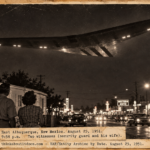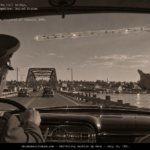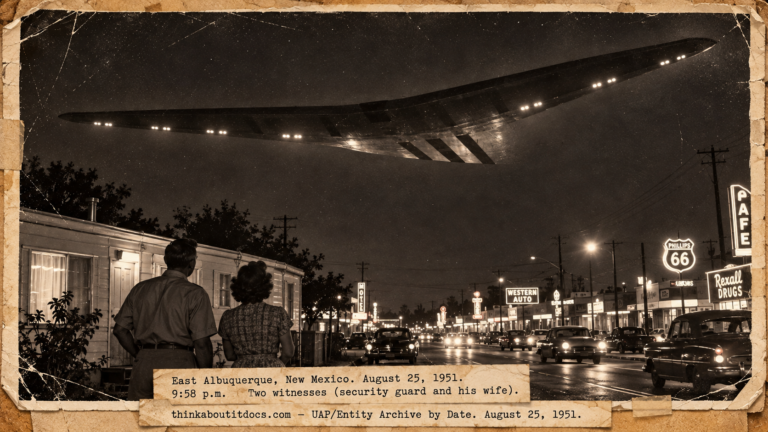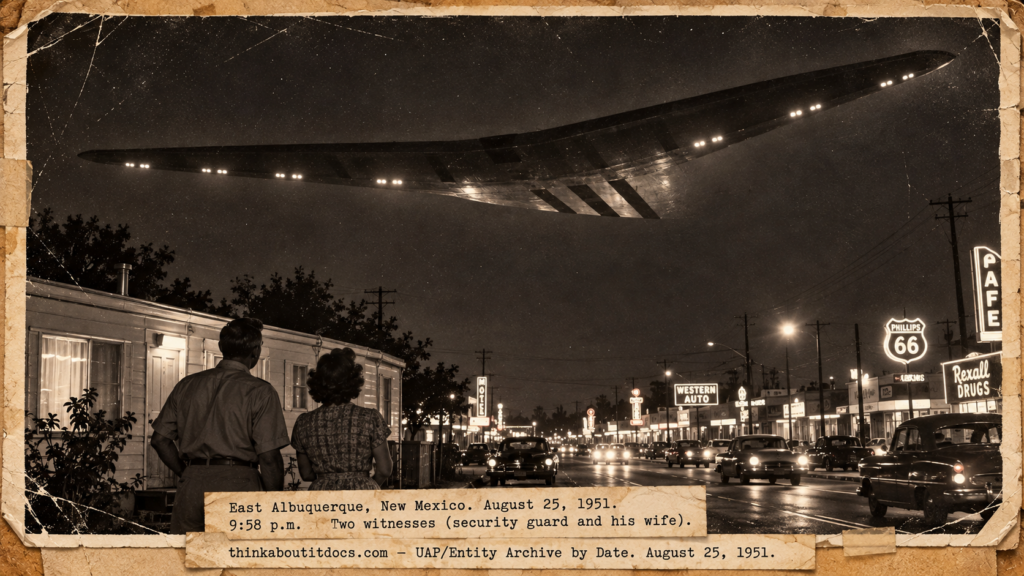
Albuquerque, New Mexico, August 25, 1951: a Sandia Base guard and his wife watch a silent flying wing cross Central Avenue.
THINK ABOUTIT UFO|UAP SIGHTINGS REPORT
1951 Albuquerque UFO: Sandia Base Flying Wing Sighting
At 9:58 p.m. on August 25, 1951, a Sandia Base security guard and his wife stood in front of their trailer in east Albuquerque, New Mexico, waiting for his ride to the night shift, when a silent, wing-shaped object slid across the sky from the north. It was a dark chevron one and a half to two times the wingspan of a B-36, with six to eight pairs of soft, glowing white lights along its trailing edge and dark stripes running across its underside. As it passed over the bright strip of Central Avenue (U.S. Highway 66), the glow of the street lights and car headlights played across its belly, and the lights along the wing went out just after it crossed the highway.
The Air Force could find nothing to explain this UFO sighting. Strategic Air Command had no B-36 in the area, Northrop had no flying-wing bomber in the air, and the radar station at Kirtland AFB saw nothing. Two months later, investigators showed the couple the Lubbock Lights photographs, and both said the pattern of lights matched what they had seen. Project Blue Book rated the case Unknown, and it remains one of the most carefully investigated flying-wing UFO reports in the 1951 record.
Date: August 25, 1951
Sighting Time: 9:58 p.m. MST (2158 local; 0458Z, August 26)
Day/Night: Night
Location: East Albuquerque, New Mexico, at the witnesses’ trailer home near Central Avenue (U.S. Highway 66)
Urban or Rural: Urban
No. of Entity(‘s): Not Applicable
Entity Type: Not Applicable
Entity Description: Not Applicable
Hynek Classification: Nocturnal Light (NL) with structural detail (flying-wing outline); no entity, landing, or physical effect reported
Duration: About 30 seconds
No. of Object(s): 1
Description of the Object(s): A flying-wing or chevron-shaped craft with no fuselage, wings swept back about 15 degrees with no taper from the mid-section to the tips, dark chordwise stripes on the underside, and six to eight pairs of round, soft, glowing white lights on the trailing edge. No running lights were seen and no sound was heard.
Shape/Size/Color of Object(s): Flying wing or chevron; one and a half to two times the wingspan of a B-36 (about 350 feet in Berliner’s catalog); silver where street and automobile lights reflected off it, with dark stripes beneath and white lights along the trailing edge
Distance to Object(s): Passed directly overhead; at closest about 15 degrees east of the zenith
Height & Speed: About 800 to 1,000 feet; about 300 to 400 mph, straight and level, on a heading of about 160 to 170 degrees (from the north toward the south-southeast)
Number of Witnesses: 2 (Sandia Base security guard H. R. “Hugh” Young and his wife)
Special Features/Characteristics: Completely silent; no visible means of propulsion; lights went out just after the object passed north of Highway 66; the male witness held a “Q” clearance; later compared by both witnesses to the Lubbock Lights photographs
Case Status: Unknown (Project Blue Book record card); Air Force Office of Special Investigations closed its inquiry on November 14, 1951, unable to confirm the sighting through other sources
Source: Project Blue Book case file (record card; OSI spot intelligence report of August 27, 1951; 34th Air Division message; OSI report of September 18, 1951; OSI letter of November 14, 1951); Berliner; Dan Wilson; Bill Schroeder
Summary/Description: A Sandia Base guard and his wife watched a silent, swept-back, wing-shaped object with rows of white lights on its trailing edge cross low over Albuquerque; no known aircraft or radar target accounted for it, and the couple later matched its lights to the Lubbock photographs.
Related Cases: The Lubbock Lights (August 25, 1951, 9:10 p.m. CST, and the August 30 Hart photographs); a similar, unreported sighting by a Lubbock woman in late August or early September 1951
Detailed Report
The Sighting
On the morning of August 26, 1951, the officer of the guard at Kirtland AFB told the Office of Special Investigations duty agent, Special Agent Harold E. Peterson, that a Sandia Corporation guard living in Albuquerque had reported an unconventional aircraft. The man worked the night shift at Sandia Base and held a “Q” clearance. He told Peterson that on the evening of August 25 he was standing in front of his trailer with his wife, waiting for his ride to work, when he saw an object approaching from the north on a true course of about 160 to 170 degrees. Its flight path took it about 15 degrees east of the zenith as seen from where they stood.
He described it as similar to the Northrop flying wing bomber in that it had no fuselage. The wings were swept back about 15 degrees with no taper. As the object passed over the brightly lit Central Avenue (U.S. Highway 66), the reflection of those lights could be seen on its underside. He put its size at one and a half times that of a B-36, said it appeared silver except for six or eight dark stripes on each side of the center line running lengthwise on its underside, and said that along the trailing edge, between the dark stripes, were six to eight pairs of round, glowing white lights. The lights went out just after the object passed north of U.S. 66. It made no sound whatever, flew straight and level at an estimated 300 miles per hour and 800 to 1,000 feet, and showed no method of propulsion. It faded from view in the darkness after about half a minute. The witness deliberately checked his watch at the end of the sighting and noted 9:58 p.m. His wife saw the object too and agreed with his account in every respect.
The Air Force Response
The OSI filed a spot intelligence report on August 27 and began trying to locate other witnesses. Air Force headquarters then asked the 34th Air Division at Kirtland to forward all available information immediately by teletype, to verify the sighting further by investigating along the route and the extrapolated course, and to check any ground or airborne radar operating near Albuquerque. The 34th Air Division replied with a more detailed description: chevron-shaped, flying-wing type, one and a half to two times the size of a B-36, dark stripes visible on the underside from leading to trailing edge, no fuselage, six to eight soft lights on the trailing edge, a noiseless passage at 300 to 400 mph and 800 to 1,000 feet on an estimated heading of 160 degrees. The weather was a temperature of 64 degrees F, a south wind at 5 mph, five miles of visibility and a broken ceiling at 17,000 feet. The object was not detected on ground radar at Kirtland AFB.
Investigators checked for a conventional explanation. The Albuquerque OSI district reported that the possibility of a known aircraft was checked with negative results, and that the guard’s background had been checked and, because he held a “Q” clearance, it was assumed he was mentally stable. The Air Technical Intelligence Center later reported that the Strategic Air Command had no B-36 aircraft in the area at the time and that Northrop Aircraft had been contacted and none of its flying-wing bombers were flying.
The Lubbock Connection
On October 30, 1951, the Air Technical Intelligence Center wrote to the Albuquerque OSI district enclosing an OSI report on the Lubbock, Texas, sighting of August 25 and four photographs taken on August 30 that were “very similar” to what had been seen over Lubbock. It asked investigators to show the photographs to the Albuquerque guard and see whether they matched what he saw, and to have him sketch in the wing he reported. The center said it believed there was “enough similarity between the Albuquerque and Lubbock sightings to warrant an investigation.”
On November 10, 1951, the couple were shown the photographs. They stated that the formation of lights appeared similar to the lights they had observed on the trailing edge of the object, and the husband sketched in the outline of the wing on the photograph. His wife, assisted by her husband, also drew a separate sketch of the object. The file also records that a very similar sighting had taken place in Lubbock, but that its witness believed she had seen an illusion and never reported it, so only a date of “late in August or early September” could be given.
The Investigation Closes
On November 13 the chief aircraft communicator at the Albuquerque Air Route Traffic Control Center told the OSI that no unusual sightings had been reported on the night of August 25. With no other witnesses found and no radar or aircraft explanation available, the Albuquerque OSI district closed its investigation on November 14, 1951, while telling the Air Technical Intelligence Center it would answer any further request. The Blue Book record card rates the case Unknown. An earlier status extract reads “No conclusions – Investigation closed,” while an appendix in the same file says the investigation would continue until the authenticity of the Lubbock photographs could be determined.
RESEARCHER’S NOTES
Why the Albuquerque Flying Wing Still Matters
- The witnesses: The guard held a “Q” clearance, was familiar with all types of aircraft, and was described by investigators as apparently reliable. His wife agreed in every detail.
- The reflected glow: The silver color came from Central Avenue’s street lights and passing cars reflecting off the object’s underside. That means the witnesses saw the surface of a solid object, not just a light, and the file titles the report an “unconventional type of aircraft.”
- Known aircraft ruled out: The Strategic Air Command had no B-36 in the area, Northrop had no flying wing in the air, and the Kirtland radar did not detect the object. Those checks closed off the obvious explanations.
- The Lubbock match: The Air Force asked the couple to compare their sighting to the Hart photographs, and both said the light pattern was similar. The comparison is only as strong as the photographs, and the file says the investigation would continue until their authenticity could be established.
- Figures that differ: The file gives the size as one and a half to two times a B-36 wingspan, and Berliner’s catalog converts one and a half times to about 350 feet. The witness’s speed estimate is 300 miles per hour in the spot report and 300 to 400 in the later message.
The honest position is that this was a credible two-witness report of a large, silent, structured object that investigators could not match to any aircraft, radar return, or test flight. The only physical link to another case is a set of photographs whose authenticity the Air Force itself was still trying to settle when the file closed. The Albuquerque flying wing stays Unknown, and its main value is that it ties a ground-level, close-range observation to the Lubbock Lights on the same night.
“The possibility of this being a known aircraft was checked with negative results.”
— Air Force Office of Special Investigations, Albuquerque district, 1951