Two radar controllers at Selfridge AFB tracked a target at up to 45,000 feet on two radars on March 9, 1950.
THINK ABOUTIT UFO|UAP SIGHTINGS REPORT
1950: Selfridge AFB Dual-Radar UFO
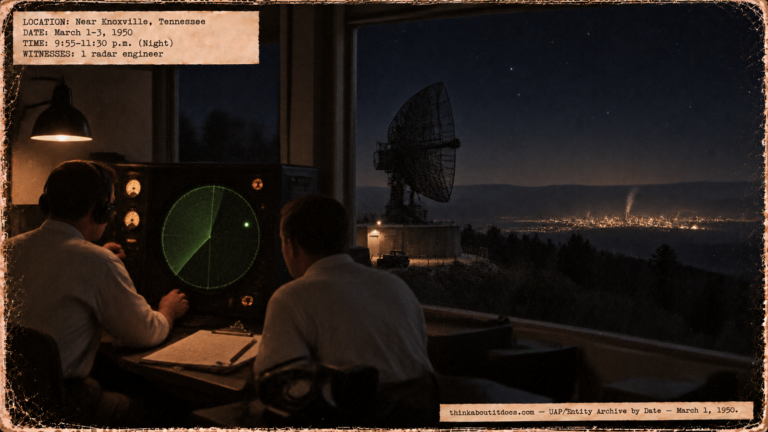
On the night of March 9, 1950, at Selfridge AFB, Michigan, two radar controllers watching their own jet fighters on an AN/CPS-5 surveillance set and an AN/CPS-4 height-finder noticed something that did not belong: a target at 40,000 feet and 65 miles to the west that held steady for a few seconds, faded, and came back minutes later somewhere else. Over the next two hours it climbed and dived between 15,000 and 45,000 feet, appeared to hover for two minutes, and showed up on both radars at once. The controllers checked the jets’ reported altitudes against their scopes, found the height-finder accurate to within a thousand feet, and concluded they were looking at a B-36-sized aircraft that no one could account for.
Continental Air Command’s own technical experts agreed that the two radars, one L-band and one S-band, made anomalous propagation almost impossible, and wrote that no known electronic phenomenon could produce all the observations. The Selfridge AFB March 9 radar sighting is also the case Project Blue Book’s card filed under a single handwritten word: Balloon. Six days earlier, one of the same controllers had seen an unexplained light over the base, which is on the same Blue Book file.
Date: March 9, 1950 (and a related visual sighting on March 3, 1950)
Sighting Time: About 7:45 p.m. to 9:30 p.m. EST (1945 hours to about 2130); the best-logged track ran from 2046 to 2052
Day/Night: Night
Location: Selfridge AFB, Michigan, USA, on the radar scopes of an Aircraft Control and Warning squadron; the target was 40 to 120 miles away, mainly to the west and south
Urban or Rural: Airbase radar station
No. of Entity’s: Not Applicable
Entity Type: Not Applicable
Entity Description: Not Applicable
Hynek Classification: RV (radar only; Hynek’s category requires a visual sighting)
Duration: Several hours of intermittent contact; a six-minute logged track; about two minutes stationary
No. of Object(s): 1
Description of the Object(s): A single radar target that appeared at 40,000 feet and above, faded and reappeared at different positions, climbed and dived rapidly, stayed stationary for about two minutes, and seemed at times to follow the vectors of jet fighters; no visual sighting
Shape/Size/Color of Object(s): Not seen; the return was judged comparable to a B-36 (the card) or to a B-29 or larger (Continental Air Command’s experts); its presentation on the height-finder was narrow and sharply defined, like an F-80’s
Distance to Object(s): From about 38 to 79 miles on the logged track, and out to about 120 miles when last faded
Height & Speed: 15,000 to 47,000 feet, with climbs and dives of up to 20,000 feet very rapidly; estimated speed up to 1,500 mph on the card and about 2,500 mph in the OSI spot report, which called the figure not well founded; Parker’s logged track went from 156 to 133 degrees and from 45 to 79 miles in six minutes
Number of Witnesses: 2 radar controller officers (1st Lt. Francis E. Parker and 1st Lt. Frank K. Mattson) plus several enlisted radar crew who logged the same target (including a Sgt. McCarthy and a Cpl. Melton)
Special Features/Characteristics: Seen on two radars of very different frequency (AN/CPS-5, L-band; AN/CPS-4, S-band); height-finder checked against four jets at 24,000 feet; no weather report or coverage charts available at the time; Continental Air Command’s technical comment; OSI spot report; Air Materiel Command follow-up
Case Status: Disputed. Project Blue Book’s record card carries the handwritten conclusion “Balloon.” Continental Air Command’s technical experts, with Air Materiel Command analysts concurring on the key points, said no known electronic phenomenon could produce all the observations.
Source: Headquarters Continental Air Command (Mitchel AFB) letter INT 373.5 (B), April 1950, with narrative reports of 1st Lt. Francis E. Parker and 1st Lt. Frank K. Mattson (March 10, 1950); AFOSI 5th District (Detroit) spot report of March 10, 1950, forwarded March 14; Air Materiel Command routing sheets and Headquarters USAF reply of April 12, 1950; Project Blue Book (Project 10073) record card
Summary/Description: On March 9, 1950, two radar controllers at Selfridge AFB tracked a target at up to 45,000 feet that faded and returned, climbed and dived rapidly, and hung stationary for about two minutes, and that appeared on both the AN/CPS-5 and the AN/CPS-4. Continental Air Command’s experts said no known electronic effect could produce all the observations. Blue Book’s card concludes Balloon.
Related Cases: Wright-Patterson AFB and Vandalia, Ohio (March 8, 1950); Knoxville, Tennessee, radar returns (March 1-3, 1950); Okinawa radar case (March 27, 1950)
Detailed Report
Mattson’s Account
1st Lt. Frank K. Mattson, a rated pilot since 1942 with more than 2,900 flying hours and seven months of experience as a radar controller, went on duty as controller at 1530. At 1945 a blip was pointed out to him at 270 degrees, 68 miles, 40,000 feet, as read on the height-finder scope. He and another officer watched it for three minutes without movement before it faded. At 2002 it was picked up again at 40,000 feet and moved laterally to the northeast, and he estimated its speed at 1,500 mph. At 2006 a target appeared at 350 degrees, 58 miles, 45,000 feet. Four jet aircraft were flying locally at 24,000 feet, and the jet on a bearing of 340 degrees, 38 miles was checked at 25,000 feet on the height-finder while its pilot reported 24,000, which Mattson took as support for the scope’s accuracy. The strange object faded after a minute. At 2020 he returned to the height-finder and saw an object at 350 degrees, 38 miles climb from 30,000 to 45,000 feet in one minute with no lateral movement. The night was clear with unrestricted visibility and no moon.
Parker’s Account
1st Lt. Francis E. Parker came on duty at sundown, relieved Mattson at the PPI scope of the AN/CPS-5, and began working the F-80s already airborne. The rest of the crew told him an aircraft had been picked up intermittently at 45,000 feet and over on the height-finder, and since the highest assigned altitude was 24,000 feet he put the reports down to interference or inexperience. Over the next fifteen minutes the crew repeatedly reported the target at rapidly changing altitudes. When he finally saw it himself it was a very narrow, sharply cut presentation at about 47,000 feet and about 70 miles. He checked the pilots in the area by radio and was assured the highest was at 24,000 feet. The clarity and definition were definitely those of an aircraft, he wrote, and no cloud or atmospheric effect. It did not appear on the CPS-5, which ruled out a B-29 or other large target. Contact continued intermittently with increasing regularity for 45 minutes to an hour. At 2046 he identified the target on the PPI and the height-finder together and took a six-minute log: 156 degrees, 45 miles, 25,000 feet at 2046; 152 degrees, 49 miles, 29,000 feet; 145 degrees, 56 miles, 35,000 feet; 142 degrees, 60 miles, 33,000 feet; 139 degrees, 67 miles, 35,000 feet; 136 degrees, 73 miles, 33,000 feet; and 133 degrees, 79 miles, 35,000 feet at 2052. The target faded from the PPI at 2052, was picked up for periods of one to two minutes out to 120 miles, appeared to hover for about two minutes at about 110 miles, and faded at 120 miles for the last time. The height-finder carried it past the logged six minutes. He wrote that the CPS-5 was very accurate that night, supported by the F-80 pilots, and that the CPS-4, though more erratic, could not through any known failure account for such extreme altitude changes, and that he reviewed every possible error exhaustively with his technical staff.
The OSI Spot Report
The 5th District OSI in Detroit interviewed both officers and filed a spot report on March 10. It records the first sighting at 1948 hours at about 40,000 feet on a bearing of 270 degrees at 65 miles, brilliant for a few seconds and then fading, with the blip returning about five minutes later at a different location. It gives the speed as about 2,500 miles an hour, a combination of vertical and horizontal speed that it calls not well founded, and notes both officers thought the target was about the size of a B-36 and at times appeared to follow the vectors of jet fighters in two of the four radar zones. Both also believed the erratic vertical readings looked deliberate, since the target appeared to hold steady on the height-finder for several seconds to a minute before changing. The report also records Mattson’s visual sighting of March 3. It rates both men as sincere and interested.
Continental Air Command’s Comment
Headquarters Continental Air Command, in a cover letter to the Director of Intelligence at Air Force headquarters, said that the fact the object was on the scopes of two radars was worthy of special note. Its technical experts wrote that while ionospheric layers cause reflections at lower frequencies, they have no effect at the frequencies used here except through temperature inversions or ducting, and that even in idealized ducting a small lateral motion could seem a larger change on the scope. They added that the great difference between the L-band CPS-5 and the S-band CPS-4 and the evident correlation between them almost rule out anomalous propagation, that the velocities and accelerations of the three-dimensional movements were beyond known heavier- or lighter-than-air vehicles in controlled flight, and that the report of the object staying stationary in free space for about two minutes supported that. They noted that first indications came on the height-finder before the surveillance radar, which fits the CPS-5’s poor high-altitude coverage, and that a CPS-5 target at those ranges would have the reflecting area of a B-29 or greater. They said a more complete study was not feasible without coverage charts and weather reports, and concluded that no known electronic phenomenon, nor combination of several, could conceivably produce all the observations. The command added that such reports were increasing, that it had told all its radar installations to report unusual scope sightings, and that it recommended reconsidering the submission of unidentified object reports from all zone-of-interior agencies.
Air Materiel Command and Headquarters USAF
Air Materiel Command asked the OSI for the type of radar, the weather in detail and whether the fighters saw anything unusual, and its analysts delayed a final judgment until they had 24-hour weather reports for March 8 and 9 for the Selfridge area. In a routing-sheet reply dated April 12, 1950 they recommended telling Continental Air Command they concurred with its conclusions about the velocity and accelerations and the two minutes of stationary flight. They noted a conflict in the witnesses’ dates and compared the Selfridge case to the Wright-Patterson radar echo of March 8, which was traced to ice clouds. The reply to the command’s recommendation said that cursory examination of such reports had merely confirmed the conclusions that justified discontinuing the special consideration once given to them, and that Air Force headquarters already had standing requirements for technical intelligence.
The March 3 Light
At about 2305 on Friday, March 3, Mattson, leaving the Officers’ Club after one beer, saw a yellowish light descend vertically over the base to about 5,000 feet, hover about a minute, then move west about 50 miles, south, and back north in about four minutes. He compared it to a house window at night seen from 30 yards. A C-47 flew past and faded at about eight miles, while the object did not shrink or dim as it moved off. Blue Book’s card for that sighting concludes UNIDENTIFIED.
The Card
The Project 10073 card gives the date as March 9, 1950, the source as radar operators, the time as 2046 EST, the speed as up to 1,500 mph and the altitude as up to 45,000 feet, with changes in altitude very fast. Its summary says the object was observed in the area of Selfridge AFB for several hours by two radar sets in erratic flight, that radar station personnel doubted the return was due to phenomena, and that its size was comparable to a B-36. A handwritten parenthetical reads “(Balloon).”
RESEARCHER’S NOTES
Two Radars, One Target, and a Verdict of Balloon
- A Balloon That Flew Like That: The card’s Balloon conclusion appears over the Continental Air Command’s finding that the object’s velocity and accelerations exceeded any known vehicle and that it stayed stationary for two minutes. The file does not explain how a balloon could do both.
- Two Radars, Two Frequencies: The experts’ strongest point is that an L-band and an S-band set agreed. Anomalous propagation depends on frequency, so a false target on both is unlikely. The same experts note weather data and coverage charts were missing, so they could not rule out every condition.
- Checked Against the Jets: Mattson’s cross-check, a jet at 25,000 feet on the scope with a pilot reporting 24,000, is the best evidence the height-finder was reading correctly that night.
- Not Everyone Saw It at First: Parker first blamed interference or inexperience. He changed his mind only when he saw the narrow, sharply defined target himself, which makes his account closer to a skeptic’s than a believer’s.
- A Date Conflict: Air Materiel Command’s reply notes that one witness gives the incident as March 9 and another as a different day. The OSI report, Mattson’s and Parker’s accounts and the card all say March 9.
- A Similar Day in Ohio: The analysts compared the case to the March 8 radar echo at Wright-Patterson, which turned out to be ice clouds. Selfridge’s own file offers no equivalent explanation, and its weather reports are not in the file.
The Selfridge radar case is the best-documented radar report of early 1950, with named officers, two radars of different frequency and a log of altitudes and bearings, and the Air Force’s own experts wrote that no known electronic effect could produce all of it. It is filed here as Disputed: Blue Book’s card says Balloon, and the file never explains how a balloon would behave that way.
“…no known electronic phenomena…could conceivably produce all of the observations.”
From Continental Air Command’s technical comment on the March 9, 1950 Selfridge AFB radar sighting.