Controllers at Dayton's Vandalia airport and Air Force pilots chased a bright daylight object on March 8, 1950; investigators concluded it was Venus.
THINK ABOUTIT UFO|UAP SIGHTINGS REPORT
1950: Wright-Patterson and Vandalia UFO, Venus and Ice Clouds
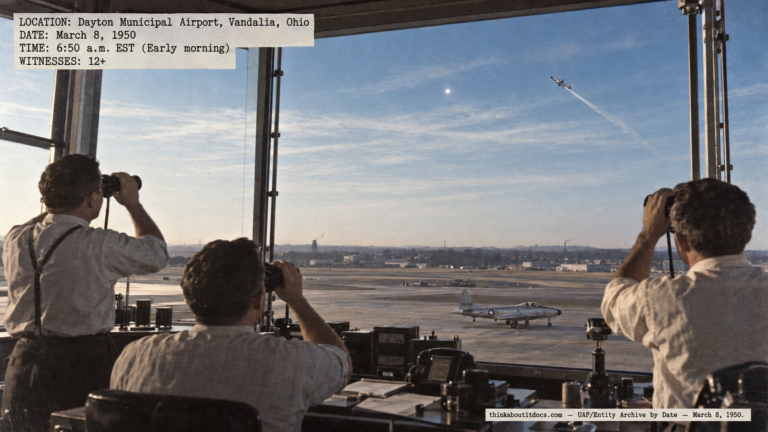
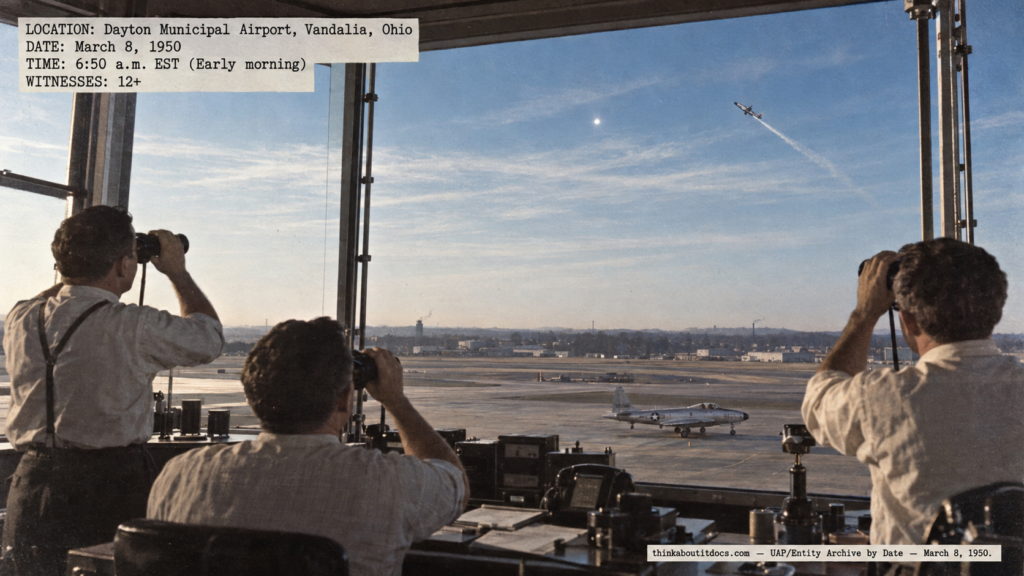
A little before seven on the morning of March 8, 1950, airport traffic controller George Barnes at Dayton’s municipal airport at Vandalia saw something fast and luminous in the east-northeast: bullet-shaped, trailing a vapor trail about six times its own length, covering from a bearing of 70 to 120 degrees in five seconds before it stopped. A TWA crew coming in to land saw a very bright light in the southeast. By midmorning the object had drawn the chief controller, the Weather Bureau’s chief, Wright-Patterson’s own intelligence and radar staff, an F-80, and an Ohio Air National Guard colonel who climbed an F-51 to an indicated 58,000 feet and never got any closer.
The Wright-Patterson AFB and Vandalia, Ohio sighting took place in plain sight of the Air Force’s Air Technical Intelligence Center. Air Materiel Command’s own investigation concluded within a day that the visual object was Venus, seen in daylight through morning mist, and that the radar echo that same morning was reflection from ice-laden clouds. Project Blue Book’s card agrees, recording both explanations in a single line.
Date: March 8, 1950
Sighting Time: About 6:50 a.m. EST (Barnes) through about 11:50 a.m.; the radar echo was reported at about 11:30 to 11:50
Day/Night: Day (early morning)
Location: Dayton Municipal Airport (Vandalia), Ohio, and the airspace and radar sites of Wright-Patterson AFB, Ohio, USA
Urban or Rural: Airport and airbase
No. of Entity’s: Not Applicable
Entity Type: Not Applicable
Entity Description: Not Applicable
Hynek Classification: DD (Daylight Disc), with a separate radar report
Duration: About 2 to 4 hours of visual observation; the radar echo some time later
No. of Object(s): 1 (a second, radar-only target reported around 11:30)
Description of the Object(s): A bright, luminous object in the southeast, high among the cirrus, that Barnes described as bullet-shaped with a vapor trail and others saw as a bright disk; it appeared to ascend into the wind and was lost behind cloud cover; separately, a large echo on a radar scope 35 miles to the east
Shape/Size/Color of Object(s): Bullet-shaped with a vapor trail (Barnes); a very luminous disk like a cosmic balloon (Stevens, Weather Bureau chief); a bright, shiny dime (a TWA ticket clerk, in the press); size about two feet in diameter to the naked eye (Barnes); a radar echo about 100 mils wide
Distance to Object(s): Not estimated; the tower placed it at the height of the 30,000-foot cirrus; the radar echo was 35 miles east at a bearing of 105 degrees
Height & Speed: Seen at 10,000 feet by the airline pilots’ first report and at or above the cirrus (30,000 to 50,000 feet) by the controllers; Barnes’s object covered 50 degrees of bearing in five seconds; Shafer’s F-51 reached an indicated 58,000 feet without any change in the object’s 40-degree elevation or its 165-170 degree bearing
Number of Witnesses: At least a dozen named or described: controllers George Barnes and Sherman Seydler, Weather Bureau chief Stevens and Fordham, Lt. Col. Dale E. Shafer Jr. (Ohio Air National Guard), AMC test pilot Maj. Kenneth C. Chilstrom, Capt. Robert M. Howe, radar operators at Wright-Patterson, a TWA flight crew and Dayton airline staff
Special Features/Characteristics: Air Force intelligence staff and test pilots saw it themselves; two fighters sent after it; radar echo separate from the visual object; Weather Bureau and CAA tower staff among the witnesses; a University of Dayton dean of science consulted; full Air Materiel Command investigation within a day
Case Status: Explained. Air Materiel Command and Project Blue Book’s card conclude Venus (visual) and ice-laden clouds (radar), with the handwritten addition “visual: solar image also.”
Source: Air Materiel Command Intelligence Department reports of March 8-15, 1950 (Capt. Robert M. Howe; Albert Deyarmond and Fred Kobernuss; R. A. Johnson and Mr. James), Air Materiel Command Daily Intelligence Brief of March 9, 1950, Headquarters USAF routing sheet of April 12, 1950; Dayton newspaper clippings; Project Blue Book (Project 10073) record card; Loren E. Gross, UFOs: A History, 1950: January–March
Summary/Description: On the morning of March 8, 1950, controllers at Dayton Municipal Airport at Vandalia saw a bright, bullet-shaped, vapor-trailing object in the east-northeast that stopped in the southeast and stayed in view for hours. Fighters were sent after it and a radar scope showed a large echo. Air Materiel Command concluded the visual object was Venus and the radar echo ice-laden clouds, and Blue Book’s card agrees.
Related Cases: Selfridge AFB, Michigan, dual-radar case (March 9, 1950); Holloman AFB and Vaughn, New Mexico (March 5 and 11, 1950); Orangeburg, South Carolina (March 9, 1950)
Detailed Report
The Tower
Airport traffic controller George Barnes of the CAA’s Dayton tower told two Air Materiel Command intelligence representatives that at about 0650 he saw an object in the east-northeast, at a bearing of about 70 degrees. It moved quickly and looked quite luminous and bullet-shaped, with a vapor trail about six times the object’s diameter. When it stopped it was at about 120 degrees, possibly 180, in the south-southwest, five seconds after it began. Its angle of elevation stayed at 15 degrees, and it seemed about two feet across. He called others to the tower at about 0715 to look through binoculars. Chief controller Sherman Seydler said the object seemed thin when it turned, which he thought sun reflection might explain, and that he thought it climbed above 50,000 feet because he believed the high cirrus lay between it and the ground. He said the captain of TWA Flight 21 saw it about fifteen minutes after it was first pointed out but could not describe it clearly. Weather Bureau chief Stevens, who came to the tower at about 0750, watched it with binoculars and the naked eye for about two and a half hours until cloud cover hid it, saw a very luminous disk that reminded him of a cosmic balloon, and said it ascended into the wind. Fordham, also of the Weather Bureau, watched it climb.
The Air Force’s Own Chase
Capt. Robert M. Howe, of the Air Materiel Command’s Experimental Test Pilot School, wrote that at about 0745 the Patterson Field tower told him to search for an object high over the field that two airline pilots had reported to the Vandalia tower as a long, slender body at about 10,000 feet approaching from the northwest. By then the Vandalia tower had it in field glasses. At 0810 Maj. Kenneth C. Chilstrom took off in an F-80, and for about the next hour the Vandalia tower kept it located at a bearing of 155 to 160 degrees from the tower, at about the height of the 30,000-foot cirrus. Howe called Col. Osgood of the Electronic Subdivision and Capt. Whiting of the All Weather Division, whose search radar is at Jamestown, Ohio, and neither radar detected anything. Chilstrom was told by the tower that he was apparently fairly close to the object, but he could not see any object. Later Lt. Col. Dale E. Shafer Jr. of the Ohio Air National Guard saw an object from the ground and took off in an F-51. He reported that during his climb the angle of elevation, about 40 degrees, and the bearing, 165 to 170 degrees, never changed. He reached an indicated 58,000 feet, where his oxygen system’s cabin pressure limit ended the climb, and he noted the object’s intensity increased as he climbed. He concluded it was a star. A University of Dayton science dean told him the planet Venus was in that position at that time of year and might be visible in daylight.
The Radar Echo
At about 11:30 to 11:50 the operator in charge at the Electronic Subdivision’s radar reported an echo 35 miles east of the station at a bearing of 105 degrees and about 100 mils wide. Two engineers, R. A. Johnson and Mr. James, wrote that signals of very large amplitude were being received on an SCR-584, and that objects described as celestial bodies had been seen earlier. They suggested checking by interception, and a fighter vectored to the position reported strips of ice-laden clouds running northwest to southeast at about 10,000 feet. Plots from the radar agreed, and they concluded the radar targets were reflections from the ice-laden clouds and the visible sightings were due to the early morning sun striking the ice-laden clouds.
The Verdict
The two Air Materiel Command intelligence representatives who interviewed the Vandalia staff wrote that the object appeared to have been Venus, that Barnes, on the graveyard shift, may have been tired, and that morning mist may have refracted the planet’s light into the appearance of a luminous sphere moving rapidly. Air Materiel Command’s Daily Intelligence Brief of March 9 said the reports resulted from two phenomena: ice-crystal clouds that reflected sunlight and registered on radar scopes, and the visibility of Venus, sometimes seen in daylight. Wright-Patterson pilots, it said, had reported only ice haze and clouds, and one pilot had reported an object believed to be Venus. Blue Book’s card says the visual sighting was Venus and the radar sighting ice-laden cloud, adding a handwritten note “visual: solar image also.” Newspaper reports quoted Shafer, who said he felt “darn foolish” and that he was convinced he had gone chasing a star or some kind of celestial body.
RESEARCHER’S NOTES
A Planet by Day, a Cloud by Radar, and a Bullet in the Tower’s Eyes
- A Planet in Broad Daylight: A University of Dayton science dean told Shafer that Venus was very bright that month and could be visible by day. The object’s fixed elevation and bearing during Shafer’s climb, and its growing brightness as he rose, fit a distant celestial object.
- The Tower’s Description: Barnes’s bullet-shaped object with a vapor trail, moving 50 degrees in five seconds, does not describe Venus. The investigators put it down to his fatigue on the night shift, and the Weather Bureau’s and Seydler’s descriptions of a steady, luminous disk fit better.
- Radar and Eyes Disagreed: The radar crews saw nothing at the visual object’s position. The echo that appeared later was in a different place, 35 miles east, and a fighter found ice-laden clouds there. The file treats them as two separate things.
- A Chase Without a Contact: Neither F-80 pilot Chilstrom nor F-51 pilot Shafer could close on it, which is what would be expected for a celestial object. The tower repeatedly said he was close to it.
- A Second Account of Venus: Newspaper reports and the Air Force brief agree on Venus. The only dissenting detail is the early vapor-trail description.
- Why It Matters: The Wright-Patterson case was cited the next day in the Selfridge radar file as a similar radar echo explained by clouds, which is how the two incidents became linked in the Air Force’s thinking.
The Wright-Patterson and Vandalia morning is one of the best-documented explained cases of early 1950: dozens of trained observers, fighters sent up, radar crews on the scopes, and an Air Materiel Command conclusion within a day. It is filed here as Explained, with the note that Barnes’s first description, a bullet with a vapor trail crossing 50 degrees in five seconds, is the one detail the Venus explanation handles least well.
“I’m convinced I went chasing a star or some kind of celestial body.”
Lt. Col. Dale E. Shafer Jr., Ohio Air National Guard, quoted in a Dayton newspaper clipping in the Project Blue Book file.