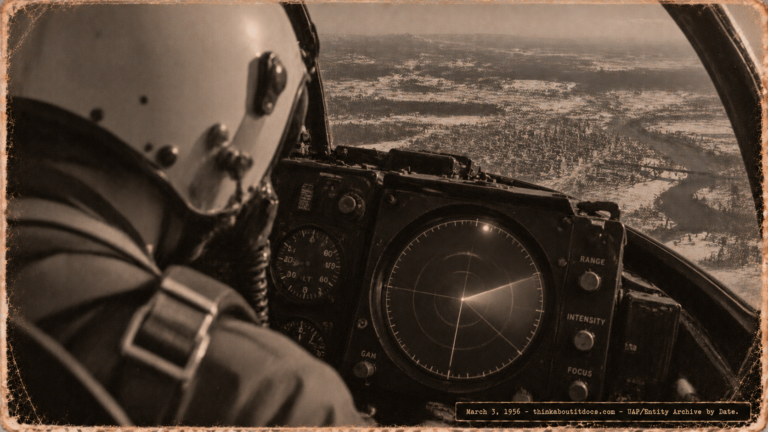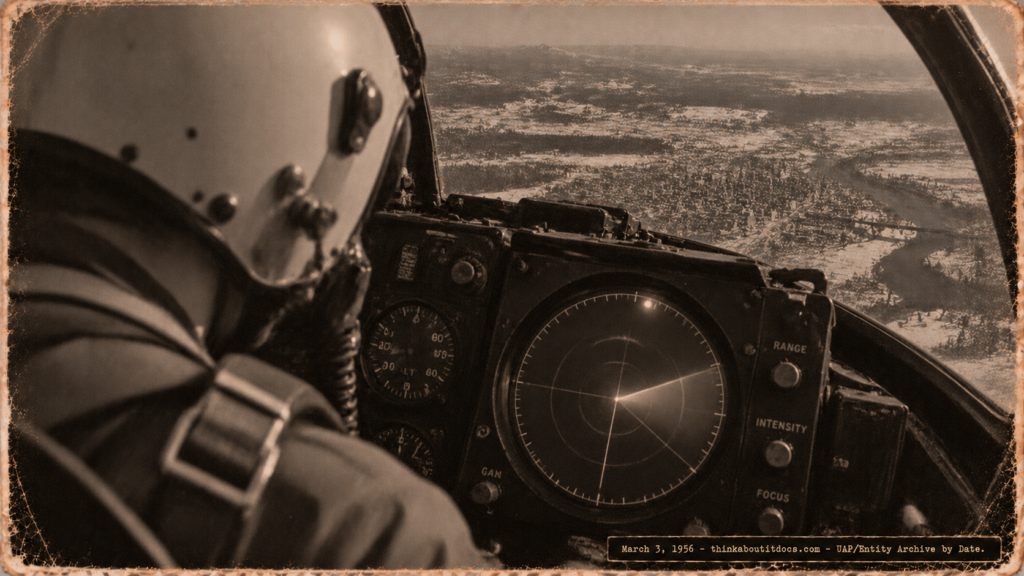
Spokane, Washington, March 3, 1956: a target moved up the F-86D's radar scope faster than anything Lt. Stoner had tracked in 560 hours on the aircraft.
THINK ABOUTIT UFO|UAP SIGHTINGS REPORT
1956: Spokane, Washington: The Radar Target That Ran Away From an F-86D
At 4:40 p.m. on March 3, 1956, 1st Lt. Donald A. Stoner was flying a North American F-86D Sabre Dog at 22,000 feet over Spokane, Washington, on a routine air defense mission, when something appeared on his airborne radar. He had never seen a target move like this before. It came up his radar scope rapidly — faster than any aircraft he had tracked in 560 hours of F-86D time — and then simply faded. He decided it was worth reporting.
Ground radar saw it too. The observation is listed in the Project Blue Book index as both air-intercept radar and ground radar, making it a dual-system radar detection with a named, experienced pilot. The Spokane F-86D case is the best-documented of the March 1956 Blue Book unknowns and one of the cleaner single-element radar cases of the year: no visual component to argue about, no ambiguous lighting, just a radar return moving faster than anything Stoner had seen and a pilot with enough experience to know what he was looking at.
Date: March 3, 1956
Sighting Time: 4:40 p.m. (PST)
Day/Night: Day
Location: Airspace over Spokane, Washington
Urban or Rural: Airborne (over an urban area)
No. of Entity(‘s): Not Applicable
Entity Type: Not Applicable
Entity Description: Not Applicable
Hynek Classification: Radar-only (no visual component)
Duration: Brief; the target appeared, moved rapidly up the scope and faded
No. of Object(s): 1
Description of the Object(s): A radar return only; no visual description
Shape/Size/Color of Object(s): Unknown (radar return only)
Distance to Object(s): Unknown; on the F-86D’s airborne radar at 22,000 feet
Height & Speed: At approximately 22,000 feet (the F-86D’s altitude). Speed was not given numerically, but Stoner described it as the fastest target movement away from an aircraft he had ever seen, in 560 hours on the F-86D flying near 300 mph.
Number of Witnesses: 1st Lt. Donald A. Stoner (airborne radar); ground radar personnel (unnamed)
Special Features/Characteristics: The target moved up the radar scope at a rate Stoner had never seen in 560 hours and 930 total flight hours on the F-86D. Both the pilot’s airborne radar and a ground radar station detected the object.
Case Status: Unexplained (Project Blue Book unknown)
Source: Project Blue Book files (BBU); Brad Sparks; NICAP 1956 UFO Chronology; McDonald list
Summary/Description: During an air defense mission over Spokane at 22,000 feet, 1st Lt. Stoner’s F-86D airborne radar acquired a target that moved up the scope faster than anything he had seen in 560 hours on the aircraft, then faded. Ground radar also detected the object. Blue Book listed it as unknown.
Related Cases: 1956: March UFO|UAP & Entity Sightings Archive; 1956: Wurtsmith AFB, Michigan F-89D radar lock (January 11, 1956)
Detailed Report
1st Lt. Donald A. Stoner of the USAF was flying his F-86D Sabre Dog on an air defense mission over Spokane at 4:40 p.m. on March 3, 1956. He was at 22,000 feet. The F-86D was one of the Air Defense Command’s principal all-weather interceptors; Stoner had 560 hours in the type and 930 total flight hours, making him a fully experienced interceptor pilot on a demanding aircraft.
A target appeared on his airborne radar and moved up the scope rapidly in the same general direction the aircraft was flying. The movement was unlike anything Stoner had tracked before. The target then faded from the scope. Ground radar simultaneously detected an object in the same area.
In his written statement to Air Force investigators, Stoner described why he chose to report it: he had never before seen target movement that rapid away from an aircraft going almost 300 mph in the same general direction. He said the incident was peculiar and worthy of calling to someone’s attention. The Blue Book index lists the observation type as both ground radar and air-intercept radar.
RESEARCHER’S NOTES
What Stoner’s Experience Means for the Radar Reading
- Experience context: Stoner’s 560 hours on the F-86D matters specifically because the F-86D’s APG-37 fire-control radar was an airborne intercept system used continuously on air defense missions. He would have tracked hundreds of conventional targets. His statement that this was the fastest movement he had ever seen is an expert comparison, not a layman’s impression.
- Dual detection: The simultaneous ground-radar detection removes the possibility that the return was an instrument malfunction or a scope artifact unique to Stoner’s aircraft. Two independent radar systems seeing the same thing is the minimum standard for a credible radar UFO report.
- No visual: The case has no visual component. What Stoner saw with his eyes, if anything, is not in the surviving summaries. The sole evidence is the radar return. Radar-only cases are harder to evaluate than radar-visual cases because there is nothing to cross-check against.
- Speed estimate: The target moved “up the scope rapidly” in the same direction as a 300-mph aircraft. The F-86D’s APG-37 radar had a sweep rate that allows rough speed estimates from scope presentations, but without the full Blue Book file showing the sweep and the target’s movement, a precise speed cannot be given.
- Blue Book classification: The NICAP 1956 chronology lists this case as both a BBU (Blue Book unknown) and notes a possible date of March 2 in one index entry, with March 3 as the primary date. The file itself would settle this.
The Spokane case is clean because it involves a named, experienced pilot, a contemporary written statement in his own words, and confirmation on two independent radar systems. What is missing is a speed figure and any visual observation. It sits in the record as an unexplained radar unknown that was remarkable enough for an experienced interceptor pilot to report in writing and for Blue Book to leave unresolved.
“I had never before seen such rapid target movement away from an aircraft going almost 300 mph in the same general direction.”
1st Lt. Donald A. Stoner, USAF F-86D, Spokane, Washington, March 3, 1956 (Project Blue Book files)