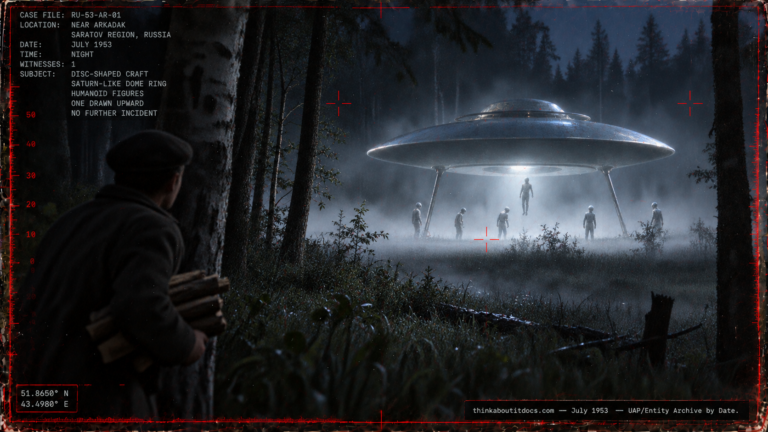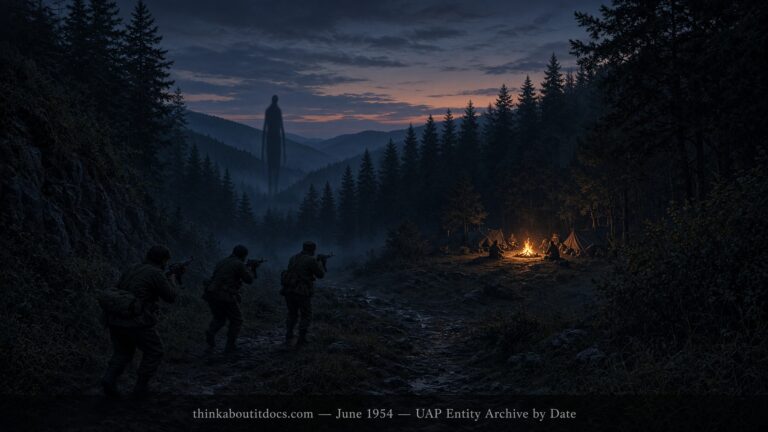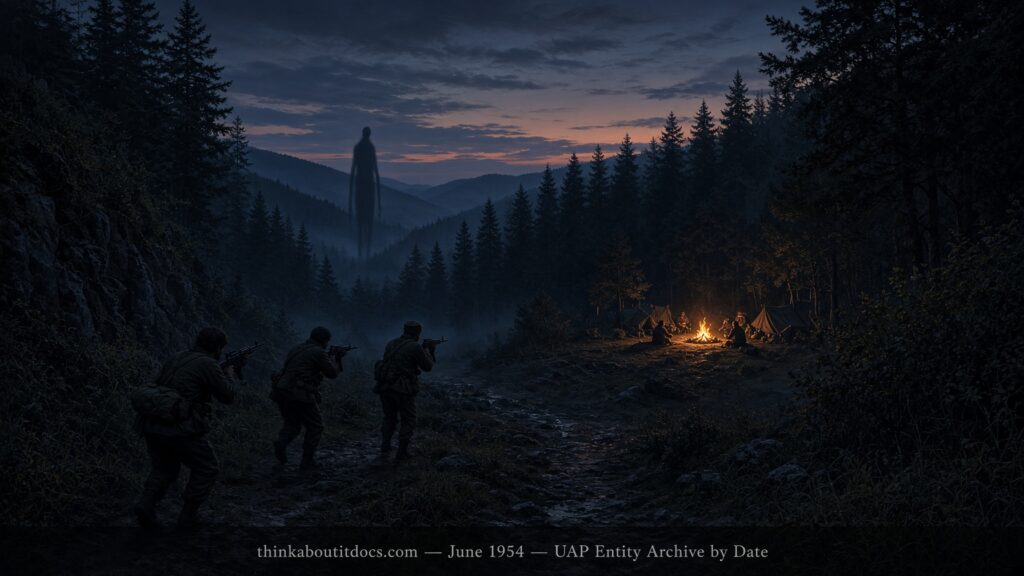
The forest edge in Russia's North Caucasus foothills where a floating entity was fired upon, June 1954.
THINK ABOUTIT UFO|UAP ENCOUNTER REPORT
1954: The Gubskaya-Barakayevskaya Encounter — North Caucasus, Russia
Eight people camped in the foothills of the North Caucasus for a night of garden work heard footsteps that weren’t human coming from a gully in the trees. What emerged as twilight fell was over two meters tall, unnaturally thin, and floating just above the ground. When one of the armed young men shouted a warning and fired, the figure only sped up — and every rifle in the group jammed when they tried to fire again.
Date: June 1954 (exact date not recorded)
Sighting Time: Evening/twilight
Day/Night: Evening
Location: Between the villages (stanitsa) of Gubskaya and Barakayevskaya, Mostovskiy area, Krasnodar region, North Caucasus, Russia
Urban or Rural: Rural (forest edge/foothills)
No. of Entity(‘s): 1
Entity Type: Humanoid
Entity Description: More than 2 m (over 6.5 ft) tall, very thin; further physical detail limited by fading twilight light and the group’s fear
Hynek Classification: CE-II (Close Encounter, Second Kind — physical/mechanical effect; no craft observed, no communication)
Duration: A brief encounter of a few minutes, from first hearing the footsteps to the entity’s disappearance
No. of Object(s): 0 — no craft was seen at any point
Description of the Object(s): Not Applicable
Shape/Size/Color of Object(s): Not Applicable
Distance to Object(s): Not Applicable
Height & Speed: The entity floated just above the ground and accelerated noticeably in speed after being fired upon, passing close to the group before vanishing into darkness
Number of Witnesses: 8 (three young men aged 16-18, including reporter Nikolay Dmitrievich Grachyev; three young women; one additional adult woman); three of the group (the young men) had direct visual contact with the entity
Special Features/Characteristics: The group first heard footfalls unlike any human tread, coming from a deep, narrow gully near the forest edge, prompting the three young men to retrieve loaded double-barrel rifles before returning to investigate; as twilight fell, they saw a floating humanoid figure emerging from the forest and approaching; witness Volodya Tkachenko shouted a warning and fired a shot out of fear, causing the figure to accelerate and pass close by the group before disappearing into the darkness near the main camp; the witnesses attempted to fire again but found their rifles would not function; the group was unable to eat the dinner they had prepared and left the work site early the following day
Case Status: Unresolved — a multi-witness account with a specific, checkable physical claim (simultaneous rifle malfunction), formally reported by a named witness to a national scientific body decades after the event
Source: Letter from Nikolay Dmitrievich Grachyev to the Academy of Sciences of the USSR, dated May 27, 1980; Mikhail Gershtein
Summary/Description: In June 1954, eight people — including three young men aged 16 to 18, three young women, and an additional adult woman — camped overnight near a garden plot between the villages of Gubskaya and Barakayevskaya in the North Caucasus foothills of Russia’s Krasnodar region, preparing dinner by a bonfire. The three young men, walking near a forest gully, heard unusual footsteps and ran back to arm themselves with double-barrel rifles before returning to investigate. As twilight fell, they saw a humanoid figure, over two meters tall and very thin, floating just above the ground and approaching them from the forest. One of the armed witnesses, Volodya Tkachenko, shouted a warning and fired out of fear; the figure accelerated, passed close to the group, and vanished into the darkness near the camp. Attempts to fire again failed — the rifles would not function. The group could not eat their prepared dinner and left the area early the next day. The account was formally reported by witness Nikolay Dmitrievich Grachyev in a 1980 letter to the Academy of Sciences of the USSR.
Related Cases: None known
Detailed Report
In June 1954, a group of eight people — three young men between sixteen and eighteen years old, three young women, and an additional adult woman — had been assigned to work a garden plot in the foothills of the North Caucasus, situated between the villages of Gubskaya and Barakayevskaya in Russia’s Krasnodar region. They camped for the night at the edge of the forest, building a bonfire and preparing dinner. The group had come equipped with loaded double-barrel rifles, standard precaution for an overnight stay in the countryside.
As the sun began to set, the three young men — including Nikolay Dmitrievich Grachyev, who would later become the account’s primary reporter — went for a walk along the meadow, approaching a deep, narrow gully near the forest’s edge. There, they heard something that immediately struck them as wrong: footsteps, but not the kind a person makes. They ran back to camp, grabbed their rifles and ammunition belts, warned the others to stay behind, and returned to the spot where they’d heard the sound.
Twilight was falling quickly by the time they saw it: a humanoid figure, well over two meters tall and strikingly thin, emerging from the forest not far from their position. It wasn’t walking in any conventional sense — it appeared to be floating just above the ground as it began moving toward the stunned young men.
One of them, Volodya Tkachenko, armed and frightened, shouted at the figure to stop. When it didn’t, he pulled the trigger out of fear. The shot rang out — and rather than deterring the figure, it seemed to accelerate. The floating shape sped past the men, passing close to their position and continuing toward the camp where the others had stayed behind, before vanishing entirely into the darkness.
The young men tried to fire again. Their rifles wouldn’t work — every attempt to shoot failed, with no explanation any of them could offer. Shaken, the group found they couldn’t manage to eat the dinner they’d prepared. The following day, they finished their assigned work as quickly as they could and left the area.
RESEARCHER’S NOTES
Gubskaya/Barakayevskaya — 1954 and Weapons That Simply Stopped Working
- The rifle malfunction is the case’s most specific claim: Multiple firearms failing simultaneously, immediately after one had fired successfully moments before, is a concrete mechanical claim that doesn’t easily fit an ordinary explanation — equipment failure affecting several weapons at once, right after one worked normally, is a notable coincidence at minimum.
- Eight witnesses, though only three had direct visual contact: The group’s size lends some collective weight to the account, though it’s worth being precise that the entity itself was seen directly only by the three young men who went to investigate — the remaining witnesses experienced the aftermath (the group’s shared fear, the abandoned dinner) rather than the sighting itself.
- A floating, rather than walking, gait: The entity’s apparent locomotion — hovering just above the ground rather than making contact with it — is a specific detail distinct from most humanoid encounters in this archive, most of which describe entities walking normally.
- A very long gap between event and formal report: Grachyev’s 1980 letter to the Academy of Sciences came 26 years after the reported event — a significant span that this archive notes without assuming it undermines the account, given that Soviet-era witnesses often had limited early channels for reporting such experiences.
- A specific, named formal reporting channel: Submitting an account directly to a national academy of sciences, rather than to a UFO-specific publication or researcher, is a notably formal and institutional reporting choice, distinct from most contactee-style accounts in this archive.
This case combines a substantial witness group with one genuinely specific, checkable physical claim — the simultaneous rifle failure — and a formal, institutional reporting channel unusual among this archive’s entries. It remains unresolved, without independent verification beyond Grachyev’s own decades-later written account.
“The boys attempted to shoot their rifles again but all their efforts failed, the rifles all malfunctioned.”
— Nikolay Dmitrievich Grachyev, letter to the Academy of Sciences of the USSR, May 27, 1980