July 12, 1952 — Belleville, Illinois
THINK ABOUTIT UFO|UAP SIGHTINGS REPORT
1952 Belleville, Illinois Case: Radar Targets, a Visual Fireball, and Front-Page Coverage
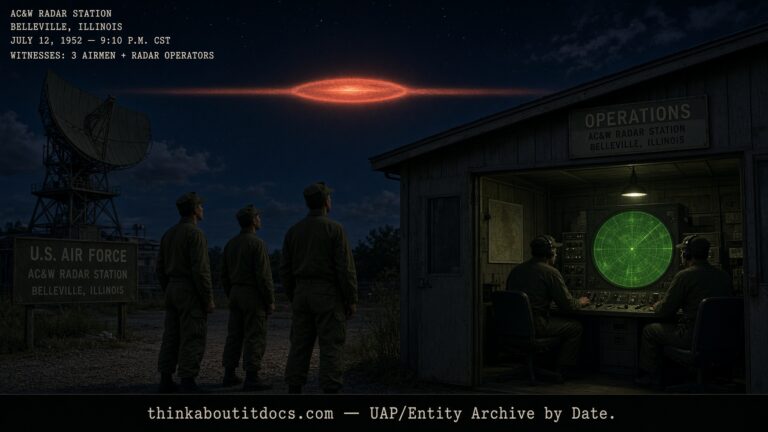
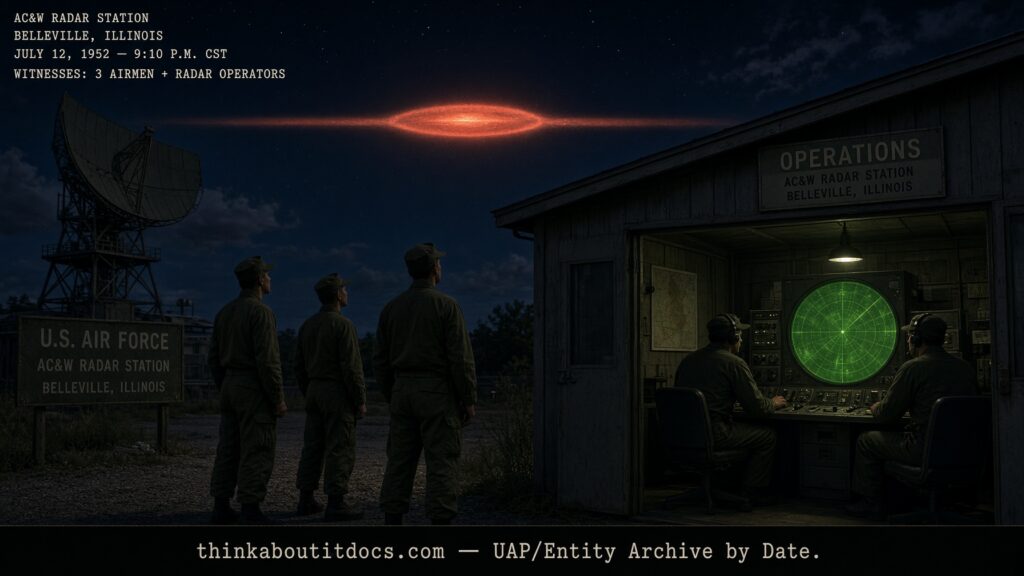
Starting at 8:30 on the evening of July 12, 1952, radar operators of the 798th Aircraft Control and Warning Squadron at Belleville, Illinois logged five separate unidentified targets in under an hour — one clocked at 1,700 knots — and then, at 9:10 p.m., three airmen stepped outside and watched with their own eyes as a large, intensely reddish-orange, round object crossed the sky in a straight line faster than any known aircraft. What makes this case unusual isn’t just the radar-visual combination: it made the next day’s local paper. The Edwardsville Intelligencer ran it on page one, placing this alongside a wider fireball seen by many witnesses across the Belleville/St. Louis area that same night — a rare instance of a Blue Book case with a contemporaneous, dated newspaper citation rather than a retrospective compilation decades later.
Date: July 12, 1952
Sighting Time: 8:30 p.m. to approximately 9:20 p.m. CST (radar); 9:10 p.m. CST / 2110Z (visual)
Day/Night: Night
Location: Belleville, Illinois
Urban or Rural: Military installation (798th AC&W Squadron radar station)
No. of Entity(‘s): Not Applicable
Entity Type: Not Applicable
Entity Description: Not Applicable
Hynek Classification: RV (Radar-Visual)
Duration: Radar contacts logged over roughly 50 minutes (8:30-9:20 p.m.); the visual sighting itself lasted approximately 20 seconds
No. of Object(s): 5 radar targets logged across the evening; 1 object visually observed
Description of the Object(s): The visually observed object was large, round, and an intense reddish-orange color, flying a straight, horizontal course; the wider fireball reported across the Belleville/St. Louis area that night traveled in a straight line parallel to the ground from southeast to northwest
Shape/Size/Color of Object(s): Round, intensely reddish-orange
Distance to Object(s): Radar tracks ranged from 20 to 200 nautical miles across the five logged targets; the visual sighting’s distance was not separately recorded
Height & Speed: Radar-tracked speeds ranged from 1,600 to 1,700 knots across the logged targets; the visually observed object was described only as “faster than any known aircraft”
Number of Witnesses: 3 named-by-role airmen of the 798th AC&W Squadron for the direct visual sighting, plus radar operators, plus “many witnesses” across the wider Belleville/St. Louis area for the associated fireball reported in the newspaper account
Special Features/Characteristics: Five separate radar contacts logged in sequence over less than an hour, at varying bearings and ranges; one interceptor aircraft was scrambled for observation purposes in response; the visual sighting by the three airmen occurred independently of, but roughly contemporaneous with, a much more widely witnessed fireball reported by the general public across the Belleville/St. Louis area the same evening
Case Status: Unresolved — a genuinely well-documented radar-visual case, strengthened by a rare contemporaneous newspaper citation rather than a retrospective compilation
Source: Edwardsville Intelligencer, Illinois, July 14, 1952, page 1
Summary/Description: Beginning at 8:30 p.m. CST on July 12, 1952, radar operators of the 798th Aircraft Control and Warning Squadron at Belleville, Illinois logged five separate unidentified objects using J-Five radar observations over the following 50 minutes: at 8:30 p.m., a target at 355° and 200 nautical miles, traveling at 1,600 knots; at 8:35 p.m., a target at 30° and 20 nautical miles, at 1,700 knots; at 8:47 p.m., a target at 6° and 190 nautical miles; at 8:49 p.m., a target at 330° and 180 nautical miles; and at 9:20 p.m., a target at 280° and 175 nautical miles. At 2110Z (9:10 p.m. CST), three airmen of the squadron directly observed one very large, intensely reddish-orange, round object flying a straight, horizontal course at a speed faster than any known aircraft, for approximately 20 seconds. One aircraft was scrambled for observation purposes. Around the same time (roughly 9:00 p.m. CST), a large fireball-type object was independently seen by many witnesses across the wider Belleville/St. Louis area, traveling in a straight line parallel to the ground from southeast to northwest — an event significant enough to make the front page of the Edwardsville Intelligencer two days later.
Related Cases: The same 798th AC&W Squadron radar station logged a separate multi-object radar case at Belleville roughly two weeks later, on July 27, 1952 (4 elliptical objects tracked at 2,800-3,200 knots, comparable in radar-echo size to a B-50 or B-36) — a distinct incident, not a duplicate, but worth noting as a second significant detection by the same station within the same month
Detailed Report
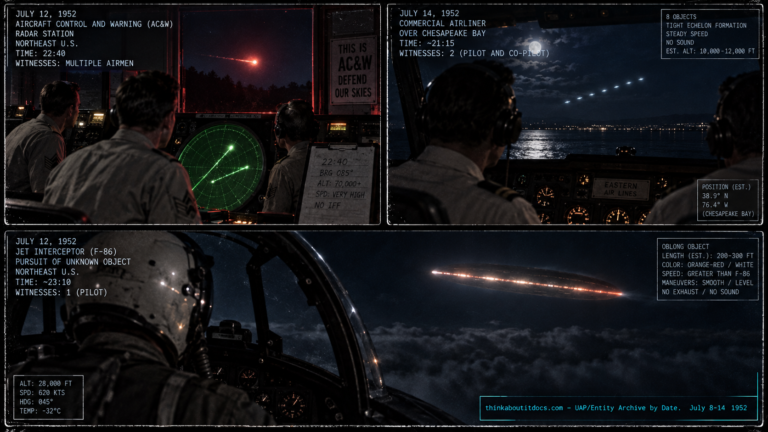
The Belleville case stands out among the flood of July 1952 reports for the specificity of its radar data and the rare survival of a contemporaneous press account. Beginning at 8:30 p.m. CST on July 12, radar operators of the 798th Aircraft Control and Warning Squadron began logging a sequence of unidentified targets. The first, at 8:30 p.m., appeared at a bearing of 355 degrees and a range of 200 nautical miles, moving at 1,600 knots. Five minutes later, at 8:35 p.m., a second target appeared much closer — 30 degrees bearing, only 20 nautical miles out — moving even faster, at 1,700 knots. Further targets followed at 8:47 p.m. (6 degrees, 190 nautical miles), 8:49 p.m. (330 degrees, 180 nautical miles), and 9:20 p.m. (280 degrees, 175 nautical miles).
At 2110Z — 9:10 p.m. local time — the case moved from radar to direct visual confirmation. Three airmen at the squadron observed one very large, round object with an intensely reddish-orange color, crossing the sky in a straight, horizontal course. Its speed was described as faster than any known aircraft of the period. The sighting lasted approximately 20 seconds, and in response, one interceptor aircraft was scrambled for observation purposes.
What elevates this case above a typical single-station radar log is its independent public corroboration. At around 9:00 p.m. CST that same evening, a large fireball-type object was reported by many witnesses across the broader Belleville/St. Louis metropolitan area, traveling in a straight line parallel to the ground from southeast to northwest. This wasn’t a claim that surfaced years later through a UFO compiler — it was significant enough to run on the front page of the Edwardsville Intelligencer on July 14, 1952, just two days after the event, giving this case a level of contemporaneous documentation that most Blue Book entries from this era simply don’t have.
Whether the newspaper’s wider public fireball sighting and the squadron’s own radar/visual sequence describe precisely the same object, or two related but distinct events occurring in the same region within the same hour, isn’t fully resolved by the surviving record — but the timing and character of both strongly suggest they’re connected pieces of the same night’s activity over southern Illinois.
RESEARCHER’S NOTES
The Belleville Case — Rare Contemporaneous Press Coverage for a Radar-Visual Sequence
- The contemporaneous newspaper citation is genuinely uncommon for a case this well-documented technically. Most of this archive’s strongest radar cases survive only through later Blue Book compilations, decades-removed catalogs, or researcher retrospectives — a same-week, page-one local newspaper account is a rarer and more immediately verifiable kind of source.
- Five separate radar contacts in under an hour is a substantial evidentiary base on its own. A single anomalous blip is common in this era’s radar logs; five distinct targets at varying bearings and ranges, logged systematically with timestamps, is a stronger pattern.
- The radar-to-visual transition strengthens the case considerably. A direct visual sighting by three airmen, occurring within the same general window as the radar activity, moves this beyond a radar-only anomaly into the more evidentially significant radar-visual category.
- The precise relationship between the squadron’s sighting and the wider public fireball report isn’t fully resolved. Both occurred in the same region within roughly the same hour, but the surviving sources don’t explicitly confirm they describe the identical object rather than two related, near-simultaneous events.
- This sits within an extraordinarily active radar month for the 798th Squadron specifically. The same station logged another significant multi-object radar detection at Belleville just two weeks later, on July 27 — worth keeping in mind as regional/institutional context rather than treating either case in isolation.
The Belleville case combines a genuinely detailed, timestamped radar sequence with direct visual confirmation and a rare contemporaneous press account — a stronger-than-average documentary foundation for this period, even though the precise relationship between the military sighting and the wider public fireball report isn’t fully nailed down.
“The speed of the object was faster than any known aircraft.”
— Edwardsville Intelligencer, Illinois, July 14, 1952, page 1