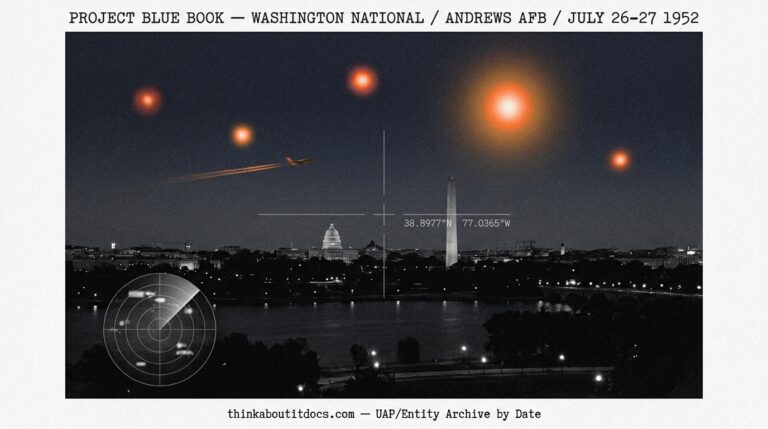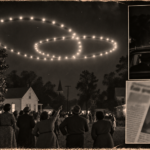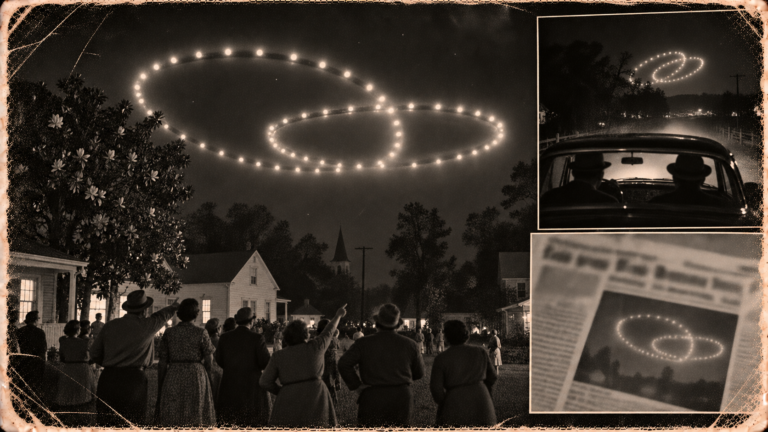
Washington, D.C., overnight August 13-14, 1952 — controllers plot dozens of stationary targets over four and a half hours.
THINK ABOUTIT UFO|UAP SIGHTINGS REPORT
1952: The August 13–14 Washington, D.C. Radar Return
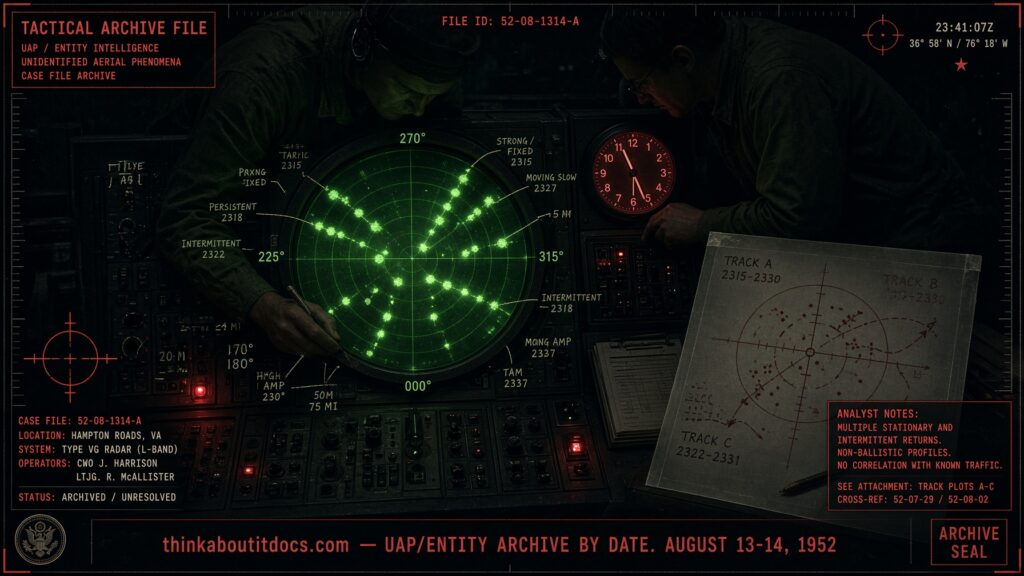
For four and a half hours over the nation’s capital, radar controllers watched dozens of stationary, unidentified targets sprinkle across their scopes in a wide belt between Washington and Baltimore — carefully timed and plotted by hand, then preserved on acetate before the targets vanished at half past midnight.
Date: August 13–14, 1952
Sighting Time: 7:57 p.m. through 12:30 a.m.
Day/Night: Night
Location: Washington, D.C. area, extending in a belt toward Baltimore, Maryland
Urban or Rural: Urban/metropolitan airspace
Hynek Classification: RV (Radar-Visual) — this entry is radar-only in the surviving record; no accompanying ground-visual report is documented for this specific overnight period
Duration: Approximately 4.5 hours
No. of Object(s): Many — an initial group of seven strong, stationary targets, followed by a scope-wide scattering across a belt roughly 6 miles wide between Washington and Baltimore, plus an additional cluster 10–15 miles south of the antenna
Description of the Object(s): Radar returns only; no physical description beyond target strength and position is recorded
Distance to Object(s): The first group appeared roughly 15 miles north-northeast of the radar antenna; subsequent targets ranged across the D.C.-to-Baltimore corridor and a zone 10–15 miles south of the antenna
Height & Speed: Not recorded in the surviving summary; the targets were characterized specifically as stationary rather than fast-moving
Number of Witnesses: Radar controllers on duty at the tracking facility; individual names are not recorded in the surviving source
Special Features/Characteristics: The targets were persistent and stationary rather than transient blips, allowing controllers to methodically plot dozens of them by hand in grease pencil directly on the Type VG scope face over multiple antenna revolutions, recording the time of each for ground-speed calculations. To preserve a permanent record, the time data and track plots were transferred from the scope face onto a sheet of frosted acetate. All targets disappeared simultaneously at 12:30 a.m. on August 14.
Case Status: Unexplained in the surviving record as documented; this case is not accompanied in this archive’s sourcing by a specific named conventional explanation (e.g., temperature inversion, ground clutter), though such explanations are common for period radar-only returns of this kind and cannot be ruled out absent further primary documentation.
Source: Dan Wilson (Blue Book documentation research)
Summary/Description: Beginning at 7:57 p.m. on August 13, 1952, a group of seven strong, stationary radar targets suddenly became visible roughly 15 miles north-northeast of a Washington, D.C.-area radar antenna. Over the next two or three antenna revolutions, the scope filled with stationary targets scattered across a belt about 6 miles wide between Washington and Baltimore, joined by an additional cluster 10–15 miles south of the antenna. For the following four and a half hours, controllers carefully plotted the many unidentified targets in grease pencil directly on the scope face, timing each one to calculate ground speeds. To create a lasting record, the time data and plotted tracks were transferred from the scope to a sheet of frosted acetate. The targets disappeared simultaneously at 12:30 a.m. on August 14.
Related Cases: Not Applicable — though this case occurred roughly three weeks after the much larger and more widely reported Washington, D.C. radar-visual flap of July 19–20 and 26–27, 1952, and shares the same general geography and radar-scope character.
Detailed Report
This case survives in far less narrative detail than its more famous predecessor — the July 1952 Washington National Airport radar-visual flap that made national headlines and prompted a personal Pentagon press conference from Air Force Maj. Gen. John Samford. What’s preserved of the August 13–14 event is nonetheless methodical: a documented sequence of target appearances, a described plotting procedure, and a specific, timestamped end point.
The most notable procedural detail is what the controllers did with the data as it came in. Rather than simply noting that “many targets” appeared, the account describes a deliberate, sustained effort — grease-pencil plots made in real time directly on the Type VG scope face, each timestamped so ground speeds could be calculated, over a period spanning four and a half hours. The decision to then transfer that data onto frosted acetate for a permanent record suggests the controllers themselves regarded the event as significant enough to document carefully rather than dismiss as routine clutter.
No accompanying ground-visual sighting from that specific overnight period survives in the sourcing available to this archive, which limits this case to a radar-only classification. That is a meaningful gap: many of the era’s most convincing D.C.-area radar cases (including the July flap) were strengthened considerably by simultaneous visual sightings from pilots or ground observers corroborating what the scopes showed. Absent that here, the case rests on the radar record and the controllers’ own evident seriousness in documenting it.
RESEARCHER’S NOTES
The August 13–14, 1952 Washington, D.C. Radar Return
- A lesser-known echo of the July flap: This case sits in the shadow of the far more famous July 19–20 and 26–27, 1952 Washington radar-visual sightings, but it is a separate, independently documented event roughly three weeks later, with its own scope-plotting record.
- Radar-only, no corroborating visual sighting located: Unlike the July flap, no simultaneous ground or pilot visual report survives in this archive’s sourcing for this specific night, which is a real limitation on how the case can be classified and assessed.
- Deliberate real-time documentation is itself notable: The controllers’ choice to hand-plot dozens of targets over 4.5 hours and preserve the record on acetate indicates they treated the event as worth documenting carefully, rather than as routine clutter or a known, already-explained phenomenon.
- No named conventional explanation in the available sourcing: This archive has not located a specific temperature-inversion or clutter-based explanation tied to this exact date in the material reviewed; that absence should be read as an information gap, not as evidence the case is unexplainable.
Whatever passed over the Washington-Baltimore corridor that August night left no name attached to it — no press conference, no general’s statement — just four and a half hours of careful grease-pencil plotting that someone thought was worth saving on acetate.
“The area on the scope between Washington and Baltimore became heavily sprinkled with stationary targets in a belt about 6 miles wide.”
— Blue Book radar log, August 13, 1952