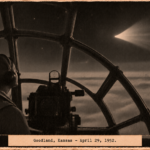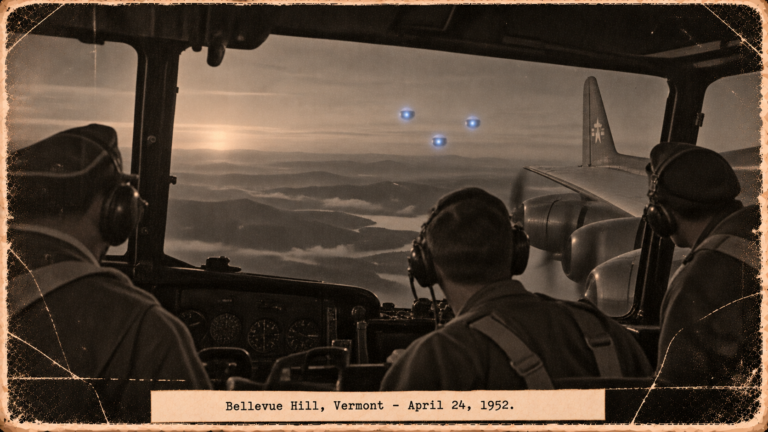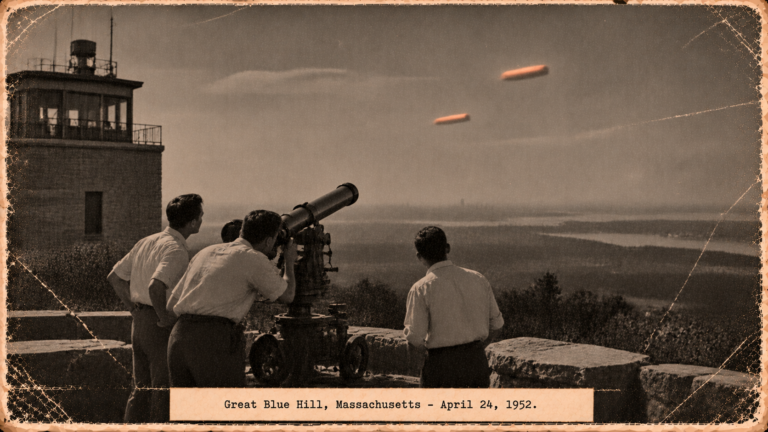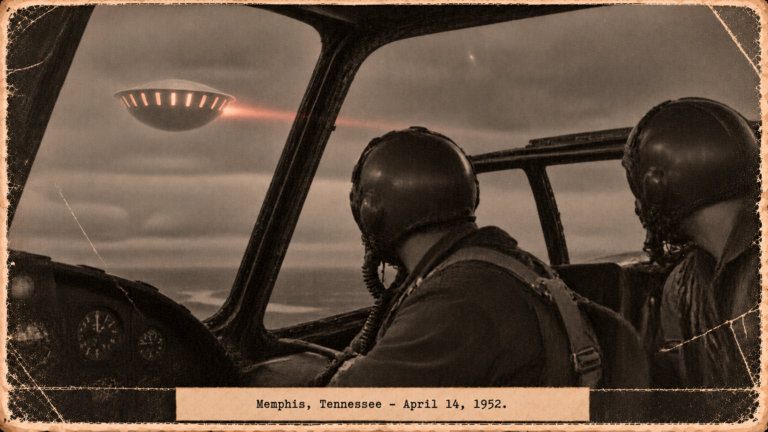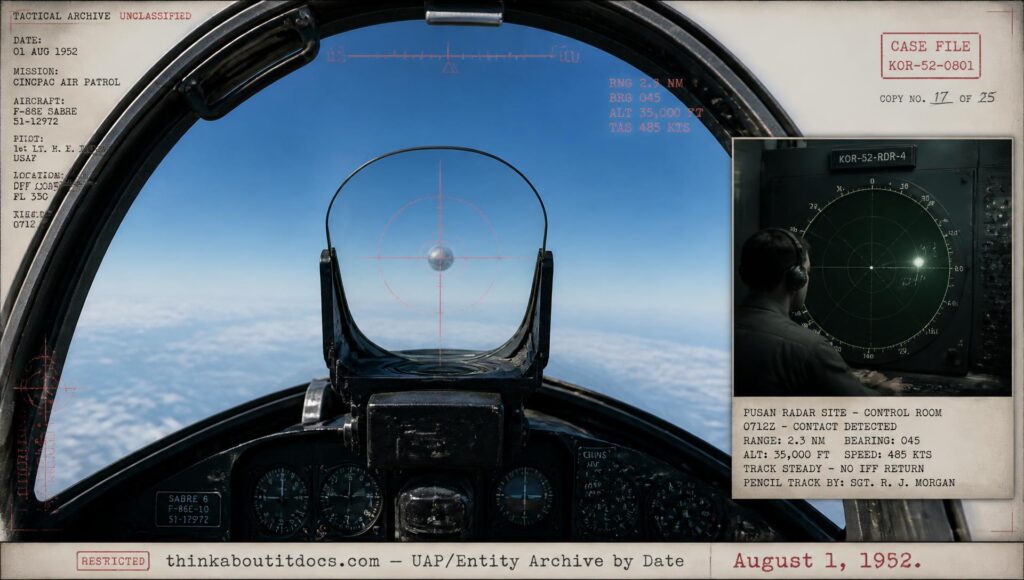
Near Wright-Patterson AFB, Ohio, August 1, 1952 — Maj. James B. Smith's gun-camera view of the object.
THINK ABOUTIT UFO|UAP SIGHTINGS REPORT
1952: The Bellefontaine, Ohio Gun-Camera Intercept
A ground radar near Wright-Patterson AFB tracked a target racing at 525 mph — until the intercepting F-86 pilots caught up and found it nearly motionless, close enough for gun-camera film, in a case Project Blue Book itself first ruled genuinely unexplained before quietly changing its mind weeks later.
Date: August 1, 1952
Sighting Time: 10:51–11:13 a.m. EST
Day/Night: Day
Location: Bellefontaine, Ohio (radar site atop Campbell Hill) and airspace roughly 20 miles NNW of Wright-Patterson AFB, Dayton, Ohio
Urban or Rural: Rural airspace near a military installation
Hynek Classification: DD (Daylight Disc) with radar and photographic corroboration
Duration: Roughly 22 minutes from radar contact to intercept break-off
No. of Object(s): 1
Description of the Object(s): A round, silver or white sphere or disc, filmed via gun camera as a small, fuzzy image with discernible motion
Shape/Size/Color of Object(s): Round; estimated 24–40 ft in diameter; silver or white in color
Distance to Object(s): Initially 20 miles NNW of Wright-Patterson AFB per radar; the pilots closed to visual and camera range at altitude, roughly 100 miles WSW of Dayton by the time the intercept was broken off
Height & Speed: Estimated altitude 60,000–70,000 ft; ground radar measured the initial target at 400–450 knots (roughly 500–525 mph) on a heading of about 240° (WSW)
Number of Witnesses: Ground radar operators at the Bellefontaine ADC site (664th AC&W Sq), plus two F-86 pilots — Maj. James B. Smith and Lt. Donald J. Hemer (also spelled Hemmer)
Special Features/Characteristics: Radar tracked the object moving at a constant high speed, but the intercepting pilots found it essentially stationary once they reached the target’s indicated position — a discrepancy that later became central to the case’s re-evaluation. Smith obtained a weak radar-gunsight lock and shot 16mm gun-camera film showing the object as a small, fuzzy shape with visible motion across the frame. Investigators specifically tested whether the image’s size on film was consistent with a 20-foot balloon at the estimated distance and altitude.
Case Status: Disputed. Blue Book investigators Lt. Andy Flues and Lt. Robert Olsson initially filed the case as a genuine Unknown. Ruppelt changed the evaluation weeks later, after ATIC’s Technical Analysis Division chief transferred out, reclassifying the sighting as two separate, coincidentally aligned conventional objects — a weather balloon (matching the radiosonde released from Wright-Patterson that morning) and, separately, an unrelated jet whose flight plan was not on file, accounting for the radar speed reading. Physicist and UFO researcher James E. McDonald later placed this case on a short list of Condon Report “explained” cases whose explanation he found did not hold up to close examination. Ruppelt himself went on to use this case prominently in briefings to the CIA’s Robertson Panel as an example of a UFO report that could be explained through careful investigation.
Source: Project Blue Book Special Report No. 8; Capt. Edward J. Ruppelt, “The Report on Unidentified Flying Objects” (1956), Chapter 13; Center for UFO Studies (CUFOS); Brad Sparks catalog via NICAP; Donald Keyhoe, contemporary account published in True magazine
Summary/Description: At 10:51 a.m. on August 1, 1952, an Air Defense Command radar site atop Campbell Hill near Bellefontaine, Ohio tracked an unidentified target 20 miles northwest of Wright-Patterson AFB, moving at roughly 400–450 knots. Two F-86s, piloted by Maj. James B. Smith and Lt. Donald J. Hemer, were scrambled from the 97th Fighter-Interceptor Squadron and vectored toward the target, making visual contact within about four minutes. The pilots climbed to 48,000 feet twice, and once at altitude found the object nearly motionless despite the radar’s high-speed reading. Smith obtained a weak return on his radar gunsight and captured gun-camera film of a round, silver or white object estimated at 60,000–70,000 feet altitude and 24–40 feet in diameter. The intercept was broken off around 11:13 a.m., roughly 100 miles southwest of Dayton. Blue Book investigators initially could not identify the object and filed it as an Unknown; Ruppelt later revised the finding to a coincidental pairing of a weather balloon and an unrelated jet, a conclusion that has remained disputed among later researchers.
Related Cases: Not Applicable
Detailed Report
The Bellefontaine case stands out among 1952’s radar-visual reports for a simple reason: it produced physical evidence — gun-camera film — from an aircraft in active pursuit, reviewed at the time by the same officers who would go on to run Project Blue Book. The sequence of events is unusually well documented across multiple independent tellings, from Ruppelt’s own 1956 book to Keyhoe’s contemporary account published in True magazine using photographs the Air Force itself released.
What makes the case genuinely puzzling rather than simply another unexplained blip is the internal contradiction investigators wrestled with from the start: ground radar had the target moving at a constant 400–450 knots on a steady heading, but when the F-86 pilots reached the indicated position, the object appeared essentially stationary. Ruppelt’s own account describes the pilots’ realization, upon breaking off the intercept, that they were still in almost the same location they’d occupied ten minutes earlier — meaning whatever they’d been filming had not been moving anywhere near radar speed while they observed it.
Lt. Andy Flues, working the case for Ruppelt, initially found no satisfying conventional explanation and filed it as an Unknown, despite privately suspecting a weather balloon might be involved — a nearby radiosonde balloon release and the winds recorded that morning were both consistent with a balloon drifting through the area. What didn’t fit a simple balloon explanation was the radar’s 400+ knot reading, since a balloon does not travel at anywhere near that speed. Flues ultimately proposed that the radar’s high-speed reading had actually come from an unrelated jet aircraft with no flight plan on file, passing through the same general area at roughly the same time — meaning the case, on this reading, involved two coincidentally overlapping conventional objects rather than one anomalous one.
Ruppelt did not adopt this explanation until weeks after the initial Unknown filing, following a change in ATIC’s Technical Analysis Division leadership, and he subsequently used the case prominently in his 1953 briefings to the CIA-convened Robertson Panel as a model of how a seemingly inexplicable sighting could be resolved through diligent follow-up. Physicist James E. McDonald, reviewing the Condon Report’s “explained” cases years later, singled out Bellefontaine as one whose official resolution he found did not survive close scrutiny — largely because the coincidental-pairing explanation requires two separate, ordinary objects to have aligned closely enough, by chance, to be mistaken for one.
The gun-camera film itself never resolved the question either way. Investigators specifically tested whether a 20-foot balloon, photographed from roughly 40,000 feet by an aircraft looking up at an object near 70,000 feet, would produce an image consistent with what the film showed — a test aimed at supporting the balloon explanation, though the surviving accounts of that analysis stop short of describing it as conclusive.
RESEARCHER’S NOTES
Bellefontaine, Ohio — 1952 and a Reclassified Unknown
- A rare physical-evidence case: Few 1952 radar-visual reports come with surviving gun-camera film shot by the intercepting pilot himself — this is one of the small number that do, which is part of why it has been re-examined repeatedly over the decades.
- The radar-speed discrepancy is the crux of the case: A target moving at 400+ knots on radar that then appears essentially stationary to intercepting pilots is not a minor inconsistency — it’s the specific detail that drove Blue Book’s investigators to propose two separate objects rather than one.
- The explanation changed after the fact, under a leadership transition: Ruppelt’s initial Unknown finding stood for weeks before being revised, and the revision followed a change in who was running ATIC’s Technical Analysis Division — a sequence of events later researchers, including McDonald, found worth flagging rather than simply accepting at face value.
- A coincidence-based explanation carries its own burden of proof: Explaining one sighting as two unrelated objects that happened to align in time, direction, and rough position is a real possibility, but it is not self-evidently simpler than a single-object explanation, and this archive presents it as Ruppelt’s official position rather than as settled fact.
- Ruppelt used this exact case as a debunking model: Its selection for the Robertson Panel briefings shows how much institutional weight was placed on this specific resolution, which is itself worth noting given how contested that resolution later became.
Seven decades later, the gun-camera frames survive, the balloon-and-jet explanation remains the Air Force’s official word, and researchers who’ve gone back to the primary documents still can’t quite agree that the math on that 20-foot balloon adds up the way Blue Book said it did.
“It also points up the fact that our investigation and analysis work…”
— Capt. Edward J. Ruppelt, “The Report on Unidentified Flying Objects,” on the Bellefontaine case