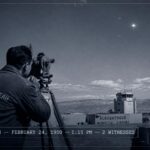
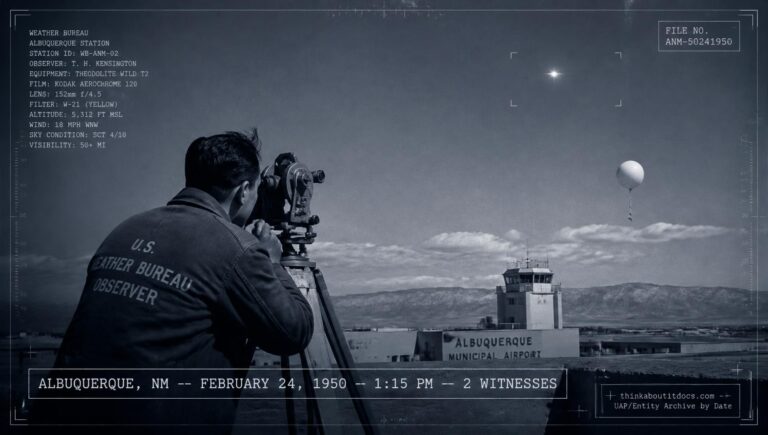
February 24, 1950 — a theodolite set up to track a weather balloon instead recorded 1.5 minutes of precise data on an unidentified object over Albuquerque.
THINK ABOUTIT UFO|UAP SIGHTINGS REPORT
1950: The Albuquerque/Los Alamos Theodolite Case
A Weather Bureau observer tracking a routine balloon through a precision theodolite watched something else cross his field of view entirely — a white, egg-shaped object holding a straight, measurable course for a minute and a half, its exact angular position logged the whole time by the same instrument built to track the balloon.
Date: February 24, 1950, BBU 642
Sighting Time: 1:15-2:00 p.m.
Day/Night: Day
Location: Atop the TWA Building, Albuquerque Municipal Airport, New Mexico (with the object’s apparent trajectory toward Los Alamos)
Urban or Rural: Urban
No. of Entity(‘s): Not Applicable
Entity Type: Not Applicable
Entity Description: Not Applicable
Hynek Classification: DD (Daylight Disc)
Duration: Approximately 1.5 minutes through the theodolite; roughly 20-30 seconds for the separate naked-eye observation
No. of Object(s): 1
Description of the Object(s): White and round, not quite as elongated as an egg, darkened on the top-left side; to the naked eye, brilliant white like metal reflecting sunlight
Shape of Object(s): Round, slightly egg-shaped
Size of Object(s): Angular size roughly matching the upper part of the moon as seen through the theodolite’s telescope sight; to the naked eye, about the apparent size of a weather balloon
Color of Object(s): White, darkened on the top-left side; brilliant white/metallic to the naked eye
Distance to Object(s): Not independently determined; only angular position was recorded
Height & Speed: Flying straight and level, crossing from about 20° to 23° elevation at roughly 110° azimuth (in the east), on an apparent heading of about 240°-270°, covering about 2° of angular sky in 1.5 minutes
Number of Witnesses: 2 (Weather Observers Luther B. McDonald and Harrison S. Manson)
Special Features/Characteristics: Precision Instrument Tracking (Theodolite), Two Independent Observation Methods (Instrumented and Naked-Eye), Professional Weather Bureau Observers, Straight-Line Measurable Trajectory
Case Status: Unexplained
Source: Berliner; Jan Aldrich
Summary/Description: While tracking a weather balloon from atop the TWA Building at Albuquerque Municipal Airport, Weather Observer Luther B. McDonald was using a David White pibal theodolite (with an approximately 21x telescope sight) when a white, round object — not quite as elongated as an egg and darkened on its top-left side — crossed his field of view. Over about 1.5 minutes, the object moved from roughly 20° to 23° elevation at about 110° azimuth, flying straight and level on an apparent heading of 240°-270° — a trajectory that, projected onward, pointed toward Los Alamos. Its angular size roughly matched the upper portion of the moon as seen through the theodolite’s telescope. McDonald lost sight of the object when he had to shift his attention back to the weather balloon. A second Weather Observer, Harrison S. Manson, separately saw the object with the naked eye for about 20-30 seconds, describing it as brilliant white, like metal reflecting sunlight, roughly the apparent size of a weather balloon about to disappear into the distance, with an impression of flight heading toward the east-southeast (consistent with the object actually having come from that direction).
Related Cases: Not Applicable
Detailed Report
This case’s strength lies in its instrumentation rather than its drama: a theodolite is a precision surveying and tracking instrument, and McDonald’s use of it to track a weather balloon put him in position to record the intruding object’s angular position with far more precision than an unaided witness could manage. The 1.5-minute duration and the specific elevation and azimuth changes recorded give this account a level of quantifiable detail — 2° of sky covered in 90 seconds, a consistent 240°-270° heading — that is rare in this archive’s 1950 record.
The independent naked-eye sighting by Manson, a second named professional observer, adds meaningful corroboration without simply duplicating McDonald’s account: Manson’s brief, unaided observation is consistent with McDonald’s instrumented one in general character (a bright, metallic-looking object at high altitude) without being identical in every detail, which is the kind of imperfect-but-compatible corroboration that argues against fabrication or simple confusion between the two men’s testimony.
The object’s apparent trajectory toward Los Alamos places it within the broader context of New Mexico’s ongoing nuclear-site-adjacent sighting pattern from this era, though no source consulted for this report documents any corresponding observation from Los Alamos itself on this date.
RESEARCHER’S NOTES
The Albuquerque Theodolite Case — New Mexico 1950 and the Value of an Instrument Already Running
- Classification issues/corrections: Filed as DD given the daytime timing and disc-adjacent (egg/round) shape; no entity or close approach is claimed.
- Source chain assessment: Documented through Don Berliner’s compilation and Jan Aldrich’s archival research, with enough operational specificity (named observers, specific instrument model, precise angular readings) to suggest derivation from an original Blue Book case file (BBU 642) rather than a later, less precise retelling.
- Pattern context/comparative cases: Incidental instrument-tracked sightings — where a UFO was recorded by equipment set up for an unrelated purpose — are uncommon in this archive; this case is one of the clearer examples, alongside the Palomar Observatory cosmic-ray case from the previous October, of a phenomenon being caught by instrumentation that happened to be running for other reasons.
- Physical evidence/evidentiary weight: No photograph or retained instrument log is documented, but the theodolite reading itself — even if not preserved as raw data — represents a stronger evidentiary basis than an unaided visual estimate, since the instrument’s angular measurements are inherently more precise than human judgment of distance or size.
- Geographic/historical context: The object’s apparent heading toward Los Alamos situates this case within the broader pattern of New Mexico nuclear-site-adjacent sightings that runs through this archive’s 1949-1950 record, though no direct connection to any other specific case is documented.
A precision instrument, already running for an unrelated purpose, recorded this object’s path with a level of angular accuracy no unaided witness could match — and still, no conventional explanation accounts for what crossed the theodolite’s field of view that afternoon.
“Brilliant white like metal reflecting sunlight.”
Weather Observer Harrison S. Manson, describing the February 24, 1950 Albuquerque object.