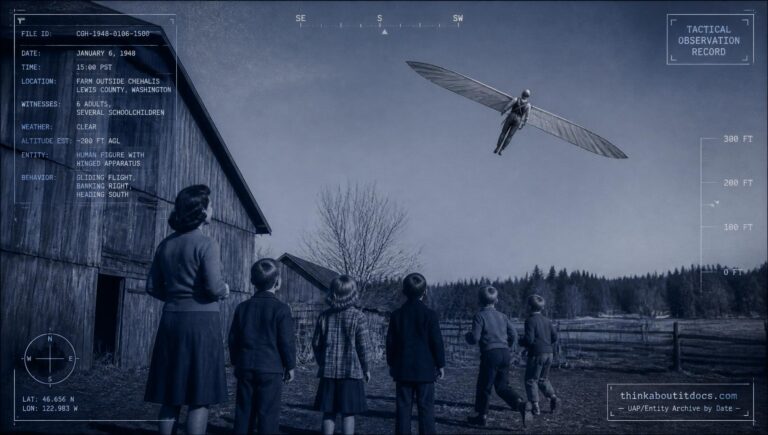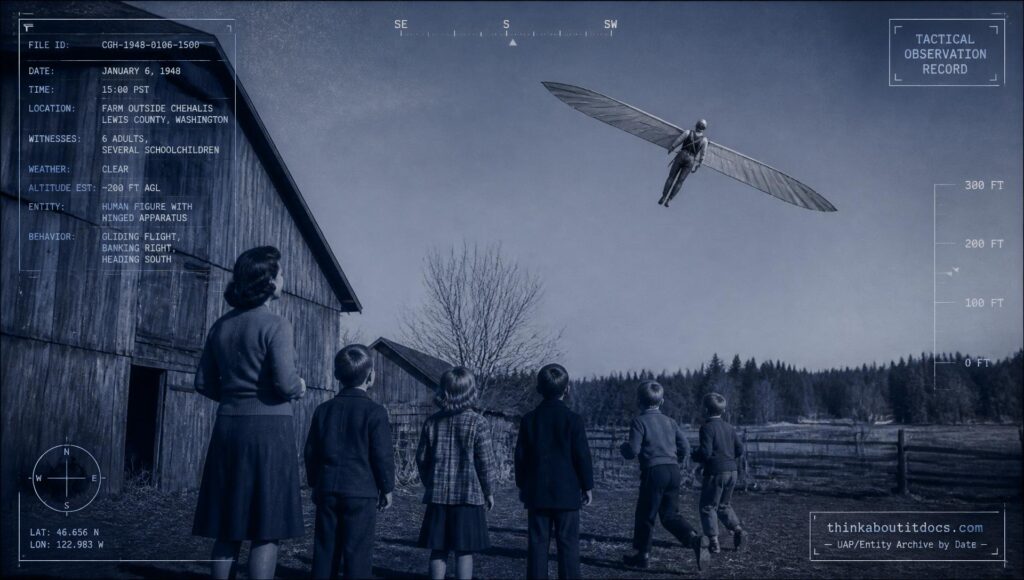
January 6, 1948 — Chehalis, Washington. Bernice Zaikowski and five other adults, plus a group of schoolchildren, watched a silver-winged "birdman" hover, bank, and fly over her barn — 13 years before hang gliders existed.
THINK ABOUTIT UFO|UAP ENTITY ENCOUNTER REPORT
1948: The Chehalis Birdman — Bernice Zaikowski
Eighteen months after Kenneth Arnold took off from Chehalis, Washington and gave the world the term “flying saucer,” the same small town produced a stranger sight: a man in an upright flying posture, silver wings strapped across his shoulders, hovering and banking above a woman’s barn in broad afternoon daylight. Six adults and a crowd of schoolchildren watched it happen. Skeptics reached for the obvious explanation — a hang glider — only to find that hang gliders wouldn’t be invented for another thirteen years.
Date: January 6, 1948
Sighting Time: 15:00
Day/Night: Day, afternoon
Location: A farm just outside Chehalis, Washington
Urban or Rural: Rural — a farm property with a barn
No. of Entity(s): 1
Entity Type: Human-appearing figure with technological flight apparatus (“flying humanoid” category)
Entity Description: A man in an upright flying position, equipped with long silver wings fastened over the shoulders with a strap. He appeared to manipulate controls strapped to his own chest. No facial features, clothing detail, or other physical description survives in the source material beyond his flying apparatus and posture.
Hynek Classification: CE-I — Close Encounter of the First Kind. A structured, close-range aerial phenomenon (in this case, an apparently piloted flight apparatus rather than a conventional craft) observed at close proximity by multiple witnesses, with no landing, physical trace, or direct interaction.
Duration: Not precisely specified; long enough for the figure to ascend, hover, bank, and proceed into level flight, and for schoolchildren to be summoned and arrive in time to also see the figure
No. of Object(s): 1 (the flight apparatus/wings, not a separate craft)
Description of the Object(s): Long, silver wings, fastened over the wearer’s shoulders with a strap. The wings did not flap and did not rotate; they retracted close to the body during ascent and extended again during hovering and level flight. No propeller, motor, or other conventional means of propulsion was visible to any witness, despite the “sizzling and whizzing” sound accompanying the figure’s movements.
Shape of Object(s): Wing-like, long and silver
Size of Object(s): Not precisely specified
Color of Object(s): Silver
Distance to Object(s): Approximately 200 feet in altitude above the witness’s barn
Height & Speed: Approximately 200 feet altitude; ascended “very rapidly,” then hovered, banked, and proceeded in level flight to the south
Number of Witnesses: 6 adults (including primary witness Bernice Zaikowski) plus an unspecified number of schoolchildren who ran to the yard for a better view
Special Features/Characteristics: The figure’s wings retracted close to the body during ascent and extended during hovering/level flight — a specific, mechanically consistent behavior pattern rather than a vague impression; the “sizzling and whizzing” sound accompanying flight had no identifiable source, as no propeller, rotor, or motor was visible; Mrs. Zaikowski specifically ruled out a helicopter-type explanation in her own account, noting the wings “did not rotate”; the most commonly proposed conventional explanation — that the figure was a hang glider pilot — is chronologically impossible, since the first foot-launched Rogallo-wing hang glider was not flown until August 1961, thirteen years after this sighting, and even that pioneering flight fell far short of the altitude and distance described by witnesses; period authorities responded with open skepticism, and contemporary press coverage included a soldier’s speculation that the U.S. Army might be secretly experimenting with individual “birdman” flight technology.
Case Status: Unexplained
Source: HUMCAT, quoting contemporaneous newspaper coverage including the Chehalis Advocate (“Woman Reports Having Seen ‘Sizzling’ Birdman Over City”) and the Bremerton Sun (January 21, 1948), syndicated further via International News Service; John Keel
Related Cases: 1948: January UFO|UAP & Entity Sightings Archive | 1947 Kenneth Arnold Sighting (Arnold departed from Chehalis on his historic flight, the same town this sighting occurred in) | a similar three-witness “flying men in dark suits” case reported in nearby Longview, Washington, three months later, in April 1948
Detailed Report
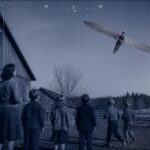
At three o’clock in the afternoon on January 6, 1948, 61-year-old Bernice Zaikowski, a Polish-born resident on a farm just outside Chehalis, Washington, heard an unusual “sizzing and whizzing” sound and looked up. What she saw, roughly 200 feet above her barn, was a man in an upright position, equipped with long silver wings fastened over his shoulders with a strap. He ascended very rapidly, then hovered, banked, and continued on in level flight to the south.
Mrs. Zaikowski’s account, preserved across multiple contemporary newspaper reports, is specific about the mechanics of what she observed: the wings did not flap, and — she was careful to note, apparently anticipating a helicopter-type explanation — they did not rotate either. Instead, they retracted close to the figure’s body during his rapid ascent, then extended again as he hovered and moved into level flight. The man appeared to be manipulating controls strapped to his own chest, but no propeller, rotor blade, or other visible source for the “sizzling and whizzing” sound, or for his propulsion generally, was apparent to her or to any other witness.
Mrs. Zaikowski was not alone. She stated that five other adult witnesses saw the same figure, and a number of schoolchildren, alerted to the sight, ran into her yard specifically to get a better view of what contemporary press coverage dubbed the “birdman.” The sighting was picked up locally by the Chehalis Advocate, under the headline “Woman Reports Having Seen ‘Sizzling’ Birdman Over City,” and syndicated further afield through International News Service, appearing in papers including the Bremerton Sun on January 21, 1948.
The reaction from local authorities was one of open, if not entirely dismissive, skepticism — described in period coverage as an “oblique ‘Huh?'” One soldier, quoted in the coverage, speculated that the U.S. Army might be secretly experimenting with individual flight apparatus of exactly the kind described. Mrs. Zaikowski, for her part, was reported as steadfast in her account despite the skepticism, noting that she had discussed the sighting with others in Chehalis who took it seriously.
RESEARCHER’S NOTES
The Explanation That Arrived Thirteen Years Too Late
- On the hang glider explanation, and why it doesn’t hold up chronologically: The most commonly proposed conventional explanation for this sighting in modern retrospective discussion is that Mrs. Zaikowski and the other witnesses saw an early hang glider or parakite pilot — one family account even suggests the area was being considered for hang gliding at the time. This explanation faces a decisive chronological problem: the first foot-launched Rogallo-wing hang glider, generally credited as the first modern hang glider of its type, was flown by American engineer Barry Palmer near Sacramento, California in August 1961 — thirteen years after this sighting. Even that pioneering flight, once achieved, covered distances of roughly 600 feet at altitudes up to 80 feet, well short of the sustained 200-foot altitude, hovering, and banking behavior described by multiple 1948 witnesses in Chehalis.
- On why the multi-witness, contemporaneous nature of this case matters: Unlike many “flying humanoid” reports that surface decades after the claimed event through a single retrospective account, this sighting was reported to and published by local newspapers within days, corroborated by five additional adult witnesses and multiple children, in a small community where the sighting became well enough known to draw both press attention and public skepticism in real time. This is a materially different evidentiary situation than a single uncorroborated late-life recollection.
- On the case’s place within the broader “flying humanoid” genre: This sighting predates the far more famous 1966 Mothman sightings in Point Pleasant, West Virginia, by eighteen years, and is itself part of a small but genuine cluster of similar Pacific Northwest reports from the same general period — including a three-witness sighting of “men in dark drab flying suits” near Longview, Washington, just three months later in April 1948. Whether these cases share a common cause, whatever that cause might be, or represent independent phenomena connected only by superficial similarity, is a question this archive cannot resolve, but the pattern itself is worth noting.
- On Mrs. Zaikowski’s own specificity: Her explicit statement that the wings “did not rotate” — anticipating and ruling out a helicopter-style explanation before anyone had necessarily proposed one — suggests a witness thinking carefully and specifically about what she observed, rather than offering a vague or embellished impression. This kind of self-correcting precision is generally regarded as a marker of careful observation.
A man with silver wings hovered over a Chehalis barn on a January afternoon in 1948, watched by six adults and a yard full of children, in the same small town where Kenneth Arnold had taken off eighteen months earlier on the flight that started it all. Seventy-plus years later, the town still remembers both stories — Chehalis holds an annual celebration of its UFO history — and the “birdman” still has no explanation that actually fits the decade it happened in.