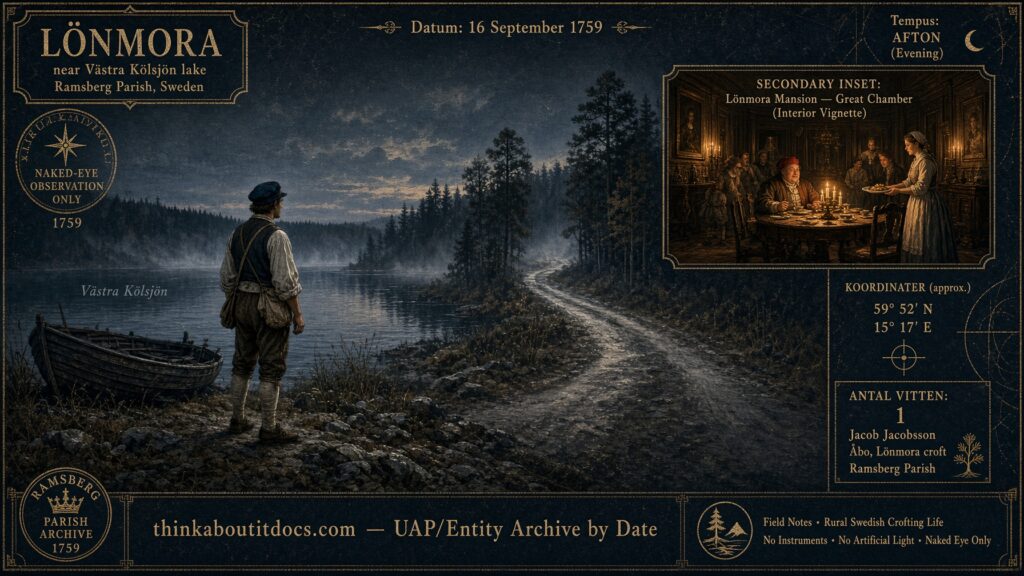
Four days, no memory of their passing — Jacob Jacobsson, Ramsberg, Sweden, 1759
THINK ABOUTIT ENTITY ENCOUNTER REPORT
1759: The Jacob Jacobsson Case | Four Days Missing, Ramsberg, Sweden
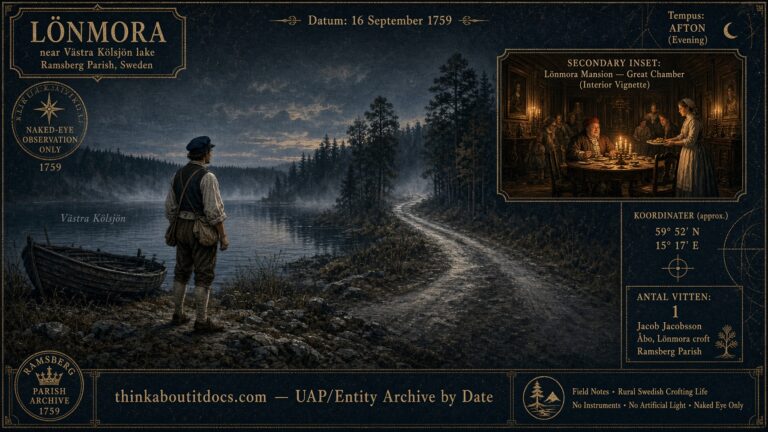
A 22-year-old man “Jacob Jacobsson” pulls his boat onto a familiar lakeshore and finds a road that was never there before. It leads to a grand red mansion filled with short people going about ordinary business — a chubby man in a red cap, a fine maiden offering food. He says no. They ask if he’ll stay. He asks for God’s help getting home. Instantly he’s back on the shore. Four days had passed. He hadn’t eaten, hadn’t slept, and didn’t feel like he’d been gone at all. The village minister took his statement in front of his parents and wrote it into the parish book.
Date: September 16, 1759 (return); statement recorded September 29, 1759 (St. Michael’s Day)
Sighting Time: Evening (initial disappearance); Thursday evening (return, four days later)
Day/Night: Night (disappearance and return)
Location: Lönmora and Västra Kölsjön lake, Ramsberg Parish, Sweden
Urban or Rural: Rural — Swedish crofting/farming community
No. of Entity(‘s): Multiple — described as “crowds of little people,” with specific mention of one chubby man in a red cap and one fine-looking maiden
Entity Type: Small humanoid beings, described as being in every way like ordinary men but of short stature
Entity Description: A crowd of short-statured beings resembling ordinary humans in every respect except height, including a chubby figure in a red cap seated at the head of a table and a taller, fine-looking maiden who offered food and drink
Hynek Classification: Not Applicable — no aerial craft described; classified as a CE-III/missing-time entity encounter outside the standard Hynek scale
Duration: Four days and nights of missing time, subjectively experienced by the witness as “only a little while”
No. of Object(s): Not Applicable
Description of the Object(s): Not Applicable
Shape of Object(s): Not Applicable
Size of Object(s): Not Applicable
Color of Object(s): Not Applicable
Distance to Object(s): Not Applicable
Height & Speed: Not Applicable
Number of Witnesses: One direct witness (Jacob Jacobsson the younger, age 22); his testimony taken in the presence of his parents by Reverend Vigelius
Special Features/Characteristics: A four-day, four-night disappearance during which the witness neither ate, drank, nor slept, yet showed no desire for food or water upon return and subjectively believed only a short time had passed; a search involving neighbors covering the woods and lake found no trace of him during the missing period; the witness experienced a lingering “uneasy feeling in his body and mind” the day after his return; the witness was formally described by the recording minister as simple, pious, meek, and gentle in character, and praised by everyone who knew him
Case Status: Unexplained
Source: Ramsberg sockens kyrkobok, El:1, 1736–1774, handwritten entry by Reverend Vigelius, kept at Landsarkivet, Uppsala, Sweden; translation by Clas Svahn
Summary/Description: On the evening of September 16, 1759, 22-year-old Jacob Jacobsson, having crossed the lake Västra Kölsjön to deliver a food packet to a neighboring crofter, pulled his boat onto the shore and encountered a large, broad road that had not been there before. Following it, he reached a large red mansion, grander than any he knew locally. He found himself seated on a bench in a great chamber, where a chubby little man in a red cap sat at the head of a table amid crowds of small people going about their business, all resembling ordinary men but of short stature. A fine-looking maiden, taller than the rest, offered him food and drink; he declined. Asked whether he wished to stay, he replied, “God, help me back home to my father and mother!” The man in the red cap then said, “Throw him out, he has such an ugly mouth!” In the next instant he was back on the lake shore. Four days and nights had passed, during which his worried parents and neighbors had searched the woods and lake without success. He had neither eaten nor slept in that time but felt no hunger or thirst, and believed he had been away only a little while. The following day he felt normal except for an uneasy feeling in his body and mind. Reverend Vigelius recorded Jacob’s statement, given in the presence of his parents, on St. Michael’s Day, 1759, describing him as a simple, pious, meek, and gentle young man well regarded by his community.
Related Cases: 1656: Cardiganshire, Wales bedroom entities
Detailed Report
This account carries an unusually strong chain of custody for an entity-contact case of this period: it survives as a handwritten entry in the official parish register (kyrkobok) of Ramsberg, Sweden, recorded directly by the parish’s own minister, Reverend Vigelius, who explicitly notes he took Jacob’s statement in the presence of the young man’s parents. Parish registers of this kind were official administrative and ecclesiastical records, not folkloric compilations or sensationalist pamphlets, and Vigelius’s inclusion of a detailed character reference for Jacob — describing him as simple, pious, meek, gentle, and universally well-regarded — reflects a deliberate effort to establish the witness’s credibility within the very document recording the account, exactly the kind of contemporaneous credibility-vouching seen in the period’s more formal scientific reports.
The account’s structural details are notable for their internal consistency with what would later become recognized abduction-narrative elements, despite predating any modern ufological framework by over two centuries: a sudden environmental alteration (the unexpected road), transportation to an unfamiliar interior space, encounter with numerous small humanoid beings engaged in ordinary domestic activity, an offer of food that the witness instinctively declines, a request to remain that the witness refuses, and an abrupt return to the point of departure. The physiological detail — four days without food, water, or sleep, with no apparent ill effect beyond a lingering unease — and the striking discrepancy between objective elapsed time (four days, independently confirmed by a search party) and the witness’s subjective sense of time (“only a little while”) are both recurring features of later entity-contact and missing-time literature, documented here in a genuine 1759 ecclesiastical record.
RESEARCHER’S NOTES
The Jacobsson Case — Sweden 1759 and the Pre-Modern Record’s Most Institutionally Documented Missing Time
- Source chain assessment: This is among the most institutionally credible entity-contact accounts in the entire pre-modern archive — a direct entry in an official parish register, recorded by the community’s own minister, with the witness’s statement explicitly taken in the presence of his parents and accompanied by a formal character assessment.
- Physical evidence / evidentiary weight: The independently confirmed four-day search by neighbors and family, covering the woods and lake without result, corroborates the objective duration of Jacob’s absence, even though it cannot corroborate what happened to him during that time.
- Pattern context / comparative cases: The narrative structure — sudden environmental transition, small humanoid hosts, an offer of food declined, a request to stay refused, and abrupt return with a marked time discrepancy — closely parallels the 1656 Cardiganshire, Wales bedroom visitation and the broader British “Good Neighbors” fairy-folk tradition, suggesting a durable cross-cultural entity-contact narrative template across Northern Europe in this period.
- Geographic or historical context: The parish register format itself is significant: Swedish Lutheran clergy of this period maintained detailed local administrative records as a matter of course, and Vigelius’s decision to formally document Jacob’s account within that record — rather than dismiss it outside the official record — reflects a degree of institutional seriousness toward the claim uncommon even among sympathetic clerical witnesses elsewhere in this archive.
The Jacob Jacobsson case remains the pre-modern archive’s most institutionally documented missing-time account — not a tale retold generations later, but a minister’s own contemporaneous parish-register entry, taken directly from the witness in front of his own parents, describing four days that a search party could confirm were lost and that Jacob himself experienced as barely any time at all.
“Four days and nights had passed without a trace of him. When he finally came back… he had not eaten or slept for four days, yet he had no desire for food or drink. He thought he had been away only for a little while.”