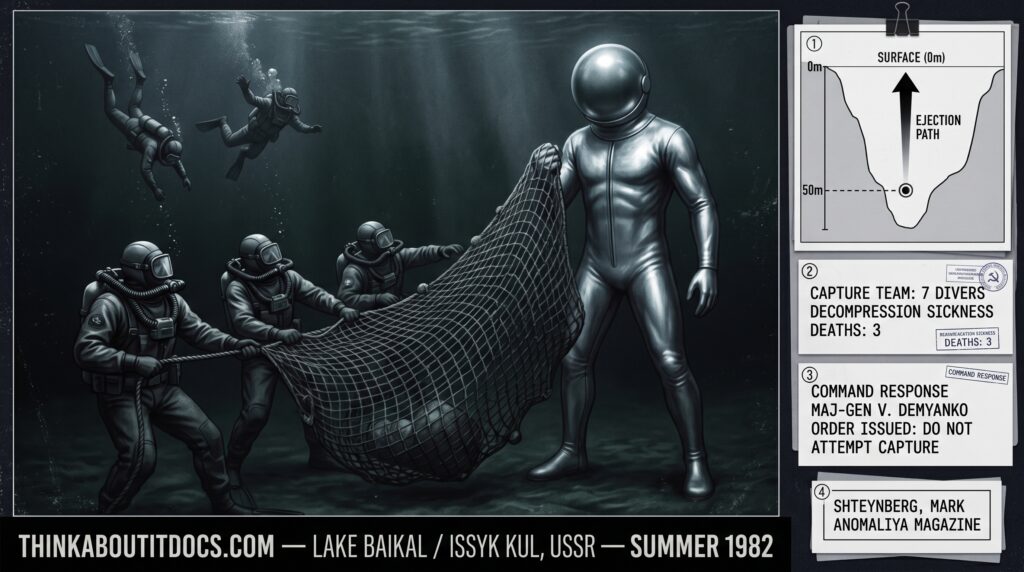
Lake Baikal / Issyk Kul, USSR — Summer 1982. Soviet military frogmen encounter three-meter silvery-suited humanoids at 50 meters depth. Capture attempt results in seven divers force-ejected to surface, three deaths from decompression sickness. Major-General Demyanko issues order against further attempts. Soviet Ministry of Defense bulletin lists multiple lakes with registered anomalous humanoid swimmer activity. Source: Shteynberg, ANOMALIYA #4, 1992.
THINK ABOUTIT UFO | UAP | ENTITY | ENCOUNTER REPORT
SUMMER 1982: TRANS-BAIKAL / ISSYK KUL, USSR SOVIET FROGMEN VS. UNDERWATER HUMANOIDS
In the summer of 1982, seven Soviet military divers went into Lake Baikal at fifty meters depth with a net. They were trying to capture one of the enormous silver-suited humanoids their service had been encountering in deep Soviet lakes. They did not capture it. Instead the entire team was propelled to the surface by a force they could not describe or explain — a violent decompression event in a body of men who had been trained for years in the one rule of deep diving: you do not surface fast from fifty meters. Three of them died. The commanding officer was among the dead. The others became permanent invalids. A Major-General flew from Moscow to Issyk Kul to personally warn the local commanders against any further capture attempts. The Soviet high command issued an order. The order acknowledged the existence of the swimmers. The order said: do not try again.
Date: Summer 1982
Sighting Time: During military training dives — specific time not recorded
Day/Night: Unknown
Location: Primary encounter: Trans-Baikal and West Siberian military regions, Lake Baikal, USSR. Secondary warning briefing: Issyk Kul Lake, Transiliysk Ala Tau, Kyrgyzstan, USSR.
Urban or Rural: Rural — deep-water lake military training area
No. of Entity(‘s): Multiple — at least one encountered during capture attempt; multiple “swimmers” observed in initial encounters
Entity Type: Aquatic humanoid — “underwater swimmers”
Entity Description: Humanoid beings of enormous size, approximately three meters (ten feet) tall. Wearing tight-fitting silvery suits despite icy-cold water temperatures. Observed at depth of fifty meters with no scuba or breathing equipment of any kind — only sphere-shaped helmets concealing their heads. Movement consistent with swimming. During capture attempt, demonstrated ability to generate a powerful propulsive force sufficient to eject seven equipped military divers from fifty meters depth to the surface simultaneously.
Hynek Classification: CE-III — close encounter with animate non-human beings; associated with anomalous aquatic phenomena
Duration: Multiple encounters over the training period; capture attempt of unknown duration
No. of Object(s): Soviet Ministry of Defense bulletin subsequently references descent and ascent of gigantic discs and spheres in affected lakes — not directly observed in this incident
Description of the Object(s): Not directly observed in this incident
Shape of Object(s): Not applicable to this incident
Size of Object(s): Entities: approximately 3 meters tall
Color of Object(s): Silvery suits; sphere helmets
Distance to Object(s): Close range — divers attempted to deploy a capture net
Height & Speed: Depth of encounter: 50 meters. Force of ejection: sufficient to propel seven divers from 50 meters to the surface, continuing 10–15 meters above the water surface per fisherman witnesses at Lake Baikal.
Number of Witnesses: Direct — seven military divers (capture attempt); Mark Shteynberg and Lt. Colonel Gennady Zverev (briefed by Major-General Demyanko); Major-General V. Demyanko (received original reports). Corroborating — Irkutsk fishermen (witnessed divers being expelled from the lake)
Special Features/Characteristics: Entities wore silvery suits and sphere helmets at 50 meters depth with no breathing apparatus; demonstrated propulsive force sufficient to eject seven military divers to the surface; decompression sickness killed three divers including commanding officer; four forced into a two-person pressure chamber; Soviet Ministry of Defense issued formal order against capture attempts; Ministry of Defense bulletin listed multiple Soviet deep-water lakes with registered anomalous humanoid swimmer appearances, disc/sphere descents and ascents, and deep luminescence; Issyk Kul Lake specifically listed as a site with similar creatures present; fishermen at Baikal independently observed divers being expelled 10–15 meters above water surface
Case Status: Unexplained
Source: Shteynberg, Mark, ANOMALIYA magazine (Russian paranormal phenomena journal), issue #4, 1992. Corroborating: Demidenko, Mikhail (Russian writer, USSR Union of Writers), personal account published 1992. Original events reported by Major-General V. Demyanko, commander, Military Diver Service, Engineer Forces, Ministry of Defense, USSR.
DETAILED REPORT
In the summer of 1982, Mark Shteynberg — a Soviet Afghan War veteran and author, expert on Russian military affairs — was conducting periodic training exercises for reconnaissance divers of the Turkistan and Central Asian military regions at Issyk Kul Lake. His co-trainer was Lt. Colonel Gennady Zverev. The exercises were routine until Major-General V. Demyanko, commander of the Military Diver Service of the Engineer Forces of the Ministry of Defense, USSR, arrived unexpectedly from Moscow.
Demyanko had not come to observe the training. He had come to report, and to warn.
He informed Shteynberg and Zverev that during similar training dives in the Trans-Baikal and West Siberian military regions, Soviet frogmen had encountered what he described as mysterious underwater swimmers: humanoid beings approximately three meters tall, wearing tight-fitting silvery suits and sphere-shaped helmets, observed at a depth of fifty meters with no breathing apparatus of any kind. The beings moved with apparent ease through water cold enough to require full thermal protection from the equipped military divers.
The initial encounters had prompted a decision at the command level. A special group of seven military divers, under an officer’s command, was assembled and dispatched to capture one of the creatures. They entered the water equipped with a net.
At fifty meters depth, as the divers attempted to cover one of the beings with the net, the entire group was simultaneously propelled from depth to the surface by a powerful, unidentified force. The nature of the force — whether kinetic, pressure-based, acoustic, or something else — was not described in any technical detail in the available record. The effect was unambiguous: seven trained military divers were ejected from fifty meters to the surface against their will.
The consequences were medically catastrophic. Autonomous diving equipment does not permit surfacing from fifty meters without strict decompression stops. All seven members of the capture team suffered aeroembolism — decompression sickness. The only pressure chamber available in the military region was operational and rated for two persons. The local commanders forced four men into it. Three of the four died, including the officer commanding the group. The remaining members of the team became permanent invalids.
Demyanko’s personal arrival at Issyk Kul was a direct consequence of these deaths. He was there to ensure that local commanders did not attempt a similar operation. His message was explicit: the Soviet high command was aware of the swimmers, was aware of their presence in multiple deep-water Soviet lakes, and had issued orders against any further capture attempts. Whether the command’s awareness was based on additional encounters not in the public record, or on intelligence of another kind, was not communicated to Shteynberg.
Shortly after Demyanko’s visit, the staff headquarters of the Turkmenistan military region received a formal order from the Commander-in-Chief of the Land Forces, supplemented by an information bulletin from the Engineer Forces Ministry of Defense headquarters. The bulletin listed numerous deep-water lakes across Soviet territory where anomalous phenomena had been registered: appearances of underwater creatures analogous to the Baikal type; descent and ascent of gigantic discs and spheres; powerful luminescence emanating from depth. Issyk Kul Lake — where Shteynberg was at that moment conducting his training — was among the listed sites.
Shteynberg published his account in ANOMALIYA magazine, issue #4, 1992, after the Soviet censorship on UFO subjects was lifted in 1989. Russian writer Mikhail Demidenko, upon reading Shteynberg’s account in 1992, recalled that during a 1986 assignment at Lake Baikal from the USSR Union of Writers, he had heard from local Irkutsk fishermen that some years earlier they had observed Soviet frogmen being expelled from the lake and continuing upward ten to fifteen meters above the water surface. Demidenko had not connected this to any military incident at the time. After reading Shteynberg’s account he attempted to verify the story through military contacts. A colonel from the Chief Logistics Directorate confirmed that such an order existed and was held in special archives requiring top security clearance. Demidenko pursued the matter until his death in 2003 without gaining further access.
RESEARCHER’S NOTES
The Institutional Response as Evidentiary Data: The most analytically significant aspect of the 1982 Soviet frogmen case is not the entity encounter itself but the institutional response to it. A Ministry of Defense Major-General flew personally from Moscow to a training site in Kyrgyzstan to warn local officers against capture attempts. A formal order was issued by the Commander-in-Chief of the Land Forces. A classified bulletin was circulated listing affected lake sites. Three military personnel died from decompression sickness in a botched capture attempt. These are not the responses of a military institution to a misidentification or a collective hallucination. They are the responses of an institutional chain of command to a phenomenon it has assessed as real, has attempted to interact with, and has decided to leave alone. The institutional response is the case’s strongest evidentiary element and it is entirely independent of whether the entity descriptions are accurate.
The Decompression Deaths — Physical Evidence: Three Soviet military divers died from aeroembolism following the capture attempt. This is a documented, physically verifiable consequence of a real event: something caused seven military divers to surface rapidly from fifty meters. Whatever the cause — the entities, a weapons test, an equipment failure, a panic-driven ascent, or something unknown — the deaths are the physical evidence that something happened at depth. The cause of the rapid surfacing is the unresolved question. Shteynberg’s account attributes it to a propulsive force generated by the entity being netted. No alternative explanation is documented in the available record.
Corroboration Structure: The case has three independent corroborating layers: Shteynberg’s primary account (direct briefing by Major-General Demyanko, published 1992); Demidenko’s independent recollection of the Irkutsk fisherman account (consistent with the physical event without knowledge of the military context); and the formal military order and bulletin (referenced by Shteynberg and partially confirmed by Demidenko’s source). The fisherman account is particularly significant because it describes the physical outcome — divers ejected above the water surface — without any knowledge of the military operation that caused it, providing corroboration from outside the military information chain.
Classification Note: This case is classified as CE-III on the basis of close encounter with animate non-human beings. The aquatic humanoid classification — USO-associated, possibly amphibious — places it in a small category of underwater entity encounters that includes the 1985 Juneau Alaska Wrangell Narrows USO, the 1952 Shemya Island Aleutian bat-shaped USO descent, and multiple Black Sea and Pacific Coast Soviet-era reports. The archive treats aquatic humanoid encounters as a subset of the broader entity record rather than a separate classification.
The Soviet high command knew about the swimmers and told its officers to leave them alone. That order exists in a classified archive in Moscow that Mikhail Demidenko spent years trying to access before he died. Three men died trying to net one. The lake was listed, along with other Soviet deep-water sites, in a Ministry of Defense bulletin as a location of registered anomalous phenomena. Issyk Kul does not freeze. The archive’s position is this: something was in those lakes, something interacted violently with military divers who tried to capture it, and the Soviet institutional chain of command found it significant enough to issue orders about. The rest is unresolved.