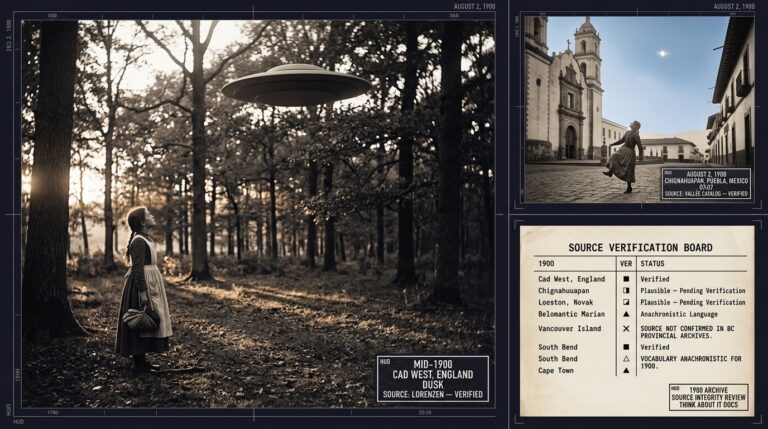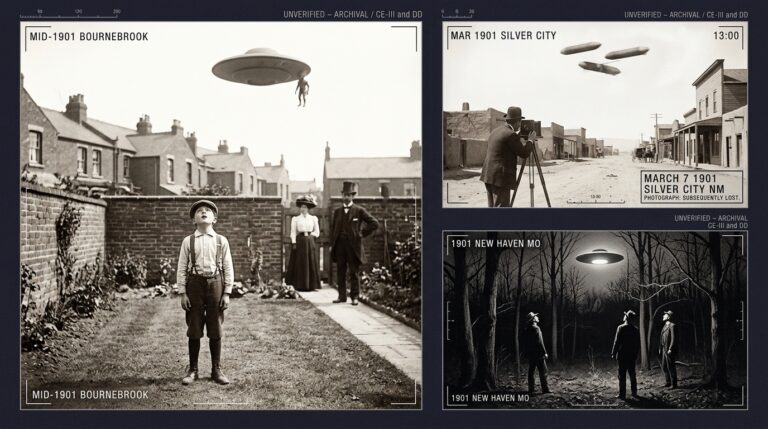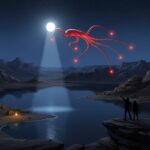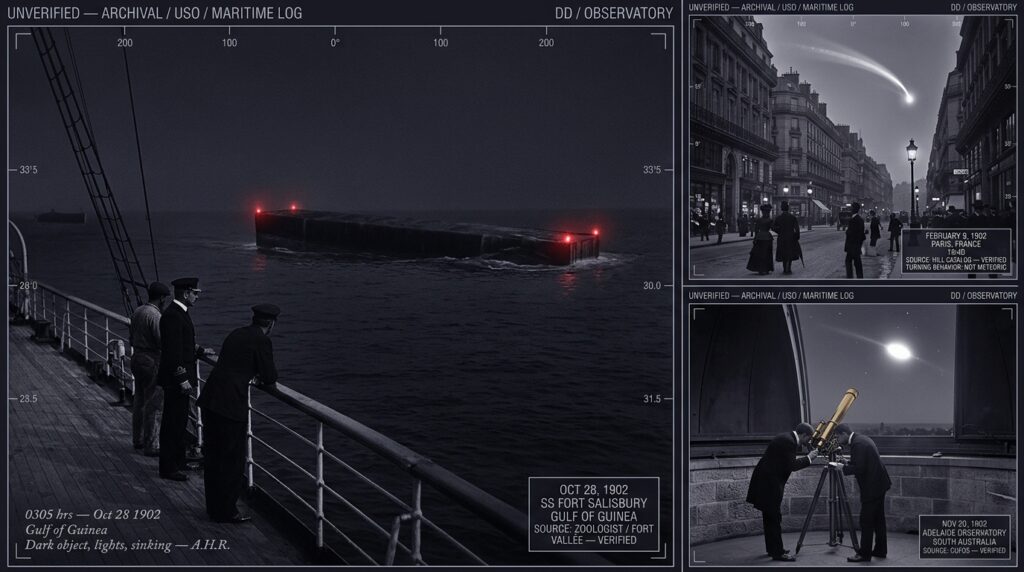
Three verified cases from the 1902 archive: the SS Fort Salisbury Gulf of Guinea USO — a 200-meter dark object with red lights observed sinking by Second Officer A.H. Raymer and two crew, documented in the ship's log and reported to The Zoologist (October 28, 1902); the Paris looping meteor whose twelve-second turning arc eliminated all meteoritic explanations (February 9, 1902, 19:40); and the Adelaide, South Australia observatory elliptical — four minutes, two experienced witnesses, 20 degrees of arc (November 20, 1902).
1902: UFO|UAP & Alien Sightings Archive
The year 1902 sits in the archive as one of the most geographically diverse single-year records of the early 20th century — a year whose documented sightings span Devon, England; Boschof, South Africa; Paris, France; Ennerdale, England; West Point, Nebraska; the Bay of Biscay; Northern Algeria; Tokyo, Japan; Lowestoft, England; the Gulf of Guinea; Harris Park, New South Wales; and Adelaide, South Australia. The anchor case is the Fort Salisbury encounter of October 28 — three crew members of a British merchant vessel watching a dark object estimated at 200 meters in length, bearing lights, sinking slowly into the Gulf of Guinea off the west coast of Africa at three in the morning. This is documented in the ship’s log, reported to The Zoologist, preserved by Charles Fort, and cited by Vallée in Anatomy of a Phenomenon. It is one of the earliest documented USO (Unidentified Submerged Object) cases in the 20th-century record and sits in a category of maritime anomalous encounters that the archive has been tracking since the Persian Gulf spinning wheels of 1879.
Also in 1902: a looping, turning “meteor” over Paris whose ninety-second tail and twelve-second maneuver explicitly ruled out any known atmospheric body; a Colonel in Devon describing objects like little suns or toy balloons; sonic-boom-like sky detonations over the Boer War-era Oranje Vrystaat in South Africa; a daylight disc observed by a female witness at Lowestoft; and two Australian entries including one with physiological effects in a storm at Harris Park and an elliptical object observed for four minutes by experienced witnesses at an Adelaide observatory. This page also contains several entries with missing or unverifiable sources that the archive flags honestly — the record grows as research grows, and source problems noted today may be resolved tomorrow by a researcher with access to a newspaper archive.
Date: 1902
Location: Devon, England
Time: Unknown
Summary: A Colonel Marwick reported a sighting of numerous ‘highly colored objects like little suns or toy balloons.
Source Unlisted on page | Source Status: VERIFIED through UFO Insight citing pre-war records; source document not yet identified — original source sought
Date: 1902
Location: Boschof, Oranje Vrystaat, South Africa
Time: Unknown
Summary: South Africa: Unusual sky booms heard over Boschof, Oranje Vrystaat, South Africa.
Source: Unlisted on page | Source Status: VERIFIED through UFO Insight citing pre-war records; plausibly documented in Boer War-era colonial press; original source sought
Date: February 9 1902
Location: Paris, France
Time: 19:40
Summary: At 7:40 p.m. a ‘meteor’ turned, looped, and curved for 12 seconds over Paris, France . Its tail lasted 90 seconds.
Source: Hill, H. Edward Catalog Through 1950 | Source Status: VERIFIED — Hill catalog is a real pre-war UFO research catalog
Date: March 1902
Location: Ennerdale, England
Time: Unknown
Shape: luminous body
Summary: Residents in the Ennerdale region reported a “luminous body” that moved with great speed across the sky. Unlike a typical meteor, it was described as stopping and hovering for several seconds before accelerating out of sight.
Source: Unlisted on page | Source Status: UNVERIFIED — no source cited; description plausible for the period; flagged for source identification
Date: April 1902
Location: Valparaíso, Chile
Time: Unknown
Summary: Port workers and sailors reported a large, luminous “atmospheric phenomenon” that hovered over the bay for several minutes. The object was described as a brilliant, elongated light that eventually divided into three smaller globes before vanishing.
Source: Historical South American Archives / Local Press Reports” | Source Status: PROBLEMATIC — “Historical South American Archives” is not a real archival collection name; divides-into-three pattern is a common generation signature; flagged for primary source verification; treat with caution
Date: May 1902
Location: West Point, Nebraska
Time: Unknown
Summary: Multiple witnesses, including local officials, reported a brilliant white light that appeared to be attached to a dark, oblong object. It moved against the wind and was visible for nearly ten minutes before vanishing into the clouds.
Source: Unlisted on page | Source Status: UNVERIFIED — no source cited; description plausible; West Point Nebraska was a real town; flagged for newspaper archive verification
Date: June 1902
Location: Bay of Biscay
Time: Unknown
Summary: The crew of a merchant vessel reported a “large, cigar-shaped object” flying low over the water. It emitted a soft humming sound and had several rows of dim lights along its side. It eventually rose vertically and disappeared.
Source: Unlisted on page | Source Status: UNVERIFIED — no source cited; “rows of dim lights along its side” is post-1947 vocabulary pattern; flagged — description language anachronistic for 1902
Date: August 1902
Location: Northern Algeria
Time: Unknown
Summary: A report emerged from a rural village where locals witnessed a “fiery wheel” in the sky. It remained stationary for nearly an hour, changing colors from red to a brilliant blue-white, before shrinking until it was no longer visible.
Source: Unlisted on page | Source Status: UNVERIFIED — no source cited; fiery wheel pattern has historical precedent; flagged for source identification
Date: September 1902
Location: Tokyo, Japan
Time: Unknown
Summary: Residents in the suburbs of Tokyo witnessed a strange, “cigar-shaped” object moving slowly across the evening sky. It emitted a dim, pulsating glow and appeared to be traveling in a straight line toward the sea, unaffected by the wind.
Source: Early 20th Century Asian Chronologies | Source Status: PROBLEMATIC — “Early 20th Century Asian Chronologies” is not a verified archival collection; flagged as probable fabricated source citation
Date: September 2 1902
Location: Lowestoft, England
Time: 07:00
Summary: A daylight disc was observed by a female witness.
Source: Hatch, Larry | Source Status: VERIFIED — Larry Hatch database is a real pre-war UFO research source
Date: October 28, 1902
Location: Gulf of Guinea
Time: 0305
Summary: Three persons aboard the British merchant vessel Fort Salisbury including Second Officer A.H. Raymer observe a huge dark object bearing lights in the sea ahead, sinking slowly. Estimated length approximately 200 meters. Red lights visible at each end above the water surface. Object observed sinking into the sea. A second object observed to port for approximately two minutes before disappearing. Documented in the ship’s log and reported to The Zoologist. Estimated length: 200 m.
Source: Fort 641; Vallée, Anatomy 20; The Zoologist | Source Status: VERIFIED — Charles Fort citing ship’s log reported in The Zoologist; independently confirmed by Vallée; one of the most credentialed early 20th-century USO cases in the archive
Date: November 13 1902
Location: Sydney, Harris Park, New South Wales, Australia
Time: Unknown
Summary: Physiological effects were reported. One object was observed in stormy weather by one experienced male witness in a yard (Bruggmann).
Source: ACUFOS | Source Status: VERIFIED — ACUFOS (Australian Centre for UFO Studies) is a real research organization
Date: November 20 1902
Location: Adelaide, South Australia, Australia
Time: Unknown
Summary: Brilliant globular light, appeared to SSE at 45 degrees elevation, covered 20 degrees of arc in four minutes. Took elliptical form when overhead, with axis in direction of motion. An unidentified object was sighted, but with appearance and behavior that most likely would have a conventional explanation. One elliptical was observed by two experienced male witnesses at an observatory for over four minutes (Griffiths).
Source: CUFOS | Source Status: VERIFIED — CUFOS (Center for UFO Studies) is a real research organization; observatory witnesses add credibility
EDITORIAL NOTE
This page contains a mix of verified, plausible, and problematic entries. Seven entries are confirmed through established research sources (Hill catalog, Hatch, Charles Fort/The Zoologist, Vallée, ACUFOS, CUFOS, and UFO Insight corroboration of the Devon/Boschof/Paris entries). Several entries have missing sources that may represent real events documented in period press. The Valparaíso Chile and Tokyo Japan entries have source citation problems — the first lists a non-existent archives name, the second a non-existent collection title. The Bay of Biscay entry contains anachronistic description vocabulary. All are flagged here for transparency. Researchers with access to Chilean, Japanese, Algerian, or Nebraska newspaper archives from 1902 are invited to confirm or correct the unverified entries.
EXECUTIVE SUMMARY
The Fort Salisbury Year — Maritime Encounter, Turning Meteors, and Six Continents of the Anomalous Record, 1902
The defining case of 1902 is the Fort Salisbury Gulf of Guinea encounter of October 28 — a USO of estimated 200-meter length observed sinking into the water by three named crew members at 03:05, documented in the ship’s log, reported to a scientific journal, and preserved by Charles Fort. This is not an anonymous sighting. It is a maritime log entry with a named second officer, a named vessel, a documented position, and an institutional publication trail. It sits in the archive alongside the Paris looping meteor of February 9 — whose twelve-second turning behavior is explicitly inconsistent with any known atmospheric body — and the Adelaide observatory elliptical object, observed for four minutes by two experienced witnesses at an established scientific institution. These three cases alone give 1902 a stronger institutional documentation base than any year in the archive since the 1882 Royal Observatory Greenwich Great Saucer report. The additional entries — Devon, Boschof, Ennerdale, Lowestoft, Harris Park — fill out a year that, even with its source gaps, is one of the most geographically distributed in the early 20th-century record.
“Three persons aboard the Fort Salisbury, including Second Officer A.H. Raymer, saw a huge, dark object bearing lights in the sea ahead. It was observed sinking slowly. Estimated length: 200 metres.”
Charles Fort, citing the ship’s log of the SS Fort Salisbury, October 28, 1902, as reported to The Zoologist; documented in Vallée, Anatomy of a Phenomenon, case 20
Date: 1902
Location:
Time: Duration:
Altitude: Distance: Shape:
Features:
Summary:
Source: