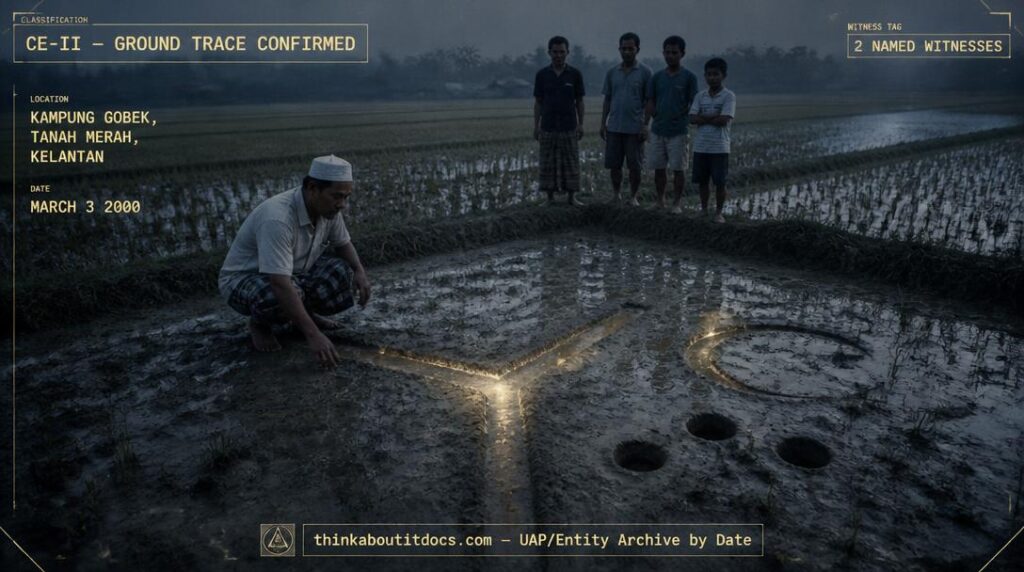
Recreation of the March 2000 Kampung Gobek discovery, in which villagers found a precise Y-shaped depression, a crescent hollow, and three holes in marshland after a hovering, light-emitting object was seen overnight.
THINK ABOUTIT UFO|UAP|ENTITY SIGHTINGS REPORT
2000: The Kampung Gobek UFO Landing, Kelantan, Malaysia
At 3 AM on March 3, 2000, a bright object hovered for several minutes over a marshy field in Kampung Gobek, a rice-farming village in Kelantan, Malaysia, its light pulsing “like lightning” through the walls of nearby homes — and by daybreak, villagers had found a precise, Y-shaped depression measuring 15 by 5 meters gouged into the marshland, along with a crescent-shaped hollow and three evenly spaced, one-meter holes nearby.
Date: March 3, 2000
Sighting Time: 3:00 AM
Day/Night: Night
Location: Kampung Gobek, Tanah Merah district, Kelantan, Malaysia
Urban or Rural: Rural — an agricultural village roughly two hours from Kota Bharu, on marshland formerly used as rice paddy
No. of Entity(‘s): Undocumented
Entity Type: Not Applicable — no entity described in connection with this specific landing event
Entity Description: Not Applicable
Hynek Classification: CE-II (Close Encounter II) — observation of an object in close proximity to witnesses, with physical traces (ground depressions) left behind. This classification fits the reported facts well.
Duration: Several minutes of hovering, per witness account
No. of Object(s): 1
Description of the Object(s): A large object emitting rays of light that came in intervals, described by one witness as similar to lightning but with no accompanying rain or storm. The object hovered over marshland before landing, then departed by the time villagers reached the site at daybreak.
Shape of Object(s): Not directly described — witnesses saw the light and its effects rather than a resolved solid shape
Size of Object(s): Large — inferred from the resulting ground depression measuring 15 meters by 5 meters
Color of Object(s): Undocumented — described only as “shining” and emitting bright, intermittent rays of light
Distance to Object(s): Undocumented precisely; the primary witness’s house was approximately 100 meters from the site where the ground depression was later found
Height & Speed: Height undocumented. The object was described as hovering (stationary) over the marshland for the observed duration rather than moving at speed.
Number of Witnesses: Reported as “some 1,000 people” — this refers to the general population of Kampung Gobek, who were collectively “in a state of high suspense” following the event, not 1,000 direct eyewitnesses to the object itself at 3 AM. Two named direct witnesses are quoted: Mohamad Mat Diah (51) and Saupi Salleh (28).
Special Features/Characteristics: At daybreak, villagers found a “Y”-shaped depression in the marshland measuring 15m by 5m, a separate crescent-shaped hollow roughly 3m across, and three holes, each about one meter in diameter, spaced one meter apart. Mohamad Mat Diah concluded from the marks that a heavy object must have caused them. The site subsequently became locally known as a landmark, and the named primary witness was still being interviewed about the event, as a local figure associated with it, more than a decade later.
Case Status: Unexplained — a multi-witness, wire-service-reported (Bernama/The Star) case with physical ground traces, corroborated by multiple independent later Malay-language retrospectives naming the same primary witness
Source: The Star (Malaysia), March 6, 2000, via Bernama wire report (original URL: thestar.com.my/online/newsreport.asp, now defunct; content independently corroborated by multiple later Malay-language sources — see Researcher’s Notes)
Summary/Description: TANAH MERAH, KELANTAN: A large object emitting rays of light was reported to have landed on a piece of marshland here three days ago, holding some 1,000 people of Kampung Gobek in a state of high suspense. The residents said yesterday they saw the shining object land at 3am. “The lights from the object came in intervals, similar to lightning, but there was no sign of rain,” Mohamad Mat Diah, 51, said. “The light from the object was very bright and the rays bathed the inside of my house. I suspected something was happening outside and looked out and saw the object hovering over the marshland for several minutes,” he added. Mohamad said at daybreak he went over to the area some 100m from his house and saw a ‘Y’ shaped depression measuring 15m by 5m which could have been caused by the unidentified flying object (UFO). Near the depression was another crescent-shaped, 3m-deep hollow and three holes, one metre apart and each one metre in diameter, he said. “I was accompanied to the area by two others who initially were afraid to come with me,” he said. Another resident, Saupi Salleh, 28, said he was awakened by the bright light. “I clearly saw the light from the object,” he said. “I thought it was lightning but when it prevailed I realised it was something else.” He went to see the depression and concluded it must have been a heavy object. Many residents were seen inspecting the landing site of the UFO. — Bernama
Related Cases: Undocumented on this site, though independent Malay-language sources note that residents of nearby Kampung Gual Ipoh separately claimed sightings of a scaled, tailed alien creature around the same general period — a related but distinct local report not independently verified here
Detailed Report
This is among the better-corroborated entries in the archive’s Malaysia coverage. The original account was carried by Bernama, Malaysia’s national news agency, and published in The Star, one of the country’s major English-language newspapers, within days of the event — a meaningfully stronger sourcing chain than the secondary folklore compilations behind several other Malaysian entries in this archive. The named primary witness, Mohamad Mat Diah, described being woken by intermittent bright light bathing the inside of his house, resembling lightning but occurring under clear skies with no rain. Looking outside, he observed the object hovering over nearby marshland for several minutes before it departed. At daybreak, accompanied by two initially reluctant companions, he found a precise “Y”-shaped depression in the marsh measuring 15 by 5 meters, along with a separate crescent-shaped hollow and three evenly spaced, meter-wide holes — physical ground traces consistent with something heavy having rested there, as Mohamad himself concluded. A second named witness, Saupi Salleh, independently corroborated being awakened by the same light and initially mistaking it for lightning before concluding otherwise. Beyond the original 2000 report, independent Malay-language retrospectives published years later (including a 2011 magazine feature) returned to interview Mohamad Mat Diah again, by then known locally as “Pakcik Mat,” confirming his account had not changed and noting the site had since become a minor local landmark. Reported village population figures of “some 1,000 people” describe Kampung Gobek’s general population affected by the resulting local stir, not 1,000 people who personally witnessed the object — that distinction is preserved here rather than allowed to imply mass direct observation that the source does not actually claim.
RESEARCHER’S NOTES
The Y-Shaped Depression — Kampung Gobek 2000 and a Rare Physical Trace Case
- Classification Assessment: CE-II is a strong fit here — a close-proximity object observation paired with genuine, measured physical ground traces (the Y-shaped depression, the crescent hollow, the three holes) is precisely what the category describes, and this case has more concrete physical evidence than most other CE-II candidates in this archive.
- Source Chain Assessment: This case benefits from wire-service sourcing (Bernama, carried by The Star) close to the event date, two named direct witnesses, and later independent Malay-language retrospective journalism returning to the same named witness years afterward with a consistent account. This is a notably stronger chain than the secondary book-compilation sourcing behind several related Malaysian cases in this archive. One minor discrepancy across retellings: at least one later source describes the depression as 15m by 3m rather than 15m by 5m as in the original Star/Bernama report used here; the original contemporaneous figure is retained as primary.
- Evidentiary Weight: The ground depressions are the strongest physical evidence in this case, and their precise, geometric description (a Y-shape, a crescent, three evenly spaced equal-diameter holes) is unusual detail for a rural marshland report. No scientific soil or geological analysis of the depressions is cited in any source located, however, so their cause remains established only by witness inference (“must have been a heavy object”), not by instrumented examination.
- Pattern and Comparative Context: Ground-trace cases involving geometric depressions in soft or marshy ground are a well-established report category internationally, sometimes linked to mundane explanations such as ground subsidence, drainage patterns, or livestock activity, though the specific “Y” plus separate crescent-and-holes configuration described here is more elaborate than typical subsidence patterns. Independent local sources also connect this case to a separate, distinct claim from nearby Kampung Gual Ipoh of a scaled, tailed creature sighting around the same period — a related but unverified local report, not confirmed as connected to this landing.
- Geographic and Historical Context: Kampung Gobek is an agricultural village in Kelantan’s Tanah Merah district, roughly two hours from Kota Bharu. The case became sufficiently well-known locally that the site was still referenced as a landmark and the primary witness still sought out for interviews more than a decade after the event, an unusually durable local legacy for a report of this kind.
Few cases in this archive combine a wire-service report, two named witnesses, and genuine, geometrically described ground traces the way this one does. What actually caused the marks in that Kelantan marshland was never established by any instrumented study located here, but the account’s consistency across more than a decade of independent retelling — and a named witness willing to keep answering questions about it — gives this case a durability most reports never earn. It stands as Unexplained.
“I clearly saw the light from the object. I thought it was lightning but when it prevailed I realised it was something else.”