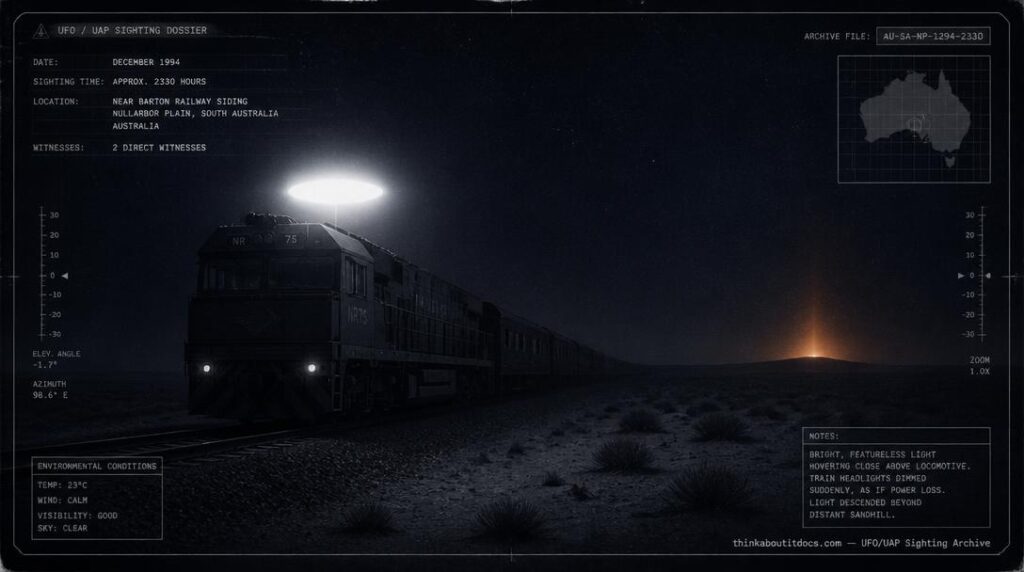
A diesel train crossing the Nullarbor Plain near Barton railway siding lost power as a bright light hovered above the engine before apparently crashing nearby, December 1994.
THINK ABOUTIT CRASH REPORT
The 1994 Nullarbor Plain Train UFO Incident:
A Power Loss and a Crash Rumor
Late one night, likely in December 1994, a diesel train crossing the Nullarbor Plain lost power the instant its driver and fireman spotted a bright light hovering above the engine. The light moved alongside them, climbed, then dove steeply and appeared to crash into a nearby sandhill with a distant glow — at which point the train’s power returned and it continued on, nearly three hours behind schedule. A railway station assistant several sidings away, who heard the whole exchange over the radio telephone, has spent decades since wondering what frightened his two colleagues badly enough that both quietly quit their jobs and vanished.
Date: December 1994 (the source material’s own detailed report states “1984,” which this page treats as a likely transcription error; see Editor’s Note)
Sighting Time: Approximately 2330 hours (11:30 p.m.)
Day/Night: Night
Location: Near Barton railway siding, Nullarbor Plain, South Australia, Australia (close to the Woomera joint USA/Australia prohibited area); Gary Edwards, who relayed this account, was stationed separately at Cook railway siding at the time
Urban or Rural: Rural — remote railway line across the Nullarbor Plain
No. of Entity(‘s): None documented
Entity Type: None documented
Entity Description: None documented
Hynek Classification: CE-II (Close Encounter II) — the train’s documented loss of power coincident with the object’s presence is a genuine physical/electrical effect, consistent with this classification
Duration: The light’s presence above the train lasted roughly a minute before it departed; the train arrived at Cook siding approximately three hours overdue as a result of the incident
No. of Object(s): 1
Description of the Object(s): A bright light that hovered above the train’s engine for about a minute, moved to beside the engine, climbed, then executed a steep dive to the right before appearing to crash into a nearby sandhill, producing a visible glow in the distance
Shape of Object(s): Not documented — described only as a bright light, with no structural detail given
Size of Object(s): Not documented
Color of Object(s): Bright light, no further color detail given
Distance to Object(s): Not documented in absolute terms; described as directly above and then beside the train engine
Number of Witnesses: 2 direct witnesses — the train driver and fireman (assistant), whose names were not given; Gary Edwards, the source of this account, was not a direct witness to the object itself but heard the driver’s real-time radio report from a separate railway siding
Special Features/Characteristics: The train’s engine lost power at the exact moment the light was spotted, then regained power without further incident once the light departed; both crew members were reportedly severely shaken and quit their jobs shortly afterward, subsequently described as having “disappeared”; Gary Edwards states he telephoned Pine Gap, the joint US-Australian intelligence facility near Alice Springs, to report the incident — a notable choice given Pine Gap is considerably more distant from the Nullarbor Plain than the Woomera prohibited area, which sits directly adjacent to the reported crash site; an Australian National Railways spokesperson, John Beattie, was quoted acknowledging the company did not know the cause of the power loss, while noting the crew’s extensive outback experience made their report of something sufficiently unusual to note itself significant; local rumors circulated afterward, explicitly described as rumor rather than confirmed fact, that a crashed flying saucer had been recovered from the site and taken to the Woomera area; the story reportedly received national coverage on ABC radio and in local newspapers the following day, though it did not receive international coverage and was largely forgotten afterward
Case Status: Unexplained — the power-loss element is acknowledged, if not explained, by a named railway company spokesperson; the crash and recovery narrative rests on rumor explicitly labeled as such in the source material, and neither crew member has ever been identified or independently interviewed
Source: Gary Edwards
Summary/Description: A diesel train crossing the Nullarbor Plain near Barton railway siding lost power the moment its driver and fireman spotted a bright light hovering above the engine, which then departed after an apparent crash into a nearby sandhill; power returned immediately afterward. The account was relayed by Gary Edwards, a railway station assistant at a nearby siding who heard the driver’s radio report in real time. Both crew members reportedly quit their jobs shortly after the incident and were never heard from again by Edwards.
Related Cases: None documented — the Nullarbor Plain has an independently documented history of other reported UFO sightings, including the 1988 Knowles family encounter
Detailed Report
Gary Edwards originally wrote in asking whether a crashed UFO had been recovered on the Nullarbor Plain near the Barton railway siding around December 1994. He explained that he had been the station assistant on duty at Cook railway siding — a separate location along the line — when the incident occurred, and recalled what he heard the train driver and fireman (the driver’s assistant) report over the radio telephone at the time: that the train’s engine lost power when a UFO hovered above it for about a minute, then dove steeply to the right and crashed into nearby sand hills. Edwards stated he telephoned Pine Gap, the joint US-Australian facility near Alice Springs, to report the incident, and has since sought further information about what happened.
Based on Edwards’s recollections, the following account was compiled. The Nullarbor Plain — the site of 1950s-era nuclear testing, and whose name means “no trees” — is a vast, sparsely vegetated desert region straddling the border of South and Western Australia, extending roughly 180 miles west and 150 miles east of the state line.
At approximately 11:30 p.m. one night, Gary Edwards, working as a Station Assistant Class 3 for the Australian National Railways Commission, was monitoring the radio telephone — the only communications link to train control in Port Augusta, South Australia — when he heard the driver of an approaching diesel train report a bright light above the train and a simultaneous loss of engine power. The driver then reported the light moving beside the engine, climbing, and executing a steep dive to the right, appearing to crash into a nearby sandhill with a visible glow in the distance. The engine’s power returned immediately afterward, and the train continued its run without further incident, arriving at Cook siding roughly three hours behind schedule.
According to Edwards, both the driver and fireman were visibly shaken by the experience, to the extent that both left their jobs shortly afterward and, in Edwards’s words, disappeared. Australian National Railways spokesperson John Beattie was quoted stating the company did not know what had caused the diesel train to lose power, noting that both crew members reported the power loss occurring at the exact moment they spotted the light, and that their extensive experience traveling through the outback made it notable that they considered the light unusual enough to report.
The incident occurred near the Barton railway siding, close to the Woomera joint US-Australian prohibited testing area. Local rumors following the incident held that a crashed flying saucer had been recovered from the site and taken into the Woomera area — a claim presented explicitly as rumor rather than established fact. The story reportedly reached national coverage the following day via ABC radio and local newspapers, though it did not receive wider international attention and was largely forgotten in the years since. Edwards states he has continued to wonder what so thoroughly frightened his two colleagues that both walked away from steady jobs and were never heard from again.
Researcher’s Notes
The Nullarbor Train Incident — 1994 and Separating the Acknowledged Mystery From the Rumor
- The source material’s own date contradicts itself. The header and Gary Edwards’s original query both say December 1994, while the compiled report body says 1984. This page uses 1994, but the contradiction is preserved rather than silently corrected, since it’s impossible to know from the material available which figure reflects a genuine error versus which one is the typo.
- Gary Edwards is a secondhand source for the object sighting itself, and that distinction matters. He was not present at the location of the sighting; he heard a live radio report of it from a separate railway siding. His account of the crew’s real-time description is valuable, but he is not a direct witness to the object, a distinction the original site record didn’t make clear.
- The power-loss element carries real institutional weight; the crash-and-recovery narrative does not. A named company spokesperson acknowledging an unexplained power loss, corroborated by two crew members’ matching real-time reports, is a genuinely documented and semi-officially recognized mystery. The claim of a recovered crashed saucer taken to Woomera is explicitly labeled local rumor in the source material itself, and this page maintains that distinction rather than blending the two into a single confirmed narrative.
- Contacting Pine Gap, rather than Woomera, is a curious detail worth noting without over-interpreting. Woomera sits directly adjacent to the reported crash site and is explicitly mentioned in the same account as the nearby prohibited area, making it the more geographically obvious facility to contact. Choosing to instead call Pine Gap, several hundred kilometers away in the Northern Territory, is an interesting detail that this page notes but does not attempt to explain.
- Neither crew member has ever been named or independently located. The claim that both men quit and vanished afterward is a dramatic detail with real potential significance, but it rests entirely on Edwards’s own secondhand account and cannot be independently verified without their identities.
The Nullarbor train incident is best understood as two layers of claim with very different evidentiary footing: a documented, company-acknowledged power failure coincident with a reported light sighting by two named-role crew members, and a separate, explicitly rumor-based crash-and-recovery story that this page treats with appropriate caution rather than as an extension of the same confirmed event.
“We don’t know what it was, or what caused the diesel train to lose power.”
— John Beattie, Australian National Railways spokesperson