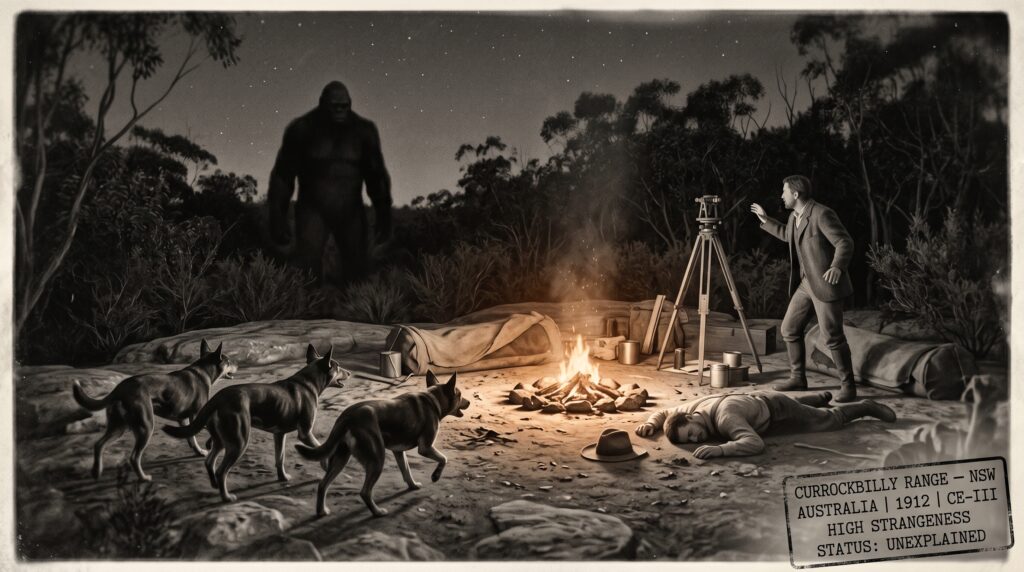
Currockbilly Range, New South Wales, Australia, 1912 — a huge man-like animal approached surveyor Charles Harper's bush camp at 9PM. His fierce hunting dogs retreated whining. One assistant remained unconscious for several hours. Source: Tony Healy, High Strangeness in Yowie Reports. Case status: Unexplained.
THINK ABOUTIT ENTITY ENCOUNTER REPORT
1912: Australian Humanoid Sighting
In 1912 in the Currockbilly Range of New South Wales, surveyor Charles Harper was working a remote stretch of Australian bush with two assistants and a pack of fierce hunting dogs when something approached the camp at nine o’clock at night. The dogs — described as fierce — did not bark, did not charge, and did not hold their ground. They retreated whining. One of Harper’s assistants fainted and remained unconscious for several hours. What had come out of the dark toward them was a huge man-like animal. Tony Healy documented it. The archive holds it. The dogs knew what it was before anyone else did, and every one of them ran.
Sighting Time: 21:00 — 9:00 PM
Day/Night: Night
Location: Currockbilly Range, New South Wales, Australia
Urban or Rural: Rural — remote bush, survey work in isolated mountain range
No. of Entity(‘s): 1
Entity Type: Unknown large humanoid — locally classified as Yowie; Australian equivalent of Bigfoot / Sasquatch in regional tradition; high strangeness classification retained
Entity Description: Described as a huge man-like animal; no further physical detail recorded in available source beyond its size, humanoid morphology, and the extreme reaction it produced in trained hunting dogs and a human witness; approached the camp directly at night; its presence caused the complete failure of nerve in experienced bush dogs and rendered one adult human unconscious for several hours
Hynek Classification: CE-III (Close Encounter III) — close observation of an animate non-human being at close range with behavioral effect on witnesses and animals. Note: no aerial craft is associated with this case. CE-III is applied as the closest standard classification for a close-range animate entity encounter with physical and psychological effect on witnesses. The case is retained under high strangeness cryptid classification — the Yowie as an entity type falls outside conventional zoological categories and has entered the ufology record through cases exhibiting characteristics beyond simple large primate behavior.
Duration: Insufficient Data — not recorded in available source; long enough to cause sustained unconsciousness in one witness lasting several hours
No. of Object(s): None — entity only, no associated craft
Description of the Object(s): N/A
Shape of Object(s): N/A
Size of Object(s): N/A
Color of Object(s): N/A
Distance to Object(s): Close range — entity approached the camp directly; exact distance not recorded
Height & Speed: Approached on foot from the bush; height described as huge relative to a human adult; speed not recorded
Number of Witnesses: 3 — surveyor Charles Harper and his two unnamed assistants; pack of hunting dogs also present
Special Features/Characteristics: Complete failure and retreat of trained fierce hunting dogs — experienced bush dogs that retreated whining rather than engaging; one of the two assistants fainted at the encounter and remained unconscious for several hours — a duration of unconsciousness that suggests severe physiological or neurological impact rather than simple shock; surveyor Charles Harper — a professional in a demanding field requiring calm observation in remote terrain — was sufficiently affected to have the incident documented; the case entered the ufology catalog through Tony Healy’s research into high strangeness Yowie reports, distinguishing it from conventional cryptid sightings by the extreme physiological effects on witnesses and the dog retreat pattern
Case Status: Unexplained
Source: Tony Healy, High Strangeness in Yowie Reports
Summary/Description: In 1912 at 9:00 PM in the Currockbilly Range of New South Wales, a huge man-like animal approached the remote bush camp of surveyor Charles Harper and his two assistants. The party’s fierce hunting dogs retreated whining rather than engaging the entity. One assistant fainted and remained unconscious for several hours. No further physical description of the entity was recorded in the available source. The case was documented by Australian researcher Tony Healy in his study of high strangeness Yowie reports and entered the ufology catalog due to the extreme witness effects distinguishing it from conventional large animal encounters.
Related Cases: 1893: Fayette County Pennsylvania Monster — Seltzer’s Hole | 1909: West Hobart Tasmania Sighting | Australian High Strangeness Archive | Yowie Sightings Archive
Detailed Report
The Dogs Retreated — Currockbilly Range, New South Wales, 1912 Source: Tony Healy, High Strangeness in Yowie Reports
In 1912, in the Currockbilly Range of New South Wales, Australia, surveyor Charles Harper was engaged in remote survey work with two assistants. The party had with them a pack of hunting dogs described as fierce — experienced bush animals accustomed to the sounds, smells, and threats of remote Australian terrain.
At nine o’clock in the evening, a huge man-like animal approached the camp. The hunting dogs did not advance to meet it. They retreated, whining. One of Harper’s two assistants fainted and remained unconscious for several hours.
Tony Healy, documenting high strangeness elements in Australian Yowie reports, recorded the case. It entered the ufology catalog due to the severity of the physiological effects on witnesses — effects that distinguish the Currockbilly encounter from conventional large animal encounters and place it in the same evidentiary category as other high strangeness entity cases in which the proximity of an unknown being produces measurable physical consequences in both humans and animals simultaneously.
No further physical description of the entity was recorded in the available source summary.
RESEARCHER’S NOTES
The Dogs Retreated — Currockbilly Range 1912 and the High Strangeness Yowie as Archive Evidence
- The Dog Retreat as Cross-Species Physiological Marker: The behavior of the hunting dogs is the single most analytically significant element of the Currockbilly case. Trained fierce hunting dogs in remote Australian bush are not animals that retreat from large mammals. They are bred, conditioned, and experienced specifically to engage large and dangerous prey without hesitation. The fact that the entire pack retreated whining — not barking, not holding ground, not even standing their ground before breaking — indicates a stimulus that bypassed the dogs’ training and triggered a retreat response that overrode their instincts. This same pattern — trained dogs refusing to engage, retreating in fear, or becoming silent in the presence of an unknown entity — is documented across multiple high strangeness cases in the archive including the 1893 Fayette County Pennsylvania monster case. It is not anecdotal color. It is a cross-species physiological response pattern that the archive treats as evidentiary.
- Several Hours of Unconsciousness — Beyond Shock: One assistant fainted and remained unconscious for several hours. Simple vasovagal syncope — fainting from shock or fear — produces unconsciousness measured in seconds to minutes, not hours. Unconsciousness sustained for several hours following proximity to an unknown entity is a physiological event in a different category entirely. It suggests either a direct neurological effect produced by the entity’s proximity, an extreme psychological trauma response of a severity rarely produced by animal encounters, or some form of physical effect on the human nervous system that conventional zoology has no framework to explain. The archive notes the duration specifically because it is the detail that separates this case from a man fainting at the sight of a large animal.
- Source Chain — Tony Healy and the High Strangeness Yowie Taxonomy: Tony Healy is one of the most rigorous Australian researchers working the intersection of cryptid and UAP phenomena. His specifically noting this case under high strangeness Yowie reports — rather than standard cryptid sightings — flags it as having characteristics beyond large primate behavior. The distinction matters: a large bipedal animal that frightens people is a cryptid report. A large bipedal entity whose proximity renders a trained professional unconscious for several hours and causes experienced hunting dogs to retreat whining is something that requires a different analytical framework. Healy’s taxonomy recognizes that distinction. The archive follows it.
- Currockbilly Range Geographic and Historical Context: The Currockbilly Range sits in the Southern Tablelands of New South Wales, remote sandstone plateau country that in 1912 was accessible only to survey parties, stockmen, and experienced bush travellers. Charles Harper was a professional surveyor — a man whose work required calm, accurate observation in precisely the kind of isolated terrain where this encounter occurred. He was not a casual visitor startled by an unfamiliar animal. He was a trained professional observer working in his element, accompanied by experienced assistants and seasoned bush dogs. The Currockbilly Range and the broader Southern Tablelands have a continued history of Yowie reports extending into the 21st century that the archive will develop in related entries.
In 1912 something came out of the Currockbilly Range at nine in the evening and the dogs ran from it and a man lay unconscious on the ground for several hours. Charles Harper saw it and Tony Healy wrote it down. The archive holds it here — not under the heading of Australian wildlife, and not under the heading of folklore. Under the heading of unexplained.