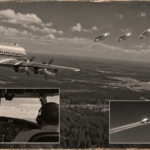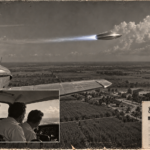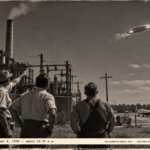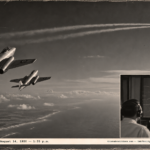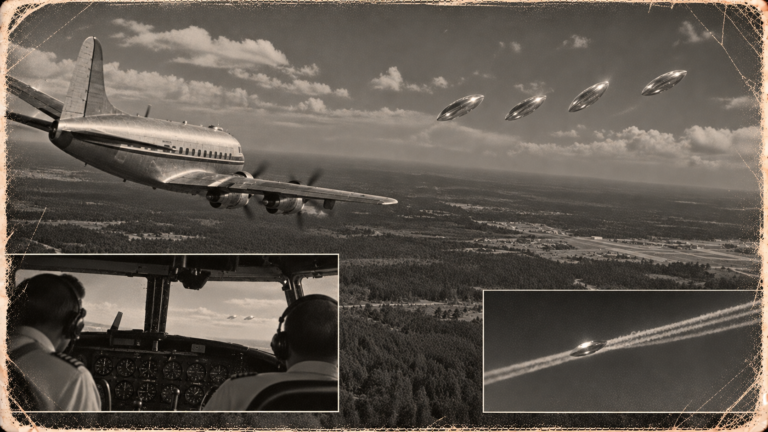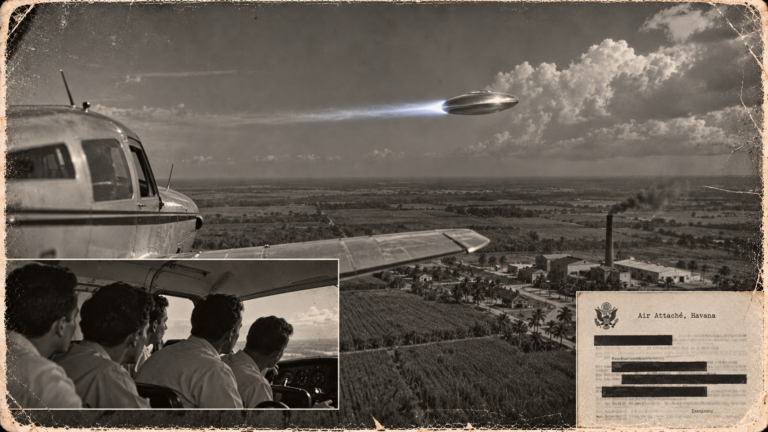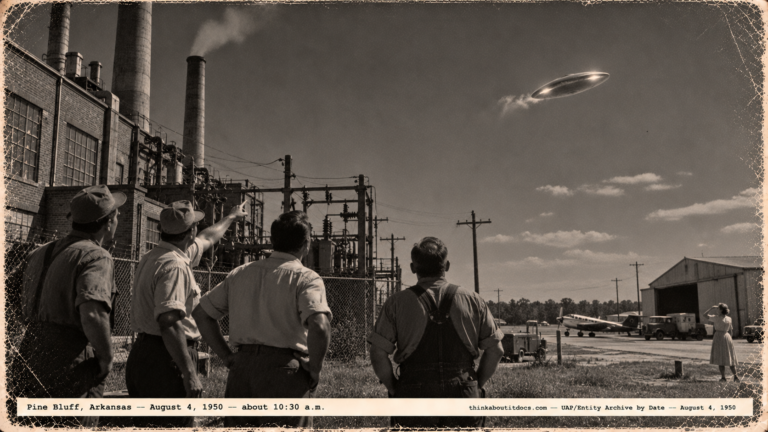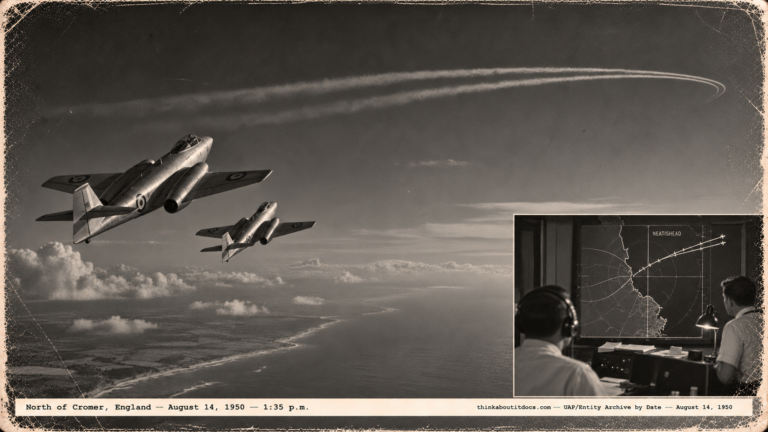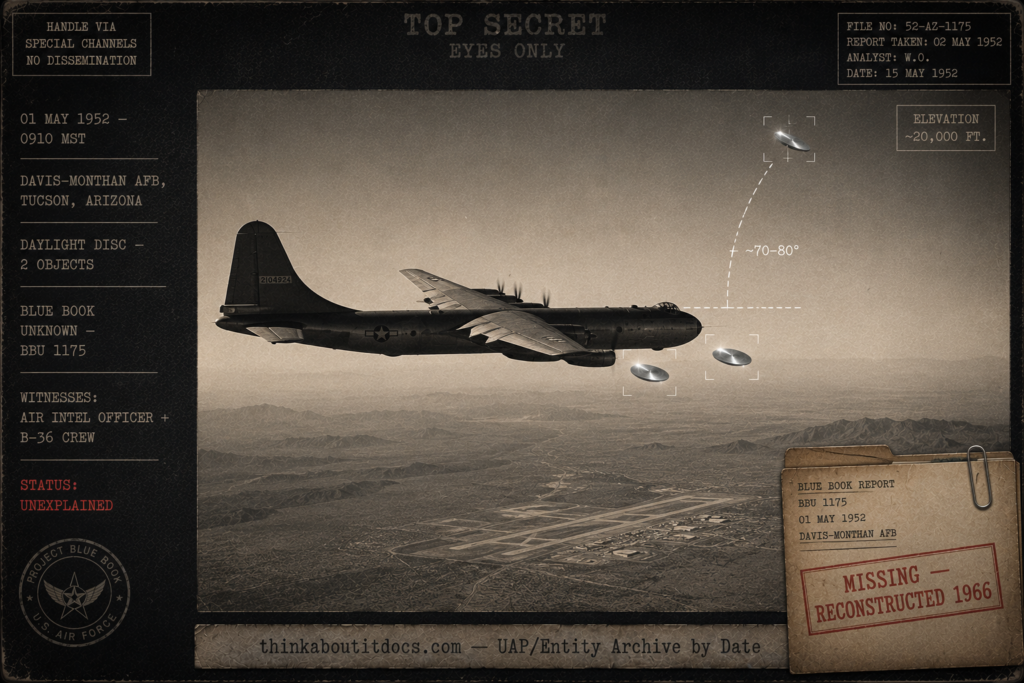
9:10 a.m., May 1, 1952 — two discs overtake and pace a B-36 over Davis-Monthan as the base intelligence officer watches from the ground. The report he filed later vanished from Blue Book. Logged Unexplained, BBU 1175.
THINK ABOUTIT UFO|UAP|ENTITY SIGHTINGS REPORT
1952: Air Force Bomber Encounters Discs
The ideal UFO witness is the man whose job is to debunk UFO reports — and on the morning of May 1, 1952, that man was standing on the ground at Davis-Monthan, watching two shiny discs overtake a B-36 strategic bomber, slow to match its speed, and ride alongside it for twenty seconds before peeling away in a sharp no-radius turn that no aircraft of the era could survive. Major Rudolph Pestalozzi was the base Air Intelligence Officer, the officer whose regular duty was analyzing exactly this kind of report; with him was a master sergeant on the hospital steps, and overhead the bomber’s own crew crowded a gun blister to stare down at the nearest object. Pestalozzi filed what he remembered as the thickest UFO report of his career. Fourteen years later, when a scientist went looking for it, it was gone from the files — and the archive’s interest in this case is split evenly between what those airmen saw and what happened to the paperwork afterward.
Date: May 1, 1952 (Blue Book Unknown — BBU 1175)
Sighting Time: 9:10 a.m. MST
Day/Night: Day
Location: Over/near Davis-Monthan AFB, Tucson, Arizona
Urban or Rural: Military air base
No. of Entity(‘s): 0
Entity Type: None
Entity Description: N/A — no occupants or entities involved
Hynek Classification: DD (Daylight Disc)
Duration: Approximately 20 seconds (the pacing phase); one object then hovered briefly before departing
No. of Object(s): 2
Description of the Object(s): Two shiny, round metallic objects; the nearest, viewed from the bomber’s starboard blister, appeared lens-shaped or double-disc-shaped. They overtook the B-36, matched its speed and held formation, then made a sharp, no-radius turn away; one stopped to hover briefly before vanishing. No sound and no vapor trail were noted
Shape of Object(s): Disc (lens / double-disc profile)
Size of Object(s): Approximately 20–28 feet in diameter (closest object estimated 20–25 ft)
Color of Object(s): Shiny / metallic
Distance to Object(s): Bomber at approximately 20,000 feet, on an east–west heading; objects observed from the ground at roughly 50° (±10°) elevation, and at close range alongside the aircraft by its crew
Height & Speed: Objects overtook a B-36 in level flight at ~20,000 feet — themselves far faster than the bomber — paced it for ~20 seconds, then departed at high speed via a sharp 70–80° no-radius turn; one halted to hover
Number of Witnesses: Multiple — Maj. Rudolph Pestalozzi (base Air Intelligence Officer), M/Sgt. Edmond L. Bouton Jr. (on the base hospital steps), the B-36 flight crew, and several others
Special Features/Characteristics: Two structured discs overtaking and pacing a strategic bomber in daylight; a sharp no-radius high-angle turn and brief hover; no sound or vapor trail; multiple credible military witnesses both on the ground and aboard the aircraft; the original Air Force report later went missing from Project Blue Book (“The Case of the Missing Report”)
Case Status: Unexplained (catalogued Blue Book Unknown, BBU 1175; the original report vanished from the files and was reconstructed; a reported “aircraft” disposition is not tenable — see notes)
Source: J. Allen Hynek, The Hynek UFO Report (Dell, 1977), pp. 109–112, 292–294; Dr. James E. McDonald files, University of Arizona Library; Project Blue Book files, National Archives, Washington, D.C.; Brad Sparks, Comprehensive Catalog of Project Blue Book Unknowns (BBU 1175); NICAP
Summary/Description: On the morning of May 1, 1952, near Davis-Monthan AFB in Tucson, Arizona, base Air Intelligence Officer Maj. Rudolph Pestalozzi, M/Sgt. Edmond L. Bouton Jr., and others on the ground — along with the crew of a B-36 bomber overhead — watched two shiny disc-shaped objects overtake the bomber at about 20,000 feet, pace it for some 20 seconds, then break away in a sharp no-radius turn, one object hovering briefly before disappearing. No sound or vapor trail was observed. The bomber made an unscheduled landing and its crew was interrogated. Pestalozzi filed an unusually thick report to Project Blue Book, which was later found missing when Dr. James McDonald investigated in 1966 and had to be reconstructed. The case is carried as a Blue Book Unknown.
Related Cases: The summer 1952 UFO wave (including the July 1952 Washington National radar-visual sightings); the 1951 Fort Monmouth radar-visual; other military “pacing” encounters of jets and bombers in the early 1950s
Full Report
The encounter opened the month that would become the most intense of the early UFO era. At about 9:10 on the morning of May 1, 1952, a B-36 — the enormous six-engine intercontinental bomber then forming the backbone of Strategic Air Command — was flying east to west at roughly 20,000 feet over Davis-Monthan AFB at Tucson. On the ground, Major Rudolph Pestalozzi looked up. Pestalozzi was not a casual observer: as the base Air Intelligence Officer, one of his standing duties was the analysis of UFO reports made to the installation. Near him, M/Sgt. Edmond L. Bouton Jr. — by one account just leaving the base hospital after having a knee treated — saw it too, as did several others. What they watched was two shiny, round objects overtake the bomber from behind, decelerate to match its speed, and settle into formation alongside it.
Aboard the aircraft, the crew became aware of the company. Several crowded into the starboard blister aft of the wing and looked down at a slight angle at the nearest object, which presented a lens- or double-disc profile and an estimated diameter of twenty to twenty-five feet. For about twenty seconds the two discs held station on the bomber. Then they broke — not in the sweeping arc an aircraft would need, but in a sharp, essentially no-radius turn of seventy to eighty degrees off the B-36’s flight path — and accelerated away. One of the two reportedly stopped and hovered for a moment before it vanished. The witnesses noted no sound and no vapor trail. Shaken, the bomber crew made an unscheduled landing at the base, where they were interrogated at length by Pestalozzi, who by happenstance was both the base UFO officer and one of the eyewitnesses.
Pestalozzi did what a conscientious intelligence officer does: he wrote it up. He later recalled the document as the thickest UFO report he ever filed, and he forwarded it to Project Blue Book. Within two months the summer 1952 wave would crest into national headlines, radar-visual chases, and jet scrambles over Washington — and this Tucson sighting would stand near the head of that surge as one of its more credible opening entries.
The case’s second life began in 1966, when the atmospheric physicist Dr. James E. McDonald, then conducting his own rigorous review of UFO reports, set out to examine Pestalozzi’s account. When McDonald went to pull the original report from the Blue Book files, it was not there. The thickest report its author ever filed had simply gone missing. Hynek, who later recounted the episode in The Hynek UFO Report, named it “The Case of the Missing Report.” McDonald interviewed the surviving witnesses directly and the report was reconstructed as faithfully as possible and re-entered into the record; only a fragment of the original appears to survive in the Blue Book microfilms.
That disappearance is inseparable from the question of the case’s official disposition, which is genuinely tangled. The case is carried as a Blue Book Unknown — it appears as number 1175 in Brad Sparks’s comprehensive catalog of Blue Book Unknowns — and it has been treated by serious investigators, Hynek and McDonald among them, as a strong unexplained military sighting. Yet at least one account holds that the Air Force at some point carded the event as “aircraft,” and because the original report vanished, the case did not always appear where it should in Blue Book’s own lists of unexplained events. The “aircraft” label, whatever its provenance, does not survive scrutiny: no aircraft in 1952 could overtake a cruising B-36 from the rear, decelerate to pace it, then execute a no-radius seventy-to-eighty-degree turn and hover silently without a vapor trail. The behavior described is not the behavior of any conventional airplane, which is precisely why the Unknown designation, not the “aircraft” dismissal, reflects the evidence.
What gives the case its weight is the caliber of the witnesses. This was not a lone motorist glimpsing a light. It was a trained Air Intelligence Officer whose professional task was to find the mundane explanation for UFO reports, corroborated by a non-commissioned officer and by the flight crew of the very aircraft the objects paced — observers positioned both on the ground and in the air, in daylight, with a clear view. They reported the same structured objects performing the same impossible maneuvers, and the officer best equipped to explain it away instead filed the longest report of his career.
Researcher’s Notes
The Case of the Missing Report — Davis-Monthan 1952 and the Witness Who Couldn’t Debunk It
- Classification — DD is correct and clean: This is a textbook Daylight Disc: daytime, shiny structured discs, observed at range and at close quarters, with no occupants and no physical traces. No entity or close-encounter class applies. The radar-visual character often associated with 1952 belongs to the wider wave (Washington National, two months later), not to this specific visual-only sighting; DD is the right and sufficient label here.
- Source chain — strong, with two factual fixes: The provenance is excellent — Hynek’s The Hynek UFO Report, McDonald’s investigative files at the University of Arizona, the Blue Book records at the National Archives, and Sparks’s catalog (BBU 1175), with NICAP carrying the case. Two corrections improve the page: the sighting time was 9:10 a.m. MST (the field was blank), and the previously unnamed “airman” is identifiable as M/Sgt. Edmond L. Bouton Jr., with the intelligence officer’s full name being Maj. Rudolph Pestalozzi. Naming the second military witness materially strengthens the entry.
- Pattern context — the overture to the 1952 wave: This sighting sits at the leading edge of the great 1952 flap that would dominate national headlines by July. It belongs to the recognizable subclass of military “pacing” encounters, in which structured objects approach, match speed with, and formate on an aircraft before departing at performance no contemporary craft could match. Its value to that pattern is unusually high because of who saw it: trained military observers, on the ground and aboard, in good daylight.
- Evidentiary weight and the missing report: The observational core is about as good as a 1952 visual case gets — multiple credible military witnesses, daylight, close range, consistent description of non-conventional behavior. The single most troubling feature is documentary rather than aerial: the disappearance from Blue Book of the thickest report its author ever filed. Whether that loss was ordinary bureaucratic mishandling or something less innocent cannot be established, and the archive does not assume the worst; but it is a genuine gap, and the case survives in usable form only because McDonald reconstructed it from the witnesses. Weighed honestly, the event has no credible conventional explanation, the “aircraft” disposition is untenable, and the case stands as Unexplained — a Blue Book Unknown whose paperwork became nearly as mysterious as the objects.
The record’s honest final position is that Davis-Monthan is one of the better military daylight sightings of 1952 and deserves to be carried as a clean Unknown. Two structured discs did something over that bomber that no aircraft of the period could do, and the men who reported it included the very officer assigned to explain such things away. The “aircraft” label that was apparently hung on the case does not fit the maneuvers described, and the Unknown designation it carries in the catalogs is the accurate one. The lingering shadow over the file is not the objects but the vanished report — the thickest its author ever wrote, gone from the government’s own records and recoverable only because an independent scientist went back to the witnesses. The archive logs the sighting Unexplained and keeps the missing report in plain view beside it, because in this case the fate of the evidence is part of the evidence.