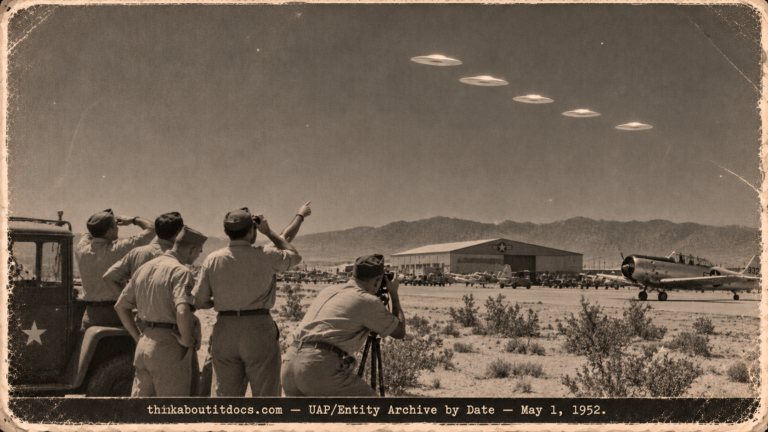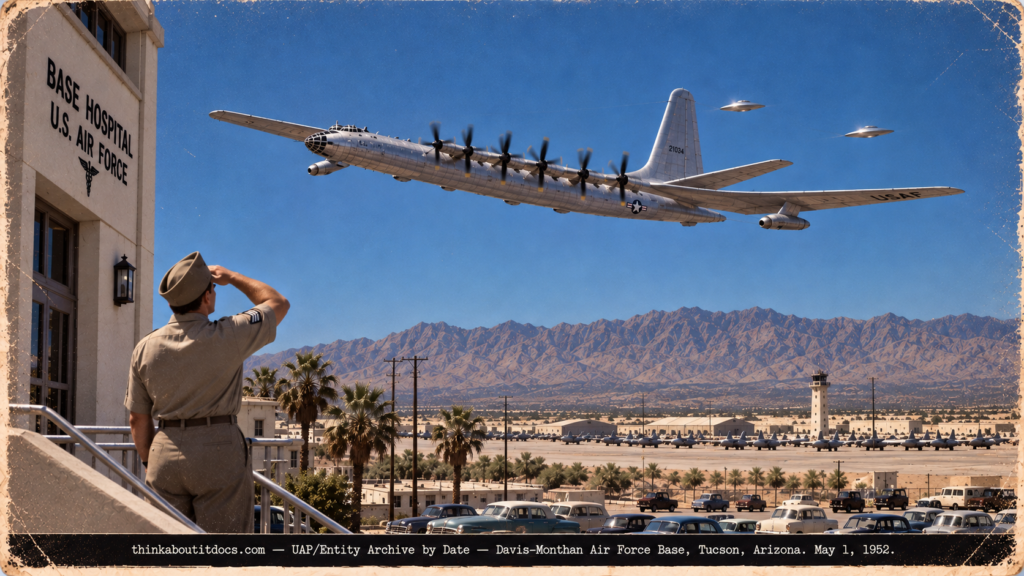
Davis-Monthan AFB, Arizona, May 1, 1952: two shiny objects overtake a B-36.
THINK ABOUTIT UFO|UAP SIGHTINGS REPORT
Air Force Bomber Encounters Discs:
Two Shiny Objects Overtake a B-36 Over Davis-Monthan AFB
At 9:10 on a clear May morning in 1952, a sergeant standing outside the Davis-Monthan Air Force Base hospital watched a B-36 lumber across the Tucson sky. Then two shiny, round objects came up behind it in line, overtook the six-engine giant at three to four times its speed, slowed to match it, and rode beside it as though keeping it company.
This Davis-Monthan B-36 UFO sighting is unusual because the paperwork survives: the 43rd Bomb Wing’s Air Intelligence Information Report, with a hand-drawn diagram of the approach, is in the Project Blue Book file, and a 1966 letter from the officer who wrote it adds what the crew said. The Air Force card still reads Possibly Aircraft.
Date: May 1, 1952
Sighting Time: 9:10 a.m. MST (0910)
Day/Night: Day
Location: Over Davis-Monthan Air Force Base, Tucson, Arizona (observer at 32°10’52″N, 110°52’35″W, in front of the Base Hospital)
Urban or Rural: Air base on the edge of a city
No. of Entity(‘s): Not Applicable
Entity Type: Not Applicable
Entity Description: Not Applicable
Hynek Classification: Daylight Disc (DD)
Duration: About 20 seconds in formation with the bomber, then about 30 seconds of hovering; total time not stated in the report
No. of Object(s): 2 (labeled A and B in the report diagram)
Description of the Object(s): Approximately round, shiny metal, no protruding surfaces; flew in a line formation above the B-36, overtook it, slowed to its speed, then one object made a sharp turn, stopped, hovered and shrank away
Shape/Size/Color of Object(s): Round / each about the length of the B-36’s horizontal stabilizer / shiny metal
Distance to Object(s): Not stated in the report; one object paced the bomber at close range
Height & Speed: Objects estimated at something over 35,000 feet (digit hard to read on the copy); B-36 about 300 mph; objects overtook it at 3 to 4 times its speed
Number of Witnesses: A sergeant on the ground (name redacted) is the report’s source; the B-36 crew and several other base personnel are described in a 1966 letter
Special Features/Characteristics: No sound beyond the B-36’s engines; no contrail or exhaust trail from either object or the bomber; a 70–80 degree “no radius” turn; stop-and-hover with a shimmering, dancing motion; one object shrank away as if gaining altitude without forward motion
Case Status: Blue Book card: Possibly Aircraft. The original Air Intelligence Information Report (AF Form 112) survives in the Blue Book file.
Source: Project Blue Book file (Davis-Monthan AFB, May 1952): record card and 43rd Bomb Wing Air Intelligence Information Report No. 1 (dated May 2, 1952) with diagram; James E. McDonald letter to Maj. Hector Quintanilla, July 14, 1966, enclosing a July 7, 1966 letter from the reporting officer; BBU 1175 (Sparks)
Summary/Description: Two shiny round objects overtook a B-36 over Tucson at 3 to 4 times its speed, paced it for about 20 seconds, then one turned sharply away, hovered about 30 seconds and shrank out of sight.
Related Cases: Wichita Falls and Phoenix, May 1952; Edwards AFB, May 29, 1952
Detailed Report
The report was prepared on May 2, 1952, by Capt. R. H. Pestalozzi of the 43rd Bomb Wing Intelligence Division. It states that at 0910 hours on May 1 a sergeant, whose name is blacked out in the released copy, observed two unidentified flying objects over the base while standing in front of the Base Hospital watching a B-36. The base weather station recorded clear sky, 50-mile visibility, 72°F, a 50°F dew point and calm wind at 0928 MST.
The sergeant described two approximately round, shiny metal objects with no protruding surfaces, flying in line formation above the bomber’s altitude. They overtook the B-36 at about three to four times its speed, then slowed immediately to the bomber’s estimated 300 mph. After about 20 seconds in formation, object B made a sharp, “no radius” turn of 70 to 80 degrees away from the bomber’s line of flight and covered about a quarter of the distance to the horizon at roughly its approach speed. It then stopped and hovered for about 30 seconds, seeming to shimmer and dance, before it began to shrink “as if gaining altitude without forward motion” until it disappeared. When the sergeant looked back at the B-36, object A was gone in a manner unknown to him.
Each object was judged about as large as the bomber’s horizontal stabilizer is long. The sergeant heard nothing but the B-36’s engines and saw no contrail or exhaust trail from either object or the aircraft. A one-page diagram marks the aircraft route, the approximate route of approach and the point of disappearance toward the horizon.
In 1966, University of Arizona physicist James E. McDonald, unable to find the full file, wrote to Blue Book’s Maj. Hector Quintanilla enclosing a letter from the officer who had investigated the case. Writing from memory fourteen years later, he recalled that the B-36 crew, interrogated after landing at Davis-Monthan, confirmed the ground observation; that one object held station just behind and to port of the bomber while the other sat between the pusher propeller spinners and the starboard elevators; that all crew but the pilot reached the starboard observation port; that the pilots denied any interference with flying characteristics, navigation or radio; and that the object, on leaving, lost altitude, crossed under the aircraft, joined the other, and both departed south at extremely high speed. He also recalled the crew’s size estimate as 20 to 25 feet. The aircraft was from Carswell AFB, Texas, on a flight to March AFB, California. The Blue Book card evaluates the sighting Possibly Aircraft, with the remark that the objects might have been fighters but the description precludes this, and notes that the B-36’s altitude is unknown.
RESEARCHER’S NOTES
What the 1952 Report Says and What 1966 Adds
- The report survives: The Air Intelligence Information Report and its diagram are in the Blue Book file, so the case is not one of a missing report. What is missing is the crew’s interrogation material McDonald says the officer filed.
- Two layers of testimony: The 1952 report rests on the sergeant on the ground. The crew’s account, the 20 to 25 foot size, the port and starboard positions and the pale red band some crew saw come only from the officer’s 1966 letter, written from memory, and should be labeled that way.
- Rank and name: The report signs the officer as Capt. R. H. Pestalozzi; McDonald’s later letter calls him Maj., which fits a later rank.
- Heading discrepancy: The 1952 report puts the B-36 on a general northwest heading; the 1966 letter says east-west. The report is the contemporary source.
- Size: The report gives size only as the length of the B-36’s horizontal stabilizer; the 20 to 28 foot figures are later recollection.
- Blue Book evaluation: Possibly Aircraft sits uneasily beside the card’s own remark that the description precludes fighters. The objects’ speed, the 70 to 80 degree turn and the stop-and-hover are what any aircraft explanation has to cover.
The Davis-Monthan B-36 case is stronger than its card suggests: a contemporary intelligence report with a diagram, weather data, precise timings and an officer who still considered it important fourteen years later. It does not prove anything about the objects, but it shows trained observers describing structured, shiny discs flying in formation with a bomber.
“The diameter of each object was about the size of the length of the horizontal stabilizer of the B-36 aircraft.”
— Air Intelligence Information Report No. 1, 43rd Bomb Wing, Davis-Monthan AFB, May 2, 1952