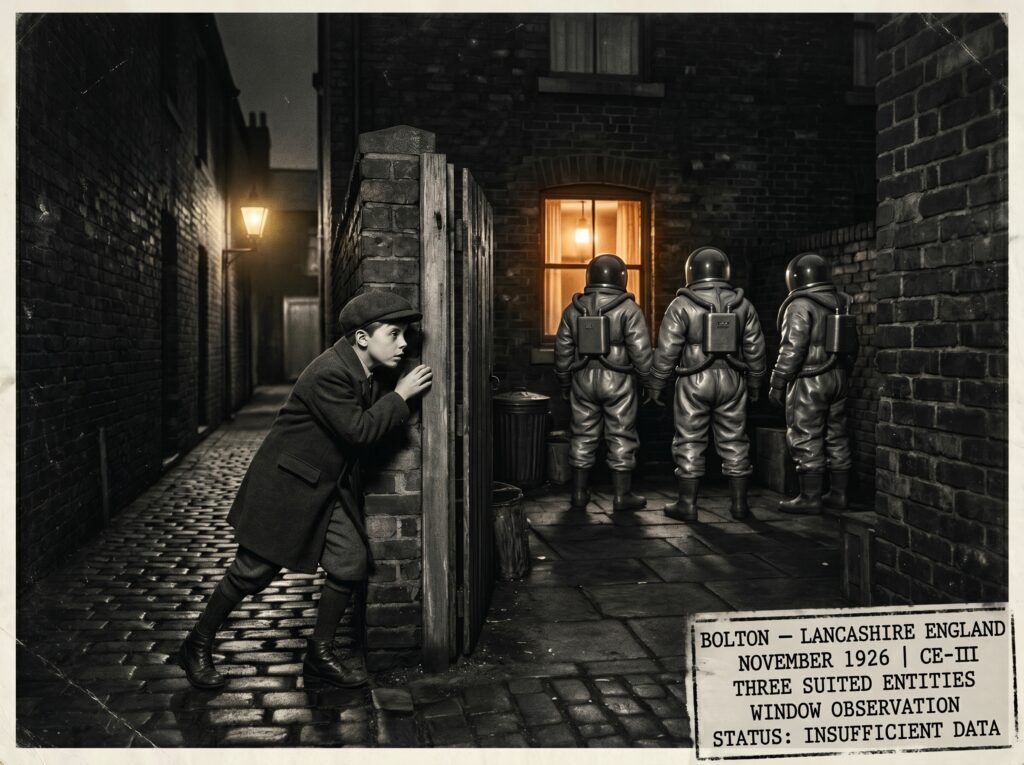
Bolton, Lancashire, England, November 1926 — Henry Thomas crept through an open back gate during a game of hide and seek and found three suited figures with transparent dome helmets and lightbulb-shaped heads peering through a window. They turned, one gurgled, all three advanced. He ran. Decades later as a professional artist he told Jenny Randles. Source: Peter Brookesmith, UFO: The Complete Sightings Catalogue, p31. Case status: Insufficient Data.
THINK ABOUTIT ALIEN ENCOUNTER REPORT
1926: Humanoid Hide and Seek
On a November evening in 1926 in the back streets of Bolton, Lancashire, a boy named Henry Thomas was out past his bedtime playing hide and seek. He spotted a back gate standing open and crept through hoping to find one of his friends hiding in the yard. What he found instead were three figures in bulky silver-grey suits made from rubber tubes, transparent dome-like helmets connected by tubes to small tanks on their backs, and black boots — peering through the back window of a house. When they spun to face him he saw their heads were shaped like lightbulbs. Their eyes were dark slits. One made a gurgling sound and all three advanced toward him. He ran. He ran all the way home and did not stop. Despite his terror, he felt — then and for the rest of his life — that they had not meant him any harm. His family eventually believed him and called them the Three Wise Men. Decades later, now a professional artist, he told his story to UFO researcher Jenny Randles. The visual memory of a trained artist, preserved across decades. The archive holds it.
Date: November 1926 — exact date unknown
Sighting Time: Evening — after dark, past the witness’s bedtime
Day/Night: Night
Location: Back street yard — Bolton, Lancashire, England
Urban or Rural: Urban — residential back streets of Bolton
No. of Entity(‘s): 3
Entity Type: Suited humanoid — helmeted and pressure-suited; no craft observed; entity type consistent with beings operating in a contained atmospheric environment
Entity Description: Three figures of broadly humanoid proportion. Wearing bulky suits constructed from silver-grey rubber tubes — the witness described the appearance as reminiscent of the Michelin Man. Transparent dome-like helmets on their heads. Black boots. The helmet breathing apparatus was connected by tubes to small tanks strapped to their backs — a self-contained atmospheric system. Heads described as shaped like lightbulbs — elongated cranium, narrow base. Dark slit-like eyes. Tiny noses. No mouth description recorded. When the witness entered the yard all three were facing away from him, peering through the back window of a house. When they became aware of his presence all three spun simultaneously to face him. One entity made a gurgling sound. All three then advanced toward the boy. Despite the terror of the encounter and his flight from the scene the witness retained a strong impression that the entities were friendly and meant him no harm.
Hynek Classification: CE-III (Close Encounter III) — close observation of animate beings at very close range; entities demonstrated awareness of and response to the witness; no associated craft observed. Note: the absence of a craft does not preclude CE-III classification — the classification applies to the close observation of animate non-human beings regardless of craft presence.
Duration: Brief — seconds from discovery to flight; long enough for the witness to observe all entity details, see the simultaneous turn, hear the gurgling sound, and register the advance before running
No. of Object(s): None observed
Description of the Object(s): N/A — no craft seen
Shape of Object(s): None seen
Size of Object(s): Humanoid scale — no specific height recorded in available source
Color of Object(s): Silver-grey suits; transparent helmets; black boots
Distance to Object(s): Very close range — the witness entered the yard and approached the figures before they turned; exact distance not recorded but sufficient to observe fine details of suit construction, helmet design, breathing apparatus, and facial features
Height & Speed: Ground level — standing in yard; advanced toward the witness on foot after turning
Number of Witnesses: 1 primary — Henry Thomas, Bolton, Lancashire; child at time of encounter; adult professional artist at time of reporting; account given to UFO researcher Jenny Randles and published by Peter Brookesmith
Special Features/Characteristics: Three entities simultaneously peering through a back window — suggesting observation or surveillance of the house’s interior; simultaneous turn when they became aware of the witness — coordinated awareness response; self-contained atmospheric breathing apparatus — suits with tanks and tube connections to helmets suggesting either a requirement for a different atmosphere or protection from the local environment; the witness’s adult occupation as a professional artist is analytically significant — his visual memory and descriptive precision were occupationally trained; the family’s eventual acceptance of the account despite initial skepticism; the Three Wise Men family designation suggests the account became part of family history rather than being dismissed; the entities’ suit design parallels descriptions from the European mid-1950s UFO entity wave noted by Peter Brookesmith
Case Status: Insufficient Data — single witness, account reported decades after the event; the adult artist’s occupational precision for visual detail is a credibility factor; no physical evidence; no corroborating witnesses; internally consistent and detailed description argues against simple childhood confabulation
Source: Peter Brookesmith, UFO: The Complete Sightings Catalogue, p31; Jenny Randles (researcher who received the account)
Summary/Description: In November 1926, a boy named Henry Thomas was playing hide and seek after dark in the back streets of Bolton, Lancashire when he entered a back yard and discovered three suited humanoid figures with transparent dome helmets, rubber tube suits, and breathing apparatus peering through a house window. When they turned to face him he saw lightbulb-shaped heads with dark slit eyes. One gurgled. All three advanced. He ran. Despite the terror he felt they meant no harm. His family eventually believed him and called the figures the Three Wise Men. Decades later Henry Thomas — by then a professional artist — shared the account with researcher Jenny Randles. Published by Peter Brookesmith.
Related Cases: 1912: Contact Near Vancouver, British Columbia | 1914: Algeria — Helmeted Entities Sample Collection | 1954: European UFO Entity Wave | England Sightings Archive
Detailed Report
The Three Wise Men of Bolton — Back Streets, Bolton, Lancashire, November 1926
One November evening in 1926, a young boy named Henry Thomas was out past his bedtime in the back streets of Bolton, Lancashire, playing hide and seek with his friends. Spotting a back gate standing ajar, he crept into the yard behind it hoping to find one of his playmates hiding there.
Instead he found three strangely clad figures standing in the yard, all three peering through the back window of the house.
The figures wore bulky suits made from silver-grey rubber tubes — an appearance the witness later compared to the famous Michelin Man tyre advertisements of the period. On their heads were transparent dome-like helmets. Their boots were black. The helmet breathing apparatus was connected by tubes running down to small tanks strapped to each figure’s back — a self-contained system suggesting they were carrying their own atmosphere or operating under some form of environmental protection.
Henry stood in the yard behind them. Then all three figures spun around simultaneously to face him.
Their heads were shaped like lightbulbs — elongated at the top, narrowing toward what served as a face. They had dark slit-like eyes and tiny noses. One of the figures made a gurgling sound. Then all three began advancing toward the boy.
Henry Thomas ran. He ran home as fast as he could and did not stop.
Despite the terror of the encounter and the speed of his flight, he retained throughout his life a strong feeling that the entities had been friendly and meant him no harm. His family, initially sceptical, eventually accepted that he was telling the truth. They gave the three figures a name that became part of the family’s history: the Three Wise Men.
Decades later, Henry Thomas — by that time a professional artist with a trained visual memory for precise descriptive detail — recounted his experience to UFO researcher Jenny Randles. Peter Brookesmith included the case in UFO: The Complete Sightings Catalogue, noting that the entities’ description bears similarity to figures reported in the European UFO entity wave of the mid-1950s.
RESEARCHER’S NOTES
The Three Wise Men of Bolton — Lancashire 1926 and the Suited Entity as Pre-War Archive Evidence
- The Professional Artist as Witness — Occupational Visual Precision: Henry Thomas reported his encounter in adulthood as a professional artist. This occupational detail is not incidental. A professional artist’s livelihood depends on precise visual observation and accurate descriptive translation of visual memory — exactly the cognitive skills that make a witness account analytically useful. When a trained visual professional describes silver-grey rubber tube suits, transparent dome helmets, tube-connected back tanks, lightbulb-shaped heads, and dark slit eyes, the archive treats that description with the same weight it would give to a technical professional’s instrument readings. The description is not vague or impressionistic. It is the specific, structured visual account of someone who spent their adult life learning to see and describe precisely.
- Self-Contained Breathing Apparatus — Pre-War Suit Technology Significance: The entities’ breathing apparatus — transparent dome helmets connected by tubes to back-mounted tanks — is the most analytically significant element of the Bolton case. In November 1926 no human technology produced suits of this description for civilian use. Deep-sea diving suits of the era used hard helmet designs with external air lines, not self-contained back-mounted tanks with dome helmets. Self-contained breathing apparatus — SCBA — was not developed for human use until the 1940s. The entities in Bolton in 1926 were wearing a functional atmospheric containment system that did not exist in human technology at the time of the encounter and would not exist for nearly two decades. A child in 1926 Lancashire could not have invented this description from available cultural reference points.
- Window Observation Behaviour — Surveillance Pattern: All three entities were engaged in the same activity when discovered — peering through the back window of a house — and none of them were aware of the witness until he was already inside the yard. The simultaneous surveillance of a residential interior by three suited figures with self-contained breathing systems, at night, via a back window that would not be visible from the street, describes a covert observation operation. The archive notes this behavioral detail alongside the sample collection behavior at Blida 1914 and the ground examination at Vancouver 1912 as part of a documented operational pattern of non-human intelligence conducting systematic observation of human environments and activities across multiple continents and decades.
- Pre-War Suit Entity Pattern and the 1950s Connection: Peter Brookesmith’s observation that the Bolton entities’ appearance parallels descriptions from the European mid-1950s UAP entity wave is a significant cross-case linkage. The 1954–1955 European wave produced multiple independent descriptions of suited humanoids with helmet and breathing apparatus — the Kelly-Hopkinsville case in America in 1955 involved differently described entities but the suited humanoid with contained atmospheric equipment appears across multiple European cases of the period. The Bolton 1926 account predates the wave by nearly thirty years and was reported to a researcher independently of that wave by a witness with no apparent knowledge of the parallel cases. The archive holds the temporal gap as evidence against contamination and the descriptive parallel as evidence for a consistent phenomenon.
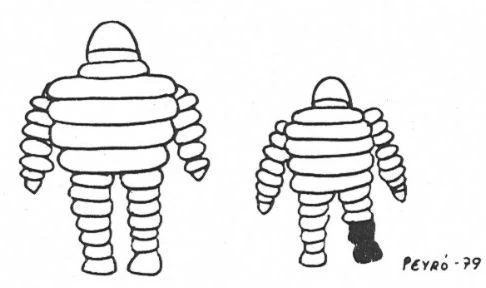 Henry Thomas ran home through the Bolton back streets in November 1926 with the image of three lightbulb-headed figures in rubber tube suits advancing toward him locked into a visual memory that his adult career as an artist kept precise and available.
He felt they meant no harm. His family called them the Three Wise Men and kept the story. Jenny Randles wrote it down. The archive holds it here — not as proof of what was in that yard, but as the detailed visual account of a trained observer who saw something in 1926 that the technology of 1926 cannot explain.