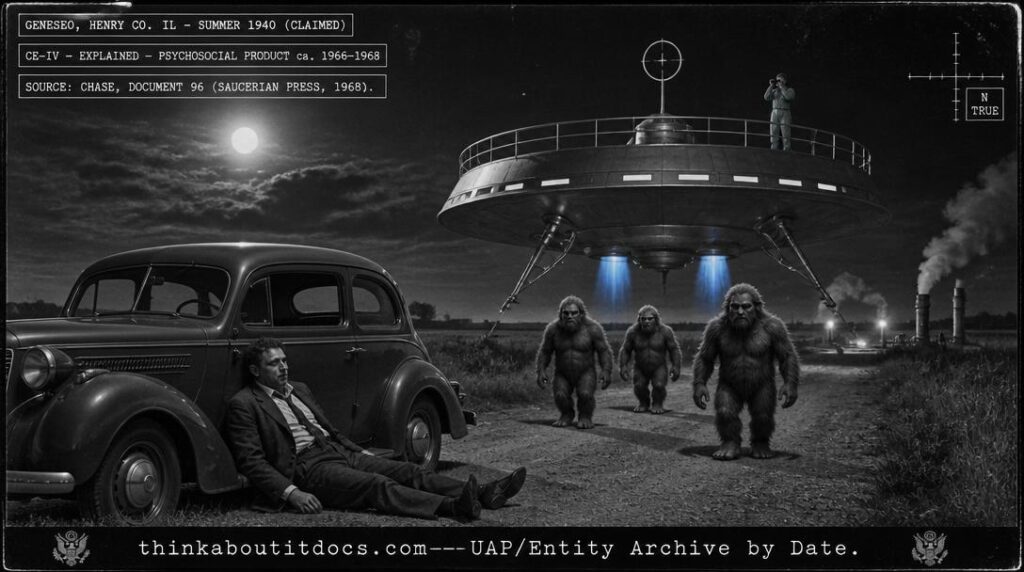
Near Geneseo, Henry County, Illinois, summer 1940 (claimed) — Industrial chemist Rex Ball encounters a Saturn-disc craft and three hairy pygmy entities before being transported through underground tunnels to a subterranean facility purportedly beneath Fort Knox. Source: Frank Martin Chase, Document 96 (1968). Case status: Explained — psychosocial product of the mid-1960s per Kottmeyer analysis.
THINK ABOUTIT ABDUCTION REPORT
1940 Geneseo Abduction:
The Rex Ball UFO Case & Underground Bases
In the summer of 1940 — or so the story goes — an industrial chemist named Rex Ball pulled off a rural Illinois road near Geneseo, exhausted from a long drive out of Detroit. What happened next, according to the only published account of the incident, is one of the strangest and most analytically revealing abduction narratives in the UFO literature: three powerfully built “pygmy” beings with hairy, “highly Oriental” features carried Ball to a hovering Saturn-disc craft equipped with silent blue exhaust flames and a radio direction finder, then transported him through an underground tunnel complex to a subterranean military facility purportedly located beneath Fort Knox, Kentucky — hundreds of miles away. There, American Army officers inspected him before ordering, “Take him back. Seal his mouth — call him a nut.” He woke in a community hospital in Geneseo. The case appeared in a single, nearly unobtainable source — Frank Martin Chase’s Document 96, published by Gray Barker’s Saucerian Press in 1968 — and was excavated from obscurity by researcher Martin S. Kottmeyer, whose forensic psychosocial analysis reveals it as a fascinating period artifact: a “love child of Sixties paranoia” that fused Cold War spy fiction, early abduction-era motifs, and the still-dominant public belief that flying saucers were secret American weapons.
⚠ ANACHRONISM FLAG:
The claimed date of summer 1940 is demonstrably false. The concept of “flying saucers” did not exist until Kenneth Arnold’s June 1947 sighting and the subsequent press coinage. Every identifiable cultural reference in Ball’s narrative — the Saturn-disc craft, the missing-time syndrome (inaugurated by the Hill case, published 1966), the Oriental facial features of the entities (echoing both the Hills’ descriptions and the 1954 Venezuelan hairy-dwarf cases), the underground-base spy-thriller corridor sequences (matching Bond films from 1964–1967), and the radio direction finder atop the craft (a ubiquitous 1950s–60s film/TV prop) — places the story’s actual composition squarely in the mid-to-late 1960s. Researcher Kottmeyer’s analysis, preserved in full below, is dispositive. The “1940” date is retained in the archive as reported, with this correction.
⚠ SUBTERRANEAN BASE CONTENT:
This case describes a purported underground military facility beneath Fort Knox, Kentucky, staffed by American officers and connected to a flying saucer ready room with “Oriental” pilots. While Kottmeyer’s analysis conclusively identifies this as a psychosocial fiction product, the underground-base theme places this report within the broader pattern of subterranean facility claims documented across the UAP literature. For the full catalog of alleged underground and subterranean installations, see subterraneanbases.com.
Date: Summer 1940 (claimed; actual composition ca. 1966–1968)
Sighting Time: Night
Day/Night: Night
Location: Near Geneseo, Henry County, Illinois
Urban or Rural: Rural
No. of Entity(‘s): 3 (plus multiple American military personnel and “Oriental” saucer pilots observed inside the underground facility)
Entity Type: Hairy Humanoid / Atypical
Entity Description: Three powerfully built beings, approximately half Ball’s height. Described as hairy, with features of “highly oriental cast,” compared to “a pygmy Japanese” or “one of the more primitive of the hairy Ainus who live in the northern islands of Japan.” Additional entities observed inside the underground facility included short “Orientals” lounging in a saucer-pilot ready room in flight outfits, some equipped with claws or webbing for grasping handholds on the craft. American military personnel — described as “erect and hard-bitten men in uniforms of U.S. Army officers of field grade” — were also present, along with a Filipino mess-boy and a blonde female adjutant.
Hynek Classification: CE-IV (Close Encounter IV) Abduction of the witness or other direct contact
Duration: Unknown — multiple memory lapses reported throughout the experience
No. of Object(s): 1
Description of Object(s): Saturn-disc craft with a circular railing or platform around the rim, tripod landing gear, brilliant landing lights, silent blue exhaust flames (two), and a radio direction finder mounted on a metal post on top. Internal features included a “ready room” for pilots, glass-cased science-fiction-style weaponry, and electronic consoles for navigation and position plotting. Slit windows ran along the craft wall. The exterior was draped in pipes conducting steam to an underground location.
Shape of Object(s): Saturn-disc (circular with a railing/platform)
Size of Object(s): Large enough to contain a ready room, internal corridors, and multiple occupants
Color of Object(s): Not specified beyond the blue exhaust flames and brilliant landing lights
Distance to Object(s): Immediate — witness was physically carried to and placed aboard the craft
Height & Speed: Initially observed hovering on silent blue exhaust flames near ground level
Number of Witnesses: 1
Special Features/Characteristics: Multiple memory lapses (missing time); transport through underground tunnel complex to purported subterranean military facility beneath Fort Knox, Kentucky; observation of both American military officers and “Oriental” saucer pilots working in apparent cooperation; science-fiction weaponry in glass display cases; flight suits equipped with claws/webbing for handholds; the order “Seal his mouth — call him a nut” from a general; witness awoke in Geneseo community hospital with no memory of return
Source: Frank Martin Chase, Document 96: A Rationale for Flying Saucers (Saucerian Press / Gray Barker, 1968); analysis by Martin S. Kottmeyer; brief mention in John Keel, The Mothman Prophecies (1975); entry in Joe Lewis, UFOs and Popular Culture (2000)
Case Status: Explained
Summary/Description: In the summer of 1940 (claimed), industrial chemist Rex Ball was allegedly abducted near Geneseo, Illinois, by three short, hairy “pygmy” entities and taken aboard a Saturn-disc craft to a subterranean facility purportedly located beneath Fort Knox, Kentucky. After being paraded through underground corridors past American Army officers, a general ordered him returned with the instruction to “seal his mouth — call him a nut.” Ball awoke in a Geneseo hospital. The sole source is Frank Martin Chase’s Document 96 (1968). Forensic analysis by Martin S. Kottmeyer conclusively identifies the narrative as a psychosocial product of the mid-to-late 1960s, with every identifiable cultural element — the flying saucer concept (post-1947), the missing-time syndrome (post-1966 Hill case publication), the Oriental entity features (echoing Hill descriptions and 1954 Venezuelan cases), the underground-base spy-thriller sequences (matching 1964–1967 Bond films), and the radio direction finder (1950s–60s film/TV prop) — placing actual composition decades after the claimed date.
Related Cases: Betty & Barney Hill Abduction (1961) | Father William Gill, Boianai Papua New Guinea (1959) | Subterranean Bases Catalog
Detailed Report
The Rex Ball abduction case is one of the most obscure and analytically significant narratives in the UFO abduction literature — not because of what it reveals about extraterrestrial contact, but because of what it reveals about the cultural construction of abduction stories. The following account and analysis draws primarily on the work of researcher Martin S. Kottmeyer, who tracked down the original source after an extended and frustrating search through dozens of indexes, catalogs, and abduction histories.
The original and sole primary source for the Rex Ball encounter is Frank Martin Chase’s Document 96: A Rationale for Flying Saucers, published in 1968 by Gray Barker’s Saucerian Press. The book is an extraordinary rarity — copies have sold for hundreds of dollars when they surface at all. Chase was an enigmatic figure in 1960s ufology; Barker’s original promotional blurb described him as suggesting “some saucers may be built by terrestrials — maybe the Nazis.” The book includes dozens of meticulous pointillist-style drawings by Chase, and is structured as a technical rationale for the terrestrial-secret-weapon theory of flying saucers. The Rex Ball case appears in the book’s final chapter, “The Little Men — 10 Astonishing Cases.”
The narrative itself is richly detailed. Ball, described as a gentleman involved in industrial chemistry, was in the middle of an exhausting drive from Detroit. Rolling along at night, he was puzzled to see in the moonlight what appeared to be a locomotive in the middle of nowhere, draped in pipes that seemed to be conducting steam to some underground location — presumably a mine. He drove a bit further, but exhaustion forced him to pull over and rest. As he drifted to sleep, three powerfully built little men approached — approximately half his size. They lifted him and walked him back toward the area of the locomotive. Nearby, a circular UFO now hovered atop silent blue exhaust flames. On its Saturn-ring-type railing, a man in light green aviation garments was scanning the area with binoculars.
Ball described the beings in period-specific ethnic terms as “a short, hairy man-like creature of the highly oriental cast — a pygmy Japanese, perhaps, which I think he was, one of the more primitive of the hairy Ainus who live in the northern islands of Japan.” A drawing accompanying the account in Document 96 is captioned “The Rex Ball UFO Case: A Saturn-Disc Craft with Platform, Tripod Gear, brilliant landing light, and Pygmy Jap Crewman, Hovering.” One significant technical detail is the projection on the craft’s top — a circle on a metal post — which Kottmeyer identifies as a radio direction finder, a device ubiquitous in 1950s and 1960s military and science fiction film and television but essentially unknown in UFO drawings.
A lapse in memory occurs at this point. Ball next finds himself dressed in a shabby U.S. Army uniform, being led by a group of soldiers into a cave or underground tunnel. These soldiers are different from the Japanese entities. He is led first into a large chamber — part concrete construction, part rough-hewn rock — then through a series of officers’ quarters containing “erect and hard-bitten men in uniforms of U.S. Army officers of field grade.” In one quarter, he observes a Filipino mess-boy giving a massage to a white American officer. Another memory lapse occurs. He is now outside, alone in the night air. His escorts reappear and guide him into another tunnel and another large chamber with more officers. They seem familiar yet unfamiliar simultaneously.
Then he is told: “You are now under Fort Knox.” But Fort Knox is in Kentucky, hundreds of miles from Geneseo, Illinois. He is eventually brought to a briefing room where a dozen men in civilian clothes sit behind a long desk. In the center is a graying man with a general’s insignia, beside him a girl adjutant with long blonde hair. Ball is scrutinized sharply, particularly by the woman. In a low voice comes the verdict: “Take him back.” Then: “Seal his mouth — call him a nut.”
Ball is taken through what resembles an office building sub-basement, then through what appears to be the ready room of the saucer pilots. Short “Orientals” lounge around, smoke hanging in the air. Flight outfits hang on the wall, some equipped with claws or webs for grasping handholds on the ship. Along one wall is a glass case arrayed with weapons that look more appropriate to science fiction comic books. Electronic consoles and navigation devices are visible. From there he exits the facility. His memory jumps once more, and he finds himself in a small community hospital in the town of Geneseo.
Ball himself acknowledged the obvious paradoxes: he could not really have been to Fort Knox; if the saucer was an American secret weapon, why were the pilots Japanese; if it was Japanese, why were there American Army personnel? These internal contradictions — which Ball apparently could not resolve — are precisely the features that mark the narrative as a product of dream logic rather than waking experience.
Kottmeyer’s Psychosocial Analysis
Researcher Martin S. Kottmeyer’s forensic deconstruction of the Rex Ball narrative is among the finest examples of psychosocial analysis in UFO scholarship. Kottmeyer identifies every major element of the story as deriving from identifiable 1960s cultural sources, conclusively dating the narrative’s actual composition to the mid-to-late 1960s despite its claimed 1940 setting.
The flying saucer concept itself is anachronistic: the term derives from a journalist’s error in reporting Kenneth Arnold’s June 1947 sighting. No one described seeing “flying saucers” before 1947. Placing the story in 1940 makes it an impossibility. The missing-time syndrome echoes the format inaugurated by the Betty and Barney Hill case, first published in The Interrupted Journey (1966). The “Oriental” features of the entities parallel both Barney Hill’s description of his abductors in his April 1964 hypnosis session (“They had Oriental sort of eyes”) and Betty Hill’s June 1964 session (“I keep thinking that the crewmembers are Oriental, Asiatic. Only they were not as — they’re short”). The use of the word “pygmy” in size descriptions was common among UFO researchers throughout the 1950s and 1960s. The hairiness of the entities specifically echoes the 1954 Venezuelan cases embraced by both Donald Keyhoe and Coral Lorenzen as highly credible.
The underground-base sequences map directly onto the Bond film series of the same period. The large rough-hewn rock-and-concrete chamber recalls the volcano crater base in You Only Live Twice (1967), which also features Japanese-themed antagonists. The Fort Knox reference recalls Goldfinger (1964). The flying saucer cave appeared in the Bond parody Casino Royale (1967). Most Bond films feature blondes and people receiving massages — both present in Ball’s account. The long corridors also evoke The Mysterians (1957), a Japanese monster film featuring alien beings who establish a base to take over Earth and acquire fertile women — that base, too, had glass-enclosed equipment. The spy television series The Man from U.N.C.L.E. (1964) and Get Smart (1965) provide additional parallels for the underground corridor aesthetics.
The blue-flame exhaust suggests jet or rocket technology of the era, reinforcing the terrestrial-secret-weapon framework. Kottmeyer notes that the twin exhaust configuration echoes the Titan boosters of Project Gemini (1965–1966), which distinctively had two rocket engines. The radio direction finder atop the craft is a telling period detail — as seen in the film Phantom from Space (1953), where a comically oversized version is mounted on a car. The slit windows along the craft wall appear inspired by tank viewing slits or atomic testing bunker apertures.
The order “Seal his mouth — call him a nut” became a favorite of John Keel, the single prominent ufologist who mentioned Rex Ball in his writings. In The Mothman Prophecies, Keel paraphrased it as the “battle-cry of the phenomenon.” Keel mistakenly wrote that Ball woke up in a field rather than a hospital — an error Kottmeyer attributes to simple memory confusion rather than deliberate suppression of the hospitalization detail.
Kottmeyer’s overall assessment is that the Geneseo abduction is “a sterile hybrid, a mule of a case, that joined strands of ufo lore and spy fiction into an ugly product that spawned no offspring of its own.” While it shares surface similarities with later underground-base narratives — the Dulce Base tales of Myrna Hansen and Christa Tilton in the 1980s — there are no shared details beyond the commonplace mythological motif of vast subterranean complexes. The case did not father those later narratives; it merely occupied the same cultural niche. Kottmeyer concludes: “It is a lovable lost little mutt — a love child of Sixties paranoia. If you think of abductions as a psychosocial phenomenon, there is no denying it is a member of the breed. It just has a very unexpected pedigree.”
Researcher’s Notes
The Geneseo Chimera — Illinois 1940/1968 and the Anatomy of a Psychosocial Abduction
- Classification and Dating: This case carries a CE-IV classification for archival purposes, as the narrative describes a physical abduction. However, the claimed date of summer 1940 is demonstrably false. Every cultural marker in the narrative — the flying saucer concept (post-1947), the missing-time format (post-1966), the Oriental entity features (paralleling the Hill hypnosis sessions of 1964), the Bond-film underground-base aesthetics (1964–1967), the Gemini-era twin rocket exhaust (1965–1966), and the radio direction finder (1950s–60s prop) — places actual composition in approximately 1966–1968, consistent with the 1968 publication date of Document 96. The case status is Explained: this is a psychosocial fiction product, not a report of an anomalous event. Whether Rex Ball consciously fabricated the narrative, reified a dream into a false memory (as Kottmeyer suggests, analogous to Betty Hill’s process), or collaborated with Chase in constructing a narrative illustration of the terrestrial-weapon theory cannot be determined from available evidence.
- Source Chain Assessment: The source chain is extremely narrow. The sole primary source is Frank Martin Chase’s Document 96 (Saucerian Press, 1968), published by Gray Barker — a figure known for both genuine UFO research and deliberate hoaxing. The book is exceedingly rare; New Saucerian Press issued a reprint (ISBN 978-1499105124). The case was mentioned briefly and with factual errors by John Keel in The Mothman Prophecies (1975), and referenced in Joe Lewis’s UFOs and Popular Culture (2000). No other source — not Coral Lorenzen, not J. Allen Hynek, not Budd Hopkins, not David Jacobs, not any of the major abduction researchers — ever cited this case. Kottmeyer’s analysis, hosted on this page, represents the most thorough scholarly treatment the case has ever received. The absence of the case from Jay Rath’s The I-Files (which Kottmeyer considered comprehensive for Illinois UFO cases) further underscores its obscurity.
- Subterranean Base Context: The underground facility described by Ball — with its rough-hewn rock chambers, military officer quarters, saucer pilot ready room, science-fiction weaponry, and electronic navigation consoles, all purportedly located beneath Fort Knox — places this narrative within the broader pattern of subterranean military/alien base claims in UFO literature. However, as Kottmeyer notes, the motif of vast underground complexes is a mythological commonplace that predates the UFO era entirely. There are no documented underground military installations in the Geneseo area of Henry County, Illinois, and no other UFO reports from this region describe subterranean facilities. The Fort Knox claim is geographically absurd (approximately 450 miles from Geneseo) and narratively unmotivated — Ball himself could not explain why he would have been transported there. The later Dulce Base narratives (1980s) share the underground-facility motif but none of the specific details. For the full catalog of alleged subterranean installations worldwide, see subterraneanbases.com — Alien Bases, Military Installations & Strange Underground Locations.
- Pattern Context and Comparative Analysis: Kottmeyer’s most significant contribution is demonstrating how the Rex Ball narrative functions as a “transitional fossil” — not in the sense of an evolutionary intermediate between genuine phenomena, but as a specimen that reveals the cultural DNA of abduction narratives. The case privileges the terrestrial-secret-weapon theory (still dominant in public opinion polls through 1969, with 57% of adults agreeing that UFOs were “secret defense projects”) over the extraterrestrial hypothesis. This makes it structurally different from the post-Hill abduction canon, which increasingly assumed alien origin. The “hairy Ainu” pilots cannot be reconciled with the bald Grey archetype that would dominate abduction narratives from the 1980s onward. The mechanical-lever technology and glass-cased weaponry reflect an industrial, nuts-and-bolts conception of UFO interiors that was standard in the 1950s and 1960s but would be replaced by the sterile, organic interiors described by later abductees. The case is, as Kottmeyer concludes, a “sterile hybrid” — it combined existing strands of UFO lore and spy fiction into a unique product that left no offspring in the abduction literature.
The Geneseo abduction sits in this archive not as evidence of an anomalous event, but as a document of cultural history — a snapshot of how abduction narratives were constructed from available cultural material in the mid-1960s, before the Grey-abduction paradigm crystallized in the 1980s. Martin Kottmeyer’s analysis, preserved in the Detailed Report above, is the definitive scholarly treatment of this case and should be considered required reading for anyone studying the psychosocial dimensions of the abduction phenomenon.