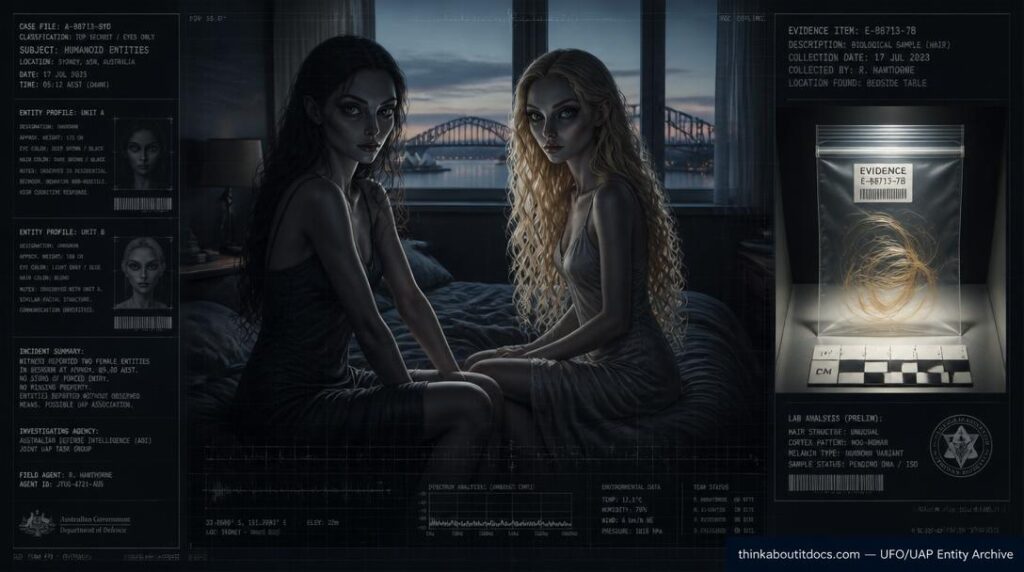
Peter Khoury's 1992 Sydney encounter with two unusual humanoid women left behind strands of blond hair later subjected to mitochondrial DNA testing.
THINK ABOUTIT ABDUCTION REPORT
The Peter Khoury Case:
Sydney’s 1988/1992 Abduction and DNA-Tested Hair
In July 1988, a Sydney man named Peter Khoury woke paralyzed to find three or four small, hooded figures beside his bed, moments before blacking out to a needle at his temple — and later realizing an hour had passed that felt like ten minutes. Four years later, in a second, far stranger encounter, two nude, unusually beautiful women appeared in his bedroom; when one forced his head toward her, he bit her in resistance — and later found two strands of her blond hair painfully wrapped around his body. That hair became the subject of what may be the first DNA test ever conducted on physical material from an alleged abduction, with a result its own investigators still can’t fully explain.
Date: Two separate encounters — July 1988, and July 23, 1992
Sighting Time: 1988 encounter: not documented precisely, at night. 1992 encounter: approximately 7:30 a.m.
Day/Night: 1988: night. 1992: morning
Location: Sydney, New South Wales, Australia
Urban or Rural: Urban
No. of Entity(‘s): 1988 encounter: three or four small, hooded figures. 1992 encounter: two humanoid females
Entity Type: Humanoid
Entity Description: The 1988 figures were small and hooded, with no further physical description recorded. The 1992 figures were two adult women who appeared human in nearly every visible way, with well-proportioned bodies; one had straight, dark, shoulder-length hair, dark eyes, and an appearance the witness described as somewhat Asian; the other had light-colored, possibly bluish eyes and long blond hair falling halfway down her back, in an unusually curled style the witness had never seen before. Both had unusually high cheekbones, overly chiseled features, and eyes two to three times larger than normal; the witness specifically noted the blonde’s face appeared too long to be entirely human, and both women displayed a stiff, somewhat blank quality to their expressions
Hynek Classification: CE-IV (Close Encounter IV) — corrected from the source material’s original CE-III. The 1988 encounter involved documented missing time (an hour or more passing while the witness and his brother believed only about ten minutes had elapsed) and a physical puncture wound, while the 1992 encounter involved direct, forced physical contact — both go well beyond CE-III’s close-observation-only definition and fall within CE-IV’s direct contact/abduction criteria
Duration: Not precisely documented for either encounter; the 1988 event included an unaccounted-for period of an hour or more
No. of Object(s): None directly observed during either primary encounter described in this case; a separate, earlier sighting of unusual moving lights was reported by the witness and his wife in February 1988
Shape/Size/Color/Distance of Object(s): Not applicable — no craft was described in either primary encounter
Number of Witnesses: 1 primary witness, Peter Khoury, for both direct encounters. During the 1988 event, his father and brother were nearby and independently corroborated the sense of missing time upon his return to the living room, though neither directly witnessed the figures themselves. His wife, Vivian, was not present during either primary encounter but was informed of both afterward
Special Features/Characteristics: In the 1988 encounter, the witness felt his ankles grabbed, became numb and paralyzed while remaining conscious, received a telepathic reassurance that “it would be like last time,” and blacked out as a needle was inserted into the side of his head, later finding a puncture mark with dried blood at that location; in the 1992 encounter, the blonde woman forcibly drew the witness’s face toward her chest, he bit her in resistance and swallowed a small fragment of tissue, the two women then vanished, and he subsequently found two strands of blond hair painfully wrapped around his body, which he preserved in a sealed bag; the swallowed fragment caused a throat sensation lasting three days; the hair sample was later subjected to mitochondrial DNA testing by a self-organized volunteer group (the Anomaly Physical Evidence Group), which reported the hair carried five distinctive DNA markers otherwise found, in an extensive literature survey, only in four other known individuals, all of Chinese ancestry with black hair — despite the hair itself being fine, nearly colorless, and chemically untreated; the witness had recently begun exposure to UFO literature (Whitley Strieber’s “Communion”) between the two encounters, and was taking prescribed pain medication for a work injury at the time of the 1992 event
Case Status: Unexplained — a single primary witness, but supported by a physical puncture wound, partial third-party corroboration of missing time, and a preserved hair sample that underwent genuine forensic DNA testing; the DNA results themselves have not been independently replicated or peer-reviewed, and their significance should be weighed with that limitation in mind
Source: Bill Chalker, published in International UFO Reporter (CUFOS), Spring 1999 edition
Summary/Description: Sydney resident Peter Khoury reported two disturbing encounters four years apart: a 1988 event involving small hooded figures, a puncture wound, and missing time, and a 1992 event involving two strikingly unusual women, one of whom forcibly contacted him before vanishing, leaving behind strands of blond hair recovered from his body. DNA testing of that hair, conducted by a volunteer forensic research group, found rare mitochondrial markers otherwise associated only with a small number of individuals of Chinese ancestry — a result its investigators describe as raising more questions than it answers.
Related Cases: None documented on this site — the case’s investigator draws comparisons to the 1975 Travis Walton abduction and the 1957 Antonio Villas Boas case in Brazil, the latter also involving forced sexual contact with a humanoid female aboard a UFO
Detailed Report
Peter Khoury was born in Lebanon in 1964 and moved to Australia in 1973, later meeting his future wife Vivian at school in 1981; they married in 1990 and live in Sydney, where Khoury has worked in the building trades. In February 1988, the couple experienced a simple sighting of unusual moving lights. That July, Khoury had a far more disturbing, consciously remembered encounter that he says changed his life.
Lying in bed, he felt something grab his ankles, then found himself numb and paralyzed but still conscious. He noticed three or four small, hooded figures beside the bed and experienced what he understood as telepathic communication, being told to relax and not be afraid, as “it would be like last time.” He then saw the figures preparing to insert a long needle into the side of his head, at which point he blacked out. He woke abruptly some time later, ran into the living room, and found his father and brother apparently dozing; all three initially believed only about ten minutes had passed since they’d last been awake together, before realizing an hour or more had actually elapsed. The next morning, Khoury and Vivian discovered an unexplained puncture mark, with a trace of dried blood, at the site on his head where he recalled the needle.
At the time, Khoury had no prior familiarity with abduction literature. Some months later, he and Vivian encountered a roadside billboard for Whitley Strieber’s “Communion” and obtained a copy, in which Khoury recognized numerous details matching his own experience. Frustrated by difficulty connecting with existing UFO groups, he founded the UFO Experience Support Association (UFOESA) in Sydney in April 1993, which he continued to coordinate.
The case’s central event occurred on July 23, 1992. Khoury, recently injured at work and taking prescribed pain medication, had driven his wife to her job that morning and returned to bed briefly. He woke abruptly to find two nude women sitting on his bed. Both appeared human in nearly every visible respect, with well-proportioned adult bodies — one with straight, dark, shoulder-length hair and dark eyes, appearing somewhat Asian in features, the other with light, possibly bluish eyes and long blond hair falling halfway down her back, styled in an unusually extreme curl the witness compared to an exaggerated version of a well-known 1970s hairstyle. Both women had unusually high cheekbones, overly chiseled features, and eyes considerably larger than normal; Khoury specifically felt the blonde’s face was too long to be fully human, and both women displayed a somewhat stiff, blank quality in their expressions, with the blonde appearing to communicate telepathically with her companion.
Before Khoury could process the women’s sudden presence, the blonde — kneeling on the bed and apparently in charge — reached out and drew his head toward her chest. He resisted; she pulled harder, eventually forcing his mouth against her, at which point he bit down, feeling a small piece of tissue separate in his mouth. She did not cry out, but Khoury described her expression as one of shock or confusion, glancing at her companion as though communicating that something had gone wrong. Khoury swallowed the fragment involuntarily, triggering a coughing fit, during which the two women simply vanished.
Unable to clear his throat with water, Khoury then felt an urge to use the bathroom and discovered his penis was painfully affected; pulling back the foreskin, he found two thin strands of blond hair tightly wrapped around it, which he carefully unwound despite a burning sensation and immediately sealed in a plastic bag, recognizing the physical impossibility of hair being present and positioned that way naturally. The throat sensation persisted for three days before resolving on its own. Khoury did not tell Vivian about the incident’s circumstances for two weeks, and reported she accepted the account better than he had.
Khoury first mentioned the hair sample to researcher Bill Chalker in 1996. Chalker, initially uncertain how to proceed forensically, spent several years assembling a network of scientists and forensic specialists willing to examine UFO-related physical evidence. In early 1998, this group, now organized as the Anomaly Physical Evidence Group, agreed to attempt mitochondrial DNA testing via polymerase chain reaction (PCR) amplification on the preserved hair.
The hair itself was extremely fine and nearly colorless, and testing confirmed it had not been chemically treated — a relevant detail, since chemical treatment typically degrades recoverable mitochondrial DNA. Good-quality DNA was successfully recovered. Comparison samples were also taken from Khoury’s own hair (from which DNA was successfully extracted) and Vivian’s (from which no usable DNA was recovered, possibly due to chemical treatment of her hair). The researchers reported that the blond hair carried five distinctive mitochondrial DNA markers that, per their survey of tens of thousands of samples in the scientific literature, were otherwise found in only four other known individuals — all of Chinese ancestry with black hair, suggesting a shared maternal-line ancestor with the blonde woman despite the apparent racial mismatch in hair color and features. Nuclear DNA testing, which could potentially explore paternal-line ancestry, was not conducted due to cost and has not, to date, been funded.
Chalker has speculated the finding raises questions about whether “human” abduction-associated beings might represent a rare, geographically or temporally displaced human lineage, drawing a loose, explicitly non-conclusive comparison to the controversial Tarim Basin (Taklamakan) mummies of western China, some of which show tall stature and blond hair despite the region’s historical population being predominantly East Asian.
Researcher’s Notes
The Khoury Case — 1988/1992 and Why the DNA Result Needs Careful Framing
- This is a CE-IV case, not CE-III. Missing time and a physical puncture wound in 1988, plus forced direct physical contact in 1992, both meet CE-IV’s direct-contact criteria and exceed CE-III’s close-observation-only definition. The reclassification reflects what actually happened in the witness’s own account, not just what beings were present.
- The DNA testing is genuinely unusual for this field, but it was never peer-reviewed or independently replicated. The Anomaly Physical Evidence Group was a self-organized volunteer body, not an accredited forensic or academic institution operating under standard chain-of-custody and peer-review protocols. Their finding — that the hair’s markers match only four other known individuals — is entirely dependent on how comprehensive their late-1990s reference database was; mitochondrial DNA reference databases have grown enormously since then, and a rarity claim from that era can’t be treated as a permanent, settled fact without modern re-testing against current databases.
- The timing of Khoury’s exposure to “Communion” is worth noting as context, not dismissal. Reading Strieber’s popularized abduction narrative between the 1988 and 1992 encounters doesn’t prove the 1992 event was influenced by it, but it’s a relevant detail when considering how a witness’s framework for interpreting an experience might develop over time — particularly given how closely the 1992 account’s “Nordic”-type entity description matches contactee-literature archetypes that were already circulating by then.
- The pain medication detail deserves mention without overstating its explanatory power. Khoury was taking prescribed medication for a work injury on the morning of the 1992 encounter. This is a legitimate factor to weigh alongside the physical hair evidence, not a detail that should be quietly omitted because it complicates the narrative.
- The hair’s physical existence is the case’s one piece of concrete, checkable evidence — everything else remains testimony. Chalker’s own framing — that without the hair sample, this would be “one more unprovable abduction account” — is accurate. The sample’s existence and its lab-confirmed lack of chemical treatment are facts; the interpretation of what its DNA markers mean is where appropriate scientific caution needs to be maintained.
The Khoury case remains one of the most physically substantiated abduction-adjacent accounts in the UFO literature, precisely because it produced an actual, testable sample rather than testimony alone — but the genuine rarity and significance of that sample’s DNA markers has never been confirmed outside the small, self-funded group of researchers who first analyzed it, and that limitation deserves equal billing with the finding itself.
“I have never seen a human looking like that.”
— Peter Khoury, describing the blonde woman, 1992