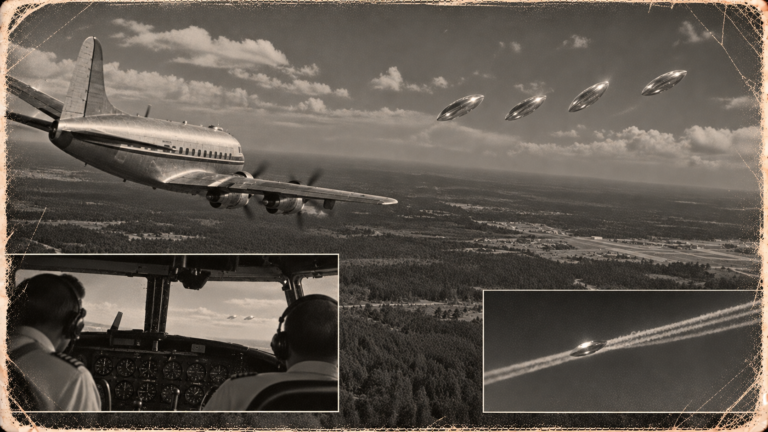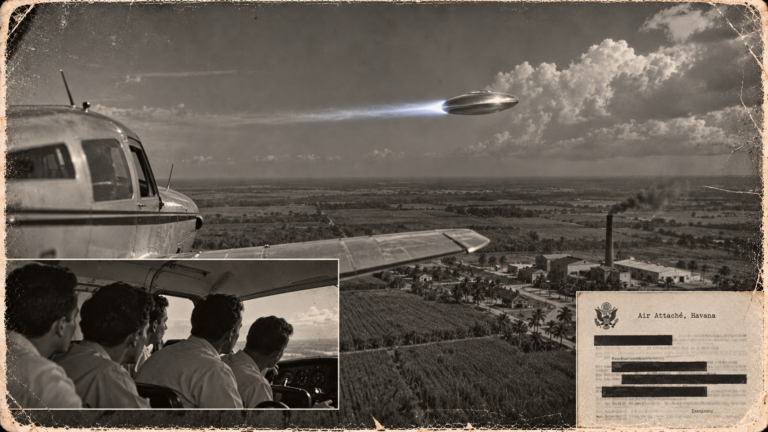
The remote Venezuelan Amazon site where a gold prospector reportedly discovered a downed craft and its deceased occupants, 1953.
THINK ABOUTIT
UFO|UAP & ENTITY ENCOUNTER REPORT
1953: The Venezuelan Amazon Crash Discovery — J.P.’s Account
A gold prospector, the last member of his expedition left in the Venezuelan Amazon, followed a glint on a distant volcano’s flank for three days before he found it: a small, beeping, domed craft resting on three legs, and at the foot of its exit ladder, the body of something that had never been human. He buried it. He kept its mask. Weeks later, in a Caracas motel room, someone broke in and took only that.
Date: 1953 (exact date not recorded)
Sighting Time: Evening (initial distant sighting); subsequent examination over following days
Day/Night: Evening/Day (multi-day encounter)
Location: Approximately 500 km southwest of Caracas, Venezuela, in remote Amazonian jungle terrain near a volcano
Urban or Rural: Remote wilderness
No. of Entity(‘s): 4 (all found deceased — 1 outside the craft, 3 visible inside through a window)
Entity Type: Non-human humanoid
Entity Description: Approximately 1.20 m (about 4 ft) in length; large head relative to body; arms proportionally longer than human arms; claw-like hands; triangular facial shape with a pointed chin, thin lips, and an almost nonexistent nose with two vague nostrils; large, almond-shaped eyes drawn out toward the temples, covered by a mask; yellowish skin; wore a one-piece garment; genitalia described as abnormally elongated, reaching nearly to knee level
Hynek Classification: CE-II (Close Encounter, Second Kind — physical evidence/discovery; no living entity contact occurred)
Duration: A multi-day encounter, beginning with a three-day trek toward the object and continuing over several subsequent days of examination
No. of Object(s): 1
Description of the Object(s): A circular object, 8-10 m in diameter, topped with a cupola, resting at a slight incline on three supports, emitting a repeating “beep, beep” sound that faded over time; a Plexiglas-like window allowed viewing of the interior; an opening beneath the disc led to a ladder
Shape/Size/Color of Object(s): Circular/disc-shaped with a domed cupola, 8-10 m diameter; color not specified
Distance to Object(s): The witness reached and directly examined the object, including its interior
Height & Speed: Not applicable — object was grounded and inert throughout the encounter
Number of Witnesses: 1 (identified only as “J.P.”)
Special Features/Characteristics: The witness’s rifle stuck to the craft’s rim as though pulled by a magnet when he touched it; the deceased entity outside the craft wore a mask which, when the witness tried it himself, made daytime scenes obscure but reportedly revealed stars and galaxies with extraordinary clarity at night; a transparent floor inside the object revealed what appeared to be bones beneath; the witness could not break through the craft’s Plexiglas-like window to examine the three additional bodies inside more closely; he buried the first body near the site and kept the mask, which was later stolen from a Caracas motel room by unknown intruders who took nothing else
Case Status: Unresolved — an extraordinarily detailed single-witness account with no independent corroboration, no surviving physical evidence, and internal details (the conveniently selective theft of the one tangible object) that warrant significant caution
Source: Joel Mesnard, Flying Saucer Review, Vol. 44, #3
Summary/Description: J.P., left alone deep in the Venezuelan Amazon after the rest of his gold-prospecting expedition had departed, spotted something glittering on a distant volcano’s flank and trekked three days to reach it. He found a circular, domed craft, 8-10 m in diameter, resting on three supports and emitting a fading “beep, beep” sound. Approaching, his rifle stuck to the craft’s rim as if magnetized. Beneath the disc he found an opening and a ladder, at the foot of which lay the body of a small, non-human entity roughly 1.2 m long, wearing a mask he later took for himself. Through a Plexiglas-like window he saw three more identical, similarly masked, deceased entities inside beside a control panel. Unable to breach the window, he buried the first body, explored the craft’s interior — where a transparent floor revealed what looked like bones beneath — and left the area with the mask. Sometime later, in a Caracas motel, unknown intruders broke in and stole only the mask.
Related Cases: None known
Detailed Report
The account, as preserved by researcher Joel Mesnard in Flying Saucer Review, describes the experience of a man identified only as J.P. — the last remaining member of a gold-prospecting expedition deep in the Venezuelan Amazon, roughly 500 km southwest of Caracas, sometime in 1953. Having wandered from the jungle to elevated ground, he spotted something glinting on the distant flank of a volcano.
It took him three days of trekking to reach it: a circular object, eight to ten meters across, topped with a cupola and resting at a slight incline on three supports, emitting a steady, repeating “beep, beep” that gradually faded as he approached. He made camp nearby to watch. When the sound stopped entirely, he worked up the nerve to approach, and touched the rim of the object with the barrel of his gun — which stuck fast, as though drawn by a magnet.
Examining the craft further, he found an opening beneath it and a short ladder leading down. At its foot lay a small figure, stretched out on the ground — a being he estimated at 1.2 meters long, with a disproportionately large head, arms longer in proportion than a human’s, and claw-like hands. Its one-piece garment had torn, revealing what J.P. described as abnormally elongated genitalia. The face was triangular, with a pointed chin, thin lips, and a nearly absent nose reduced to two faint nostrils. Large, almond-shaped eyes, drawn out toward the temples, were covered by a mask. The skin had a yellowish cast.
J.P. buried the body near the site. He kept the mask. Trying it on himself, he found that during the day it obscured everything he looked at — but at night, it was said to reveal the stars and galaxies with a clarity and immeasurable depth he’d never before witnessed.
Continuing to examine the craft, he found a Plexiglas-like window and, through it, three more bodies — identical to the first, all dead, all similarly masked, positioned before what looked like a control panel fitted with dials and switches. He couldn’t break through the window to reach them. Entering the object through the lower opening on a later day, he found the floor made of a transparent material; shining his flashlight through it, he saw what appeared to be bones beneath, their origin unknown to him. Unsettled, he left the area, taking the mask with him.
Some time afterward, staying at a motel in Caracas, his room was broken into. Nothing else was disturbed. The only thing taken was the mask.
RESEARCHER’S NOTES
The Venezuela Case — 1953 and a Story Built for Suspicion
- An account almost too complete: Nearly every element of this narrative resists follow-up — the body is buried (unrecoverable), the craft’s interior is sealed (unreachable), and the one physical object taken from the scene is conveniently stolen before it could ever be examined by anyone else. This archive notes that structure plainly: it is either a remarkable string of bad luck, or a narrative shape well suited to a story that was never meant to produce checkable evidence.
- The magnetized rifle is a specific, testable-in-principle claim: Unlike most details in this account, a weapon sticking to a metal surface is at least a concrete physical claim — though, like everything else here, it rests entirely on J.P.’s own word.
- The mask’s dual function is a striking narrative device: An object that obscures daylight but reveals the depths of the night sky is a vivid, almost literary image — the kind of detail that elevates a story’s memorability without necessarily reflecting anything observed.
- No named witness beyond initials: “J.P.” is never further identified in the surviving account, limiting any possibility of independent follow-up on the witness himself.
- Published in a respected outlet, evaluated on its own merits regardless: Flying Saucer Review was a serious, long-running UK publication, and Joel Mesnard a genuine contributor to the field — but publication in a credible outlet documents that a claim was made and considered noteworthy, not that the claim itself is true.
This is one of the most elaborate single-witness accounts in this entire archive, and also one of the least verifiable by design — every piece of potential physical evidence is unavailable by the story’s own internal logic. It is preserved here in full, with that structural pattern named plainly rather than left for the reader to notice unassisted.
“He tried the mask, which during the day made everything obscure, but at night the mask revealed to him the infinity of the stars, the immeasurability of the galaxies.”
— Joel Mesnard, Flying Saucer Review, Vol. 44 #3