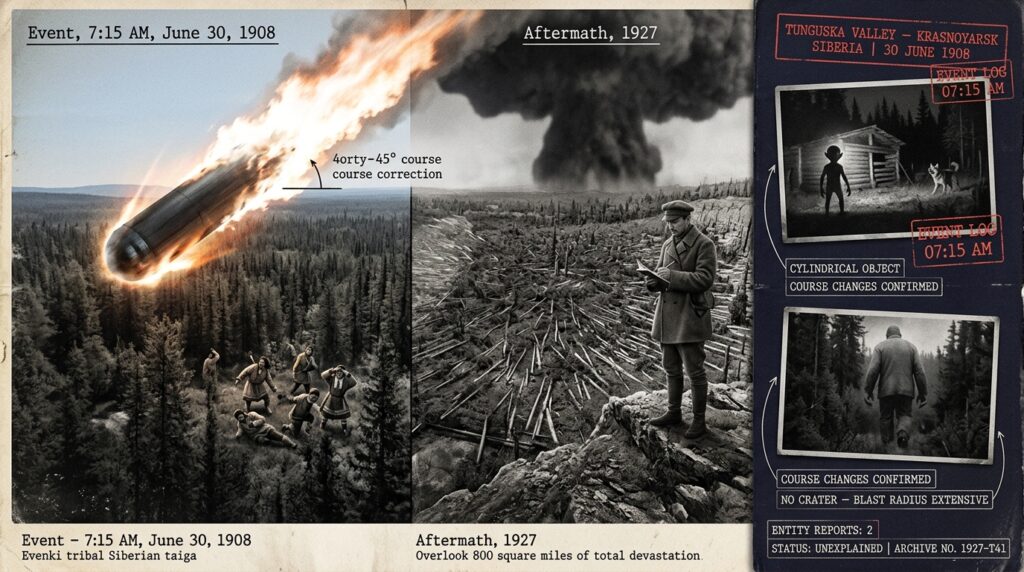
Tunguska Valley, East Siberia, June 30 1908 — a cylindrical object changed course twice before a 12–30 megaton aerial explosion flattened 800 square miles of forest and left no crater. Two entity types were subsequently reported in the region. Leonid Kulik reached the site in 1927. Case status: Unexplained. Sources: Tom Slemen, Strange But True; NLO Over Siberia, Tainy XX Veka, 2005.
THINK ABOUTIT CRASH|ENTITY SIGHTINGS REPORT
1908: The Tunguska Explosion
At 7:15 in the morning of June 30th, 1908, something brighter than the sun ripped through the atmosphere over Siberia, changed course twice at forty-five degree angles as witnesses watched, and detonated five miles above the Tunguska valley with a force estimated between twelve and thirty megatons — flattening eight hundred square miles of forest, sending a shockwave around the world twice, and lighting the skies over London, Belgium, Germany, and Scotland so brilliantly that photographs were taken in Moscow streets without a flash and a golf game in England nearly continued until four in the morning. No crater was ever found. The object was cylindrical. It turned. And in the days that followed, an Evenki villager near the blast zone captured a small dwarf-like creature with green eyes and smooth shiny skin that he kept in his cattle shed, walked at night, and watched die of an unknown illness — while a grey giant over eight feet tall was seen moving westward through the taiga for decades, last reported in a cave in Daghestan in 1941 where soldiers shot it dead and left the body for the wolves. Science has never settled what hit Tunguska. The archive keeps all of it.
Date: June 30, 1908
Sighting Time: 7:15 AM local time — primary event; entity encounters in subsequent days, weeks, and years
Day/Night: Day — primary event; entity encounters at various times including night
Location: Evenkia area, Krasnoyarsk region, East Siberia, Russia — explosion epicenter above the Tunguska Valley; entity encounters in surrounding taiga; secondary giant sightings reported 50 miles north of the Chunya River; final giant encounter 1941 in Buinaksk Mountains, Daghestan
Urban or Rural: Remote wilderness — uninhabited taiga at epicenter; nomadic Evenki tribal settlements in surrounding area
No. of Entity(‘s): Two distinct entities reported — (1) one dwarf-like creature captured by an Evenki villager shortly after the explosion; (2) one giant grey humanoid figure over eight feet in height observed by multiple Evenki herdsmen in the taiga in subsequent years and killed by Soviet troops in Daghestan in 1941
Entity Type: (1) Unknown non-human — dwarf type; (2) Unknown humanoid — giant type; both associated with the Tunguska event by proximity, timing, and regional oral tradition
Entity Description: Entity 1 — dwarf-like, slightly more than one meter in height, large green eyes, smooth shiny skin, protrusions on forehead area, short tail; described as resembling more a devil than a human being; injured and weakened when found; kept in cattle shed by Evenki villager; taken out for walks at night causing all village dogs to bark frantically; vanished — the villager stated it had walked away into the forest; the villager subsequently suffered hair and tooth loss, severe weight loss, and died of an unknown illness consistent with radiation exposure. Entity 2 — over eight feet in height; grey coloration initially interpreted as hair by Evenki observers but determined on closer observation to be tattered grey overalls of some kind; seen picking berries and drinking from streams; regarded by Mongol herdsmen as one of the fabled chuchunaa — hairy giants of Siberian legend; moved steadily westward over decades; last encountered 1941 in Buinaksk Mountains, Daghestan; shot and killed by Colonel V.S. Karapetyan and Soviet troops who cornered it in a cave; corpse left at the scene
Hynek Classification: CE-III (Close Encounter III) — close observation of animate beings associated with a craft event; entity 1 physically captured and kept; entity 2 observed at close range over extended period and ultimately killed; primary explosion event classified as crash/explosion of unknown aerial object
Duration: Primary event — seconds to minutes for atmospheric transit; explosion effects felt for hours; sky luminosity across Europe lasted weeks. Entity 1 encounter — days to weeks from capture to disappearance. Entity 2 sightings — documented from approximately 1908 through 1941, spanning thirty-three years
No. of Object(s): 1
Description of the Object(s): Cylindrical object brighter than the morning sun; observed changing course twice at forty-five degree angles during atmospheric transit — first turn 150 miles after crossing the trans-Siberian railway corridor, second turn 150 miles after that; detonated at approximately five miles altitude above the Tunguska Valley; 12 to 30 megaton yield; produced a mushroom cloud; no crater formed — explosion was aerial; extraterrestrial dust consisting of magnetic iron oxide and minute glassy droplets of heat-fused rock recovered from blast site by Florensky expeditions 1958–1962; no meteorite fragments recovered; cylindrical blast pattern at epicenter noted by geologists as consistent with internal explosion of a cylinder rather than meteoric impact
Shape of Object(s): Cylindrical
Size of Object(s): Sufficient to produce a 12–30 megaton explosion destroying 800 square miles of forest; precise dimensions unrecorded
Color of Object(s): Brighter than the morning sun — witnessed as a pillar of flame; vapor trail left across the sky
Distance to Object(s): Observed from hundreds of miles by trans-Siberian railway passengers and Evenki tribes; detonated five miles above ground
Height & Speed: Traveled at approximately one mile per second through the atmosphere; detonated at five miles altitude; performed two forty-five degree course changes during flight
Number of Witnesses: Multiple — trans-Siberian railway passengers and crew; nomadic Evenki tribes across the region; observers across Europe who witnessed the subsequent atmospheric luminosity; Leonid Kulik’s 1927 expedition interviewed multiple Evenki witnesses; Evenki herdsmen who observed the grey giant; Soviet troops who killed the giant in 1941
Special Features/Characteristics: Object changed course twice at forty-five degree angles — behavior inconsistent with any known natural bolide or comet; no crater formed despite megaton-scale explosion; radiation-like symptoms in animals and human investigators at blast site; Florensky expeditions detected extraterrestrial dust but no conventional meteorite material; cylindrical epicenter blast pattern; sky luminosity across Europe and Russia for weeks after; Evenki villager who kept entity 1 died of symptoms consistent with radiation exposure; entity 2 wore grey clothing or overalls suggesting non-terrestrial origin; entity 2 tracked moving westward from Tunguska for thirty-three years before being killed
Case Status: Unexplained — official scientific consensus favors a stony asteroid or comet fragment airburst; the course changes, cylindrical object description, absence of crater, cylindrical epicenter blast pattern, extraterrestrial dust composition, and associated entity reports are not accounted for by any current consensus explanation
Source: NLO (UFOs) Over Siberia in Tainy XX Veka (Mysteries of the 20th Century) newspaper, Saint Petersburg, Russia, No. 44, December 2005; Tom Slemen, Strange But True, Copyright 2000 (reproduced with permission)
Summary/Description: On June 30th, 1908 a cylindrical object traveling at approximately one mile per second changed course twice at forty-five degree angles over Siberia before detonating five miles above the Tunguska Valley with an estimated yield of 12–30 megatons. No crater was formed. Extraterrestrial dust was recovered but no meteorite fragments. The blast destroyed 800 square miles of taiga and sent a shockwave around the world twice. Subsequent entity reports include a dwarf-like non-human creature captured by an Evenki villager who died of radiation-consistent illness after the entity vanished, and a grey giant in tattered overalls observed moving westward through the Siberian taiga for thirty-three years before being shot dead by Soviet troops in Daghestan in 1941. No consensus explanation accounts for all documented elements of this case.
Related Cases: 1955: U.S. Senator Richard Russell Sees UFO in USSR | 1985: Captured by Russian Forces | 1989: Outside of Vladivostok Russia UFO Crash | Russia Sightings Archive
Detailed Report
The full detailed report text is contained in the existing post body sourced from Tom Slemen’s Strange But True (Copyright 2000, reproduced with permission) and NLO Over Siberia, Tainy XX Veka, Saint Petersburg, December 2005. No fabricated additions. Source text retained as published.
RESEARCHER’S NOTES
What Hit Tunguska — June 30 1908 and the Case That One Hundred and Seventeen Years of Science Has Not Closed
- The Course Changes Are the Evidentiary Core: Every conventional explanation for Tunguska — stony asteroid, comet fragment, black hole, antimatter — describes an object traveling in a ballistic arc dictated by physics. None of these objects make forty-five degree turns. The course changes were observed independently by two groups: trans-Siberian railway passengers tracking the object from below, and Evenki tribal members watching it cross the sky from elevated ground fifty miles north of the Chunya River. Two independent observer groups, separated by geography, reporting the same directional behavior. This is not folklore. It is corroborated observational data and it is the single element of the Tunguska record that most categorically separates the event from any natural phenomenon category.
- The Cylindrical Epicenter and the Dust Composition: Kirill Florensky’s expeditions of 1958–1962 produced two findings the consensus explanation has never fully absorbed. First, the blast epicenter shows an irregular shape that geologists and scientists analyzing the data described as consistent with something exploding within a cylinder — not the radially symmetric pattern of a meteoric airburst. Second, the extraterrestrial dust recovered from the site consists of magnetic iron oxide and minute glassy droplets of heat-fused rock — a composition profile that does not match known stony asteroid or cometary material. Both findings are in the published scientific record. Neither has been satisfactorily explained within the consensus framework.
- The Entity Evidence — Source Chain and Radiation Signature: The dwarf entity account derives from a 1927 scientific expedition’s data as reported in the 2005 Saint Petersburg newspaper. The source chain is secondary and the original 1927 expedition documentation has not been independently verified in available sources. However, the detail that carries the most analytical weight is not the entity description but the aftermath: the Evenki villager who kept it suffered hair loss, tooth loss, severe weight loss, and death — the classic presentation of acute radiation syndrome. This symptom cluster appearing in a man who had close prolonged contact with an entity from the Tunguska blast zone is a data point the archive flags regardless of the entity account’s secondary sourcing.
- The Grey Giant — Thirty-Three Years in the Taiga: The most extraordinary element of the Tunguska record that receives the least analytical attention is the grey giant. Observed by Evenki herdsmen at close range — close enough to determine that the grey color was tattered overalls, not hair — the figure moved consistently westward from the Tunguska epicenter over thirty-three years. It was not a legend. Soviet troops cornered it in a cave in Daghestan in 1941, fired on it with rifles, killed it, and left the body. Colonel Karapetyan wrote an account of the encounter. The corpse was not recovered or examined. A being that survived thirty-three years in the Siberian wilderness wearing tattered grey clothing and eating berries, that could be killed by rifle fire but not by the Tunguska explosion itself, and whose body was abandoned at the scene — this is the open question the archive refuses to close.
- The Tesla-Wardenclyffe Theory — Named Mechanism, Named Operator, Named Target: Of all the alternative explanations proposed for Tunguska, the Tesla-Wardenclyffe theory is the only one that offers a named human mechanism, a named operator, and a plausible intended target. By June 1908 Wardenclyffe Tower on Long Island, New York had been under development since 1901 and was by Tesla’s own account approaching optimal operating condition. The theory, formally outlined by researcher Oliver Nicholsen in his paper Tesla’s Wireless Power Transmitter and the Tunguska Explosion of 1908, proposes that Tesla was attempting to demonstrate his wireless energy transmission system by illuminating the Arctic sky — possibly to assist or impress Robert Peary whose polar expedition was active at the time — and miscalculated the discharge coordinates, placing the energy release over Tunguska instead of the intended polar region. Tunguska sits on the southernmost edge of the Arctic Circle. Long Island broadly lines up geographically with the Tunguska coordinates. The theory is also consistent with several elements that the conventional asteroid or comet airburst explanation handles poorly: no crater was formed, no debris fell from the sky, no professional or amateur astronomers anywhere on Earth reported a visible fireball on approach, and the magnetic and electrical disturbances reported across Europe for days afterward are consistent with a massive directed electrical discharge rather than a physical impact. The upward-blasted tree root patterns at the epicenter — trees stripped of branches but still standing at ground zero — have also been cited as more consistent with an energy discharge erupting from below than with a pressure wave descending from above.
- What the Tesla Theory Does Not Explain — And Why the Archive Keeps the File Open: The Tesla-Wardenclyffe theory accounts for the absence of a crater, the absence of astronomical observation, the electrical disturbances across Europe, and the cylindrical epicenter blast geometry. It does not account for the course changes. A directed energy transmission from Wardenclyffe does not perform two forty-five degree turns in flight over Siberia — it travels in a straight line determined by the geometry of the earth’s surface and Tesla’s targeting. The two documented course changes, observed independently by trans-Siberian railway passengers and Evenki tribesmen on elevated ground, remain the single element of the Tunguska record that no proposed explanation — asteroid, comet, antimatter, black hole, or Tesla discharge — has cleanly handled. They are also the element most consistent with a controlled or piloted object responding to navigational input. The archive does not resolve this. It notes that one hundred and seventeen years after the event, with multiple scientific expeditions, peer-reviewed papers, and competing theories on record, no hypothesis has successfully accounted for all documented elements of the Tunguska case simultaneously. The file remains open.
Whatever came down over Siberia on the morning of June 30th, 1908, it changed course twice on the way in, it did not leave a crater, it left dust that does not match natural space rock, it left at least one survivor small enough to keep in a cattle shed and large enough to walk away from, and it left a giant wandering the taiga in grey overalls for thirty-three years before Soviet soldiers put it down in a mountain cave. Science calls it an airburst. The archive calls it an open file.
Full Report
Evidence of the mysterious blast 13 years after the cataclysmic explosion
Had the following unexplained incident occurred today, even in the slightly relaxed atmosphere of the post-Cold War, it would have probably triggered World War Three. Fortunately, the greatest hammer blow from space to hit our Earth since prehistoric times happened when the 20th century was barely eight years old. Even today, scientists are still at loggerheads as regards to the nature of the extraterrestrial object which shook the world after exploding in the skies of pre-Revolutionary Russia.
The momentous event happened at 7.15 a.m. local time on the last day of June 1908. At that precise moment, an object brighter than the morning sun ripped through the atmosphere over Siberia. A trainload of passengers on the trans-Siberian railway stared in horror at the towering pillar of flame roared through the clear blue skies at a phenomenal velocity of around one mile per second. The sonic boom given off by the sky invader shook the railway track, convincing the engine driver that one of his coaches had been derailed. The driver jammed on the brakes and as the train screeched to a grating halt, the mysterious fiery object thundered north. The trembling train passengers listened in relief as the overhead danger became fainter, and many of them looked out the windows of the carriages and eyed the vapor trail with bafflement.
Almost 350 miles to the north of the train, the nomadic hunting tribes of the Evenki people felt the ground shake violently as they witnessed what seemed to be a second sun racing across the heavens. Only this sun seemed to be cylindrical. By now, the immense apocalyptic object had been seen to change course as if it was being controlled or steered. After passing over the terrified travelers of the trans-Siberian train, the object made a forty-five degree right turn and traveled 150 miles before performing an identical maneuver in the other direction.
The tubular shaped object then proceeded for another 150 miles before exploding over the Tunguska valley. The detonation occurred at a height of five miles, and the 12-mega-ton explosion (it might have even been 30 mega-ton) destroyed everything within a radius of 20 miles. Herds of reindeer were incinerated as they stampeded away from the explosion, and all wildlife in the area was ignited by the searing heat blast. Thirty-seven miles from the blast, the tents that the frightened Evenki people had taken refuge in were lifted high into the air by the resulting atmospheric shock wave, and the Evenki’s horses galloped off in terror, dragging their ploughs with them. At the center of the explosion a monstrous mushroom cloud rose steadily over Siberia.
Such a strange and unsettling sight would not be witnessed for another thirty-seven years at Hiroshima and Nagasaki. But this explosion was even fiercer than the A bombs which were dropped on the Japanese cities. The blast from the Tunguska explosion felled trees as if they were matchsticks for 20 miles around and set whole forests alight. The shock wave generated by the mysterious cataclysm traveled around the world twice and shook the recording pens of the micro barographs at three meteorological stations in London, where they were interpreted as seismic jolts from some distant earthquake.
At a distance of 400 miles from the epicenter of the Tunguska blast, the relentless shockwave showed no signs of abating, and knocked fishermen from their boats on the River Kan. By the time the blast had deteriorated into a hurricane-like storm, a strange black rain started to fall over the Tunguska valley. Days later, strange scabs started to break out on animals that had been too far away to be directly burnt by the blast, and weeks later, curious investigators who ventured to the site of the explosion became sick and complained of strange burning sensations within their bodies. Were these signs of radiation sickness? But what meteoric object could be radioactive? Stranger still, why was there no crater at the site of the explosion? All meteorites leave a crater. And how would a meteorite travel horizontally for hundreds of miles and change course twice? Then there were other strange occurrences which seemed to suggest that the object which had exploded over Siberia was not a meteor at all, but perhaps some nuclear-powered spacecraft from another world which had had made an emergency crash-landing in a forbidding area of our world.
The first reports of a strange glow in the sky came from across Europe. Shortly after midnight on 1 July 1908, Londoners were intrigued to see a pink phosphorescent night sky over the capital. People who had retired awoke confused as the strange pink glow shone into their bedrooms. The same ruddy luminescence was reported over Belgium. The skies over Germany were curiously said to be bright green, while the heavens over Scotland were of an incredible intense whiteness which tricked the wildlife into believing it was dawn. Birdsong started and cocks crowed – at two o’clock in the morning.
The skies over Moscow were so bright, photographs were taken of the streets without using a magnesium flash. A captain on a ship on the River Volga said he could see vessels on the river two miles away by the uncanny astral light. One golf game in England almost went on until four in the morning under the nocturnal glow, and in the following week The Times of London was inundated with letters from readers from all over the United Kingdom to report the curious ‘false dawn’.
A woman in Huntingdon wrote that she had been able to read a book in her bedroom solely by the peculiar rosy light. There were hundreds of letters from people reporting identical lighting conditions that went on for weeks after the Tunguska explosion. Scientists and meteorologists also wrote to the newspaper giving their opinions about the cause of the strange sky-glare which ranged from the Northern Lights to dust in the upper atmosphere reflecting the rays of the sun below the horizon. No one connected the phenomenon with the strange object which had come down in Siberia to explode with the fury of a H-bomb.
Even the national press in Russia gave no mention to the catastrophic even in the Tunguska Valley, because the country was then entering a major period of political upheaval. A serious investigation of the Tunguska incident did not take place for another thirteen years, when a Soviet mineralogist named Leonid Kulik led an expedition to the site of the explosion. But within those thirteen years, strange whispers and rumors spread across Siberia. There were tales of a strange being wandering the remote forests of Tunguska near the scenes of devastation.
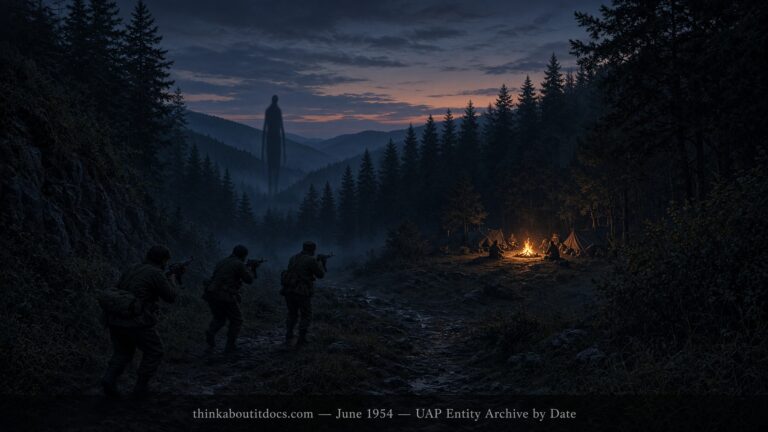
The nomadic reindeer herdsmen of Siberia sighted the gigantic grey humanoid figure some 50 miles north of the Chunya river. They saw the man, who seemed to be over 8 feet in height, picking berries and drinking water from a stream. The superstitious Mongol herdsmen regarded the freakish-looking stranger as one of the fabled chuchunaa – a race of hairy giants similar to the abominable snowman which were said to inhabit the region. The nomads crept through the forest to get a better look at the figure, and they saw that the grey color of the man was not hair, but tattered overalls of some sort. The herdsmen sensed that there was something unearthly about the being, and they retreated back into the forest and moved away from the area. There were several more sightings of the grey goliath over the years, and each report indicated that the entity from the cold heart of Siberia was moving westwards. Alas, all of the accounts of the strange giant were interpreted as mere folklore tales of the Russian peasants.
In February 1927, Leonid Kulik went in search of the strange object that had impacted into Tunguska. He had read countless old newspaper clippings on the Siberian explosion and had conjectured that the object that had caused the wide scale destruction had been a large meteorite made of stone and iron.
Being a mineralogists, Kulik looked forward to obtaining samples of the meteorite for analysis. Kulik got off the Trans-Siberian railway at the Taishet station and on horse-drawn sledges they set off on an arduous three-day odyssey through 350 miles of ice and snow until he and his men reached the village of Kezhma, situated on the River Angara. At the village Kulik and his party of researchers replenished their supplies of food, then struggled on for a three-day journey across wild and uncharted areas of Siberia until they reached the log-cabin village of Vanavara on 25 March. Kulik then tried to make headway through the untamed Siberian forests, or taiga as the Russians call it, but was forced to turn back after heavy snowdrifts almost froze the horses to death. For three days Kulik was forced to remain in the snow-bound village of Vanavara, but during this period he interviewed many of the Evenki hunters who had witnessed the Siberian fireball’s arrival on this planet. The tales of the sky being ripped open by a falling sun and of a great thunder shaking the ground made Kulik even more eager to penetrate the taiga to find his holy grail. When the weather gradually improved, Kulik set out for the Tunguska Valley. When he finally reached the site of the mysterious explosion, he was almost speechless. From a ridge overlooking the scene, Kulik took out his notebook and scribbled down his first impressions of the damage wreaked by the cosmic vandal. Kulik wrote:
From our observation point no sign of forest can be seen, for everything has been devastated and burned, and around the edge of the dead area, the young, twenty-year-old forest growth has moved forward furiously, seeking sunshine and life. One has an uncanny feeling when one sees twenty to thirty-inch giant trees snapped across like twigs, and their tops hurled many yards away.
Kulik then proceeded towards the felled forest, but two of the guides who had taken him and his assistants to the area refused to go any further. The guides told the bemused scientist that there was something or someone still lurking about in the area. Kulik thought the guides were superstitious fools, but they told him that strange things had been seen at twilight in the shadows of the dead taiga. The guides returned home and Kulik fortunately met a few bold members of the Evenki tribe, who took him and the researchers further into the taiga. By June, Kulik and his men had reached the middle of the explosion site, where uprooted trees were scattered from the center of the blast like the tangled spokes of a wheel. There were no signs of a crater. Kulik realized that the explosion had occurred above ground. The Evenki tribesmen seemed to become very uneasy in the middle of the devastation zone, and started to talk about a supernatural presence in the area. But Kulik didn’t have time to listen to such irrational ramblings of the nomads; he had limited time to collect data for his friends back home at the Russian Academy of Sciences. There were three further expeditions to the site of the Tunguska explosion, all of them headed by Kulik. In 1941, Hitler attacked Russia. The 58-year-old Leonid Kulik volunteered to defend Moscow, but was wounded by the Nazis. He was captured by German troops and thrown in a prison camp where he died from his wounds.
The next three expeditions to the Tunguska Valley in 1958, 1961 and 1962 were led by the Soviet geochemist Kirill Florensky, who used a helicopter to survey and chart the blast area. Florensky’s team sifted the soil in the area and discovered a narrow strip of dust which was of extraterrestrial origin. The dust consisted of magnetic iron oxide (magnetite) and minute glassy droplets of heat-fused rock. Florensky carefully checked the radiation levels at the site, but the only radioactivity present seemed to be from the fallout which had drifted into the area from distant Soviet H-bomb tests.
Scientists who examined the findings of Florensky and the data from further investigations of the Tunguska explosion site began to postulate that a fragment of Comet Encke had collided with our planet and smashed into Siberia in June 1908. Today, some scientists believe that the blast was caused by a wandering black hole or a chunk of anti-matter. However, there is one piece of curious evidence that seems to vindicate the spaceship theory. At the site of the Tunguska blast, there is a strange irregular shape at the center of the circle of damaged terrain. Scientists and geologists who have analyzed the shape say it looks as if it was caused by something exploding within a cylinder. Comets are not cylindrical, and they do not travel horizontally to the ground making forty-five degree turns.
And what of the fabled ‘chuchunaa’ creature? What became of him? The last known encounter of the grey giant took place in 1941 in Daghestan. A Colonel V. S. Karapetyan and his troops were called out to investigate sightings of an enormous ‘beast-like’ figure in the Buinaksk Mountains. The soldiers spotted what they regarded as a monstrosity and gave chase. They cornered the towering figure in a cave and opened fire on it with their rifles. The creature fell with a loud echoing thud, quite dead. Colonel Karapetyan later wrote an account of the confrontation with the unidentified human-like creature:
He stood before me like a giant, his mighty chest thrust forward. His eyes told me nothing. They were dull and empty – the eyes of an animal. And he seemed to me like an animal and nothing more…a wild man of some kind.
The corpse of the creature was left to the scavengers, and the colonel and his men left the mountains and concerned themselves with the task of defending Russia from the Nazis. The humanoid they had killed may simply have been one of those mysterious ‘men-beasts’ such as the Yeti or Bigfoot, but according to some of the peasants of the Buinaksk Mountains, the oversized man wore ragged grey clothes. Is it therefore possible that the creature in the cave murdered by the military was the same being that had first been seen by the Evenki tribe near the scene of the Tunguska explosion? This leads us to a tantalizing possibility; was the abnormally tall entity some marooned alien from another world who had managed to eject himself from a damaged spaceship after steering the craft away from the inhabited areas of Siberia? If this was the case, what a sad and barbaric end for a visitor who might have been able to teach us so much.
From Tom Slemen’s Strange But True Copyright 2000
This story reproduced with permission from Tom Slemen