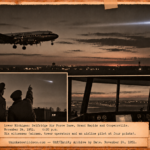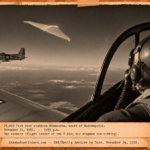
Lower Michigan, November 24, 1951: six observers at four points report a fast bright object as Selfridge radar stops.
THINK ABOUTIT UFO|UAP SIGHTINGS REPORT
1951: Fast Bright Object Seen From Four Points in Lower Michigan, Capital Flight 94 and Selfridge Radar Stops Operating
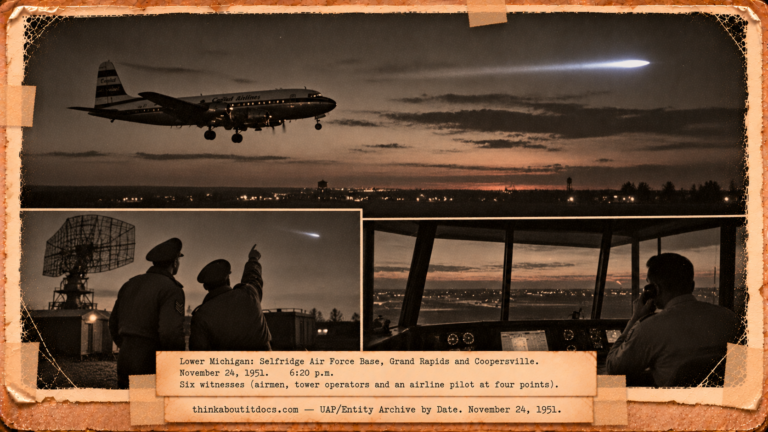
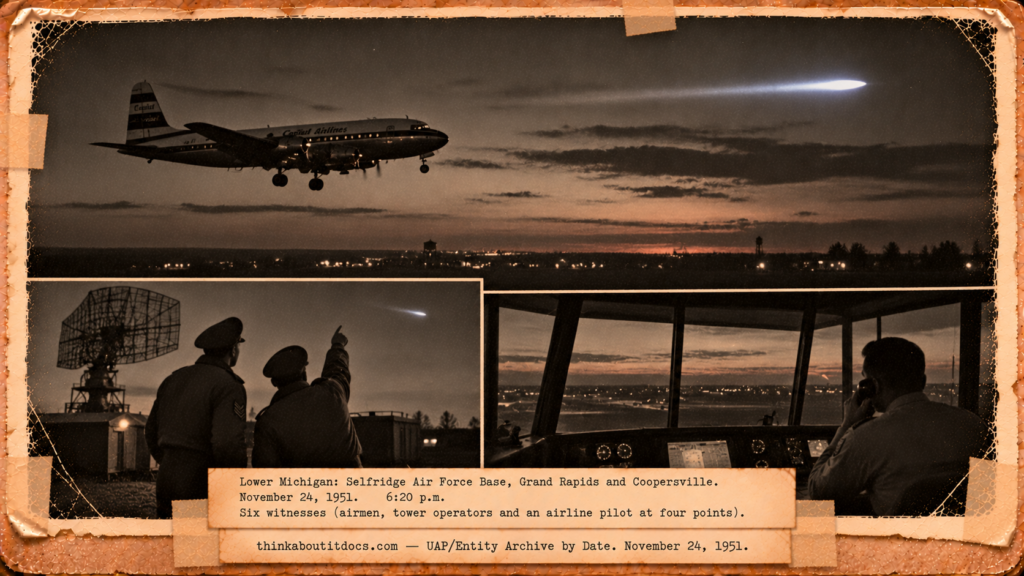
Between 6:20 and 6:25 p.m. EST on November 24, 1951, six observers at four different points in lower Michigan reported an unusual flying object. Two airmen at Selfridge Air Force Base, a Wright-Patterson airman near Battle Creek, two tower operators at Kent County Airport in Grand Rapids and the pilot of Capital Airlines Flight 94 over Coopersville all described a bright object in the southeast part of the sky, moving west or southwest parallel to the ground at speeds estimated from jet speed to 1,000 mph or more.
At 2320Z the radar at Selfridge ceased operation, and its antenna was reported turning in the opposite direction. The Air Force found no aircraft, balloon, meteor or aurora to account for the reports, but Project Blue Book later carried the case as astronomical, a meteor. The file shows an investigation that went further than that card suggests.
Date: November 24, 1951
Sighting Time: 2320Z to 2325Z (6:20 to 6:25 p.m. EST); Capital Flight 94 report at about 2325Z
Day/Night: Night (visibility unlimited; weather CAVU)
Location: Lower Michigan: Selfridge Air Force Base; one mile east of Battle Creek; Kent County Airport, Grand Rapids; and over Coopersville (Capital Flight 94, at 1,900 feet)
Urban or Rural: Mixed (an air base, two airports, a small city and open country)
No. of Entity(‘s): Not Applicable
Entity Type: Not Applicable
Entity Description: Not Applicable
Hynek Classification: Nocturnal Light (NL)
Duration: 2 to 5 seconds at each point
No. of Object(s): 1 (reported from four points; whether it was one object was not settled)
Description of the Object(s): A bright object in the southeast quadrant moving on a west or southwest course parallel to the ground. It vanished in the south or southwest sky without a change of course. Two observers reported a red exhaust, and the others reported no trail or exhaust and no sound.
Shape/Size/Color of Object(s): Described as football-shaped, round, egg-shaped and bullet-shaped; colors given as bluish white, white and bluish orange; one observer saw a cigar-shaped object with a faint glow at its tail
Distance to Object(s): Not measured; estimates of altitude ranged from about 500 feet to about 4,000 feet
Height & Speed: Altitude estimates from about 500 to 4,000 feet; speed estimates varied widely, from about that of a jet to roughly 1,000 mph or more. The Capital Flight 94 pilot called his 1,000 mph a rough guess.
Number of Witnesses: 6 at 4 points in the first report (two airmen, a Wright-Patterson airman, two tower operators and an airline pilot); the airline co-pilot also saw it but was not interviewed. Names are omitted.
Special Features/Characteristics: Selfridge radar ceased operation at 2320Z with its antenna turning the opposite way; no known aircraft or balloons in the area; the University of Michigan observatory saw no meteors or aurora; an airline pilot heard that a radar site had picked up an unidentified return 20 miles east of a station
Case Status: Astronomical (Project Blue Book record card: Was Astronomical, “Meteor”; comment “Meteor observation”). The local checks recorded in the file do not support a meteor.
Source: Project Blue Book record card; Eastern Air Defense Force and Selfridge Air Force Base teletypes of November 24 to 26, 1951; 30th Air Division Air Intelligence Information Reports; Project Grudge proposed investigation memorandum; Dan Wilson; Project 1947; FUFOR Index
Summary/Description: Six observers at four points across lower Michigan reported a fast bright object within five minutes of each other, and Selfridge radar stopped working normally at the same time. Blue Book rated it a meteor, though the Air Force’s local checks found no meteor, aircraft or balloon.
Related Cases: The Milwaukee, Wisconsin fireball seen by two Capital Airlines pilots on November 26, 1951; the Minneapolis balloon-crew sightings of October 11, 1951
Detailed Report
The Teletype That Opened the Case
The first message from Selfridge Air Force Base, sent to the Air Technical Intelligence Center with a copy to the Eastern Air Defense Force, reported that six observers had seen an unusual flying object from four different points in lower Michigan. It listed two airmen at Selfridge at 2320Z, one airman a mile east of Battle Creek, two experienced tower operators at Kent County Airport at Grand Rapids at 2325Z and a Capital Airlines pilot over Coopersville at 2325Z. The message said interrogation was incomplete but that a pattern appeared to exist.
In every case the object appeared in the southeast quadrant on a westerly or southwesterly course parallel to the ground, at estimated speeds that varied widely, from about jet speed to 1,000 mph or more. It was called football-shaped, round, egg-shaped and bullet-shaped, in colors from bluish white to bluish orange, and estimates of its altitude ran from about 500 to 4,000 feet. Observations lasted two to five seconds. Two observers reported a red exhaust, and no noise was heard. Visibility at all points was described as unlimited.
Capital Flight 94 Over Coopersville
Flight 94 was en route from Muskegon to Grand Rapids at 1,900 feet. The pilot, a senior captain, saw a bright object cross his course and described it as a dullish blue light with no tail or trail and a flat trajectory. He watched it for four or five seconds until it disappeared, could not judge its distance and estimated 1,000 mph as only a rough guess. His co-pilot also saw it but was not interviewed. The pilot told the interviewer that he had heard the Grand Rapids tower operators had also seen the object, and that he had heard of a radar site picking up an unidentified return 20 miles east of a station. The Air Force later learned that a flight of aircraft from Selfridge (the type is hard to read in the file) was airborne near Coopersville at the time.
Selfridge Radar
The Command Post message states that the Selfridge radar ceased operation at 2320Z and that its antenna was seen moving in the opposite direction. The Air Defense Command checked various stations and found no flight plan that could correspond. The Command Post duty officer asked an Air Force research and development colonel, who had no information to offer.
The Air Force’s Checks
The follow-up Air Intelligence report states that no known jet aircraft or experimental balloons were in the area, that the University of Michigan observatory at Ann Arbor reported no meteors observed during the period and no aurora visible, although the northern sky was reported as bright, and that radar stations in range recorded no electronic observation. The report describes the airline pilot as a stable person.
A second report in the file describes a Capital Airlines pilot, away from his airliner, who saw a whitish-orange light approaching an airport from the east at about 2,500 feet, moving southwest, “faster than a jet.” He was unsure of the time, which was recorded as about 0010Z on November 25. The Air Force found nothing to match it either.
Project Grudge’s Proposed Follow-Up
A Project Grudge memorandum proposed an investigation in southern Michigan, including a letter to twelve newspapers asking for further sightings, and noted that sending the letters would raise questions that the Air Force public information office would need to approve. The file does not show whether the letters were sent.
Blue Book’s Evaluation
The record card, dated November 24, 1951 with a Greenwich time of 2325Z, lists the source as military and civilian, one object on a course south of west, and checks Was Astronomical, “Meteor,” with the comment “Meteor observation.” The summary line reads only “See case file.”
RESEARCHER’S NOTES
Why the Michigan Cluster Still Matters
- Four points, five minutes: Observers at an air base, a tower and an airliner, miles apart, described the same direction, course and general look within five minutes. That pattern is what the Selfridge message called attention to.
- The meteor verdict conflicts with the checks in the file: The Air Force’s own checks found no meteors or aurora at the University of Michigan observatory, and the observers described a flat course parallel to the ground lasting several seconds. The card still says meteor.
- The radar stoppage: The Selfridge radar ceasing operation at 2320Z is the one instrument detail in the case, and the file records it without an explanation. A radar fault is the ordinary reading, but the coincidence in time was noted by the Air Force.
- Rough estimates: The speeds of up to 1,000 mph and the altitudes between 500 and 4,000 feet are untrained estimates over two to five seconds. The airline pilot said so himself.
- A thread to Milwaukee: The Capital Airlines pilot listed among the Michigan observers told investigators he had seen a second unusual object on a flight on November 26 near Milwaukee. Blue Book evaluated the Milwaukee fireball as a meteor as well.
The Michigan cluster is a well-documented multi-witness event that the Air Force investigated and then closed as a meteor. The file preserves what the observers said and what the checks found, and the two do not fit neatly together.
“In all cases object appeared in the southeast quadrant on a westerly or southwesterly course parallel to the ground.”
— Selfridge Air Force Base teletype to the Air Technical Intelligence Center, November 1951