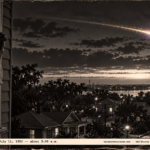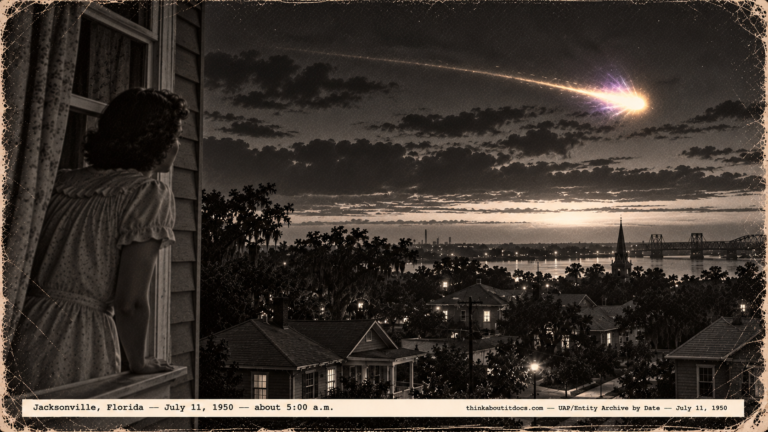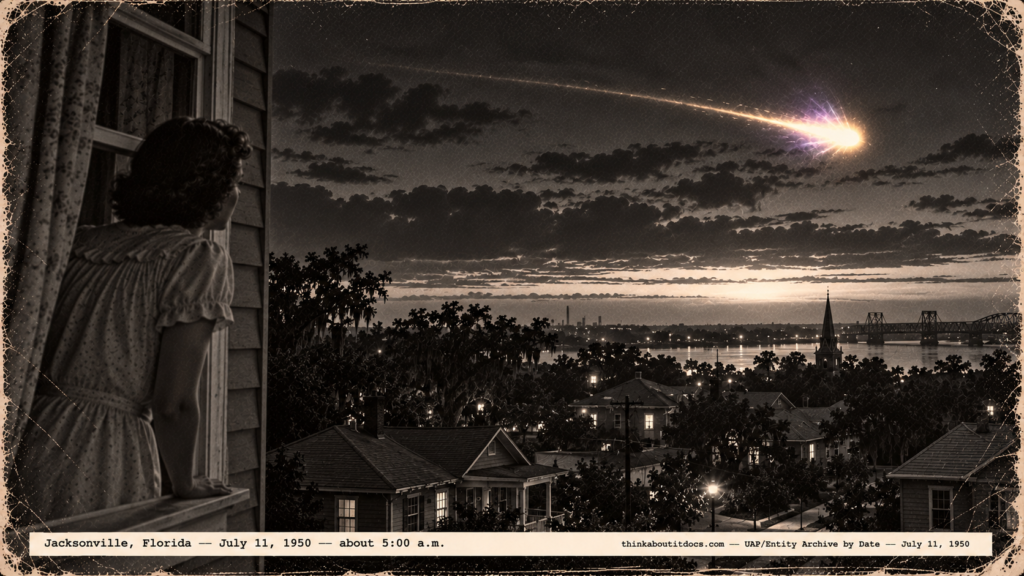
On July 11, 1950, a Jacksonville reporter watched a roaring golden light with violet flashes curve across the dawn sky.
THINK ABOUTIT UFO|UAP SIGHTINGS REPORT
1950: Jacksonville, Florida and Vandalia, Ohio
The Memo Telling Intelligence to Stop Asking
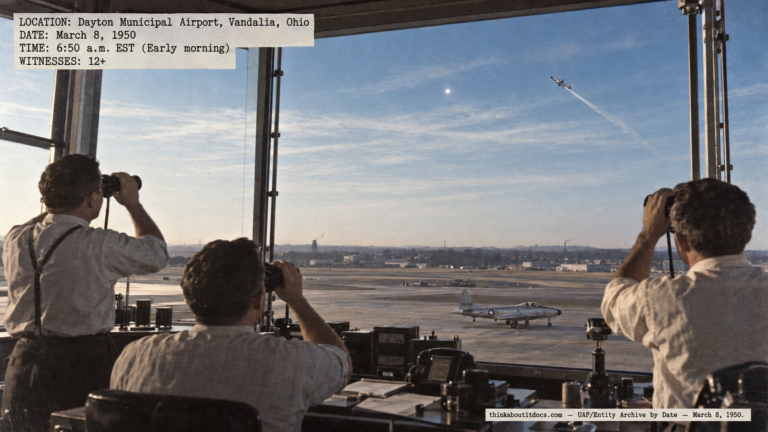
In the first half of July 1950, three small saucer stories passed through the files of Air Materiel Command. In Jacksonville, Florida, a newspaper reporter was jolted awake before dawn by a tremendous roar and watched a golden, violet-flashing object curve across the sky three times at about 15-minute intervals; two days later about a hundred people gathered outside the county courthouse to watch a shiny aluminum “pin-point” hover in a blue afternoon sky. At Vandalia, Ohio, outside AMC’s own front door, a woman driving to work and an AMC employee entering the base each reported something odd on the morning of July 14.
What makes this file memorable is the paperwork around it. An AMC intelligence officer phoned the Vandalia driver without telling her he worked for the Air Force, then checked parachute drops, balloons and astronomy before filing a four-part memo. Five days later the chief of AMC’s Technical Analysis Division answered that too much time had been spent on it, and that excessive contacts “can only serve to keep our interest” in these matters under discussion by more people than they would like. This Jacksonville and Vandalia UFO file shows how the Air Force wanted to handle sightings in 1950.
Date: July 11, 13 and 14, 1950
Sighting Time: Jacksonville dawn lights: about 5:00 a.m. (a radio announcer said 4:00 a.m.); Jacksonville courthouse: about 3:45 p.m.; Vandalia: 7:51 a.m. and about 8:30 a.m.
Day/Night: Dawn (Jacksonville, July 11) and day (Jacksonville July 13, Vandalia July 14)
Location: Jacksonville, Florida (the Riverside area and the county courthouse, Forsyth Street side); Vandalia, Ohio (Martindale Road at Frederick Pike, about six miles west of town, and Area C at Air Materiel Command, Wright-Patterson AFB)
Urban or Rural: Urban (Jacksonville); rural and base grounds (Vandalia)
No. of Entity’s: 0 — Not Applicable
Entity Type: Not Applicable
Entity Description: Not Applicable
Hynek Classification: NL (Jacksonville dawn lights); DD (courthouse object and Vandalia reports)
Duration: Jacksonville dawn: three passes about 15 minutes apart; courthouse object watched for an unstated period while it drifted upward; Vandalia: about half a minute (driver) and several minutes (AMC employee)
No. of Object(s): Three (Jacksonville dawn); one each (courthouse, Vandalia)
Description of the Object(s): Jacksonville dawn: a great golden light with violet flashes forming a short comet tail, glowing from beneath, wavering like a phonograph record on an uneven center, with a roar that rose and fell in a rhythm. Courthouse: a shiny aluminum round “pin-point.” Vandalia: a grayish-white sphere “like a parachute” with no reflection in bright sun; a bright silver object that climbed from 1,000 to 10,000 feet
Shape/Size/Color of Object(s): Golden-violet lights, consensus size 20 to 30 feet (Jacksonville dawn); round, shiny aluminum, size not determinable (courthouse); gray-white sphere (Vandalia)
Distance to Object(s): About 500 feet up at first (Jacksonville dawn); too high to resolve (courthouse); about 5,000 feet (Vandalia driver)
Height & Speed: 500 feet on first pass, about 15,000 feet per a radio announcer; courthouse object hovered and drifted upward; Vandalia sphere at high speed to the northeast
Number of Witnesses: A reporter, a radio announcer and a number of residents (Jacksonville dawn); about fifty courthouse employees and as many passersby; one woman driver and one AMC employee (Vandalia)
Special Features/Characteristics: The Vandalia witness was interviewed by an AMC intelligence officer without disclosure of his AMC connection; AMC memo advising fewer contacts
Case Status: Jacksonville dawn lights: A/C (card); courthouse object: Astro (Venus) (card); Vandalia reports: A/C (cards)
Source: Project 10073 Record Cards; Florida Times-Union, July 11 and 14, 1950; Miami Herald (UP), July 13, 1950; Third Army letter, July 17, 1950; AMC memorandum MCIAXA-1, July 14, 1950; Colonel Feiling memorandum, July 19, 1950
Summary/Description: Dawn lights over Jacksonville, a courthouse crowd, two Vandalia reports and an AMC memo advising intelligence officers to ask fewer questions.
Related Cases: Cincinnati, Ohio (July 1950) and Detroit (July 20) in the same month; no direct link established
Detailed Report
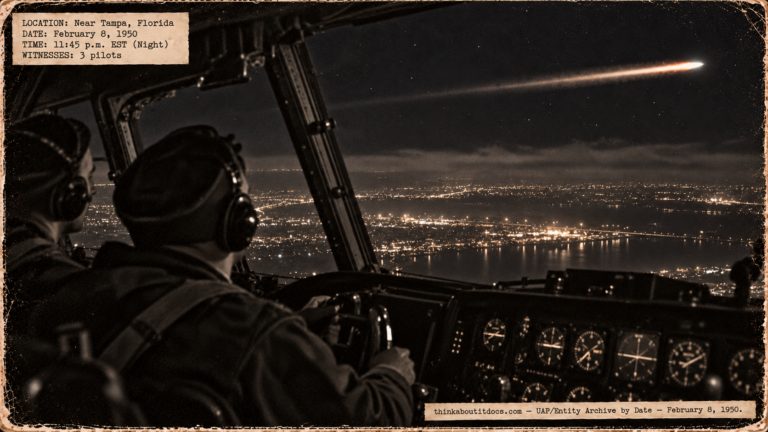
Jacksonville dawn. Times-Union reporter Toni Veverka wrote that she was shocked awake at about 5 a.m. by a tremendous roar, quite unlike that of several bombers because it lacked a steady sound and not like the whine of a jet. Out of the southeast, at about 500 feet, came a great golden light carrying no running lights; the entire object seemed suffused from beneath with a glow that surged with each increase of the roar, which rose and fell like a one-two-three, pause rhythm. As it passed she saw violet flashes spurting into a short comet’s tail; from behind it seemed to waver up and down like a gramophone disc on an uneven center. Far to the northwest it made a sweeping curve and returned apparently to its starting point. She watched from the window, and in about 15 minutes another came, much higher, on about the same course, and 15 minutes after that a third. She wrote that one thing was certain: it was no interplanetary machine, and was bound to have the made-in-America stamp on it.
Other Jacksonville witnesses. A UP story carried in the Miami Herald said the roar woke a number of residents. Radio station WMBR announcer Joe Noll saw three objects at 4 a.m. “flashing a red light, flying concentric circles at about 15,000 feet.” Another report said they moved like a ball of fire. The consensus was that they were 20 to 30 feet in diameter. The story noted that the military services had repeatedly denied knowledge of flying saucers. The Air Force card records golden light and violet, an altitude of 500 feet, three in the group, a roar unlike heavy bombers and a sweeping-curve maneuver, evaluated A/C.
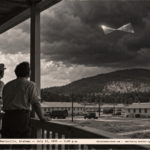
The courthouse. At about 3:45 p.m. on July 13, scores of people gathered on the Forsyth Street side of the county building to watch a shiny aluminum “pin-point” in the blue sky, too high to show features other than that it was apparently round. Two jet planes passed well beneath it, with a wingspan about twice the object’s diameter. Conservative spectators guessed a large weather balloon. It apparently hovered in one spot laterally while slowly drifting upward until it disappeared. It emitted no fiery jets and no noise. The Project 10073 card reads Astro (Venus): observation of Venus during daylight hours, with Venus in the reported position of the object.
Vandalia. A July 14 AMC memorandum describes two reports. A woman in the Advertising Department of a Dayton-area store mentioned to friends in the AMC Intelligence Department that she had seen an object; an AMC officer called her without giving his name or saying he was connected with AMC. She described a spherical object, much like a parachute, moving at high speed to the northeast about six miles west of Vandalia at 8:30 a.m. The most significant fact she noticed was that the sun was very bright but there appeared to be no reflection from the object. It was grayish white, silent, in view about half a minute at an estimated 5,000 feet. AMC found no parachute drops that morning and no balloons released; the chief forecaster at Vandalia said the wind was from the northeast at 7 mph under clear sky, and a remote possibility was a large radio-signal weather balloon released at Chanute Field or Toledo. An astronomy consultant said no planet could be seen in the daytime at that time of year. The memo concludes that no explanation can be made beyond the general explanation in the Intelligence Department’s report. A second AMC employee reported at 7:51 a.m. a very bright, silver, saucer-like object over Area C that climbed from about 1,000 to about 10,000 feet over several minutes; she thought it was a small airplane taking off from Patterson Field. Operations said nothing took off from Area C then, though many aircraft were probably at various altitudes nearby.
The memo. On July 19, 1950, Col. Feiling, Chief of the Technical Analysis Division of the AMC Intelligence Department, wrote that although an investigation had been requested, it appeared too much time had been spent on it. He suggested that in future incidents officers contact the individual concerned to get his or her story, and, if no other personnel had reported the same incident, there was no justification for contacting as many agencies as in this case. It seemed evident, he wrote, that a legitimate sighting would be reported by a number of people, and excessive contacts could only keep the department’s interest a subject of discussion by more people than they would like. Third Army had forwarded the Jacksonville clippings to AMC on July 17.
RESEARCHER’S NOTES
What the File Is Really About
- The memo: Read plainly, the July 19 memo tells officers not to chase single-witness reports and to avoid broadening awareness that the Air Force was looking. It is a policy statement about visibility, not an evaluation of any sighting.
- Dates at Jacksonville: The Times-Union piece is dated July 11; the Miami Herald says early Wednesday, July 12. The Air Force card and the Blue Book listing use July 11.
- Venus: The Jacksonville courthouse card says Venus in daylight; the AMC astronomer in the Vandalia memo said no planets could be seen in daylight at that time of year. The file does not reconcile the two statements, which concern different cases and days.
- Disguised interview: The Vandalia call was made without revealing the Air Force affiliation, a practice the memo describes without comment.
- Missing clipping: The Third Army letter lists three Jacksonville clippings; a handwritten note marks the July 14 clipping as missing from the file, though a copy is present in this scan.
- No mutual link: The three Jacksonville and Vandalia episodes are grouped by file folder, not by any evidence they were the same phenomenon.
These cases are small and each has a conventional explanation on the table. The reason they are worth preserving is the official handling: an intelligence officer calling a witness without identifying himself, and a division chief telling his staff that interest in these reports should not become a talking point. That is a record of 1950 policy as much as of 1950 sightings.
“Excessive contacts can only serve to keep our interest in these matters”
— Col. Feiling, Chief, Technical Analysis Division, Air Materiel Command Intelligence Department, July 19, 1950