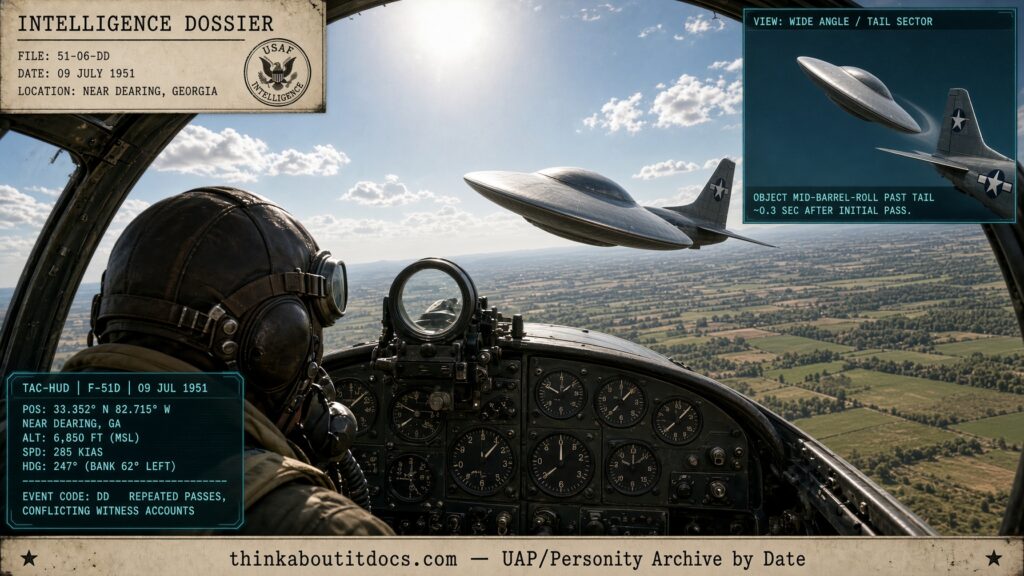
1st Lt. George Kinmon's July 9, 1951 encounter near Dearing, Georgia, in which his F-51 was repeatedly dive-bombed by a fast, white, disc-shaped object.
THINK ABOUTIT UFO|UAP SIGHTINGS REPORT
1951: The Lt. George Kinmon Pursuit — Near Dearing, Georgia
On the afternoon of July 9, 1951, an Air Force F-51 pilot flying a routine reconnaissance heading over rural Georgia found himself the target of a fast, white, oval disc that dove head-on at his aircraft from out of the sun — not once, but repeatedly, missing his fighter by what he estimated as only a few hundred feet each time. 1st Lt. George H. Kinmon, Jr. gave at least two accounts of the encounter that differ meaningfully in duration and detail, a discrepancy this archive preserves honestly rather than smoothing over, but both versions agree on the essential shape of the case: a trained military pilot, in broad daylight, describing an object that appeared to deliberately close on his aircraft multiple times before climbing away out of sight.
Date: July 9, 1951
Sighting Time: 1:40-1:50 p.m. EST
Day/Night: Day
Location: Near Dearing, Georgia, approximately 25 miles west of Augusta
Urban or Rural: Airborne, over rural Georgia
No. of Entity(‘s): Not applicable
Entity Type: Not applicable
Hynek Classification: DD (Daylight Disc)
Duration: Approximately 10 minutes overall; individual accounts differ on the internal structure (see Detailed Report)
No. of Object(s): 1
Description of the Object(s): A flat-topped and flat-bottomed, white (not aluminum-colored) oval or disc-shaped object, with rounded, slightly beveled edges and small, crater-like spots on its surface; viewed from above during its dive, it appeared round and spinning clockwise; no vapor trail, exhaust, or visible means of propulsion was observed
Shape of Object(s): Oval/disc, flat on top and bottom
Size of Object(s): Estimated at roughly twice the size of Kinmon’s F-51 (about 75 feet) in his initial account; estimated at 10-15 feet in diameter in his later account to AFOSI investigators — a substantial and unresolved discrepancy
Color of Object(s): White
Distance to Object(s): Estimated at 300-400 feet at closest approach, per Kinmon’s AFOSI account
Height & Speed: Kinmon’s F-51 was cruising at 250-270 mph at 8,000-8,500 feet on a heading of 247°; the object approached from the direction of the sun (roughly 237° azimuth, 72° elevation) at very high speed, comparable to a jet aircraft by Kinmon’s own comparison, diving beneath his plane on each pass
Number of Witnesses: 1 (1st Lt. George H. Kinmon, Jr.)
Special Features/Characteristics: The object made repeated head-on diving passes at the aircraft over a period of minutes; Kinmon reported feeling a turbulent-air “bump” as the object passed beneath his plane on at least one pass; no propulsion system, exhaust, or vapor trail was visible despite the object’s high speed and maneuverability.
Case Status: Unexplained
Source: Weinstein, Dominique; NICAP; Project Blue Book files; Loren Gross, UFOs: A History — 1951, pp. 33, 41
Summary/Description: At approximately 1:40 p.m. on July 9, 1951, 1st Lt. George H. Kinmon, Jr., flying an F-51 fighter out of Lawson AFB, Columbus, Georgia at 250-270 mph and 8,000-8,500 feet, saw a fast-moving white oval disc approaching from the direction of the sun on a head-on collision course near Dearing, Georgia. The object suddenly dove beneath his aircraft, narrowly missing it. Kinmon turned to pursue but could not locate it; roughly 15 seconds later, the object made another head-on diving pass, and repeated the maneuver several times before climbing away and disappearing on its final pass. Kinmon’s initial estimate placed the object at roughly twice the size of his own aircraft (about 75 feet); in a separate, conflicting account given to Air Force Office of Special Investigations personnel, he instead described the object as only 10-15 feet in diameter, seen at a distance of 300-400 feet, and stated that after its first dive the object had continued barrel-rolling around his aircraft for roughly ten minutes before finally disappearing beneath the plane. In both versions, Kinmon described the object as flat-topped and flat-bottomed, white in color, with rounded, slightly beveled edges and small crater-like markings, spinning clockwise when viewed from above during its dives, with no visible vapor trail, exhaust, or propulsion system. He compared its speed to that of a jet aircraft and reported feeling a turbulent “bump” of displaced air as it passed beneath his plane. The object was last seen departing a few miles south of Milledgeville, roughly 15-20 miles from Macon.
Related Cases: 1951: The Robert Haven Pursuit, Lakehurst, New Jersey (comparable aggressive, repeated head-on pass structure) | The Gorman Dogfight, 1948
Detailed Report
The Kinmon case is, in its behavioral structure, one of the clearest examples in this archive of an object appearing to deliberately and repeatedly engage a military aircraft rather than simply being observed once and lost. A single head-on near-miss might plausibly be attributed to an unlucky encounter with a balloon, debris, or a misjudged distance on a fast-moving conventional object; a sequence of several separate diving passes, each timed with roughly consistent intervals, is a much harder pattern to explain as anything other than either a genuinely maneuvering craft or a persistent misperception across an extended and stressful several minutes of flight.
The case’s most serious analytical weakness is the significant discrepancy between Kinmon’s two recorded accounts — a roughly 75-foot object seen at some distance in the earliest telling, versus a much smaller, 10-15-foot object seen at close range (300-400 feet) with an extended barrel-rolling maneuver in his later AFOSI interview. This is not a minor rounding difference; it describes objects differing by a factor of five in size, observed under meaningfully different circumstances. Such a discrepancy could reflect the genuine difficulty of judging the size and distance of a fast-moving, unfamiliar object under high-stress conditions (a well-documented human perceptual limitation, especially for pilots encountering something with no clear size reference), or it could reflect embellishment or confusion introduced between the initial report and the later, more formal interview. This archive preserves both versions rather than silently picking one, precisely because the discrepancy itself is analytically significant.
The absence of any observed exhaust, vapor trail, or visible propulsion system, despite performance Kinmon compared directly to a jet aircraft, is consistent with a broader pattern this archive has documented across many 1950-51 military pilot encounters — object descriptions that combine extreme performance with an absence of any conventional means of achieving it. Whether this reflects a genuinely exotic technology, a systematic gap in what era-appropriate witnesses knew to look for, or simply the practical difficulty of spotting a thin exhaust trail on a fast-diving object glimpsed only briefly on each pass, cannot be determined from Kinmon’s account alone.
RESEARCHER’S NOTES
The Kinmon Pursuit — Georgia 1951 and the Problem of a Witness’s Own Conflicting Accounts
- Classification issues: DD is applied for the case’s daytime, resolved-shape visual profile, though the object’s extreme maneuverability and apparent deliberate engagement with the aircraft give it more in common with dogfight-style NL cases like Robert Haven’s than with a typical passive daylight disc sighting.
- Source chain assessment: Unusually for this archive, the case’s central complication is not a gap between secondary sources but a genuine, substantial discrepancy between the witness’s own two tellings of the same event — his original report and his later AFOSI interview. Both are independently preserved in the surviving Blue Book-adjacent literature (Weinstein, NICAP, Loren Gross), giving researchers the rare ability to compare a witness’s account against itself.
- Pattern context: The case belongs to a small but notable category of 1950-51 military pilot encounters featuring repeated, aggressive head-on passes rather than a single distant sighting — see also the November 1950 Robert Haven case off Lakehurst, New Jersey — suggesting either a shared genuine phenomenon or a shared narrative pattern already circulating among military aviators by this period.
- Physical evidence and evidentiary weight: No photograph, radar corroboration, or second witness exists. The case rests entirely on one pilot’s testimony, complicated by his own internally inconsistent retellings — a real limitation that should temper confidence in any specific detail even while the broader shape of the encounter (repeated close passes by a fast, white, disc-shaped object) remains consistent across both versions.
- Geographic and historical context: The sighting occurred during an active Air Force reconnaissance training flight out of Lawson AFB, placing the witness in a professional aviation context similar to many of this archive’s other credible 1950-51 military pilot cases.
The Kinmon pursuit stands as a genuinely puzzling military pilot encounter, made more interesting rather than less by the honest preservation of its witness’s own conflicting accounts. Whatever object dove repeatedly at Kinmon’s F-51 that July afternoon, its behavior — sustained, repeated, close-range engagement with a moving aircraft — is difficult to explain as a passive misidentification, even as the specific size and distance details remain genuinely unresolved between the witness’s two tellings. It is catalogued here as Unexplained: a credible pilot’s account of a persistent aerial confrontation, honestly presented with its own internal inconsistencies intact.
“No vapor trails or exhaust or visible system of propulsion… traveling tremendous speed.”
— 1st Lt. George H. Kinmon, Jr., on the July 9, 1951 encounter near Dearing, Georgia