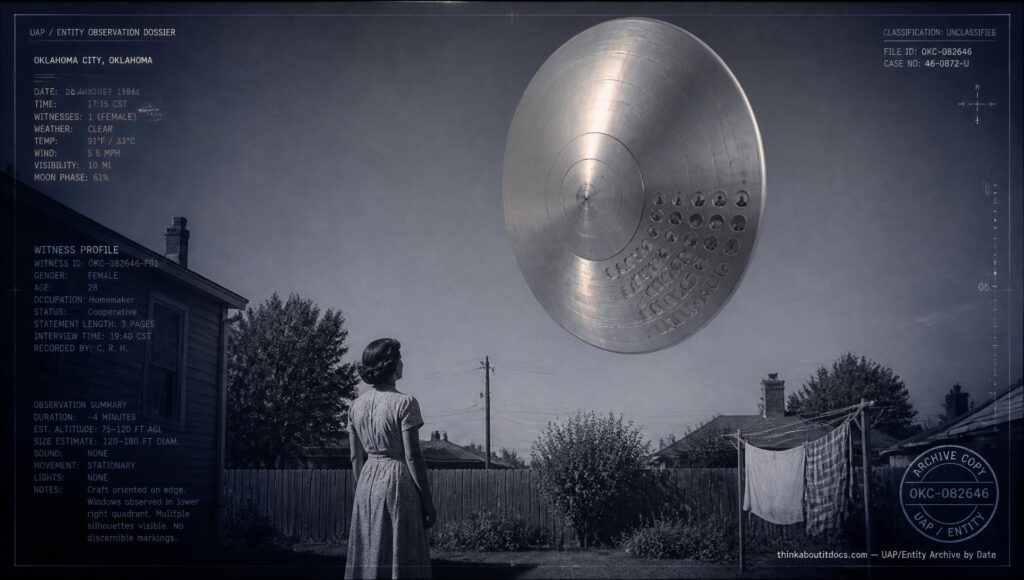
Late August 1946 — Oklahoma City. A woman watched a silent, edge-on metallic disc for 90 seconds, twelve round-headed silhouettes visible behind its windows, before it leveled off and vanished — investigated in a 14-page case study by ufologist Ted Bloecher.
THINK ABOUTIT UFO | UAP SIGHTING REPORT
1946: The Oklahoma City Disc — Twelve Faces in the Windows
A woman stepped into her own yard on a late August evening in 1946 and watched a huge metallic disc tip up onto its edge close overhead, its windows lined with silhouettes she could count — twelve of them, round-headed, motionless, watching back. Ninety seconds later it leveled off and vanished. This isn’t a case that surfaced decades later through hazy recollection. It was investigated at length, close to living memory, by one of the more serious and credentialed figures in early American ufology.
Date: Late August, 1946 (precise date not preserved in surviving sourcing)Sighting Time: 17:15
Day/Night: Day, clear weather
Location: A private residential yard, Oklahoma City, Oklahoma
Urban or Rural: Urban/suburban residential
No. of Entity(s): 12 (visible as silhouettes; not directly observed outside the craft)
Entity Type: Humanoid, based on silhouette only
Entity Description: Visible only as silhouettes of head and shoulders through the craft’s windows. Heads appeared quite round, either bald or wearing helmets; no further physical detail (facial features, coloring, clothing) could be discerned given the distance and the silhouette-only visibility.
Hynek Classification: CE-III — Close Encounter of the Third Kind. Occupants were directly observed aboard the craft at close range, meeting the standard definition for this classification tier, though no direct occupant-to-witness interaction occurred.
Duration: Approximately 90 seconds
No. of Object(s): 1
Description of the Object(s): A metallic, lens-shaped disc, observed standing on edge (i.e., oriented vertically rather than flat/horizontal) at first sighting. The lower right quadrant of the craft, as seen by the witness, was densely filled with windows, through which the twelve occupant silhouettes were visible. After approximately a minute and a half of this stationary, edge-on orientation, the object rotated to a level, horizontal orientation before accelerating away and disappearing within seconds.
Shape of Object(s): Lens-shaped disc
Size of Object(s): Approximately 80 feet across
Color of Object(s): Aluminum/metallic in appearance
Distance to Object(s): Close range — near enough for the witness to resolve individual window silhouettes at head-and-shoulders detail, implying a relatively low altitude and/or close horizontal distance
Height & Speed: Low altitude, hovering/low-speed during the main observation period; departed at high, unspecified speed, vanishing within seconds of leveling off
Number of Witnesses: 1 — a female witness, observing from her own yard (surname(s) referenced in shorthand in the original source as “Schoonover; Sprankle,” likely denoting either the primary witness and a secondary source/corroborator, or two related witnesses; this archive has not been able to fully disambiguate the exact roles from the available shorthand citation)
Special Features/Characteristics: The craft produced no sound at any point during the encounter, despite its size and the eventual high-speed departure; the “standing on edge” orientation is an unusual detail — most disc-shaped UFO reports of this era describe a flat, horizontal orientation, making this account’s specific edge-on initial posture, followed by a deliberate rotation to level flight orientation before departure, a distinctive behavioral sequence; the case was the subject of a dedicated 14-page case summary by Ted Bloecher, with direct interviews conducted jointly by Bloecher, Lucius Farish, and Mildred Higgins — a level of documented, multi-investigator scrutiny uncommon for a case from this early period.
Case Status: Unexplained
Source: Case summary by Ted Bloecher, 14 pages; interviews conducted by Bloecher, Lucius Farish, and Mildred Higgins; catalogued with reference “Ref. 3”
Related Cases: 1946: August UFO & Entity Sightings Archive
Detailed Report
In the late summer of 1946, a woman in Oklahoma City stepped into her own yard at 5:15 in the afternoon, under clear skies, and saw something that did not resemble any conventional aircraft of the period: a large, metallic, lens-shaped disc, roughly 80 feet across, positioned on edge — standing vertically rather than lying flat, the orientation most commonly associated with disc-shaped UFO reports of the era.
The craft’s lower right quadrant, from the witness’s vantage point, was densely lined with windows. Within each of these windows, she could make out a distinct silhouette: a head and shoulders. In total, she counted twelve such figures. The heads appeared notably round, and she could not determine from the silhouettes alone whether this roundness reflected the shape of the occupants’ heads directly or the presence of helmets. No further detail — facial features, coloring, posture, or activity — could be resolved at the distance and light conditions involved. The craft remained silent throughout the entire encounter, producing no engine noise, hum, or any other audible sound despite its considerable apparent size.
The witness observed this scene for approximately ninety seconds. At the end of that period, the craft rotated from its edge-on orientation to a level, horizontal position — “leveled off,” in the case summary’s own phrasing — and then accelerated away, disappearing from view within seconds. The entire encounter, from first sighting to departure, appears to have lasted under two minutes.
What distinguishes this case within the broader 1946 record is the depth of its subsequent investigation. Ted Bloecher, who would go on to co-found the influential UFO research group Civilian Saucer Intelligence in 1954 and later serve as a NICAP officer, produced a full 14-page case summary on this specific encounter. He conducted interviews jointly with two other named researchers, Lucius Farish and Mildred Higgins — a level of documented, multi-investigator engagement rarely applied to individual cases from this early period of the postwar UFO record. Bloecher’s later career underscores the seriousness of his methodology: in 1967 he authored the definitive scholarly reference work on the entire 1947 American flying disc wave, a study still cited by researchers today.
RESEARCHER’S NOTES
A Serious Investigator on a Case with an Unusual Detail
- On why Bloecher’s involvement matters: Ted Bloecher was not a fringe figure or a casual UFO enthusiast. His co-founding of Civilian Saucer Intelligence, his later work with NICAP, and above all his 1967 report on the 1947 flying disc wave — still regarded as a serious, methodical piece of ufological scholarship decades later — establish him as one of the more credible early investigators in the field’s history. A 14-page case summary, produced with two additional named co-investigators, represents a level of documentary rigor this archive rarely encounters for a mid-1940s American sighting. That doesn’t confirm the account, but it does mean the case was taken seriously and examined carefully by someone whose broader body of work reflects genuine methodological care.
- On the single-witness limitation: Despite the strength of its investigation, this remains fundamentally a single-witness case. No second observer, no photograph, and no physical trace evidence corroborates the account. The quality of the investigation speaks to how carefully the witness’s testimony was examined and recorded, not to independent verification of the events themselves. This distinction matters: a well-investigated single-witness account is more reliably documented than a poorly recorded one, but it remains, at its evidentiary core, one person’s report.
- On the “edge-on” orientation detail: The craft’s initial vertical, edge-on posture, followed by a deliberate rotation to horizontal flight orientation before departure, is a specific and somewhat unusual detail. Most contemporaneous and later disc-shaped UFO reports describe objects in level, horizontal orientation throughout. Whether this detail reflects a genuine behavioral or structural characteristic of whatever the witness saw, or a perceptual artifact of viewing a rotating or tumbling object from a fixed ground position, cannot be determined from the surviving case summary alone.
- On the silence of the craft: The complete absence of sound, despite the craft’s substantial size (80 feet across) and its eventual high-speed departure, is consistent with reports across many entity/occupant cases in this archive and stands in notable contrast to the loud whistling, roaring, or engine-like sounds described in many of this same month’s Scandinavian ghost rocket entries. Whether this represents a meaningful category distinction between “occupant disc” cases and “unmanned rocket-like object” cases in the broader 1946 record, or simply reflects the specific circumstances of each individual sighting, is an open question this archive does not attempt to resolve.
A silent disc, twelve round-headed silhouettes behind a bank of windows, ninety seconds in an Oklahoma City backyard — and then gone. Ted Bloecher spent fourteen pages trying to pin down exactly what one woman saw that August evening in 1946. What he produced is one of the more carefully documented single-witness entity cases in this entire archive, and, by his own investigation’s own conclusion, no closer to an answer than the moment it happened.