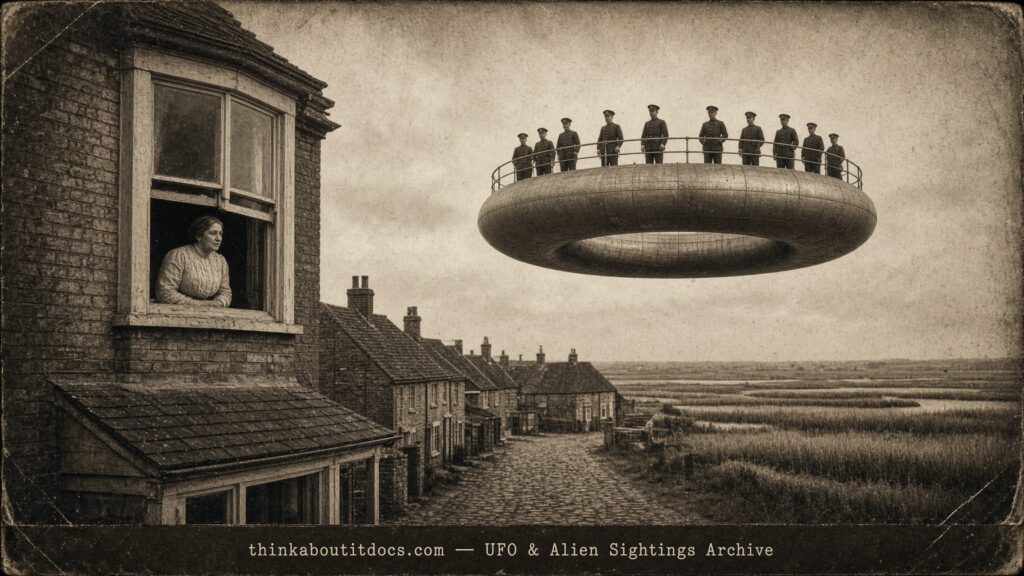
1916, Aldeburgh, England — Mrs. Agnes Whiteland watched a silent, propulsion-free platform carrying eight to twelve uniformed men float past her window at rooftop height.
THINK ABOUTIT UFO|ENTITY ENCOUNTER REPORT
The 1916 Aldeburgh, England Platform Encounter
Agnes Whiteland’s Fifty-Year Silence
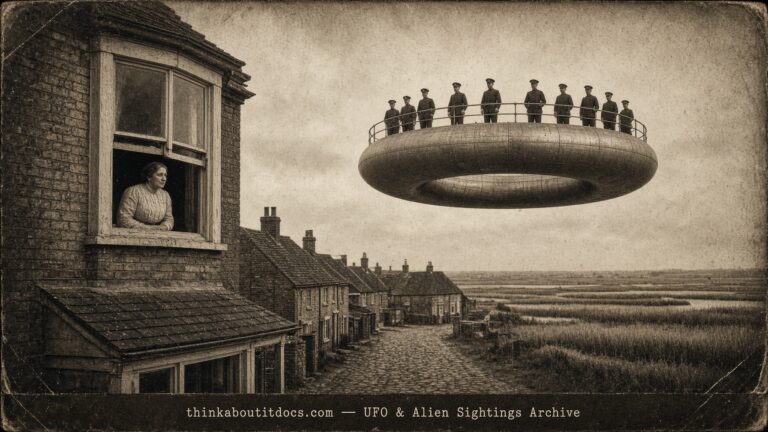
One midday in 1916, Mrs. Agnes Whiteland looked out a second-story window in Aldeburgh, Suffolk, and saw something floating past at rooftop height: a thin, ring-shaped platform, hollow in the center like a doughnut, carrying eight to twelve men in blue sailor’s uniforms who gripped a brass handrail around its edge. No sound. No visible engine. It approached slowly from nearby marshes, turned, and vanished behind the houses — and Mrs. Whiteland told no one outside her own family for over fifty years, until her son finally wrote to a national newspaper on her behalf, asking if anyone, anywhere, could explain what his elderly mother had seen as a young woman.
Date: 1916
Sighting Time: 11:55 AM
Day/Night: Day
Location: Aldeburgh, Suffolk, England
Urban or Rural: Urban (coastal town, residential street)
No. of Entity(s): 8 to 12
Entity Type: Human-appearing occupants of a hovering platform
Entity Description: Wearing blue uniforms and small, round, sailor-style caps; staring straight ahead and gripping a brass handrail tightly throughout the sighting
Hynek Classification: CE-III
Duration: Under 5 minutes
No. of Object(s): 1
Description of the Object(s): A round, torus-shaped (“doughnut”) platform roughly a foot thick, hollow at the center, with a brass handrail around its edge
Shape of Object(s): Torus/ring-shaped
Size of Object(s): Approximately 1 foot thick; overall diameter undocumented
Color of Object(s): Undocumented
Distance to Object(s): Approximately 20 feet above the ground, passing near enough to a second-story window for detailed observation
Height & Speed: Roughly 20 feet altitude, moving at a slow walking pace
Number of Witnesses: 1 direct witness (Mrs. Agnes Whiteland); reported decades later by her son, Alfred Whiteland
Special Features/Characteristics: No propulsion mechanism or sound of any kind was evident; the platform’s occupants remained rigidly still throughout, gripping the handrail and staring ahead rather than looking around or interacting with the environment
Case Status: Insufficient Data
Source: Creighton, Gordon, FSR (Flying Saucer Review) Vol. 15, #1, reporting Alfred Whiteland’s 1968 letter to the Daily Mirror describing his mother’s account
Summary/Description: Mrs. Agnes Whiteland, looking out a second-story window, watched a thin, ring-shaped platform float past at rooftop height, carrying eight to twelve uniformed men gripping a handrail. It approached slowly, turned, and disappeared behind nearby houses. The account went unpublished for over fifty years.
Related Cases: Part of the same general pre-war “occupied craft” pattern as the 1910 Invercargill, New Zealand and 1913 Killary Harbor, Ireland cases documented elsewhere on this site
DETAILED REPORT
The account survives through one channel only: a 1968 letter from Alfred Whiteland to the Daily Mirror, written on behalf of his elderly mother, and subsequently documented by Gordon Creighton in Flying Saucer Review. Alfred’s letter describes what his mother, Agnes, had told the family for decades but had never volunteered publicly: that as a young woman in 1916, she had looked out a second-story window in Aldeburgh and seen something impossible float past at close range.
What she described was a platform roughly a foot thick, appearing hollow at its center — Alfred’s own comparison was to a doughnut shape — with a brass handrail running around its outer edge. Eight to twelve men stood aboard it, gripping that rail with both hands, dressed in blue uniforms with small, round caps not unlike a sailor’s. None of them appeared to move, speak, or look around; by Agnes’s account, they stared fixedly ahead for the entire encounter, as though either unaware of her or entirely indifferent to being seen.
The platform approached slowly from the direction of nearby marshland, at a height of roughly 20 feet — level with, or just above, the rooftops of the street. It made a turn, still at walking pace, and passed from view behind neighboring houses. The whole event, start to finish, lasted under five minutes. Agnes reported no sound at any point — no engine noise, no rush of wind, nothing to suggest any conventional means of propulsion for an object of that description moving through the air.
Alfred’s letter makes clear why the account took over fifty years to surface: his mother had simply never told anyone outside the family. It was only as she aged that he decided to write in on her behalf, framing the letter as an open question rather than a claim — essentially asking whether any reader, anywhere, had ever encountered a description like it before, or could offer any explanation for what she’d seen as a young woman decades earlier.
RESEARCHER’S NOTES
Aldeburgh — Precision of Description, Absence of Corroboration
- This is one of the most physically precise craft descriptions in this archive’s pre-war record: a specific shape (torus/ring), a specific structural detail (brass handrail), a specific occupant count range, uniform description, and altitude estimate. That level of consistent, concrete detail across a fifty-year gap between event and publication is unusual — most decades-later testimony tends to be vaguer, not more specific, as memory naturally erodes detail rather than sharpens it.
- The fifty-two-year publication gap is a genuine evidentiary limitation, not just a curiosity: there is no way to verify what Agnes Whiteland told her family privately over five decades against what actually happened in 1916. The account we have is filtered entirely through Alfred’s 1968 letter, itself reporting his mother’s recollection of an event from his own childhood or before.
- The occupants’ rigid stillness is worth noting analytically: witnesses describing craft occupants in this archive’s other pre-war cases (Caerphilly Mountain, Killary Harbor, Invercargill) typically describe active behavior — working, talking, gesturing, reacting to being seen. The Aldeburgh occupants’ fixed stillness and lack of any apparent awareness of the witness is a distinct behavioral pattern from those other cases, whatever it might mean.
- No corroborating second witness, physical trace, or contemporary press account has been located for this case in any source reviewed, which is consistent with an event that, by the family’s own account, was never reported to anyone outside the household for half a century.
The Aldeburgh case offers one of this archive’s most vividly specific pre-war craft descriptions, delivered through one of its least verifiable channels — a son’s decades-later letter relaying his mother’s private, unpublished memory of a single afternoon in 1916. The precision of the account and the total absence of corroboration pull in opposite directions, and this page doesn’t try to resolve that tension for the reader.
“A little above the level of the house eight to twelve men appeared, on what seemed to be a round platform with a handrail around it… They were wearing blue uniforms and little round hats, not unlike sailors.”
— Alfred Whiteland, letter to the Daily Mirror, August 8, 1968, describing his mother Agnes Whiteland’s 1916 observation