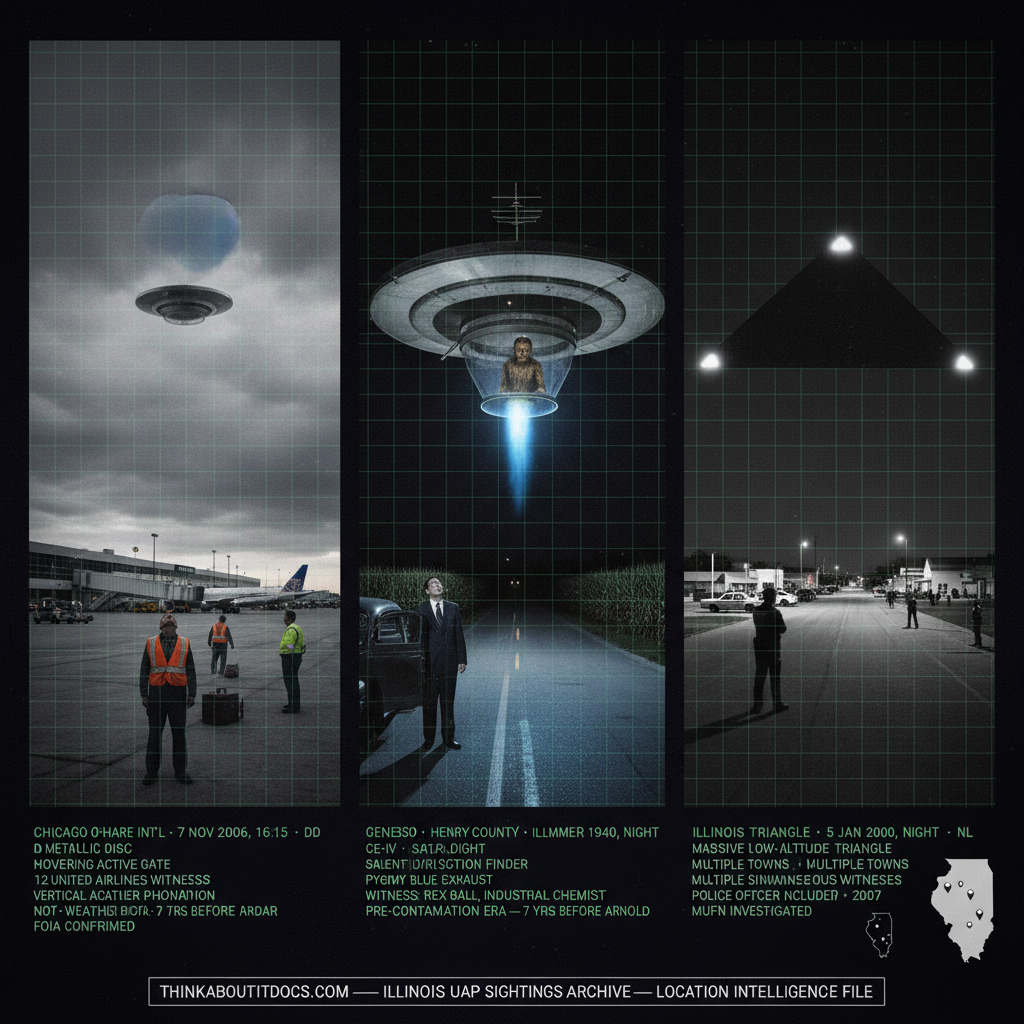
Illinois UAP archive: O'Hare Airport November 2006 metallic disc with 12 United Airlines employee witnesses, circular cloud hole on departure, FAA declined investigation (FOIA confirmed), Geneseo summer 1940 Rex Ball Saturn-disc CE-IV with radio direction finder and pygmy entities pre-1947, and January 2000 Illinois Triangle mass sighting across multiple towns (MUFON investigated). 13 documented cases 1888–2017.
Illinois UFO|UAP & Alien Sightings Archive
Illinois carries one of the most institutionally significant UAP cases in the national record: November 7, 2006, Chicago O’Hare International Airport, Gate C-17. At approximately 4:15 PM, a ramp employee pushing back United Airlines Flight 446 noticed a dark grey metallic saucer-shaped object hovering silently over Gate C-17 at low altitude. The sighting was immediately corroborated by twelve United Airlines employees — ramp workers, mechanics, pilots, and supervisors — who watched the object hover motionlessly before it accelerated straight up through the overcast cloud layer at extreme speed, punching a circular hole in the cloud cover that remained visible for several minutes afterward. The object was not detected on radar, which the FAA used as grounds to decline investigation, attributing it to a weather phenomenon. Twelve professional aviation employees at one of the world’s busiest airports, including pilots and management, simultaneously observing a metallic disc directly over an active gate before it accelerated vertically through clouds, is not a weather phenomenon by any framework that explains weather phenomena. The Chicago Tribune obtained FAA communications through a Freedom of Information Act request that confirmed the airport’s own reporting of the event, and the story ran nationally. The FAA’s refusal to investigate stands as one of the most explicitly documented institutional non-responses to a mass-witness aviation-industry UAP event in the record.
Against the O’Hare case’s institutional significance, Illinois carries a second analytically distinct case at the other end of the credibility spectrum: the 1940 Geneseo abduction of Rex Ball, an industrial chemist allegedly taken by three pygmy hairy entities aboard a Saturn-disc craft with radio direction finders, blue silent exhaust, and a journey to a subterranean facility beneath Fort Knox. Researchers have noted the 1960s Cold War paranoia overlay in the Fort Knox detail and the psychosocial complexity of the case. The pre-1947 date is the case’s most analytically useful feature — a 1940 Saturn-disc description predates post-war saucer culture by seven years and carries the specific Battelle morphology that appears in multiple other pre-1947 cases. The 2000 Illinois Triangle — a mass sighting stretching across multiple towns along the Illinois-Missouri border, investigated by MUFON with hundreds of witnesses — adds the decade’s most geographically extensive Illinois observation. The 1963 Wayne City car chase adds a law enforcement pursuit dynamic. Illinois’s thirteen documented cases span from 1888 to 2017 across the Chicago metro, the Mississippi River valley, the Illinois River bottomland, and the southern Shawnee National Forest.
- 1888: Sighting near Diamond Island, Illinois River, Illinois
- 1940: Lost UFO Abduction of Geneseo, Illinois
- 1952: UFO with Humanoids in Prospect Heights Illinois
- 1963: The Wayne City, Illinois Car Chase
- 1999: Abduction on Carlyle Lake
- 2000: Illinois Triangle UFO Sighting
- 2000: Oblong, Illinois Thee Orange Lights Coming Over The Tree-Line
- 2006: Disc Sighting in Northbrook, Illinois
- 2006: Multiple witnesses observe disc-shaped object over Chicago O’Hare Airport
- 2006: Illinois couple witness triangle over their home
- 2007: Silver saucer motionless over Grayslake, Illinois
- 2007: Typical “Sci-fi” saucer seen near Shawnee National Forest, Illinois
- 2017: Oz Park, Chicago, Illinois Mothman Sighting
- 1950: The Coulterville, Illinois Pilot Sighting
- 1952: Belleville, Illinois Case: Radar Targets, a Visual Fireball, and Front-Page Coverage
- 1954: The Chicago Lakefront Sighting — Lelah Stokes
- 1955: Rockford, Illinois: The Unsourced Claim of Jets Destroying a UFO
Executive Summary
O’Hare and the Institutional Non-Response — Illinois’s Modern Record
Illinois’s UAP archive is defined by its 2006 anchor case in a way that few state archives are defined by a single event. The O’Hare sighting is analytically significant not only for its evidence quality — twelve professional aviation workers, a metallic disc over an active gate, a circular hole punched through cloud cover on vertical acceleration — but for the institutional response it generated: the FAA’s explicit, documented refusal to investigate a multi-witness anomalous aerial event over the nation’s second busiest airport on the grounds that it was not on radar. The radar absence is itself anomalous — structured metallic objects at low altitude over O’Hare should produce radar returns. The FAA’s attribution of twelve simultaneous observations of a hovering metallic disc to a weather phenomenon, and its documented refusal to open an investigation, represents one of the most clearly articulated examples in the post-2000 record of institutional non-response to a high-quality UAP event. The FOIA-obtained FAA communications that confirmed the event’s reporting make the case’s paper trail one of the cleanest in the modern national archive. Illinois’s pre-modern entries — the 1888 Illinois River sighting, the 1940 Geneseo Saturn-disc with its pre-contamination craft description, the 1952 Prospect Heights humanoids — establish a state record that reaches back into the 19th century and carries the pre-1947 morphological thread into the 21st century’s most institutionally significant case.