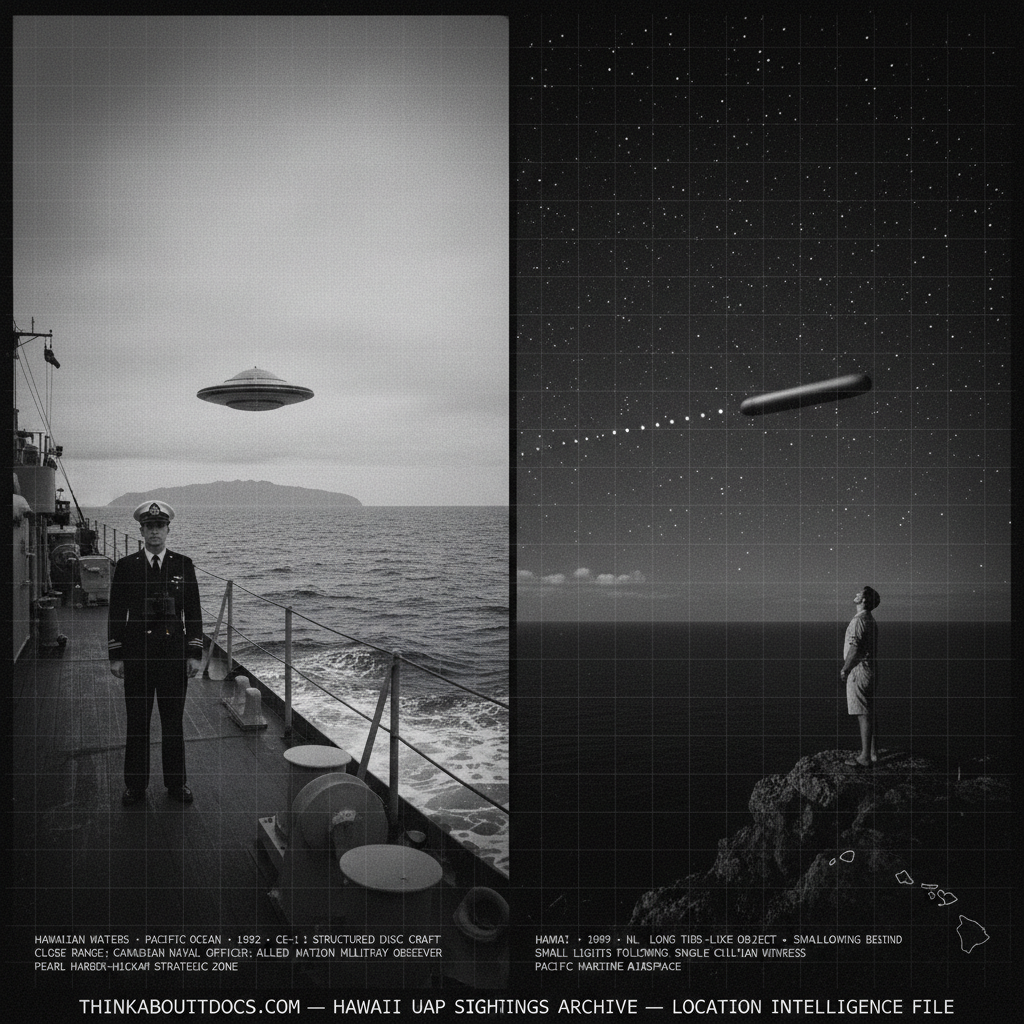
Hawaii UAP archive: 1952 Canadian Naval Officer CE-I close encounter in Hawaiian waters near the Pearl Harbor-Hickam strategic zone, and 1999 long tube-like object with trailing small lights observed over Hawaiian maritime airspace. Two documented cases — both maritime-adjacent, both in the most strategically isolated Pacific observation zone in the US archive.
Hawaii UFO|UAP & Alien Sightings Archive
Hawaii’s two-case UAP archive is one of the smallest in the national database, but its geographic position gives both cases a maritime and strategic significance that transcends their case count. Sitting at the center of the Pacific Ocean, 2,400 miles from the nearest continent, the Hawaiian Islands form the most isolated archipelago in the world and simultaneously host Pearl Harbor Naval Station, Hickam Air Force Base, and the Pacific Fleet headquarters — the westernmost permanent defense perimeter of the continental United States and the strategic anchor of American Pacific Command. Every anomalous observation in Hawaiian waters or airspace occurs at the intersection of the most heavily militarized maritime corridor in the Pacific and some of the most remote open ocean on the planet. The 1952 Canadian Naval Officer close encounter in Hawaiian waters — a CE-I involving a structured craft observed at close range from a naval vessel — places a professional military observer from an allied nation in direct proximity to an unidentified aerial object in one of the most strategically sensitive maritime zones in the world. That the observer was Canadian rather than American adds an independent allied-nation witness dimension that single-nation military records rarely carry.
The 1999 long tube-like object with small lights trailing behind it over Hawaii adds a modern maritime-adjacent sighting to the state’s record — the tube morphology with trailing lights is a consistent and unusual craft description that appears in a small number of other cases nationally and internationally across the same decade. Hawaii’s two documented cases cannot generate the analytical depth that larger state archives provide, but their maritime Pacific setting and the strategic military context of both observations distinguish them from the routine NL sighting pattern that most minimal state archives carry.
Executive Summary
The Pacific Sentinel — Hawaii’s Maritime Observer Record
Hawaii’s UAP archive is defined entirely by its geography. Two cases, both maritime-adjacent, both occurring in or over waters that are simultaneously the most remote and the most militarized in the Pacific. The 1952 Canadian Naval Officer case is the stronger of the two: a professional military observer from an allied nation, in his official capacity, observing a structured craft at close range in Hawaiian waters. Allied-nation military witnesses carry a specific credibility weighting in the UAP record — they have no domestic political framework to navigate, no classified report obligation to suppress their account, and no national security incentive to fabricate. The Canadian naval officer’s account of a CE-I in Hawaiian waters represents one of the cleaner institutional observer cases in the Pacific region pre-1947 through early-Cold War record. Hawaii’s isolation is its defining anomalous characteristic: anything anomalous observed here occurs far from the cultural contamination of mainland reporting networks, in conditions of oceanic isolation where misidentification of conventional aircraft is structurally less likely than over any continental American state.