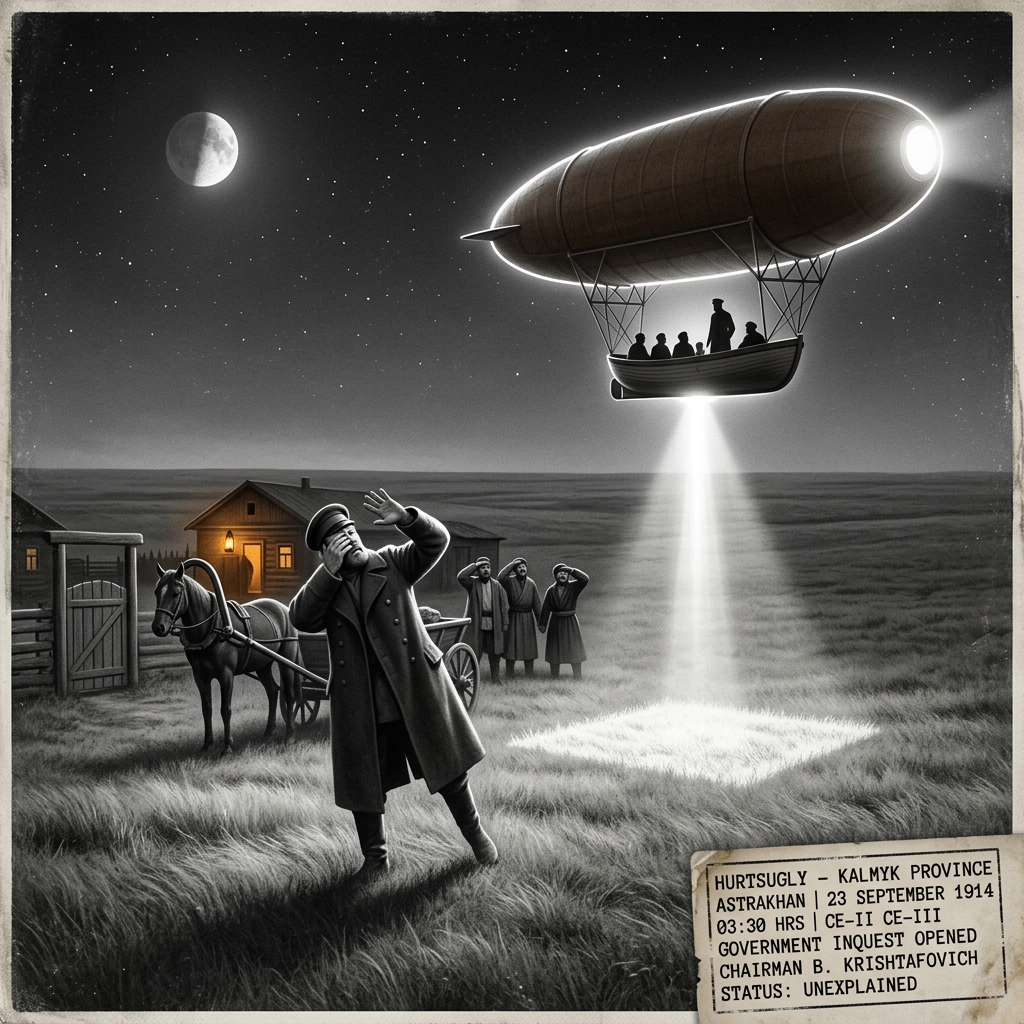
Hurtsugly, Kalmyk Province, Astrakhan, Russia, September 23, 1914, 3:30 AM — Vasiliy Sokolov watched a brown cigar with a suspended boat containing six shadow occupants descend, emit a blinding beam illuminating a ground square, rotate on its axis, and depart north. The Chairman of the Kalmyk Province opened an official government inquest. Source: Mikhail Gershtein, Crossroads of Centaurs #2, 1999; Zauralsky Kray newspaper. Case status: Unexplained.
THINK ABOUTIT UFO | UAP | ENTITY | ENCOUNTER REPORT
1914: ASTRAKHAN STEPPE, RUSSIA — THE GOVERNMENT INQUEST
At 3:30 in the morning of September 23, 1914, a stone contractor named Vasiliy Alexandrovich Sokolov had harnessed his horse in the yard of a small Kalmyk steppe village and was about to continue his journey when a bright star-like object appeared in the sky and began descending. It resolved into a cigar-shaped body outlined in bright light, brown in color, with a bright light on the front — and beneath it, suspended, a smaller craft approximately seven times smaller. In the suspended boat the shadows of six men were visible. Five sat. One stood taller than the rest. The cigar turned perpendicular on its axis and a beam of light blazed like a thunderbolt from it, temporarily blinding Sokolov and lighting a square on the ground. Then it turned toward Astrakhan and disappeared. The Chairman of the Kalmyk Province opened an official government inquest. The authorities in Saint Petersburg had been worried about German dirigibles penetrating Russian territory. What their inquest found was not a German dirigible. It was something they did not know how to file.
Date: September 23, 1914
Sighting Time: 03:30 AM
Day/Night: Pre-dawn night
Location: Hurtsugly, Hara Husovsky area, Kalmyk province, Astrakhan region, Russia — village yard, Kalmyk steppe
Urban or Rural: Rural — small steppe village
No. of Entity(‘s): 6 — visible as shadows in the suspended boat craft; one standing taller than the rest; not directly observed as individuals
Entity Type: Unknown — humanoid silhouettes in a suspended auxiliary craft; no direct observation of physical features
Entity Description: Six humanoid shadow figures visible in the suspended boat beneath the primary cigar-shaped craft. Five were sitting. One stood and appeared taller than the rest. No further physical description — observation was of shadows only, not direct entity contact.
Hynek Classification: CE-II (Close Encounter II) — direct physical effect on the witness documented: beam of light from the craft temporarily blinded Sokolov and lit a square on the ground; visible occupants in auxiliary craft constitute a CE-III proximity element simultaneously. The archive applies both CE-II for the physical effect and CE-III for the occupant observation.
Duration: Approximately 10 minutes — from first observation of the descending star-like object to the craft turning toward Astrakhan and disappearing
No. of Object(s): 2 — one primary cigar-shaped craft and one smaller suspended boat craft approximately one-seventh the size of the primary object
Description of the Object(s): Primary craft — cigar-shaped body outlined in bright light, brown in color, bright light on the front section. The craft descended from altitude on a declining trajectory before Sokolov could make out its form. During the observation it turned perpendicular to its previous direction of flight — the front lighted section pointed toward Astrakhan. A fast-moving device was noticed on the stern section of the craft during the turn. A beam of light projected from the craft, flashing like a thunderbolt, lit a square on the ground and temporarily blinded the witness. The light then became dim and decreased in size as the craft turned. Secondary craft — a suspended boat approximately seven times smaller than the primary cigar, hanging beneath it. Six male humanoid shadows visible inside. The craft departed northward.
Shape of Object(s): Primary — cigar; Secondary — boat-shaped
Size of Object(s): Primary craft — large; the suspended boat was approximately one-seventh its size; scale relative to surroundings not precisely measurable from available source
Color of Object(s): Brown primary body; bright light outlined around the body; bright front light; beam of light described as like a thunderbolt
Distance to Object(s): Visible at altitude initially; descended toward the village; close enough for shadow occupants to be distinctly visible and for the beam to temporarily blind the witness at ground level
Height & Speed: Descended from altitude on a declining trajectory before the encounter; estimated approach visible for several minutes; during the beam event was at relatively low altitude; turned and departed northward
Number of Witnesses: Multiple — Vasiliy Alexandrovich Sokolov as primary named witness; Tatar residents of the village called outside by Sokolov who also observed the object; official inquest conducted by B. Krishtafovich, Chairman of the Kalmyk Province
Special Features/Characteristics: Directed beam of light causing temporary blindness — the beam flashed like a thunderbolt, illuminated a specific ground square, and temporarily blinded the primary witness; this is the same directed energy signature documented in the 1913 Barossa Council case and the 1919 Central New South Wales case; perpendicular axis turn — the craft rotated 90 degrees on its axis while under observation, changing its orientation from flight direction to pointing toward Astrakhan; fast-moving device visible on stern during the turn — suggesting active propulsion or control mechanism; suspended secondary craft with six visible occupants — a two-vehicle operational structure consistent with the mothership-tender architecture described in the Alastaro Finland case the same year; official government inquest opened by the provincial chairman — the only pre-war case in the archive with a documented government investigation response; Saint Petersburg authorities had been concerned about German dirigibles; the inquest finding is not preserved in available sources but the inquest was conducted
Case Status: Unexplained — named primary witness; multiple secondary witnesses; government inquest conducted; contemporaneous regional newspaper source; German dirigible explanation does not account for the perpendicular axis turn, the temporarily blinding beam, or the suspended secondary craft with visible occupants
Source: Mikhail Gershtein, Mystery of the Astrakhanian Steppes, Crossroads of Centaurs #2, 1999; Newspaper Zauralsky Kray, Ural, Russia, August 1914
Summary/Description: At 3:30 AM on September 23, 1914, stone contractor Vasiliy Sokolov in the Kalmyk province steppe observed a brown cigar-shaped craft with a suspended secondary boat containing six humanoid shadows descend, emit a blinding beam of light, turn on its perpendicular axis, and depart northward toward Astrakhan. He called Tatar village residents outside who also observed the object. An official government inquest was opened by the Chairman of the Kalmyk Province. The German dirigible explanation offered by Saint Petersburg authorities does not account for the documented physical effects or the craft’s behavior. Case status: Unexplained.
Related Cases: 1913: Barossa Council, South Australia — Directed Energy | 1914: Alastaro, Finland — Sky Ship | 1916: Lt. Morgan, Royal Flying Corps, Rochford Essex | Russia Sightings Archive | Government Inquest UAP Cases Archive
Detailed Report
The Government Inquest on the Kalmyk Steppe — Astrakhan Region, Russia, September 23, 1914 Source: Mikhail Gershtein, Mystery of the Astrakhanian Steppes, Crossroads of Centaurs #2, 1999; Zauralsky Kray newspaper, August 1914
Vasiliy Alexandrovich Sokolov, a contractor for stone works, had stopped to spend the night at a small village in the Hara Husovsky area of the Kalmyk province, Astrakhan region. After drinking tea, early in the morning of September 23rd, 1914, he continued on his journey. He went to the yard, harnessed his horse, but did not get far.
A bright star-like object suddenly appeared in the sky. It began increasing in size, descending from high altitude on a declining trajectory. Sokolov began to make out a cigar-shaped body outlined in bright light. The cylinder was brown in color with a bright light on the front. The half moon was shining and the stars were visible. The sky was completely cloud free.
He then saw what he described as a kind of suspended boat beneath the cigar-shaped object — approximately seven times smaller than the primary craft. The shadows of six men could be seen in it. Five were sitting. One was standing, appearing taller than the rest. Sokolov did not see the figures move and heard no sound from the object.
The object was seen in front of him toward the village of Harahusy. He became afraid and ran to the yard, calling out for the lights to be extinguished and summoning the Tatars present to come outside and watch.
A beam of light then projected from the cigar-shaped object, flashing like a thunderbolt, which lit a square on the ground and temporarily blinded the witness. At the same moment the cigar-shaped object turned perpendicular to its previous direction of flight, with its front lighted section now pointed toward Astrakhan. The light became dim. A fast-moving device was noticed on the stern section of the craft during the turn.
The light decreased in size. The object turned and flew northward, vanishing from sight. Sokolov had watched the object for approximately ten minutes.
Sokolov was convinced he had seen some kind of foreign dirigible. An official inquest was conducted by the Chairman of the Kalmyk Province, B. Krishtafovich. The authorities in Saint Petersburg had been concerned about possible German dirigibles penetrating Russian territory during the early weeks of the war.
The inquest findings are not preserved in available source material. What is preserved is that the inquest was conducted — that the Russian provincial government of the Kalmyk province took the report seriously enough to open a formal investigation into what a contractor had seen over his harnessed horse at 3:30 in the morning on a clear moonlit September steppe.
RESEARCHER’S NOTES
The Government Inquest on the Kalmyk Steppe — Astrakhan 1914 and the Official Investigation That Found Nothing to File
- The Inquest as Institutional Corroboration: The decision by B. Krishtafovich, Chairman of the Kalmyk Province, to open an official inquest into Sokolov’s report is the single most significant institutional element in the pre-war Russian UAP record. Government officials in 1914 did not open formal inquests into weather phenomena or misidentified livestock. They opened inquests into events that witnesses reported with enough specificity and conviction to require official response. Krishtafovich opened the inquest. The archive treats this as corroboration of a kind that transcends witness testimony — it is an official government document acknowledging that something happened in the Kalmyk steppe on September 23, 1914 that required investigation. The inquest findings are not preserved. Their absence is itself notable — successful German dirigible identification would have been filed and retained as a positive security finding. Unexplained findings tend to disappear.
- The Two-Craft Structure — Mothership and Tender Again: The suspended boat approximately one-seventh the size of the primary cigar, hanging beneath it and containing six visible occupants, is the same two-craft architecture — large primary vessel and smaller tender — described by Maria Falt in Alastaro Finland just weeks earlier in the same year. Both cases describe a large carrier craft and a smaller secondary vessel. The Alastaro grandmother stated explicitly that the globe was intended to travel short distances from a sky ship. The Astrakhan case shows the two-craft structure in direct observational view — the boat suspended beneath the cigar during the approach. Two independent accounts, weeks apart, different continents, same operational architecture. The archive flags this as a pattern.
- The Blinding Beam and the Directed Energy Signature: The beam that flashed like a thunderbolt and temporarily blinded Sokolov while illuminating a specific ground square is the directed energy signature appearing in the 1913 Barossa Council South Australia case and the 1919 Central New South Wales Australia case. In each instance: directed beam from craft, temporary incapacitation of witness, specific ground effect. The Astrakhan beam illuminated a defined square of ground — suggesting precision targeting rather than a general light emission. A German dirigible searchlight of 1914 could produce a bright beam but could not produce temporary blindness at ground level or illuminate a geometrically precise square. The directed energy precision argues against any conventional 1914 explanation.
- The Perpendicular Axis Turn — Signature Maneuver: The craft turned perpendicular to its direction of flight while Sokolov watched — rotating on its axis so that the front lighted section pointed toward Astrakhan. This 90-degree in-place axis rotation without forward movement is a documented UAP maneuver appearing in multiple post-war pilot and military witness accounts. No German dirigible or any known 1914 aircraft could perform an in-place 90-degree rotation. The maneuver — combined with the fast-moving device visible on the stern during the turn, suggesting an active propulsion system responding to the rotation — describes a vehicle with positional control capabilities that no 1914 human technology possessed.
An official inquest was opened into what happened on the Kalmyk steppe at 3:30 in the morning on September 23, 1914. The chairman of the Kalmyk Province opened it. It was the first documented government investigation into a UAP event in the Russian record. Its findings are not preserved. The cigar with the boat beneath it and the six shadows inside turned toward Astrakhan and disappeared north and the inquest opened and closed and whatever B. Krishtafovich wrote at the end of it did not survive the war, the revolution, and the century that followed. The archive holds what Sokolov saw. The inquest held what the government found. Only one of those records survived.