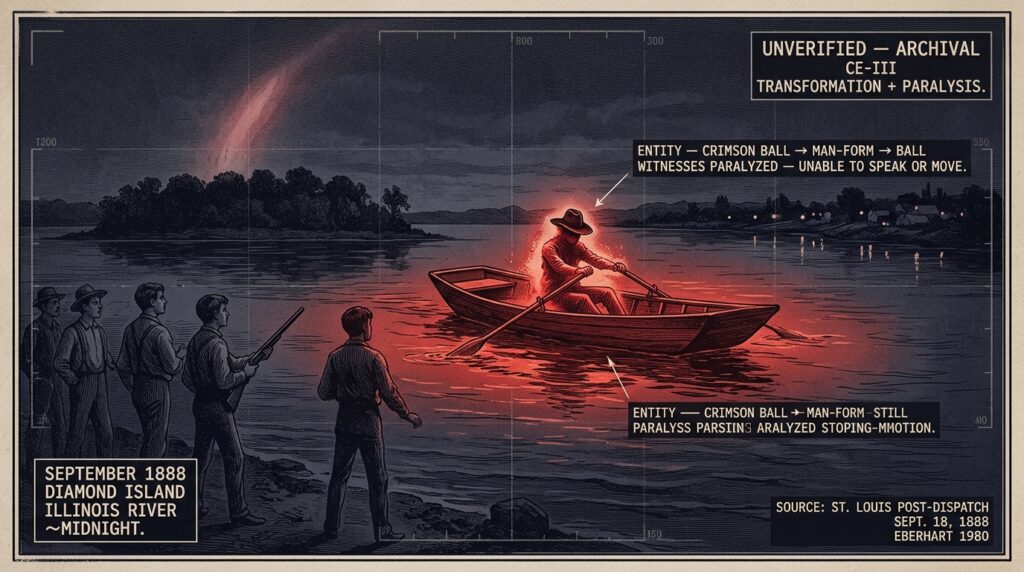
Diamond Island, Illinois River, near Hardin, Illinois — midnight, September 1888. An armed investigating party watches their boat move away from shore occupied by a crimson barrel-sized ball which gradually assumes the form of a man in a wide-brimmed hat rowing with steady strokes in surrounding red light. The witnesses are paralyzed and unable to speak or move. In midstream the man reverts to ball form, ascends to treetop height, and vanishes. Reported in the St. Louis Post-Dispatch, September 18, 1888.
THINK ABOUTIT UFO|ENTITY SIGHTING REPORT
1888: Sighting near Diamond Island, Illinois River, Illinois
For some time before September 1888, the people of Hardin, Illinois had been hearing rumors about Diamond Island in the Illinois River two miles from town — that it was haunted, that something moved there at night, that it was best avoided. Then several reputable citizens saw it themselves and the rumors became fact. Along toward midnight a ball of crimson fire the size and shape of a barrel rose from the water at the foot of the island and glided upward to approximately forty yards before fading. A party of armed young men from Hardin rowed out to investigate. They found the island quiet and took up a position in the trees to wait. The ball rose again from the water directly in front of them, ascended, and faded as before — and then they turned and ran for their boat. The boat was already in the water, moving away from the island. In the boat: the red ball. As they watched from shore, paralyzed and unable to speak, the crimson object gradually assumed the form of a man — a man in a wide-brimmed slouch hat, rowing with long steady strokes, surrounded by a peculiar crimson light that illuminated the boat and the dark river around it. Then the man became the ball again, rose to treetop height, and disappeared. A fisherman on the far shore heard their cries and rowed across to rescue them. The St. Louis Post-Dispatch ran the story on September 18, 1888. The spook of Diamond Island, it reported, was still making its nightly trips.
Date: September 1888 (primary investigation and newspaper account September 18, 1888; prior sightings span several weeks before this date)
Sighting Time: ~Midnight — “along toward midnight” per source
Day/Night: Night
Location: Diamond Island, Illinois River, near Hardin, Calhoun County, Illinois — approximately 2 miles from Hardin
Urban or Rural: Rural — small river town; Diamond Island is an uninhabited river island
No. of Entity(‘s): 1
Entity Type: Luminous shapeshifting entity — transitions between crimson ball and human-form figure; categorized locally as a ghost or spook
Entity Description: Primary form: a huge ball of fire, size and shape of an ordinary barrel, crimson/deep red in color, rising from the water surface. Secondary form: gradually assumed the form of a man — wearing a wide-brimmed slouch hat drawn down over his face; dipped oars at regular intervals with a long, steady stroke; surrounded by a peculiar light illuminating the boat and the water around it; features completely concealed; no vocalization; no acknowledgment of witnesses; transformed back to ball form after rowing to midstream; ascended to treetop height and disappeared
Hynek Classification: CE-III (Close Encounter III) — animate figure observed at close range associated with an anomalous luminous object; witnesses physically affected (paralysis, inability to speak or move)
Duration: Multiple prior sightings of unknown duration; primary investigation encounter — aerial phase seconds to minutes; entity-in-boat phase sufficient for detailed observation including rowing strokes and hat features; witnesses paralyzed throughout boat phase
No. of Object(s): 1 — the red ball and the man-form are presented as a single entity in transformation
Description of the Object(s): Huge ball of fire, size and shape of an ordinary barrel; crimson/deep red; rose from the water surface at the foot of the island; ascended to approximately 40 yards (120 feet); faded from view; subsequently reappeared in the witnesses’ boat transforming into a man-form; rose again to treetop height before final disappearance; produced a peculiar light illuminating surrounding water
Shape of Object(s): Spherical — barrel-sized
Size of Object(s): Size and shape of an ordinary barrel — approximately 2–3 feet in diameter, 3–4 feet in height
Color of Object(s): Crimson/deep red throughout both ball and man-form phases
Distance to Object(s): Initial aerial phase — within visual range from island shore; boat phase — midstream, fully visible from the shore where witnesses stood
Height & Speed: Ascended approximately 40 yards (120 feet) in the aerial phase; rose to treetop height in final departure; speed of ascent not recorded
Number of Witnesses: Multiple — the armed party of young men from Hardin (exact number not recorded; “party” implies at least three to five); prior witnesses described as several reputable citizens of Hardin; fisherman on the opposite shore heard their cries; all primary witnesses paralyzed during the entity-in-boat observation phase
Special Features/Characteristics): Witnesses physically paralyzed and unable to speak or move during observation of the entity in the boat — described as being held by “some mysterious influence they could not resist”; boat taken by the entity while witnesses were in the tree line — the entity used the witnesses’ own vessel; the entity in man-form rowed with technical competence — long steady strokes at regular intervals implying purposeful navigation rather than passive drift; features deliberately concealed by hat; the transformation sequence (ball → man → ball) occurred in full view of multiple witnesses at close range; phenomenon reportedly continued nightly after this incident; local folklore attributed it to the ghost of a murder victim; reported in St. Louis Post-Dispatch, September 18, 1888; documented in Eberhart, A Geo-Bibliography of Anomalies, 1980
Case Status: Unexplained — contemporaneous newspaper documentation; multiple witnesses; paralysis effect on witnesses; recurring phenomenon; no conventional explanation for the transformation sequence or the paralysis Source: St. Louis Post-Dispatch, September 18, 1888; Eberhart, George M., A Geo-Bibliography of Anomalies, Greenwood Press, 1980
Summary/Description: A crimson barrel-sized ball rising from the Illinois River near Diamond Island two miles from Hardin, Illinois has been observed nightly for weeks before September 1888. An armed party of young men investigates, observes the ball rise and fade, then discovers their boat has been taken — it is moving on the river with the red ball aboard. The ball transforms into a man in a wide-brimmed hat who rows with long steady strokes surrounded by crimson light, then transforms back to a ball, ascends to treetop height, and vanishes. The witnesses are paralyzed throughout the boat observation phase. A fisherman rescues them. Reported in the St. Louis Post-Dispatch, September 18, 1888.
Related Cases: 1876 Sheridan Pennsylvania — luminous figure gliding along creek bank, horse refuses to advance | 1878 Osceola Township Iowa — light approaches witness, rises and descends, multiple observers | 1837 Scarborough England — Mr. White and orange balls of fire at head height | 1827 Tjerwerk Netherlands — fireball assumes human shape and walks to burial mound
DETAILED REPORT
The geography is important. Diamond Island is a small river island in the Illinois River near Hardin, the county seat of Calhoun County — a narrow peninsula county wedged between the Illinois and Mississippi Rivers in southwestern Illinois. In September 1888 Hardin was a small river town of a few hundred people. Diamond Island, two miles downstream, was uninhabited. It had the kind of local reputation that uninhabited river islands accumulate in small riverside communities: dark, isolated, the subject of stories.
The phenomenon had been building for weeks before the armed party went out. The St. Louis Post-Dispatch is clear that the rumors had been circulating for some time before several reputable citizens confirmed they had seen the light — and only then did the community treat it seriously enough to organize an investigation. The ball was a nightly visitor: it appeared around midnight at the foot of the island, it rose to approximately forty yards, it faded. Consistent, predictable, and thoroughly unexplained.
The investigating party was well equipped for the era — revolvers, knives, shotguns, clubs. They rowed to the island, hauled the boat up on shore, and took up position in a clump of trees near the light’s usual appearance point. This is methodologically sound: they positioned themselves for observation before the phenomenon occurred rather than rushing toward it after the fact.
The ball appeared as expected — a bright red object rising from the water and ascending to forty yards before fading. The party had seen what they came for and began moving toward their boat. It was gone.
This is the pivot of the case. The boat was already in the water, moving away from the island under its own apparent direction. In the boat was the red ball. As the witnesses watched from shore — and here the St. Louis Post-Dispatch account becomes specific in a way that the archive must note — the crimson object gradually assumed the form of a man. Not suddenly, not in a flash, but gradually: the ball took on humanoid outline, the outline resolved into a figure, and the figure was rowing. Dipping the oars at regular intervals, pulling long steady strokes — competent, purposeful rowing that moved the boat toward midstream. The man’s features were fully concealed by a wide-brimmed slouch hat drawn down over his face.
The peculiar light that had characterized the ball phase continued in the man phase — illuminating the boat and the waters around it, making everything perfectly visible to the shore party. And the shore party could not move. The paralysis is described explicitly: they stood riveted by some mysterious influence they could not resist, unable to speak or move, eyes fixed on the spectral figure in the boat.
In midstream, the man became the ball again. The ball ascended — slowly — to the height of the treetops on the island. Then it disappeared. The paralysis apparently lifted as the phenomenon ended; the witnesses cried out, and a sleeping fisherman on the opposite bank heard them and rowed across.
The Post-Dispatch noted that the spook was still making its nightly trips after this incident, and that no further investigating parties had ventured out. The local tradition attributed the phenomenon to the ghost of a murder victim — a killing reportedly committed on the island some years earlier. Whether this attribution has any factual basis in local legal records is not documented in the available source.
RESEARCHER’S NOTES
The Spook of Diamond Island — 1888 Illinois River and the Transformation Sequence
- Transformation Sequence as Analytical Feature: The gradual transformation from ball to man-form and back to ball — observed in full at close range by multiple witnesses under clear illumination from the entity itself — is the most analytically distinctive feature of the Diamond Island case. The 1827 Tjerwerk, Netherlands fireball-to-human-form event is the closest structural parallel in the archive: a luminous ball that assumed upright humanoid form, moved purposefully, then returned to ball form. At Diamond Island 61 years later, the sequence is the same but extended: ball → partial form → full man → rowing → ball → ascent → disappearance. The level of morphological detail — the hat, the rowing stroke, the gradual transformation — suggests either a complex natural phenomenon the archive has no category for, or an entity that chose to perform the transformation sequence in full view.
- Paralysis Effect: The description of the witnesses being unable to speak or move, held by a mysterious influence, is the same paralysis effect documented in the 1831 Zarnów Germany case, the 1893 Central Park NSW Australia CE-II, and numerous 20th-century close encounter reports. Its appearance here in a 19th-century Illinois river account — reported in a mainstream St. Louis newspaper — is consistent with the pattern.
- Urban/Rural Correction: The existing page tags this as Urban. Hardin, Illinois in 1888 was a small river town of a few hundred people, and Diamond Island itself was an uninhabited river island two miles from town. The correct tag is Rural. This has been corrected in the template above.
The Boat Theft: The entity’s use of the witnesses’ own boat is the most operationally peculiar detail in the case. The witnesses beached the boat, took up position in the trees, and when they looked back it was already in the water. Whatever moved the boat from shore to water did so while the witnesses were focused on the aerial phase of the phenomenon — during or immediately after the ball’s ascent and fade. This implies either the entity had physical capability to move a beached boat, or a second element of the phenomenon operated independently while the aerial display held the witnesses’ attention.
The fisherman on the far shore heard them crying out and rowed across in the dark and brought them home, and nobody went back to Diamond Island at night after that. The spook, the newspaper said, was still making its trips. The ball still rose from the water around midnight, still ascended its forty yards, still faded — and presumably still took any unwary boat and rowed it to midstream with a wide-brimmed hat pulled down over a face that nobody ever saw. The archive holds what the St. Louis Post-Dispatch printed on September 18, 1888, which is more than most 19th-century accounts preserve. It holds the ball, and the man, and the paralyzed witnesses on the shore, and the fisherman who rescued them from an island that still had a boat somewhere on the river that wasn’t theirs anymore.