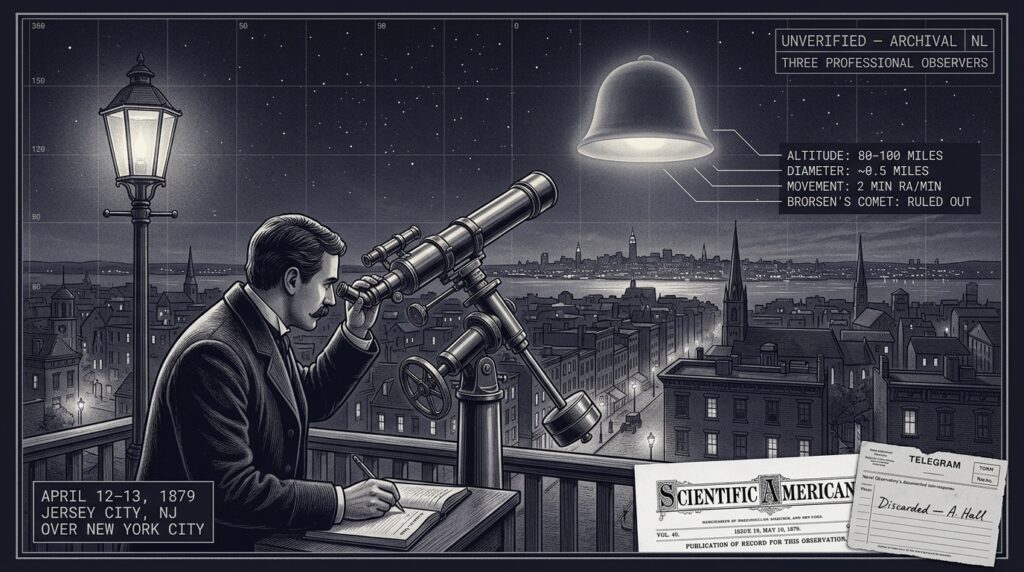
Jersey City, New Jersey, April 12–13, 1879. Astronomer Henry Harrison observes a glowing circular bell-shaped object stationary over New York City for three hours, moving at two minutes of Right Ascension per minute — explicitly ruling out Brorsen's comet. Two additional astronomers independently confirm the observation. Data published in Scientific American, May 10, 1879. Telegram to the US Naval Observatory discarded by director Asaph Hall without response.
THINK ABOUTIT UFO|UAP SIGHTING REPORT
1879: UFO Mothership Seen Over New York City
On the night of April 12–13, 1879, Jersey City astronomer Henry Harrison set up his instruments under a clear 43-degree New York sky and observed something that should not have been there. A glowing circular bell-shaped object was stationary above the city — but Harrison was too good an astronomer to be fooled by apparent stillness. He understood immediately that an object at that altitude would have to be moving at considerable speed simply to remain overhead as the Earth rotated beneath it. He watched it for nearly three hours. It was moving at a rate of two minutes of Right Ascension per minute — far too fast for Brorsen’s comet, which his critics would later suggest as the explanation, and which could only manage approximately one degree of movement per day. When the object suddenly changed direction and began flying eastward, Harrison’s case was complete. He sent a telegram to the US Naval Observatory in Washington. Astronomer Asaph Hall — the man who had discovered the moons of Mars just two years earlier — discarded it. Harrison then wrote to the New York Tribune, which published the letter on April 17. Scientific American published the observational data on May 10. Two additional New York area astronomers independently confirmed the observation. Morris K. Jessup later calculated, using measurements from all three astronomers, that the object had been at 80 to 100 miles altitude and was approximately half a mile in diameter. The US Naval Observatory’s response remains on record as one of the earliest documented instances of institutional dismissal of a credentialed astronomer’s anomalous aerial observation.
Date: April 12–13, 1879
Sighting Time: Night — exact start time not recorded; observation lasted nearly three hours
Day/Night: Night
Location: Jersey City, New Jersey — object observed over New York City
Urban or Rural: Urban
No. of Entity(‘s): 0
Entity Type: None observed
Entity Description: None observed
Hynek Classification: DD (Daylight Disc) classification not applicable — this is a nocturnal observation. Reclassification: The existing NL (Nocturnal Light) tag is insufficient for a three-hour sustained observation by a professional astronomer with corroborating independent observers, calculated dimensions, and published data. The correct classification is NL with elevated evidentiary status — or more accurately an Unknown classification given the calculated size (half-mile diameter), altitude (80–100 miles), and movement rate ruling out all known natural phenomena. NL is retained as the base tag with the full analytical weight documented here.
Duration: Approximately three hours — Harrison’s primary observation period; object then changed direction eastward and departed; Harrison made additional observations later the same night confirming the object was no longer present
No. of Object(s): 1
Description of the Object(s): Glowing circular bell-shaped object; apparently stationary over New York City but actually moving at significant speed to compensate for Earth’s rotation; movement rate calculated at two minutes of Right Ascension per minute — ruling out comet identification; subsequently changed direction sharply and flew eastward; absent on Harrison’s later observations the same night, confirming it was not a fixed astronomical body
Shape of Object(s): Circular and bell-shaped
Size of Object(s): Calculated by Morris K. Jessup using triangulated measurements from three independent observers to be approximately half a mile in diameter
Color of Object(s): Glowing
Distance to Object(s): 80 to 100 miles above the Earth — calculated altitude
Height & Speed: Altitude 80–100 miles; movement rate two minutes of Right Ascension per minute during stationary phase (compensating for Earth’s rotation); sharp directional change eastward observed
Number of Witnesses: 3 confirmed — Henry Harrison (Jersey City, primary observer); J. Spencer Devoe (Manhattanville, independent corroboration, published measurements); Henry M. Parkhurst (urged Devoe to publish); additional unspecified observers mentioned in the Scientific American account
Special Features/Characteristics: Professional astronomer primary witness — member in good standing of the Toronto Astronomical Society; object stationary relative to ground but moving at speed relative to stars — implying active positional compensation for Earth’s rotation; Brorsen’s comet hypothesis explicitly ruled out by Harrison based on movement rate differential; telegram to US Naval Observatory discarded by director Asaph Hall III without response; letter published in New York Tribune, April 17, 1879 under “A Curious Phenomenon”; observational data published in Scientific American, Vol. 40, Issue 19, May 10, 1879; two independent corroborating astronomers confirmed the observation; Morris K. Jessup retroactive triangulation calculation produced half-mile diameter and 80–100 mile altitude estimates; institutional dismissal by the US Naval Observatory is one of the earliest documented cases of an official American scientific institution discarding a credentialed anomalous aerial report
Case Status: Unexplained — three professional observers, published data in Scientific American, retroactive dimensional calculation; Brorsen’s comet hypothesis ruled out by the primary observer on movement rate grounds
Source: New York Tribune, April 17, 1879; Scientific American, Vol. 40, Issue 19, May 10, 1879; The Syracuse News
Summary/Description: Jersey City astronomer Henry Harrison observes a glowing circular bell-shaped object stationary over New York City for approximately three hours on the night of April 12–13, 1879. He determines the object is actively compensating for Earth’s rotation and moving at a rate inconsistent with any known comet. The object then changes direction sharply and departs eastward. Two independent New York area astronomers confirm the observation. Harrison’s telegram to the US Naval Observatory is discarded by Asaph Hall. His letter is published in the New York Tribune; his data in Scientific American. Morris K. Jessup later calculates the object was at 80–100 miles altitude and approximately half a mile in diameter.
Related Cases: 1882 Great Saucer — Royal Observatory Greenwich formal report, four professional astronomers | 1883 Zacatecas Observatory Mexico — José Bonilla photographs 300+ objects | 1870 Lady of the Lake Atlantic disc — peer-reviewed publication | 1874 Prague — Professor Schafarick formal report | 1820 Embrun France — François Arago formation report
DETAILED REPORT
Henry Harrison was not a casual observer. He was a member in good standing of the Toronto Astronomical Society — a professional affiliation that implies he had access to proper instruments, understood observational methodology, and knew the difference between a planet, a comet, and something that behaved like neither. When he set up his equipment on the night of April 12–13, 1879, the weather was clear and the temperature a seasonable 43 degrees Fahrenheit — optimal conditions for observational work over New York City from his Jersey City position.
The object first appeared to be stationary above the city. Harrison’s professional instinct immediately complicated this impression. At an altitude of 80 to 100 miles above the Earth — the figure retroactively calculated from triangulated measurements — an object that appeared stationary relative to the ground would in fact have to be moving at considerable speed relative to the stars in order to compensate for the Earth’s rotation beneath it. Harrison recognized this and observed accordingly, tracking the object’s movement against the stellar background rather than simply noting its apparent stability relative to ground landmarks.
What he measured was a movement rate of two minutes of Right Ascension per minute. This is an astronomical measurement of angular velocity — Right Ascension being the celestial equivalent of longitude, measured in hours and minutes. Two minutes of Right Ascension per minute is an extremely rapid angular movement across the sky. Brorsen’s comet — the explanation his critics would subsequently propose — moves at approximately one degree per day. The differential is not subtle. It is the difference between a snail and a car. Harrison was explicit: his object simply wasn’t Brorsen’s comet, and the movement rate made this mathematically demonstrable rather than a matter of opinion.
He watched the object for nearly three hours before it sharply changed direction and began flying eastward. The directional change is the single most analytically significant behavioral element of the case: a comet does not change direction. A planet does not change direction. An atmospheric optical phenomenon does not change direction. Harrison’s object changed direction deliberately and rapidly, then departed. He made additional observations later the same night and confirmed the object was no longer present — eliminating any possibility that it was a fixed astronomical body he had simply lost track of.
Harrison’s response was methodologically appropriate and institutionally instructive. He sent a telegram to the US Naval Observatory in Washington, DC — the appropriate scientific authority for an anomalous astronomical observation. The telegram was received and discarded by the observatory’s director, Asaph Hall III. Hall was not an undistinguished figure; he was the astronomer who had discovered Phobos and Deimos, the moons of Mars, just two years earlier in 1877. His decision to discard Harrison’s telegram without response is documented and remains one of the earliest recorded examples of an official American scientific institution dismissing a credentialed astronomer’s anomalous aerial report without investigation.
Frustrated by Hall’s non-response, Harrison wrote to the New York Tribune, which published his letter on April 17, 1879, under the heading “A Curious Phenomenon.” Scientific American subsequently published the observational data in its May 10, 1879 edition (Vol. 40, Issue 19). These publications generated correspondence from other astronomers, including J. Spencer Devoe of Manhattanville, who confirmed that he had independently observed the same object on the same night. Devoe published his confirming measurements at the urging of Henry M. Parkhurst. The independent confirmation from a different observation point — Manhattanville being several miles from Harrison’s Jersey City position — provided the angular baseline that later allowed Morris K. Jessup to triangulate the object’s position, altitude, and apparent size.
Jessup’s calculation, combining measurements from the three regional astronomers, produced an altitude range of 80 to 100 miles above the Earth and an estimated diameter of approximately half a mile. These are not figures that any known natural phenomenon of 1879 could produce. At 80 miles altitude, the object was above the mesosphere and into the thermosphere — well beyond balloon altitude, weather phenomena, or any aerial technology of the period. At half a mile in diameter, it was larger than any known natural object that could maintain a stationary position above a specific point on the Earth’s surface.
RESEARCHER’S NOTES
Asaph Hall’s Discarded Telegram — The Harrison 1879 New York Observation and the Institutional Suppression Pattern
- Hynek Reclassification: The existing NL (Nocturnal Light) classification is technically correct but analytically inadequate for this case. NL is defined as a point or extended luminous source observed at night. The Harrison case goes far beyond this: three professional observers, published measurements in Scientific American, retroactive triangulation producing specific altitude and size calculations, and a movement rate that explicitly rules out all known astronomical bodies. The archive retains NL as the base classification while noting that the evidentiary weight of this case places it among the most institutionally credentialed anomalous aerial observations in the 19th-century American record — well above the typical NL tier.
- Asaph Hall’s Dismissal — Institutional Significance: Asaph Hall’s decision to discard Harrison’s telegram without response is historically significant beyond this individual case. Hall was the most prominent American astronomer of the period. His non-response established a precedent: a credentialed observer reporting an anomalous aerial phenomenon to the appropriate scientific institution receives no response. This pattern — established in 1879 at the US Naval Observatory — would repeat itself across the 20th century as the defining institutional response to anomalous aerial reports from professional observers.
- Morris Jessup’s Calculation: Morris K. Jessup — later known for his controversial work on the Philadelphia Experiment — performed the retroactive triangulation that produced the half-mile diameter and 80–100 mile altitude figures. Jessup was a legitimate astronomer before his later controversial work, and the triangulation methodology he applied to the Harrison/Devoe/Parkhurst measurements is standard astronomical practice. The results should be read as calculated estimates based on the available angular measurements, not as precision measurements, but they are methodologically defensible.
- Brorsen’s Comet — Explicit Ruling Out: Harrison’s elimination of Brorsen’s comet as an explanation is one of the clearest cases of a primary observer explicitly applying the correct comparative methodology and producing a documented negative result. His movement rate comparison — two minutes of Right Ascension per minute vs. one degree per day — is not ambiguous. The critics who suggested the comet hypothesis either did not do the arithmetic or ignored it. Harrison’s rebuttal is in the published record.
Henry Harrison sent his telegram to the US Naval Observatory and Asaph Hall put it in the discard pile and that was that — which is how these things go, and always have. The object over New York City on the night of April 12–13, 1879 was half a mile across and 80 to 100 miles up and moving at a rate that ruled out every known natural object, and it changed direction and left, and two other astronomers confirmed it independently, and Scientific American published the data, and none of it produced any official investigation. Harrison had done everything right. He had the instruments, the credentials, the corroboration, the publication, the rebuttal of the comet hypothesis, and the institutional contact. The institution threw his telegram away. The record holds everything else.