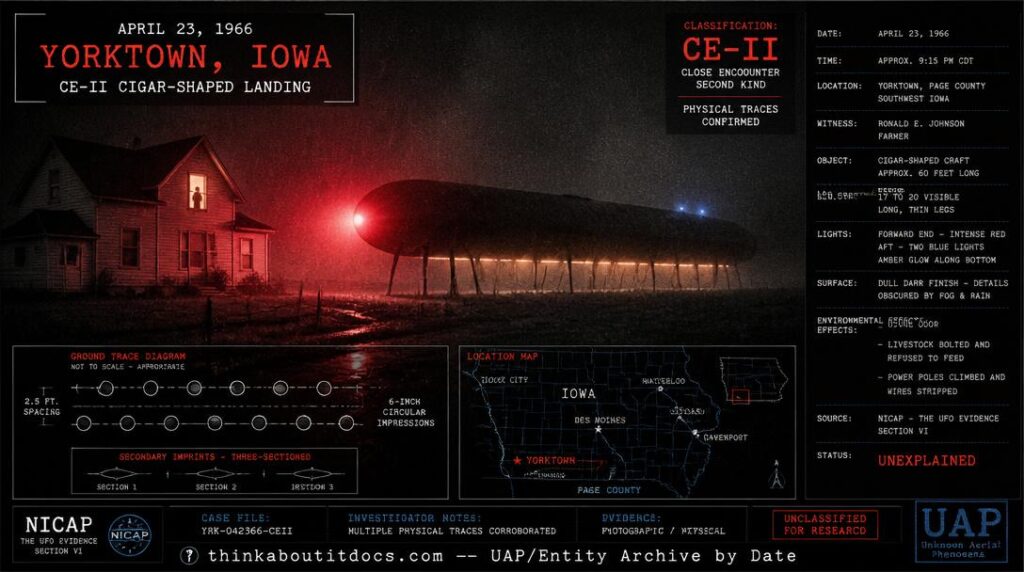
Yorktown, Iowa, April 23, 1966 — A 60-foot cigar-shaped object landed on 17-20 legs in Ronald Johnson's field, leaving ground impressions, ozone smell, stripped power lines, and panicked livestock.
THINK ABOUTIT LANDING REPORT
1966 Yorktown Iowa UFO Landing:
Cigar-Shaped Craft & Physical Traces
At 2:10 in the morning on April 23, 1966, a loud roar woke Ronald E. Johnson at his farm on Route 2 in Yorktown, a few miles west of Clarinda, Iowa. He went to the south-facing window and saw a cigar-shaped object, approximately 60 feet long, landing in his field within 50 feet of the house. It sat on 17 to 20 long legs, glowing blood-red at one end and blue at the other, with an amber glow along the bottom. It made explosive cracking sounds like gunshots at regular intervals. The air filled with an ozone-like smell. Johnson watched it for 20 minutes, then went back to bed. In the morning, it was gone — but his livestock had bolted to the far end of the pasture and refused to return for feeding, and the field was marked with two rows of six-inch circular impressions spaced two and a half feet apart. Nearby power poles bore fresh climbing marks and their wires had been stripped.
Date: April 23, 1966
Sighting Time: 2:10 AM
Day/Night: Night
Location: Route #2, Yorktown, Iowa — a few miles west of Clarinda, Page County
Urban or Rural: Rural (farmland)
No. of Entity(‘s): None observed
Entity Type: N/A
Entity Description: N/A
Hynek Classification: CE-II (Close Encounter II) — Observation of an object in close proximity to the witness, with physical traces left at the site.
Duration: Approximately 20 minutes (observation of landed object)
No. of Object(s): 1
Height & Speed: Approached from the north, passed over the house, and landed in the adjacent field. Departed silently at an unknown time.
Size of Object(s): Approximately 60 feet in length
Distance to Object(s): Approximately 50 feet from the house
Shape of Object(s): Cigar-shaped
Color of Object(s): Dull-finish surface. Brilliant red light (“blood red” glow) on the house-facing end. Two blue lights approximately 8 inches in diameter extending above the body on the far end. Amber glow extending partway along the bottom.
Number of Witnesses: 1 (Ronald E. Johnson, named farmer)
Special Features/Characteristics: Landed on 17 to 20 long “legs.” Loud roar during approach; silence after landing. Explosive “cracking” sounds like gunshots at regular intervals while on the ground. Ozone-like odor permeating the area. Ground impressions: two rows of alternating six-inch circular impressions spaced 2.5 feet apart. Second set of impressions: round on one side, square-edged on the other, divided into three sections. Livestock bolted to far end of pasture and refused to return for morning feeding. Fresh climbing depressions on two power line poles, poles smeared with dirt, wires stripped at the top.
Source: NICAP — The UFO Evidence, Section VI
Case Status: Unexplained
Summary/Description: At 2:10 AM on April 23, 1966, farmer Ronald E. Johnson of Yorktown, Iowa (near Clarinda) was awakened by a loud roar and observed a cigar-shaped object approximately 60 feet long landing in his field, 50 feet from his house. The object rested on 17 to 20 legs, displayed red, blue, and amber lights, emitted explosive cracking sounds and an ozone-like smell, and sat motionless for at least 20 minutes before departing silently. In the morning, Johnson found two rows of six-inch circular ground impressions spaced 2.5 feet apart, a second set of unusual three-sectioned impressions, evidence of fresh climbing on two power line poles with wires stripped, and livestock that had bolted to the far end of the pasture and refused to return for feeding. Documented by NICAP.
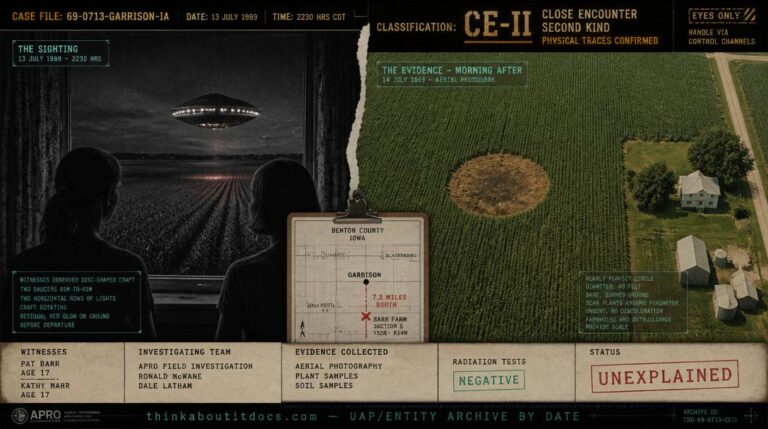
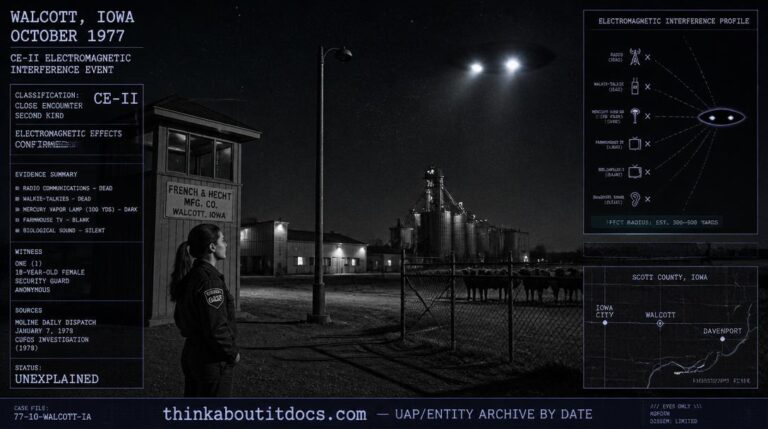
Related Cases: 1954: Osceola, Iowa Abduction | 1969: Garrison, Iowa Crop Circle | 1977: Security Guard Sees Oval UFO, Walcott, Iowa | 1920: UFO Landing, Mount Pleasant, Iowa
Detailed Report
Ronald E. Johnson was a farmer living on Route #2 in Yorktown, Iowa, a few miles west of Clarinda in Page County. At 2:10 AM on the morning of April 23, 1966, he was awakened by a loud roar. He got up and went to his south-facing window.
He saw a cigar-shaped object, approximately 60 feet in length, coming into view as it moved over the house from the north. The night was foggy and a light rain was falling. No moon or stars were visible. The roar ceased as the object landed in the field within 50 feet of the house.
On the end closest to the house, the object displayed a brilliant red light that bathed the entire area in a “blood red” glow. On the far end, two blue lights approximately eight inches in diameter extended above the body of the object. The surface had a dull finish, except for an amber glow that extended partway along the bottom. The object rested on a series of 17 to 20 long “legs.”
After landing, the object produced a series of loud, explosive cracking sounds — described as like gunshots — at regular intervals. The air filled with an odor Johnson compared to ozone. He saw nothing leaving or entering the object. He watched it sit motionless in his field for approximately 20 minutes and then went back to bed. When he got up a short time later to check, the object had either departed silently or extinguished its lights. The explosive sounds had stopped.
In the morning, Johnson discovered that his livestock had all bolted to the far end of the pasture during the night and appeared to be “acting up considerably.” They would not return for feeding that morning. Examining the landing site, he found a series of circular impressions six inches in diameter, spaced alternately in two rows with 2.5 feet between impressions. To the east of the landing impressions, he found a second set of imprints that were round on one side and square-edged on the other, with the squared-off edge divided into three sections. Johnson confirmed that these impressions were not made by his cattle.
One additional detail: two nearby power line poles appeared to bear fresh depressions in the wood at regular intervals, as if recently climbed. The poles were smeared with dirt. Wires at the top of the poles had been stripped.
Researcher’s Notes
Seventeen Legs and Ozone at Two in the Morning
- Source Chain: This case appears in NICAP’s The UFO Evidence, Section VI — a publication compiled under the editorial direction of Richard Hall, one of the most methodical civilian UFO researchers of the era. NICAP documentation of this period represents a high standard of civilian case documentation. The witness, Ronald E. Johnson, is identified by full name and specific address (Route #2, Yorktown, near Clarinda). The case is not anonymous.
- Physical Trace Evidence: This case meets every criterion for a robust CE-II classification. The ground impressions — six-inch circular marks in two alternating rows at 2.5-foot spacing — are consistent with landing gear from an object of the described size. The second set of impressions (round on one side, squared and three-sectioned on the other) do not correspond to any known agricultural implement, animal track, or natural formation. The power pole evidence (fresh climbing marks, dirt smears, stripped wires) suggests physical interaction with the electrical infrastructure — and would be consistent with the ozone-like smell reported by the witness, as ozone is produced by electrical discharge.
- Animal Response: The livestock bolting to the far end of the pasture and refusing to return for morning feeding is a well-documented animal response in CE-II cases. Animals — particularly cattle and horses — respond to ultrasonic frequencies, electromagnetic fields, and unfamiliar stimuli with flight behavior and persistent agitation. Johnson’s observation that they were “acting up considerably” is consistent with this pattern and provides indirect corroboration of the event occurring during the night as described.
- Ozone and Electrical Effects: The ozone-like odor is one of the most frequently reported atmospheric effects in close encounter cases. Ozone (O₃) is produced by electrical discharge, ultraviolet radiation, and certain high-energy processes. Its presence at the landing site, combined with the stripped power line wires and climbing marks on the poles, suggests a relationship between the craft and the local electrical infrastructure — whether through intentional interaction, electromagnetic side effects, or some other mechanism.
- Object Description: The cigar-shaped profile with differentiated lighting at each end (red at one end, blue at the other, amber along the bottom) and 17 to 20 landing legs is an unusually specific and detailed description. The “explosive cracking” sounds at regular intervals while the object was on the ground — sounds that ceased before departure — suggest either cooling/thermal contraction of the hull, periodic discharge events, or some form of operational activity. The silent departure is notable: the object arrived with a loud roar but left without detectable sound.
- 1966 Wave Context: April 1966 fell within one of the most active UAP flap periods in U.S. history. The spring of 1966 produced a wave of sightings across the Midwest and Northeast, including the Dexter-Hillsdale, Michigan sightings (March 1966) that prompted J. Allen Hynek’s infamous “swamp gas” explanation and ultimately led to the Condon Committee investigation. The Yorktown case, with its physical traces and named witness, represents the kind of physical-evidence case that the 1966 wave is often criticized for lacking.
Ronald Johnson is one of the rare witnesses who let a UFO sit in his field for 20 minutes and then went back to bed. In the morning, the evidence was in the dirt — two rows of landing impressions, a second set of marks that matched nothing in his farming experience, stripped power lines, and livestock that wouldn’t come home. NICAP documented the case. The ground told the story the witness chose not to dramatize. Status: Unexplained.