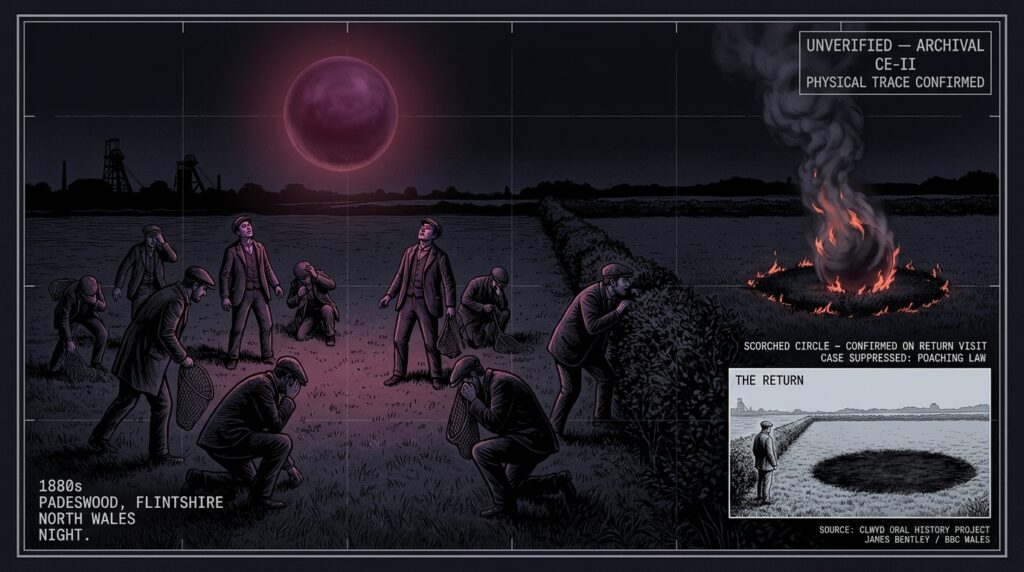
Padeswood, near Mold, Flintshire, North Wales — 1880s, moonless night. A gang of striking miners collecting poaching snares observe a large purplish-red luminous ball descend silently overhead and transform into a swirling smoke ball with flame at the base in the adjacent field. They flee and maintain secrecy for decades — poaching carried transportation as a punishment. On return, the bravest witness finds a wide black circle of scorched grass at the landing site. Collected by historian James Bentley for the Clwyd Oral History Project; reported by BBC Wales.
THINK ABOUTIT UFO|UAP SIGHTING REPORT
1880?: English Poachers sent packing by flying ball!
Sometime in the 1880s, a gang of striking miners from the Padeswood area near Mold in Flintshire, North Wales dared to do what hunger made necessary: they turned poachers. They crept out on a moonless night to collect snares they had set on land belonging to one of the mine owners. Getting caught would have meant eviction from their tied cottages and possibly transportation — which is the precise reason this story stayed secret for decades, passed only between the relatives of the witnesses, until Buckley historian James Bentley collected it for the Clwyd Oral History Project. What happened that night sent the men running home and kept them running back only once — several days later, to collect the gear they had abandoned in their panic. They felt watched before they saw anything. Then they looked up and a large purplish-red luminous ball was hovering directly above them. It descended silently into the next field. One man peered over the hedge and watched a swirling ball of smoke with small tongues of flame lifting off the ground. The men ran. When the bravest among them returned days later to collect the abandoned snares, there was no ball, no light, no smoke — only a wide black circle of scorched grass where the object had been. The physical trace survived. The story survived. Both are in the archive now.
Date: 1880s — exact year unknown; date uncertain
Sighting Time: Night — dark, moonless
Day/Night: Night
Location: Fields at Padeswood, near Mold, Flintshire, North Wales, England
Urban or Rural: Rural — open agricultural fields
No. of Entity(‘s): 0
Entity Type: None observed
Entity Description: None observed
Hynek Classification: CE-II (Close Encounter II) — object at close range with physical trace evidence: wide black circle of scorched grass at landing site confirmed by return visit several days later
Duration: Not precisely recorded — long enough for descent observation, one witness’s hedge-peering observation, and group flight response; total duration of landing not witnessed
No. of Object(s): 1
Description of the Object(s): Large purplish-red luminous ball hovering above the witness group; descended silently into the adjacent field; observed from behind a hedge as a swirling ball of smoke with small tongues of flame issuing from the base, lifting off the ground; departed before or shortly after the witnesses fled; left a wide black circle of scorched grass at the landing site
Shape of Object(s): Ball/sphere — purplish-red luminous in hover phase; swirling smoke-ball with flame at base during ground-contact phase
Size of Object(s): Large — described as large relative to the witnesses; exact dimensions not recorded
Color of Object(s): Purplish-red during hover phase; dark smoke with small orange-red flame tongues during ground phase
Distance to Object(s): Directly overhead in hover phase; one field’s width at hedge-observation phase — close range
Height & Speed: Hovering at low altitude directly above witnesses; descended vertically and silently into the next field; no horizontal transit described
Number of Witnesses: Multiple — a gang of miners; exact number not recorded
Special Features/Characteristics: Pre-encounter atmospheric tension felt by all witnesses — a sense of being watched before the object was seen; silent descent — no sound recorded; transformation from luminous ball to swirling smoke-with-flame on ground contact; physical trace: wide black scorched grass circle confirmed at the landing site several days after the encounter; secrecy maintained for decades by all witnesses due to fear of legal consequences of poaching — the reason this case survived only as oral history through family transmission; collected by Buckley historian James Bentley for the Clwyd Oral History Project; reported via BBC Wales; the secrecy explains the date uncertainty — no contemporaneous newspaper record was possible given the circumstances
Case Status: Insufficient Data — multiple witnesses, confirmed physical trace, oral history transmission through named family chains; exact date unknown; no contemporaneous documentation possible due to the legal jeopardy of the witnesses
Source: James Bentley, Clwyd Oral History Project; BBC Wales
Summary/Description: A group of striking miners poaching at night on fields near Padeswood, Flintshire feel a sudden atmospheric tension before observing a large purplish-red luminous ball hovering overhead. It descends silently into the adjacent field where one witness observes it as a swirling smoke ball with flame at the base. The group flees. Several days later the bravest witness returns and finds a wide black circle of scorched grass at the landing site. The incident remained secret for decades due to the legal risk of poaching, surviving only through family oral tradition until collected by historian James Bentley.
Related Cases: 1837 Scarborough England — Mr. White observes orange balls of fire hovering at head height in dark lane | 1873 South Australia ship Adelheid — luminous ball following vessel with ground illumination | 1882 Americus Georgia — black whirlwind with fire at center, sulfurous vapor, burns | 1884 Nebraska crash — glowing machinery, physical trace | 1887 Cape Race Atlantic — sphere rising from ocean
DETAILED REPORT
Padeswood is a small settlement in Flintshire, North Wales, lying a few miles from the market town of Mold on the flat agricultural land of the Alyn valley. In the 1880s it was coal country — the area supported several collieries, and the miners who worked them lived in tied housing on land owned by the same men who owned the pits. This economic structure is essential context for the case: a striking miner who was caught poaching on his employer’s land faced not just a fine but eviction from his home and, in the more severe interpretation of the Game Laws still operating in the 1880s, potential transportation. The legal stakes were existential.
This is why the story stayed secret. All the men involved — a gang, implying at least three or four and possibly more — agreed to say nothing. They had reason not to. The incident remained within their families, passed from the witnesses to their relatives, until Buckley local historian James Bentley collected it as part of the Clwyd Oral History Project and it reached BBC Wales as part of a regional guide to strange phenomena. The oral history transmission chain is documented; Bentley heard the account from named relatives of named witnesses. The case is not an anonymous rumor.
The encounter sequence has three distinct phases. The first is pre-encounter: before any light was seen, the men simultaneously felt a change in atmosphere. Tense and afraid, as if someone was watching them. This sudden environmental shift — the same precursor sensation documented in the 1815 Ilkley Moor case, the 1842 Stowmarket case, and numerous other close encounter reports — is a recognized feature of a significant subset of anomalous events. It arrived before any visual stimulus and affected the entire group simultaneously.
The second phase is the visual observation. Looking up, the men saw a large purplish-red luminous ball hovering directly above them. The color is specific — purplish-red rather than orange or white or blue, a hue that falls in a particular part of the spectrum that the archive associates with a subset of close-range luminous object reports. The ball was large. It was hovering at low altitude directly above the group. Then it descended — silently — into the field on the other side of the hedge.
The men hid their heads under their nets — the instinctive response of people who did not want to be seen by whatever had found them in the dark — and then, as the atmospheric tension lessened, the boldest among them peered over the hedge. What he saw was the ground phase of the object: a swirling ball of smoke with small tongues of flame issuing from the base, lifting off the ground. The object was in the process of departing — rising, smoke-trailing, flame-licking at the grass below its base. Then the men ran.
The third phase is the return. Several days later — when fear had cooled enough for practical calculation — the bravest of the group went back to collect the snares and gear abandoned in the panic. The object was gone. There was no light, no smoke, no residue in the air. But where it had been — where that smoke-swirling ball had been lifting off the dark grass — there was now a wide black circle of scorched earth. The grass within the circle was burned. The circle was wide. It was exactly where they had seen the object.
This physical trace is the most evidentially significant element of the Padeswood case. It transforms the encounter from a multi-witness nocturnal observation into a CE-II: close range, physical trace confirmed at the site by an independent return visit. The scorched circle was not described as existing before the encounter. It was not a known feature of the field. It was found specifically at the location where the witnesses had observed the object make ground contact and depart.
RESEARCHER’S NOTES
The Poachers’ Secret — Padeswood 1880s and the CE-II Physical Trace Hidden by Legal Necessity
Secrecy as Source Integrity Factor: The decades-long secrecy maintained by all witnesses is paradoxically a factor that increases rather than decreases the case’s credibility. The men had every incentive to say nothing and no incentive to fabricate an elaborate story they could never profit from or share. The account survived not through press coverage, official reports, or self-promotion, but through family oral transmission from people who were afraid of the law. When it finally emerged through James Bentley’s oral history work, it did so through the most reliable channel available for suppressed working-class historical experience.
Physical Trace Confirmation Methodology: The return visit to the site several days after the encounter, resulting in the discovery of a wide scorched grass circle, is the strongest evidence in the case. The witness did not describe the circle as pre-existing or coincidental — he went back to collect snares and found it at precisely the location where the object had been observed. This is the correct methodology for physical trace confirmation: independent return visit, specific location identification, previously undocumented physical change.
Date Uncertainty: The 1880s date range reflects the oral history transmission — no contemporaneous newspaper coverage was possible or sought given the legal circumstances. The Clwyd Oral History Project records the decade rather than the specific year. The archive retains the 1880s designation rather than inventing a specific year.
Pre-Encounter Atmospheric Effect: The simultaneous feeling of being watched before any visual stimulus is documented across multiple cases in the archive — Ilkley Moor 1815, Stowmarket 1842, and numerous 20th-century cases in Jenny Randles’s Oz Factor research. Its presence here, experienced by the entire group simultaneously in a context where they had every reason to be already acutely alert to any sign of a gamekeeper, suggests a genuine environmental change rather than individual anxiety projection.
They went back for their snares and found the circle instead — wide and black and burned into the grass exactly where the smoke-ball had been lifting off. That was all that was left of whatever had hovered above a gang of hungry miners in a moonless Welsh field in the 1880s. They never told anyone outside the family. The legal risk was too great, the story too strange, the world of newspaper coverage and scientific inquiry too far from the Padeswood fields where working men dared their employer’s land out of necessity and found something that had nothing to do with gamekeepers. Decades passed. James Bentley found the relatives. The archive holds what they remembered: the tension before the light, the purplish-red ball above them, the smoke and flame lifting off the grass, and the circle that was still there when the bravest of them went back.