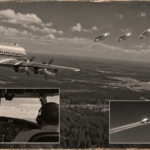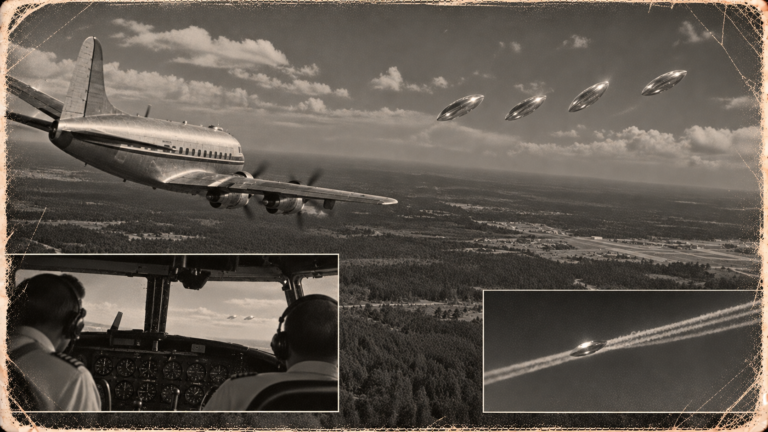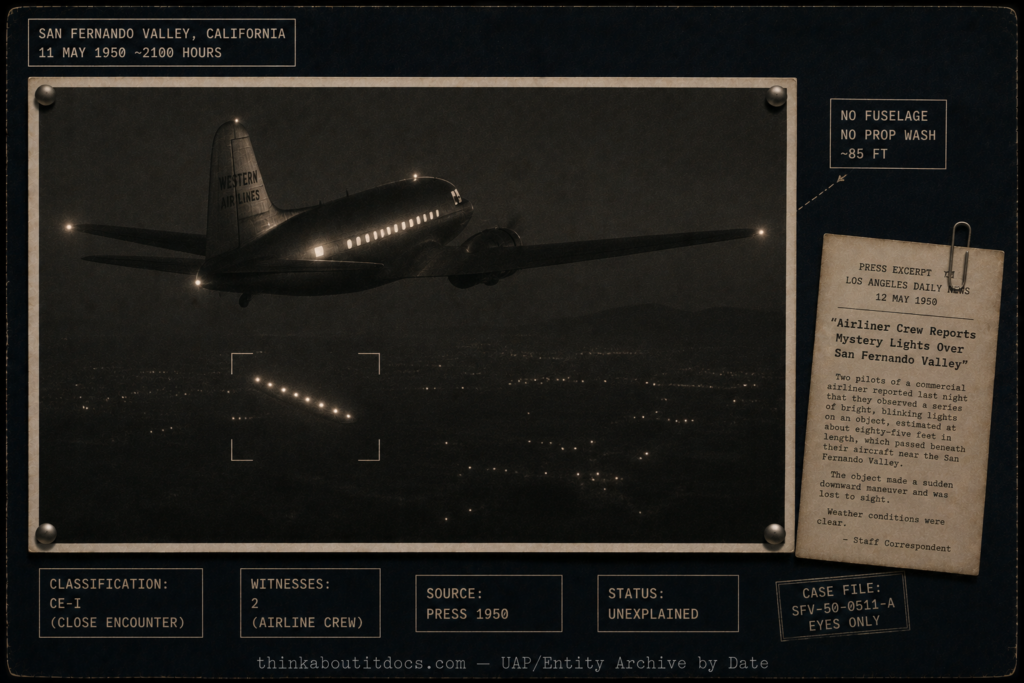
The Hardin-Conroy near-miss, in flight over the San Fernando Valley, California, October 5, 1950 — an 85-foot object with blinking lights and no fuselage passed beneath the airliner's left wing; classified CE-I, status Unexplained.
THINK ABOUTIT UFO | UAP SIGHTING REPORT
1950: Above Van Nuys and San Fernando — Airliner Near-Miss
Five minutes after lifting off from Burbank bound for Oakland, on a clear October night in 1950, the two men in the cockpit of a California Central airliner found something coming straight at them out of the dark. Captain Cecil Hardin saw it first and called it to his co-pilot — a lighted object closing head-on at the airliner’s altitude of roughly 4,500 feet. It was in view only seconds before it swerved, dropped, and shot beneath their left wing. What they described afterward fit no aircraft either man knew: an object perhaps eighty-five feet long, carrying six to eight bright lights strung in a row along its top, all of them blinking, with no fuselage visible and no propeller wash felt as it passed. Both were experienced airmen — and one of them, the record strongly suggests, was a decorated wartime pilot who would later make his name designing aircraft. Their account stands as one of the cleaner airline near-miss reports of the early 1950s.
Date: October 5, 1950
Sighting Time: Approximately 8:00 p.m. (about five minutes after the 7:55 p.m. departure)
Day/Night: Night
Location: In flight between Van Nuys and San Fernando, San Fernando Valley, California
Urban or Rural: Airborne over the San Fernando Valley (then semi-rural)
No. of Entity(‘s): None reported
Entity Type: Not applicable
Entity Description: Not applicable — airborne object encounter, no occupants observed
Hynek Classification: CE-I (Close Encounter I) — structured object observed in close proximity, passing beneath the aircraft; no physical traces
Duration: A few seconds
No. of Object(s): 1
Description of Object(s): An elongated lighted object approaching head-on at the airliner’s altitude, which swerved and passed below the left wing; estimated about 85 feet long, carrying six to eight bright lights strung along its top, all blinking; no visible fuselage; no propeller wash felt as it passed
Shape: Elongated (form indistinct beyond a single row of lights; no fuselage discerned)
Size: Estimated ~85 feet long (witnesses stressed size and distance could not be fixed precisely)
Color: Bright lights (unspecified); object body not resolved against the night sky
Distance: Estimated ~500 feet at nearest, passing beneath the left wing
Height & Speed: ~4,500 feet altitude; very high speed, described as a “terrific” rate of closure
No. of Witnesses: 2 — Captain Cecil Hardin and co-pilot Jack Conroy
Special Features/Characteristics: Head-on approach followed by an evasive swerve and pass beneath the aircraft; absence of any visible fuselage; absence of propeller wash; a row of six to eight synchronized blinking lights unlike standard aircraft lighting; both witnesses were professional pilots
Case Status: Unexplained
Source: Contemporaneous Los Angeles–area press reports, October 1950 (pilots interviewed the following day); subsequently carried in NICAP-era pilot-sighting compilations
Summary/Description: A California Central Airlines flight departed the Lockheed Air Terminal at Burbank for Oakland at 7:55 p.m. on October 5, 1950. About five minutes out, climbing through roughly 4,500 feet between Van Nuys and San Fernando, Captain Cecil Hardin alerted his co-pilot, Jack Conroy, to a lighted object approaching head-on. It remained in view only briefly before swerving to pass below the airliner. Conroy told reporters the object appeared large, fast, and close — perhaps 500 feet away — while Hardin noted it was moving at a terrific speed and, strikingly, showed no fuselage; neither man felt any propeller wash as it passed under their left wing. Both estimated it at about 85 feet long, with six to eight bright lights strung along the top, all blinking. Conroy stated that no conventional aircraft could display lights in the manner they had observed.
Related Cases: 1948 — Chiles-Whitted encounter, Alabama (airline crew, cigar-shaped object with lighted ports) | 1950 — Kodiak, Alaska radar-visual (military air/sea near-pass) | 1952 — bat-shaped object over Shemya Island, Alaska
Detailed Report
The encounter was brief, but the witnesses were as qualified as any in the early record, and the details they reported are specific enough to resist easy dismissal. The aircraft was a California Central Airlines flight — the carrier was a Burbank-based operator running the Los Angeles–Oakland corridor — that departed the Lockheed Air Terminal at 7:55 p.m. and was about five minutes into its climb when the event occurred.
Captain Cecil Hardin saw the object first: a lighted shape bearing down on the airliner head-on, at the aircraft’s own altitude of roughly 4,500 feet, somewhere over the open valley between Van Nuys and San Fernando. He called it to Conroy’s attention. By both accounts the object was in view only a few seconds before it broke from its head-on line, swerved, and passed beneath them — under the left wing — and was gone.
The descriptive details are what give the report its weight. The pilots agreed the object was large, fast, and close, with Conroy estimating perhaps 500 feet at nearest approach while candidly noting that exact size, speed, and distance could not be fixed in the few seconds available. Hardin emphasized two anomalies: the object showed no fuselage, and neither man felt any propeller wash as it passed — a sensation they would have expected from a conventional aircraft crossing that close beneath them. Both put its length at about 85 feet and counted six to eight bright lights strung along the top, all blinking in a way Conroy insisted no ordinary aircraft would display.
There was no radar track, no photograph, and no third party to corroborate the two-man crew. The case rests entirely on the consistent testimony of two professional pilots, given to the press the following day. Within those limits, it is a coherent and specific account of a structured, maneuvering object that behaved unlike known traffic — the classic profile of an airline near-miss case that the investigative groups of the era took seriously.
RESEARCHER’S NOTES
The Hardin-Conroy Near-Miss — San Fernando Valley 1950 and the Qualified-Witness Problem
- Classification. This is a CE-I: a structured object observed at close range — head-on, then passing beneath the wing at an estimated 500 feet — with no landing, no physical trace, and no occupants. The proximity is the defining feature; the witnesses discerned enough detail (length, a row of blinking lights, the absence of a fuselage) to place it well inside the close-encounter threshold. The 500-foot figure is the pilots’ own estimate and is explicitly approximate, but a pass beneath the wing implies a genuine close approach, so CE-I is the accurate label rather than a distant nocturnal light.
- Source chain. The provenance is press-based but contemporaneous and first-hand: both pilots were interviewed within a day of the event, and their statements were reported directly. There is no instrumented data and no official file attached to the public account, which places it a tier below the radar-documented cases of the same year. Its strength is the quality and immediacy of the witnesses rather than corroborating hardware, and it was later folded into the pilot-sighting compilations that groups like NICAP assembled to argue that trained aircrew were reporting genuinely anomalous objects.
- Pattern context. Airline-crew encounters were a recurring and influential category in the 1948–1952 window — the Chiles-Whitted sighting over Alabama in 1948 being the era’s archetype — precisely because professional pilots make difficult witnesses to wave off. The credibility issue sharpens here: the co-pilot named in the reports, Jack Conroy, matches in name, profession, era, and locale the decorated WWII B-17 pilot and former POW John M. “Jack” Conroy, who flew as an airline pilot through exactly this period and was based in the San Fernando Valley, where he later lived and died. The identification is not certain, but every available marker aligns, and if correct it places one of the most experienced airmen of his generation in that cockpit.
- Physical / evidentiary weight. Moderate, and bounded by the brevity of the event. Against the case: a few seconds of observation, parameters the witnesses themselves called unfixable, and no radar, photograph, or third-party corroboration. For the case: two professional pilots in agreement, a maneuvering object that actively swerved to avoid a collision, and a cluster of specific anomalies — no fuselage, no propeller wash, an 85-foot length, and six to eight synchronized blinking lights — that fit no standard 1950 aircraft. No mundane explanation accounts cleanly for the maneuver and the lighting together, which keeps the case in the Unexplained column rather than letting it resolve to conventional traffic.
The Van Nuys–San Fernando near-miss is a short encounter carried by the calibre of its witnesses. Two airline pilots, taking off into a clear night over the valley, watched a structured object close head-on and dodge beneath their wing — and described, without embellishment, an object that should not have been there. The data are thin by the standards of an instrumented case, and the pilots were honest about what they could not measure. But the consistency of the account, the specificity of the anomalies, and the professional standing of the observers — one of them very likely a celebrated wartime and test pilot — leave it standing in the record as a credible and unexplained airline sighting.