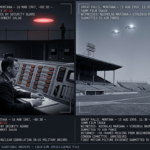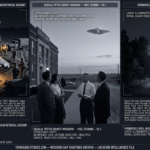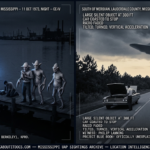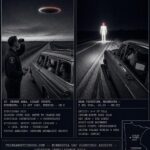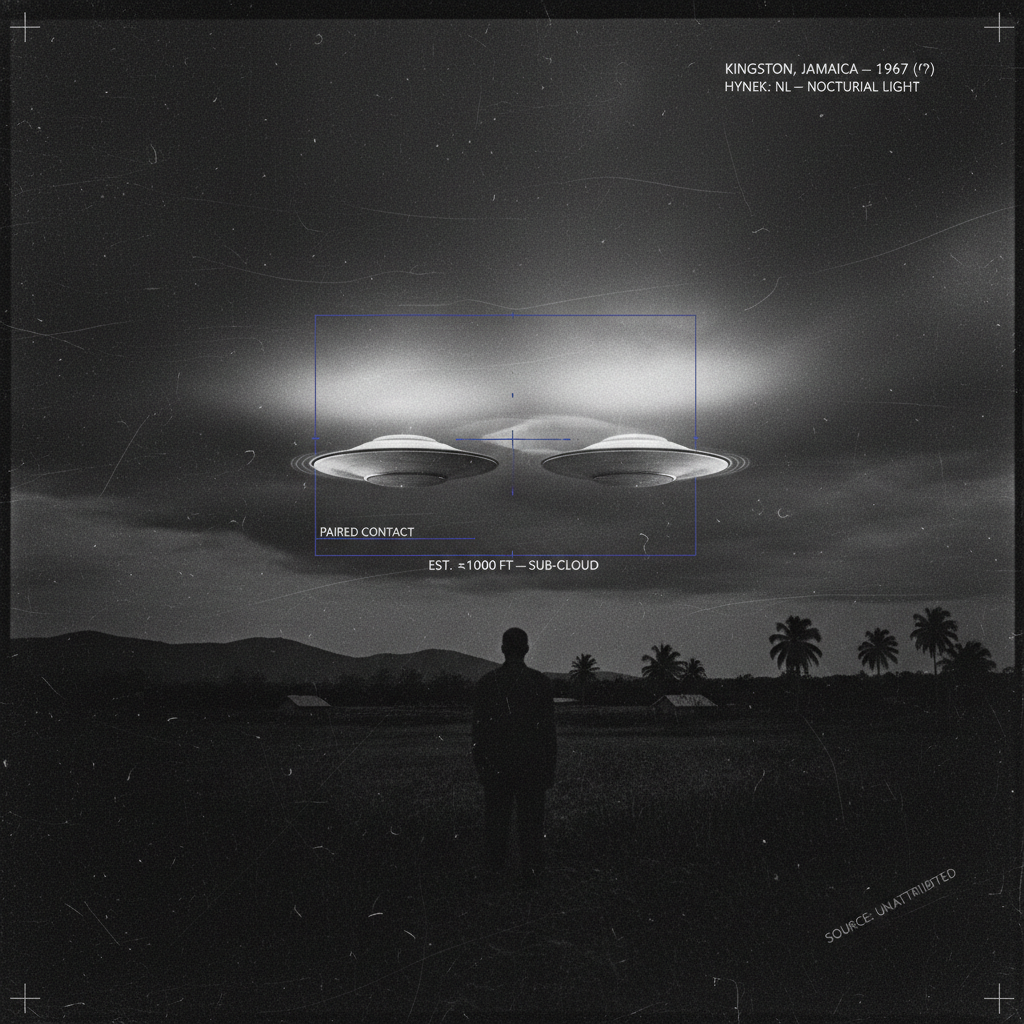
Two silver discs over Kingston, Jamaica — paired, wobbling, and vanishing between positions in an early, undated Caribbean Nocturnal Light case.
THINK ABOUTIT UFO | UAP SIGHTING REPORT
1947: Kingston, Jamaica Sighting
Two silver discs hung side by side beneath the Jamaican cloud deck, wobbling in place — and then they were gone, only to reappear an instant later in another patch of sky, as if the distance between the two points had simply been edited out. No streak, no arc, no transit: here, then there. The Kingston record is one of the earliest Caribbean disc reports on file, and one of its most frustrating — a vivid, internally consistent observation of paired objects exhibiting apparent instantaneous displacement, attached to almost no documentary scaffolding. What was seen is described with care. When it happened, who saw it, and who first recorded it remain open.
Date: 1947?
Sighting Time: Unknown
Day/Night: Night
Location: Kingston, Jamaica, West Indies
Urban or Rural: Rural
No. of Entity(‘s): None reported
Entity Type: Not applicable — no occupants or entities observed
Entity Description: Not applicable
Hynek Classification: NL (Nocturnal Light) — point or extended luminous source observed at night
Duration: Unknown
No. of Object(s): Two
Description of the Object(s): Two silver discs observed side by side, moving in unison. While stationary the objects appeared to wobble slightly. Movement between positions was not a visible transit — the objects vanished at one location and reappeared at another, producing the impression of darting or instantaneous displacement.
Shape of Object(s): Disc
Size of Object(s): Unknown
Color of Object(s): Silver
Distance to Object(s): 1,000 feet (estimated)
Height & Speed: Estimated below 1,000 feet (objects observed beneath the cloud base); speed not measurable — displacement appeared instantaneous rather than as continuous motion
Number of Witnesses: Unknown
Special Features/Characteristics: Paired objects moving simultaneously; slight wobble while stationary; apparent disappearance and rematerialization between positions; sub-cloud altitude ceiling fixing maximum height
Case Status: Insufficient Data
Source: Unattributed on original record — no source listed
Summary/Description: Two silver discs, side by side, moving from place to place simultaneously. When they moved from one location to another they were not visible in transit, appearing only when they materialized at the new position, giving the impression of darting from point to point. The discs appeared to wobble slightly while stationary. Because they were observed beneath the cloud deck, their altitude could not have exceeded approximately 1,000 feet.
Related Cases: 1981 Kingston, Jamaica Humanoid Sighting | 2008 Jamaica, West Indies Huge Glowing Green UFO | 2009 Mona, Kingston, Jamaica Sighting | 2009 Pier 1, Montego Bay Sighting
DETAILED REPORT
The Kingston observation describes two silver, disc-shaped objects seen at night below a cloud ceiling, which the witness account uses to fix the objects at no more than roughly 1,000 feet of altitude. The pair behaved as a coordinated unit: they held position together, moved together, and — most distinctively — relocated together without any observed transit between points. The account is explicit that the discs were not visible while moving from one position to another; they were seen only when stationary at each location, creating the impression of darting or stepwise jumps rather than continuous flight.
Two behavioral details carry the analytical weight here. The first is the slight wobble reported while the objects were stationary, a characteristic frequently noted in early disc reports and often cited in the period’s literature as a hallmark of the “flying saucer” wobble. The second is the apparent instantaneous displacement — the disappearance at one point and rematerialization at another. Within the limits of a single undated account this cannot be evaluated as a physical claim; it is equally consistent with genuinely anomalous behavior, with the eye losing a dim object against a dark sky during rapid lateral movement, or with two objects being mistaken for one set jumping between positions.
The evidentiary problem is structural. The record carries no firm date (the original entry itself appends a question mark to “1947”), no time, no duration, no witness count, and no named source or originating investigator. There is no institutional response on file because there is no indication the case was ever formally investigated. What survives is a clean, first-hand-sounding description with no chain of custody behind it. That does not make the observation false — the internal consistency and the specific, non-generic detail (paired motion, sub-cloud ceiling, stationary wobble, non-visible transit) are the marks of a real recollection rather than a stock fabrication — but it does cap how far the case can be pushed. The date itself is suspect on the page: the report is tagged “1981,” matching the adjacent Kingston humanoid case, which suggests the 1947 placement may be a provisional estimate rather than a documented year.
RESEARCHER’S NOTES
The Vanishing Pair — Kingston 1947 and the Problem of the Sourceless Caribbean Record
- Classification Assessment: NL (Nocturnal Light) is the correct and only defensible classification for this case. The observation is nocturnal, the objects are luminous/reflective points of light at distance, and there is no close approach, no landing trace, no physiological effect, and no entity — ruling out any Close Encounter category. While the witness reports a disc shape and silver color, shape attribution at an estimated 1,000 feet at night is a perception, not a measured form, so the case does not rise to a Daylight Disc (DD) classification despite the disc description. NL holds.
- Source Chain Assessment: This is the weakest link in the record and the reason for the Insufficient Data status. The original entry lists no source whatsoever — no researcher, no catalog, no publication, no witness name. We deliberately do not assign a default attribution here; unlike the heavily NICAP-derived aerial records of the wartime years, this Caribbean entry has no documented provenance, and inventing one would violate source fidelity. The account reads as first-person testimony, but whether it reached the archive via a direct submission, a regional researcher, or a secondary catalog is unrecoverable from the record as it stands. Any future upgrade of this case depends entirely on locating the originating source.
- Pattern Context: The paired-disc, simultaneous-motion configuration places this case alongside a recognizable subset of early postwar reports in which two or more objects maneuver in formation as a unit. The “stationary wobble” detail is period-consistent with the wider 1947 wave vocabulary, though the Kingston account predates or parallels the late-June 1947 North American flap rather than clearly following it. The reported instantaneous displacement — vanishing and rematerializing rather than flying between points — recurs throughout the global catalog and is one of the more durable anomalous behaviors on record, but in an undated single-witness Caribbean case it functions as a flag for interest, not as evidence of mechanism.
- Geographic and Historical Context: Kingston in the late 1940s sits at the edge of the documented UFO record; the Caribbean is sparsely represented for this era, which makes the entry valuable as one of the earliest regional data points even in its degraded evidentiary state. The “Rural” designation on the original record is worth flagging — Kingston proper is an urban harbor city, so “Rural” likely reflects the specific observation site on the city’s outskirts or surrounding parishes rather than the municipality itself. The case anchors a small but real Jamaican thread in the archive that continues through the 1981 humanoid report and the 2008–2009 sightings, giving the location a multi-decade record despite the thinness of this founding entry.
The Kingston discs are a genuine-sounding observation stranded without provenance. The description is specific, internally coherent, and behaviorally interesting — paired objects, a stationary wobble, a sub-cloud ceiling, and apparent point-to-point teleportation — but the record offers no date it can defend, no time, no witness count, and no source to stand behind any of it. The honest position is that this is a credible-feeling report we cannot verify and should not inflate. It stays in the archive as an early Caribbean data point and a standing research target: find the source, and the case can be reassessed. Until then, the record’s final word is Insufficient Data — observed, recorded, unproven.