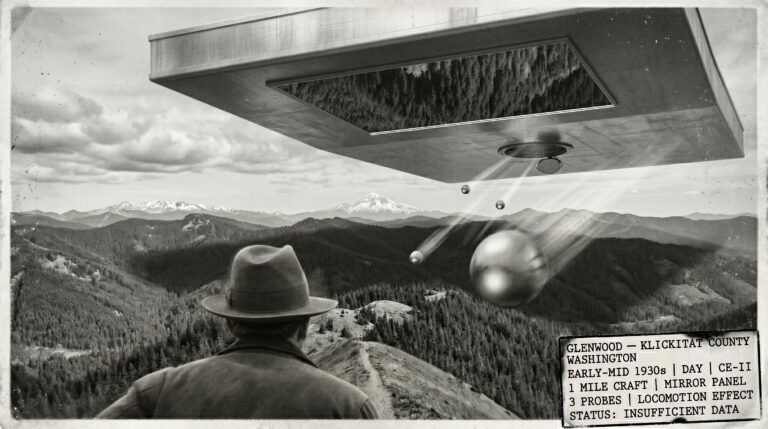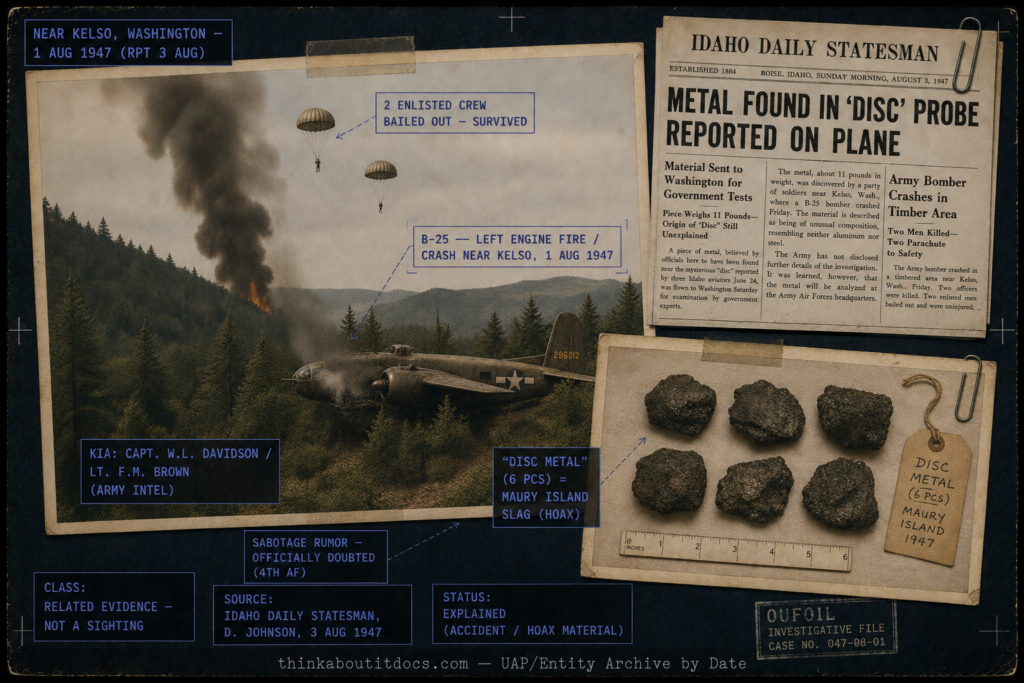
The B-25 that crashed near Kelso on August 1, 1947, killing two intelligence officers carrying Maury Island "disc metal" — a real tragedy welded to a fabricated saucer story.
THINK ABOUTIT UFO | UAP SIGHTING REPORT
1947: Metal Found in ‘Disc’ Probe Reported On Plane
Six pieces of heavy, heat-scarred metal — said to be fragments of a flying disc “in trouble” over Puget Sound — were aboard a B-25 bomber when its left engine burst into flame minutes after takeoff from McChord Field and the plane went down near Kelso, Washington, killing the two Army intelligence officers carrying them. It was the first week of August 1947, the country was gripped by the new “flying saucer” mystery, and within hours the rumor was running that the bomber had been sabotaged to keep the metal from reaching Hamilton Field. The dead men, Captain William Davidson and Lieutenant Frank Brown, had flown to Tacoma at Kenneth Arnold’s invitation to examine the material; a United Air Lines captain who had his own famous sighting handed it to them himself. The crash was tragically real and is a matter of record. The “disc metal” was something else — and the story of how the two became fused is one of the most consequential threads of the summer that began it all.
Date: August 1, 1947 (crash); reported August 3, 1947
Sighting Time: Crash shortly after ~10:00 a.m. takeoff
Day/Night: Day
Location: Near Kelso, Washington (B-25 en route from McChord Field, Tacoma, to Hamilton Field, California)
Urban or Rural: Rural
No. of Entity(‘s): None reported
Entity Type: Not applicable — no occupants or entities
Entity Description: Not applicable
Hynek Classification: None — this is a documented aircraft-crash and materials-transport event tied to the Maury Island affair, not a sighting or close encounter. Logged as a historical/related-evidence report.
Duration: Not applicable
No. of Object(s): Not applicable as a UAP sighting; the material in question was 6 pieces of “metal or lava”
Description of the Object(s): Six pieces of heavy, dark, slag-like material described as “metal or lava,” reportedly “extremely heavy” and showing evidence of having been subjected to extreme heat. Said by the claimants to be fragments shed by a flying disc “in trouble” over Maury Island. (The Maury Island claim was subsequently determined to be a hoax, the material ordinary foundry/smelter slag.)
Shape of Object(s): Irregular fragments
Size of Object(s): Hand-sized pieces (6)
Color of Object(s): Dark, slag-like
Distance to Object(s): Handled directly
Height & Speed: Not applicable
Number of Witnesses: Multiple named principals — Capt. E.J. Smith (United Air Lines), Kenneth Arnold, Harold Dahl and Fred Crisman (claimants), and the deceased officers Capt. William L. Davidson and Lt. Frank M. Brown; Brig. Gen. Ned Schramm (4th Air Force) as official spokesman; two enlisted crewmen parachuted to safety
Special Features/Characteristics: A fatal military air crash entangled with the 1947 saucer wave; transport of alleged “disc” material; immediate sabotage rumors (officially doubted); the convergence of the wave’s key figures (Arnold, Smith, Dahl, Crisman, Davidson, Brown); material later identified as terrestrial foundry slag from the hoaxed Maury Island incident; classified handling (“passed on to higher headquarters”)
Case Status: Explained (the “disc metal” was foundry slag from the hoaxed Maury Island affair; the B-25 crash was investigated and judged an accidental engine fire, with sabotage officially doubted)
Source: “Metal Found in ‘Disc’ Probe Reported On Plane Which Carried Army Intelligence Men To Death,” Idaho Daily Statesman, August 3, 1947, by Dave Johnson (aviation editor; an early independent disc witness himself)
Summary/Description: On August 1, 1947, a B-25 bomber carrying Army intelligence officers Capt. William Davidson and Lt. Frank Brown crashed and burned near Kelso, Washington shortly after takeoff from McChord Field, killing both men; two enlisted crewmen parachuted to safety. The August 3 Idaho Daily Statesman reported that the officers had been carrying six pieces of heavy, heat-marked “metal or lava” given to them in Tacoma by United Air Lines Capt. E.J. Smith and Kenneth Arnold, who had been investigating Harold Dahl and Fred Crisman’s claim that their boat was struck by debris from a flying disc “in trouble” (the Maury Island story). Rumors that the plane was sabotaged to stop the material reaching Hamilton Field were publicly doubted by Brig. Gen. Ned Schramm of the 4th Air Force, who attributed the loss to an in-flight engine fire. The material was subsequently determined to be ordinary foundry slag and the Maury Island claim a hoax.
Related Cases: 1947 Maury Island Incident (the source of the material; hoax) | 1947 Kenneth Arnold Sighting | 1947 United Air Lines Flight 105 (Capt. E.J. Smith) | broader 1947 wave and the origin of the men-in-black legend
DETAILED REPORT
This entry preserves a contemporaneous newspaper account — the August 3, 1947 Idaho Daily Statesman story by aviation editor Dave Johnson — that documents the real, fatal event at the center of the otherwise-fabricated Maury Island affair. Johnson was no casual reporter on the subject: as the Statesman’s aviation editor he had covered Kenneth Arnold’s sighting and, on assignment to find a disc himself, had reportedly watched a circular object dart before a cloud bank for some forty-five seconds. His report carries the authority of a working aviation journalist writing within forty-eight hours of the crash.
The hard facts are these. On the morning of August 1, 1947, a twin-engine B-25 bomber took off from McChord Field near Tacoma, bound for Hamilton Field, California, at about 10 a.m. Shortly after takeoff its left engine burst into flame and the aircraft went down near Kelso, Washington. The pilot and co-pilot — Captain William L. Davidson and Lieutenant Frank M. Brown, both Army intelligence officers stationed at Hamilton Field and both assigned to investigate the flying-disc reports — were killed instantly. Two enlisted crewmen bailed out, apparently on the pilot’s order, and survived. This much was confirmed by Brigadier General Ned Schramm, chief of staff of the Fourth Air Force, speaking to the Statesman by telephone from San Francisco.
The reason the crash became legend was its cargo. United Air Lines Captain E.J. Smith — himself a celebrated witness, who on July 4 had reported nine discs over southern Idaho — disclosed that he and Kenneth Arnold had given Davidson and Brown six pieces of “metal or lava” shortly before the bomber took off. Smith described the pieces as “extremely heavy” and bearing evidence of extreme heat. The material had come from Arnold’s investigation, at Tacoma, of a story told by Harold Dahl and Fred Crisman, who operated a concern called Harbor Patrol and claimed their boat had been struck by debris shed by a flying disc “in trouble” overhead — the Maury Island claim. Davidson and Brown had interviewed Smith weeks earlier during a Boise stopover and had spent a day discussing the discs with Arnold; they flew to Tacoma at Arnold’s suggestion that he “might have something interesting to show them.”
Almost immediately, the crash bred a sabotage rumor: that the bomber had been downed deliberately to prevent the six objects from reaching Hamilton Field. General Schramm publicly doubted it, attributing the loss to an in-flight engine fire, and stressed that the officers’ reports being “passed on to higher headquarters” was normal procedure carrying no special significance. He noted that whatever the men knew was largely “in their heads,” and that he could not confirm what, if anything, material was aboard — an interview given, the article notes, before Smith publicly revealed that he and Arnold had handed over the fragments. Smith and Arnold, for their part, had gone nearly into seclusion in Tacoma and were reticent to say anything for publication; Smith was reached only after United Air Lines relayed a request that he telephone the paper.
The honest disposition of this case requires separating two things the 1947 press could not. The crash and the deaths are documented historical fact. The “disc metal,” however, was the material from the Maury Island incident — which the FBI, Project Blue Book’s Edward Ruppelt, and ultimately Dahl and Crisman themselves would establish as a hoax, the “saucer slag” being ordinary foundry or smelter slag. The fatal B-25 crash was investigated and judged an accidental engine fire; no evidence of sabotage was found. What the article captures, then, is the precise moment a genuine tragedy became fused with a fabricated saucer story, lending the hoax a gravity — two dead intelligence officers — that helped propel both the Maury Island legend and the nascent men-in-black mythology for decades afterward.
RESEARCHER’S NOTES
The Crash That Carried the Hoax — Kelso 1947 and the Real Tragedy Inside a Fabricated Story
- Classification Basis: This is not a UAP sighting and carries no Hynek classification. It is a contemporaneous press record of a fatal military aircraft crash and the transport of alleged “disc” material, directly attached to the Maury Island affair. It is logged as a historical/related-evidence report supporting the Maury Island entry, with Case Status Explained.
- Source Assessment (Primary/Strong as a Document): As a source, this is valuable: a named, datable, contemporaneous newspaper article by an identified aviation editor, published within two days of the event, quoting named principals (Smith, Arnold) and a named senior officer (Gen. Schramm) on the record. The crash, the casualties, and the metal-transport claim are thus well-documented at the level of what was reported in real time. That documentary strength is independent of the truth of the underlying “disc” claim — the article faithfully records what credible people said, including the sabotage rumor and the general’s measured rejection of it.
- The Two-Layer Truth: The case must be read in two layers. Layer one — the crash — is real: Davidson and Brown died near Kelso on August 1, 1947, two crewmen survived, and the cause was an engine fire, with sabotage officially doubted and never substantiated. Layer two — the cargo — is the Maury Island material, since established as foundry slag from a confessed hoax. The enduring power of the episode comes from the welding of a true tragedy to a false story: real deaths gave the hoax an aura of deadly secrecy it never earned on its own.
- Pattern Context: This article is a connective hub of the 1947 wave. It links Kenneth Arnold (the index case), Capt. E.J. Smith (the United Flight 105 sighting), and Dahl and Crisman (Maury Island) in a single documented event, and it supplies the death-follows-the-witnesses motif that recurs throughout later conspiracy literature. The deaths of Davidson and Brown became foundational furniture of the men-in-black legend that grew out of Maury Island. Retaining the article preserves the primary-source spine to which all those later elaborations attached themselves.
- Physical Evidence and Evidentiary Weight: The crash is supported by official confirmation and investigation; the metal is accounted for as terrestrial slag from the hoax. There is no physical evidence of anything anomalous and none of sabotage. The weight of evidence supports Explained on both counts — an accidental crash and mundane material — while affirming the article’s high value as a contemporaneous documentary record of how the tragedy and the hoax became intertwined.
The August 3, 1947 Idaho Daily Statesman article is the documentary keystone of the Maury Island affair — the contemporaneous record of the one undeniably real element in an otherwise fabricated story. Two Army intelligence officers, Davidson and Brown, died when their B-25 caught fire and crashed near Kelso while carrying six pieces of heavy, heat-marked “disc metal” handed to them by Kenneth Arnold and Capt. E.J. Smith; the rumor of sabotage was immediate and was publicly doubted by the Fourth Air Force, which attributed the loss to an engine fire. The metal was Maury Island slag, the Maury Island story a confessed hoax, and the crash an accident — but the fusion of real deaths with a false saucer tale gave both the hoax and the emerging men-in-black legend their lasting charge. The archive logs this as a historical/related-evidence report, Case Status Explained, and retains it for its genuine value: a named, dated, primary-source newspaper account preserving exactly how a tragedy and a fabrication became one story in the summer the modern era began.
Metal Found in ‘Disc’ Probe Reported On Plane. Which Carried Army Intelligence Men To Death
 Idaho Daily Statesmen
August 3, 1947
By Dave Johnson
Note – Dave Johnson, the author of the foregoing article was the “aviation editor” for the Statesman, as well as one of the first people to see a UFO shortly after Kenneth Arnold’s sighting. In fact, due to his association with Arnold and having “covered” that “news breaking event,” he was on assignment to find a flying disc when after 3 days of an aerial search paid off. He witnessed for 45 seconds a circular object dart about in front of a cloud bank.
Six pieces of metal or lava obtained for investigation in connection with the flying disc mystery were being carried back to Hamilton Field, Calif., from Tacoma, Wash., in a B-25 bomber which crashed and burned near Kelso shortly after takeoff from McChord Field, it was learned tonight.
The pilot and co-pilot of the twin-engine bomber were members of army intelligence, stationed at Hamilton Field, and had been assigned to the investigation of the flying disc mystery.
They were Captain William L. Davidson and Lt. Frank M. Brown, both of whom were instantly killed when their bomber plummeted to earth after the left engine burst into flames.
Disclosed by a UAL pilot
That they were carrying with them six pieces of metal or lava substances was made by Capt. E. J. Smith of United Airlines, who was in Tacoma with Kenneth Arnold of Boise.
Davidson and Brown had gone to Tacoma in response to a message from Arnold, who had told them he “might have something interesting to show them,” according to Brig-Gen. Ned Schramm of the Fourth Air Force at Hamilton Field. Smith who on July 4 reported seeing nine flying discs while his airliner was roaring over southern Idaho said that he and Arnold had given the six pieces of metal or lava to Davidson and Brown shortly before they took off from McChord Field about 10 a.m. Friday for Hamilton Field.
“Extremely Heavy” Substance
Smith said the pieces of metal or lava were “extremely heavy” and when he and Arnold obtained them, showed evidence of having been subjected to extreme heat.
Arnold had gone to Tacoma earlier this week to investigate a story told by Harold Dahl and Fred L. Crisman of Tacoma who operate a concern known as Harbor Patrol, according to Arnold.
Boat Hit By “Disc in Trouble”
Dahl and Crisman, according to Arnold, said that their boat was struck by portions of what had appeared to be a flying disc “in trouble” and they had recovered portions of the metal.
Smith told his story to the Idaho Statesman by Telephone from Tacoma, had gone to Tacoma to join Arnold in the latter’s check of the Dahl-Crisman story. Smith would say nothing for publication beyond the fact that he and Arnold had talked at length with Brown and Davidson and had given them pieces of metal or lava. Smith says he does not know what happened to the objects after the B-25 crashed and burned.
Lt. Brown and Capt. Davidson had been in Boise several weeks ago where they interviewed Smith during a stopover at Boise air terminal and spent most of the day talking to Arnold about what he and Smith had seen of flying discs.
It was Arnold who first started the nation with his story of flying discs weaving and irregular flight path between Mt. Rainier and Mt. Adams in Washington state. In San Francisco, Gen. Schramm, chief of staff of the Fourth Air Force, told The Statesman by telephone that Brown and Davidson had been engaged in gathering material on flying discs and that this material was being passed on to “higher headquarters.”
Doubtful of Sabotage
Schramm said he did not know what had caused the airplane accident. Informed that there were stories circulating to the effect the plane had been sabotaged to prevent the six objects from reaching Hamilton Field, he said he doubted if that could be true.
He said that no special emphasis should be placed on the fact Brown and Davidson’s reports were being passed on to higher headquarters, as that was normal procedure.
Schramm said he did not know of his own knowledge if there were anything aboard the plane or any information on discs in the plane “except what Brown and Davidson were carrying in their heads.”
Two Chute To Safety
He said from information he could gather concerning the wreck of the B-25, it burst into flames in flight. Two members of the crew, both enlisted men, escaped death by bailing out apparently on the command of the pilot.
Gen. Schramm said that Brown and Davidson wanted to continue their mission in the investigation of the disc stories that have swept the nation since the day Arnold made his report of the objects near Mt. Rainier.
Schramm said the two intelligence men were experts on “questioning people” and had not been sent to Tacoma to “get anything” but to talk to Arnold in response to his “suggestion of interest” for them.
They thought, said Schramm they would “learn something new” and therefore went to Tacoma in pursuance of their efforts to “leave no stone unturned” in unraveling the disc mystery.
Not Original Object
That they received from Smith and Arnold six pieces of some metal or lava apparently was not the original cause of their going to Tacoma, as far as it could be learned.
Schramm said he “couldn’t visualize the boys’ having picked up something” but added that he was not in the position to say if they were carrying anything when they crashed.
Schramm’s telephone interview was made before Smith revealed in Tacoma in response to a direct question that he and Arnold had given the intelligence operatives the objects.
Since arriving in Tacoma, Smith, and Arnold have been extremely reticent to say anything for publication. Smith indicated that whatever had been published in Tacoma concerning their visit had not come directly from them.
They virtually had gone into seclusion Saturday and Smith was contacted only after United Airlines in Seattle, which refused to reveal his whereabouts, sent him a telegram asking him to telephone The Statesman.