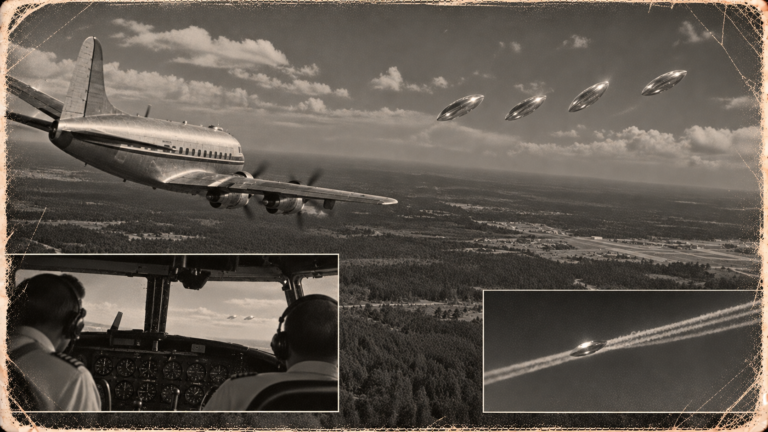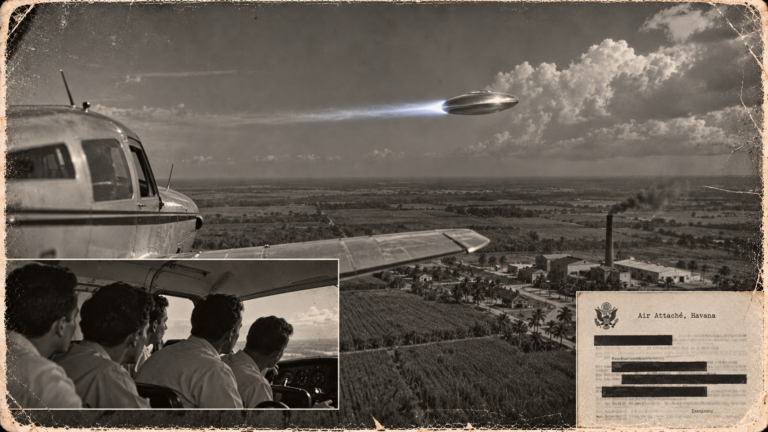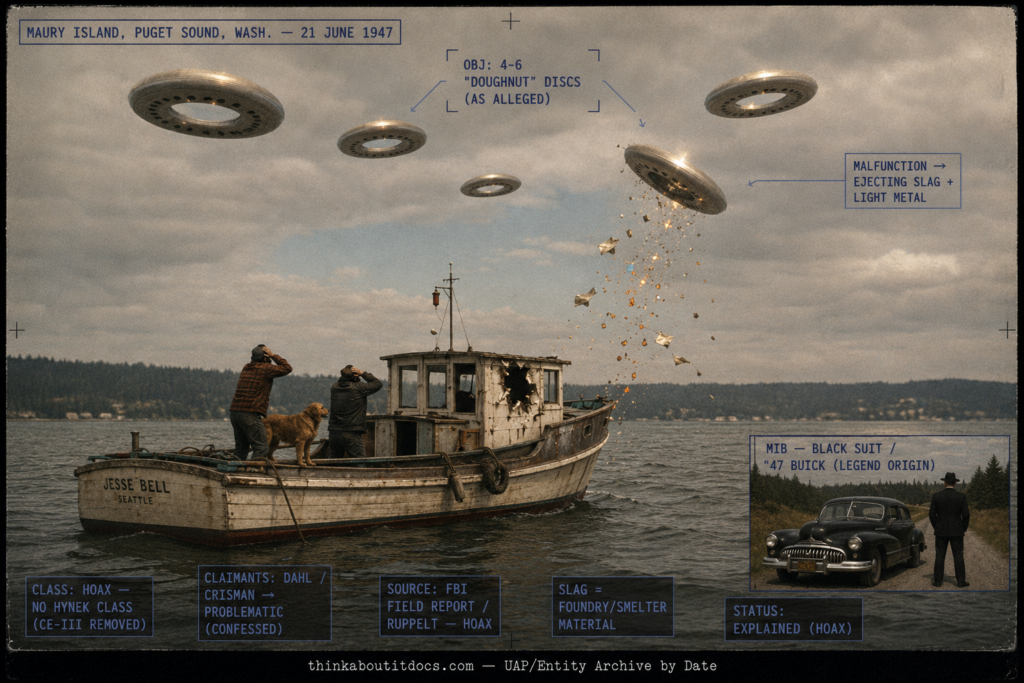
Doughnut craft, falling slag, and a man in black over Puget Sound, June 1947 — the Maury Island incident, famous, consequential, and an assessed and admitted hoax.
THINK ABOUTIT UFO|UAP | ENTITY ENCOUNTER REPORT
1947: Maury Island Incident
The Maury Island incident has everything: six doughnut-shaped craft over Puget Sound, molten slag raining down to kill a dog and injure a boy, a man in a black suit and a new Buick delivering a veiled threat over breakfast, a sample of “saucer metal” carried aboard a B-25 that fell flaming out of the sky and killed two Army intelligence officers, and a cast that links it to Kenneth Arnold, to pulp editor Ray Palmer, and to the very first “men in black.” It is one of the most consequential stories in the history of ufology — the seedbed of the MIB legend and a fixture of conspiracy lore for eight decades. It is also, by the conclusion of the FBI, of Project Blue Book’s own Edward Ruppelt, and ultimately of its two perpetrators, a hoax. Both of those facts are true at once, and the record has to hold them together: a fabricated case that nonetheless changed the field forever.
Date: June 21, 1947 (incident); story circulated late July 1947
Sighting Time: Unknown (daytime)
Day/Night: Day
Location: Maury Island, Puget Sound, near Tacoma, Washington (now a peninsula of Vashon Island)
Urban or Rural: Rural (coastal/marine)
No. of Entity(s): 1 (the alleged “man in black”)
Entity Type: MIB (man-in-black figure) — as reported; see Researcher’s Notes on the origin of the motif
Entity Description: A man described as wearing a black suit and driving a new 1947 Buick, who allegedly invited Harold Dahl to breakfast, recounted details of the sighting Dahl said he had not made public, and delivered a vague warning Dahl took as a threat to his family
Hynek Classification: Not applicable — the case is an assessed/admitted hoax and does not warrant a Hynek encounter classification. “Hoax (no valid classification).” See Researcher’s Notes.
Duration: Unknown
No. of Object(s): Four, five, or six (Dahl’s accounts varied; initial FBI report says four or five)
Description of the Object(s): As alleged — doughnut-shaped discs flying in formation, with blue sky visible through the central holes and apparent portholes lining the inner ring. One reportedly malfunctioned; another approached it; the troubled craft then ejected light metal “like newspapers” and a slag-like material that allegedly struck Dahl’s boat.
Shape of Object(s): Doughnut/torus-shaped (as alleged)
Size of Object(s): Unknown
Color of Object(s): Metallic; blue sky reportedly visible through the central openings
Distance to Object(s): Low over the boat (as alleged)
Height & Speed: Low altitude over Puget Sound; specifics not established
Number of Witnesses: 3 as claimed (Harold Dahl, his son Charles, an unnamed crewman; plus Fred Crisman, who claimed a brief follow-up sighting) — but the central claimants later confessed fabrication
Special Features/Characteristics: Alleged falling slag/metal causing property damage, a dead dog, and an injured boy; claimed photographs that never materialized (variously “didn’t turn out,” then “disappeared”); the first widely-circulated “man in black” episode; direct entanglement with Kenneth Arnold and Ray Palmer; the fatal B-25 crash near Kelso, Washington carrying the material and two A-2 intelligence officers (Capt. William Davidson, Lt. Frank Brown); slag identified as ordinary foundry/smelter slag (and as aluminum)
Case Status: Explained (assessed and later admitted hoax; debris identified as terrestrial foundry slag; the associated B-25 crash judged an accident with no sabotage)
Source: FBI field report on the Maury Island incident (concluded hoax); Edward J. Ruppelt (chief, Project Blue Book) — assessed hoax; secondary documentation via ufologie.net and the standard literature.
Summary/Description: On or about June 21, 1947, Tacoma boatman Harold Dahl claimed that while salvaging drifting logs off Maury Island he saw several doughnut-shaped craft, one of which malfunctioned and rained slag and light metal onto his boat, killing his dog and injuring his son. He claimed photographs and recovered debris, and said a man in a black suit later warned him to stay silent. His associate Fred Crisman amplified the story, which reached pulp editor Ray Palmer and then Kenneth Arnold. Arnold convened meetings in Tacoma with Crisman, Dahl, and Army A-2 intelligence officers Davidson and Brown; the two officers’ B-25 crashed near Kelso while carrying samples of the material, killing both. The debris was identified as ordinary foundry/smelter slag (and aluminum); the FBI, Ruppelt, and ultimately Dahl and Crisman themselves concluded or confessed the affair was a hoax.
Related Cases: 1947 Kenneth Arnold Sighting (directly entangled) | 1947 “Metal Found in ‘Disc’ Probe Reported on Plane” article (this site) | United Air Lines Capt. E.J. Smith, Emmett, Idaho sighting (July 4, 1947) | Albert K. Bender / origin of the “men in black” legend (1953) | broader 1947 wave
DETAILED REPORT
The Maury Island incident is best understood as two intertwined things: a fabricated UFO claim, and a real, consequential historical episode that grew up around it. The claim originates with Harold A. Dahl, who said that on or about June 21, 1947 — days before Kenneth Arnold’s famous sighting — he was salvaging drifting logs in Puget Sound with his son Charles, an unnamed crewman, and his dog when several doughnut-shaped craft appeared overhead. He described being able to see sky through the central holes and portholes around the inner rings, said one craft malfunctioned and was approached by another, and claimed the troubled object then shed sheets of light metal and a hot slag-like material that damaged his boat, killed the dog, and injured his son. He said he photographed the objects and gathered debris. The following morning, by his account, a man in a black suit driving a new 1947 Buick took him to breakfast, recited details of the sighting Dahl believed he had told no one, and issued a vague warning Dahl interpreted as a threat against his family.
Dahl’s business associate Fred Crisman — a figure with a long history of involvement in unusual claims, later (and dubiously) tied to JFK-assassination conspiracy lore — amplified the report, gathered more “slag” from the beach, and routed a sample toward Chicago and ultimately to Ray Palmer, the pulp editor of Amazing Stories. Palmer, then commissioning Kenneth Arnold to write up Northwest saucer reports, asked Arnold to investigate. Arnold flew to Tacoma and convened meetings at the Winthrop Hotel with Dahl, Crisman, United Air Lines Captain E.J. Smith, and two Army A-2 intelligence officers, Captain William Davidson and Lieutenant Frank Brown, who flew up from Hamilton Field, California. The episode then turned genuinely tragic and strange: the officers’ B-25, carrying samples of the material, caught fire and crashed near Kelso, Washington on their return, killing both men (two others aboard parachuted to safety). Anonymous callers fed lurid claims to the press — that the bomber had been shot down by 20mm cannon, that secret “saucer parts” were aboard — and a small cascade of misfortune and rumor followed, including the later death of a Tacoma Times reporter and Crisman’s hasty recall to military service and posting to Alaska and Greenland.
The evidentiary core, however, collapses under scrutiny. The promised photographs never materialized — first said not to have turned out, then to have vanished from Dahl’s glove compartment. The recovered material was identified as ordinary foundry or smelter slag, and the officers reportedly recognized it as common aluminum; a comparison at a Tacoma slag mill found Dahl’s “saucer metal” indistinguishable from generic smelter slag. The FBI’s field investigation concluded the affair was a hoax. Captain Edward Ruppelt, who would head Project Blue Book, independently judged it a hoax. Most decisively, Dahl and Crisman themselves confessed to investigators that they had invented the story; Dahl oscillated (claiming hoax, then truth, then hoax-to-protect-his-family), and Crisman later mutated the tale into one about an American plane dumping radioactive waste. The B-25 crash — the one undeniably real and fatal element — was investigated by McChord Field and judged an accident, an engine fire with no evidence of sabotage. In short, the spectacular claims were fabricated; the deaths were a coincidental air accident that the hoax’s gravity and the era’s excitement bound retroactively into the legend.
RESEARCHER’S NOTES
The Hoax That Made the Mythology — Maury Island 1947 and the Birth of the Men in Black
- Classification Assessment (Correction Required): The live page’s CE-III is indefensible and must be removed. Beyond the fact that the case is an assessed and confessed hoax, the “animate being” on which a CE-III would rest is the alleged man-in-black — a human (or fictional) visitor in a Buick, not an occupant associated with a craft, which is what CE-III requires. There is no valid Hynek encounter classification for a fabricated report; the correct log is “Hoax — no classification.” The MIB entity entry should be retained descriptively (it is historically important) but explicitly framed as the origin point of a legend rather than as a documented being.
- Source Chain Assessment: The documentary trail is unusually rich for a hoax, precisely because of the real institutional response it triggered. The authoritative sources are the FBI field report (hoax conclusion) and Edward Ruppelt’s later assessment (hoax), both Primary/strong. These outrank the claimants entirely. The originating claimants — Dahl and Crisman — are PROBLEMATIC sources by any measure: self-contradicting, financially entangled with Palmer’s pulp enterprise, and self-confessed fabricators. The slag’s identification as terrestrial foundry material is the physical anchor of the Explained status.
- Pattern Context — Why a Hoax Still Matters: Maury Island’s importance is historical and memetic, not evidentiary. It is the first widely-circulated “man in black” episode, the seed later watered by Albert K. Bender’s 1953 claims into the full MIB legend that pervades the culture to this day. It is also inextricable from the index case of the field: it pulled in Kenneth Arnold and Ray Palmer at the exact moment the “flying saucer” was being born, and Palmer’s monetization of these intertwined stories (culminating in Fate magazine’s January 1948 debut) helped shape the commercial and mythological architecture of early ufology. The fatal B-25 crash supplied the legend with martyrs and a death-follows-the-witnesses motif that recurs across conspiracy literature. Retaining the case as a documented hoax preserves this causal history without endorsing the claim.
- Physical Evidence and Evidentiary Weight: The physical evidence actively disconfirms the claim. The “saucer slag” was identified as ordinary foundry/smelter slag and aluminum; the photographs never existed in any verifiable form; the boat damage was attributed to mundane causes with “signs of recent repair” noted by a witness. The only hard, real event — the B-25 crash — was investigated and judged an accident with no sabotage. There is, therefore, no evidentiary residue pointing to an anomalous phenomenon; the weight of evidence points entirely to fabrication plus a coincidental tragedy. This is the basis for Case Status: Explained (hoax), and it is one of the rare early cases where the conventional explanation is positively established rather than merely plausible.
Maury Island is the archive’s clearest example of a case that is simultaneously false and historically indispensable. The doughnut craft, the killer slag, the vanished photographs, and the breakfast threat from the man in black were fabricated — a conclusion reached independently by the FBI and by Project Blue Book’s own Edward Ruppelt, and finally admitted by Dahl and Crisman themselves; the recovered “saucer metal” was ordinary foundry slag, and the one undeniable tragedy, the Kelso B-25 crash, was an accident. Yet from this hoax came the men-in-black legend, a deep entanglement with the Arnold sighting and Ray Palmer’s pulp empire, and eight decades of conspiracy lore. The archive removes the erroneous CE-III, logs the case as a Hoax with Case Status: Explained, populates the FBI/Ruppelt sourcing, and retains the entry for what it genuinely is — not evidence of the phenomenon, but a foundational artifact of how the phenomenon’s mythology was made.