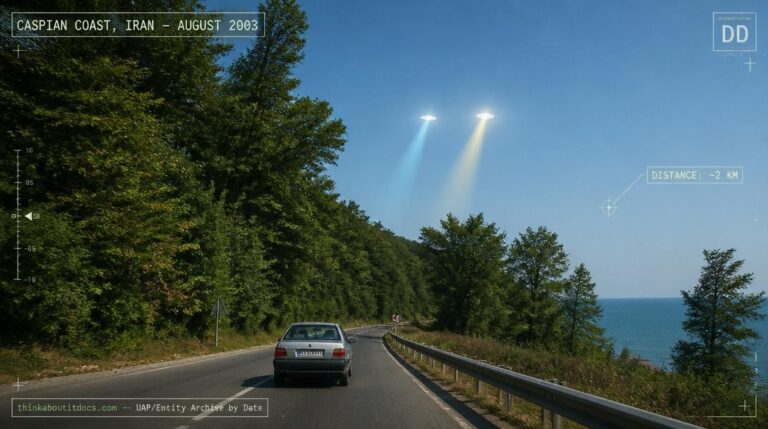
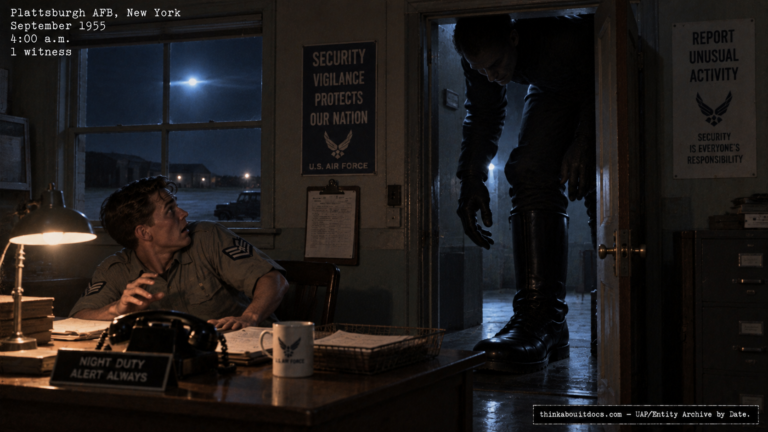
Dossier reconstruction of the object that jammed two Iranian F-4 Phantom jets over Tehran, Iran, September 18–19, 1976.
THINK ABOUTIT UFO|UAP|ENTITY ENCOUNTER REPORT
1976: Tehran, Iran F-4 Jet Chase | CE-II UFO Case Archive
Late on the night of September 18, 1976, an intensely bright, pulsating object hovering over northern Tehran drew four separate calls to Mehrabad Airport’s control tower before the night shift supervisor, Hossain Perouzi, finally stepped out to look himself. What followed, over the next several hours, became one of the most rigorously documented UFO cases on record: two F-4 Phantom jets scrambled in succession, both losing weapons and communications systems to a jamming signal unlike anything their own air force possessed; a General watching from his balcony as a smaller object detached from the main craft and raced toward one of his own fighters; and, by morning, a beeper signal leading investigators to a house where residents described a loud noise and a bright light in the night.
This case doesn’t need much added to it — it needs one thing fixed. The strong, wideband jamming that disabled two fighter jets and a civil airliner, and the temporary night-blindness some crew suffered from the object’s brightness, are exactly the kind of physical and physiological effects that define Hynek’s CE-II category. The original classification of CE-I — simple observation — undersells what actually happened that night, and this entry corrects it.
Date: Night of September 18–19, 1976
Sighting Time: Initial reports 10:30–11:15 PM on September 18; Perouzi’s own sighting around 11:15 PM; first F-4 scrambled 1:30 AM, second at 1:40 AM on September 19
Day/Night: Night
Location: Tehran, Iran — observed from Mehrabad Airport’s control tower and from General Yousefi’s residence balcony over northern and southern Tehran restricted airspace; F-4 jets launched from Shahrokhi Air Force Base
Urban or Rural: Mixed — urban (Tehran city and airport) and airborne (F-4 intercept), reflecting the original “Air” notation
Hynek Classification: CE-II (Close Encounter II) — corrected from CE-I, given extensive documented electromagnetic interference on three separate aircraft and physiological effects (temporary night-vision loss) on crew members, both explicitly cited by the DIA’s own evaluation. See Researcher’s Notes.
Duration: An extended, multi-hour incident, from initial control tower reports around 10:30 PM on September 18 through the following morning’s investigation of the suspected landing site
No. of Object(s): Primarily 1 large object, from which at least 2 smaller objects separately emerged at different points in the encounter — not simultaneous independent craft throughout. See Researcher’s Notes.
Description of the Object(s): Initially described as rectangular; witness Perouzi later assessed it as probably cylindrical, with pulsating whitish-blue light at each end and a red light circling its midsection. The second F-4 crew described flashing strobe lights in a rectangular pattern, cycling so rapidly through blue, green, red, and orange that all colors appeared simultaneously.
Shape of Object(s): Cylindrical (per witness Perouzi’s assessment), initially perceived as rectangular
Size of Object(s): Very large — its radar return was comparable in size to a Boeing 707 tanker aircraft; Perouzi’s closer visual estimate was approximately 7–8 meters long and 2 meters wide
Color of Object(s): Whitish-blue at both ends with a circling red light at the midsection; later described by the second F-4 crew as rapidly alternating blue, green, red, and orange strobe lights
Distance to Object(s): Multiple distances recorded at different points: visible from about 70 nautical miles due to its brightness; the first F-4 lost instrumentation at 25 nautical miles; General Yousefi observed it from his balcony at an estimated 12 miles. See Researcher’s Notes.
Height & Speed: Initially reported hovering at approximately 1,000 feet (300 meters) above the ground; no further altitude or speed figures given beyond radar contact and closing distances
Number of Witnesses: Multiple named military witnesses — night shift supervisor Hossain Perouzi, Base Operations Commander General Nader Yousefi (an eyewitness from his residence balcony), second F-4 pilot Lt. Jafari, and Deputy Commander-in-Chief Lt. General Azarbarzin (who confirmed the electromagnetic effects) — plus a civil airliner crew that experienced a communications failure, and civilians at a house near the suspected landing site who reported a loud noise and bright light
Special Features/Characteristics: Strong, wideband electromagnetic jamming disabled communications and weapons systems on both F-4 intercepts and separately affected a civil airliner; radar confirmed the object’s size and presence; crew members reported temporary loss of night vision from the object’s brightness; a smaller object separated from the primary craft and approached the first F-4 aggressively before returning; a second smaller object was reported descending toward and landing on the ground; a beeper signal traced the next day led investigators to a house near the suspected landing site, whose residents reported a loud noise and bright light, though no physical evidence was found at the suspected landing spot itself; a Defense Intelligence Agency evaluation rated the case as meeting all criteria for a valid UFO study
Case Status: Unexplained
Source: Don Berliner, UFO Briefing Document: The Best Available Evidence; cross-referenced with declassified U.S. Defense Attaché Office (DAO) memoranda, a 1978 U.S. military journal (MIJI Quarterly) article, and a Defense Intelligence Agency (DIA) evaluation
Summary/Description: On the night of September 18–19, 1976, a large, brightly lit object was observed hovering over Tehran, Iran, prompting the Imperial Iranian Air Force to scramble two F-4 Phantom jets. Both aircraft lost communications and weapons systems to strong electromagnetic jamming as they closed in, and a smaller object reportedly separated from the primary craft to approach one of the jets before a second smaller object descended toward the ground. The case was confirmed on the record by senior Iranian Air Force officers, corroborated by declassified U.S. defense documents, and evaluated favorably by the Defense Intelligence Agency as meeting every criterion of a credible UFO case.
Related Cases: Undocumented by name — the source notes only that a civil airliner separately experienced a communications failure that same night without a corresponding visual sighting. Not separately indexed in this archive.
Detailed Report
Between 10:30 and 11:15 PM on September 18, 1976, Mehrabad Airport’s control tower in Tehran received four separate calls reporting an unknown object hovering roughly 1,000 feet above the ground over the northern part of the city. Night shift supervisor Hossain Perouzi initially didn’t think much of it — the airport’s radar was down for repair at the time — but after the fourth call, he stepped out onto the terrace with binoculars. What he saw, by his own account, was a rectangular object, pulsing with whitish-blue light at each end and a small red light circling its midsection; further observation led him to believe it was probably cylindrical in shape.
At 12:30 AM, Perouzi reported the object up the chain of command, and General Nader Yousefi, the base’s operations commander and its number-three-ranking officer, authorized an F-4 Phantom to scramble from Shahrokhi Air Force Base. Yousefi himself stepped onto his own residence balcony and spotted what looked like an unusually large, bright star among the others. The first F-4 took off at 1:30 AM and closed to within about 25 nautical miles of the object — visible from as far as 70 miles away due to its brilliance — before losing all instrumentation and communications entirely. The pilot broke off and turned back toward base; once he had turned away, his systems came back online.
A second F-4, piloted by Lt. Jafari, launched at 1:40 AM and established radar contact, with a return comparable in size to a Boeing 707 tanker. As this aircraft pursued the object south of Tehran, a second, smaller, brightly lit object — estimated at a third to half the apparent size of the moon — separated from the main craft and came directly at the F-4 at high speed. Jafari attempted to fire an air-to-air missile, but his weapons panel went dead along with his communications, forcing him into a sharp turn and dive to escape. His systems recovered only once he’d put distance between himself and the object. The smaller object then returned to the primary craft — but a second one broke away and descended toward the ground. From his balcony, Yousefi watched it land, describing what looked like ongoing communication, marked by light, between the main object and the one that had touched down.
The strangeness didn’t end there. Another object reportedly trailed the F-4 as it came in to land, and a civil airliner flying that night separately lost communications without any accompanying visual sighting. The next day, the F-4 crew was flown by helicopter to the area where the smaller object was believed to have landed — a dry lake bed — but nothing unusual was found at the site itself. Circling to the west, however, the crew picked up a distinct beeper-type signal, strongest near a small house with a garden. Questioned, the residents described a loud noise and a very bright light, like lightning, the night before. Beyond that, the trail goes cold; no further detail about the signal or the ground witnesses was ever released, though the U.S. Defense Attaché Office noted the area had been checked for radiation and that further information would be forwarded if it became available.
The case drew serious, sustained attention from both Iranian and American authorities. Lt. General Azarbarzin, the Air Force’s Deputy Commander-in-Chief of Operations, confirmed years later in a recorded interview that the jamming was unlike anything Iran’s own forces possessed — wideband, capable of blocking multiple frequencies simultaneously. A 1978 article in the classified U.S. military journal MIJI Quarterly repeated the same core facts, its author noting that the episode would likely be “filed away and probably forgotten,” but calling it “interesting, and possibly disturbing, reading.” A Defense Intelligence Agency evaluation went further, rating the case an “outstanding report” and a textbook example meeting every standard for a credible UFO study: multiple witnesses across different locations and vantage points, high witness credibility including a general officer and experienced aircrews, radar-confirmed visual sightings, electromagnetic effects reported by three separate aircraft, documented physiological effects, and highly unusual maneuverability on the part of the object.
RESEARCHER’S NOTES
The Tehran Jet Chase — Iran 1976 and a Classification That Undersold It
- Classification Correction: CE-I substantially understates this case. The account documents strong, wideband electromagnetic jamming affecting communications and weapons systems on two separate F-4 intercepts, plus a communications failure on an unrelated civil airliner, and physiological effects (temporary loss of night vision) on crew members — effects the DIA’s own evaluation cites as defining features of the case. This entry reclassifies it as CE-II, which specifically covers physical, electromagnetic, and physiological effects.
- Distance Figure, Clarified: The original field lists a single distance, 25 nautical miles, but the source describes several relevant distances at different points: the object was visible from as far as 70 nautical miles due to its brightness; the first F-4 lost instrumentation specifically at 25 nautical miles; and General Yousefi observed it from his residence balcony at an estimated 12 miles. This entry presents these as distinct figures for different moments rather than one general distance.
- Object Count, Clarified: “Multiple” objects were involved, but not as simultaneous, independent craft throughout — the account describes one large primary object from which at least two smaller objects separated sequentially at different points, one approaching the first F-4 aggressively before returning, and a second flying toward the ground. This entry presents that structure rather than a flat count.
- The Suspected Landing, Unconfirmed: F-4 crew were taken by helicopter the next day to the dry lake bed where the second smaller object was believed to have landed, but found no physical evidence there. A beeper-type signal instead led investigators to a nearby house, whose residents reported a loud noise and bright light — a genuinely suggestive lead, but never confirmed as the actual landing site, and the source itself notes that further details about this thread were never released.
- Source Chain Assessment: This case is unusually well-documented by this archive’s standards — confirmed on the record by multiple senior Iranian Air Force officers, corroborated by a declassified U.S. Defense Attaché Office memorandum, referenced in a 1978 U.S. military journal, and positively evaluated by the Defense Intelligence Agency, which explicitly rated it as meeting every criterion for a credible UFO case study.
- Case Status Rationale: Filed as Unexplained given the strength and range of independent corroboration — radar confirmation, electromagnetic effects on three separate aircraft, named high-ranking military eyewitnesses, and a favorable U.S. government intelligence evaluation — a combination of documentation this archive rarely sees in one case.
Few cases anywhere in ufology carry this weight of corroboration: named generals on the record, declassified American intelligence paperwork, radar confirmation, and a formal U.S. evaluation calling it exactly the kind of case the field should be studying. What actually jammed two fighter jets and a civil airliner over Tehran that night has never been explained by any conventional account, and nothing in the fifty years since has closed the file. It remains, deservedly, filed as Unexplained.
“I saw a big star among the other stars.”