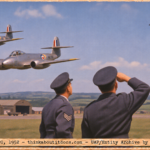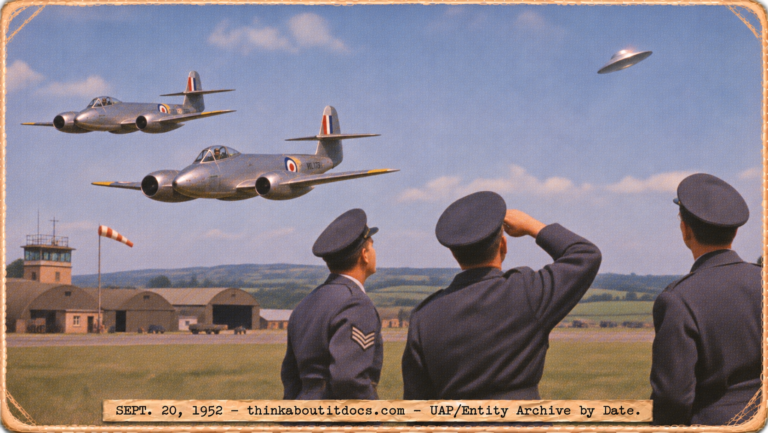
Topcliffe RAF Station, Yorkshire, September 20, 1952, 10:53 a.m.
THINK ABOUTIT UFO|UAP SIGHTINGS REPORT
1952: Topcliffe, Yorkshire, Kilburn and the Falling Leaf
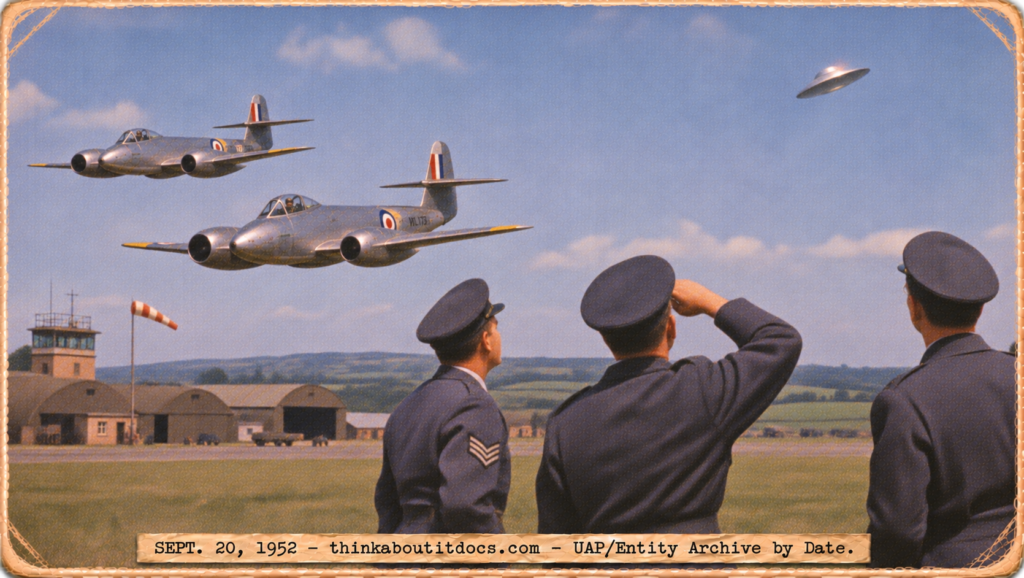
Two RAF Meteor jet pilots descending to land at Topcliffe, Yorkshire during Operation Mainbrace looked back and saw a slow-moving, circular, silver object about five miles behind them. It began swinging like a “falling sycamore leaf,” followed their jet as it turned toward Dishforth, stopped its falling-leaf motion, began to rotate on its axis and then accelerated at “incredible speed,” faster than a meteor, to the west before turning southeast and vanishing.
The pilots were Flt. Lt. John W. Kilburn and Flt. Lt. Cybulski. The object was also seen from the ground by Flying Officer Paris, Master Signaller Thompson and Higgins, and by five other aircrew, which makes this one of the best-witnessed military-aviation sightings of the entire 1952 wave and the best-known British case of Operation Mainbrace.
Date: September 20, 1952 (some sources give September 19 or 21)
Sighting Time: 10:53 a.m. (or possibly 4:14 p.m.)
Day/Night: Day
Location: Topcliffe RAF Station, Yorkshire, England, UK, in the approach toward Dishforth
Urban or Rural: Rural, over an airfield and farmland
No. of Entity(‘s): None reported
Entity Type: Not applicable
Entity Description: Not applicable
Hynek Classification: DD (Daylight Disc)
Duration: 15–20+ seconds
No. of Object(s): 1
Description of the Object(s): A slow-moving circular object that followed the Meteor on a similar course, swung like a “falling sycamore leaf” or pendulum while descending, stopped that motion, began rotating on its axis and then accelerated away at “incredible speed” to the west before turning southeast
Shape of Object(s): Circular
Size of Object(s): Not recorded
Color of Object(s): Silver (or white)
Distance to Object(s): About 5 miles behind the Meteor at first sighting
Height & Speed: About 15,000 ft at first sighting while the Meteors were at 5,000 ft; slow at first, then faster than a meteor on departure
Number of Witnesses: At least 10: Flt. Lt. John W. Kilburn and Flt. Lt. Cybulski in the Meteors, Flying Officer Paris, Master Signaller Thompson and Higgins on the ground, and five other aircrew
Special Features/Characteristics: Falling-leaf (pendulum) motion followed by axial rotation and abrupt acceleration; the object followed the Meteor as it turned toward Dishforth; ground observers and additional aircrew confirmed it; seen during the large NATO exercise Operation Mainbrace
Case Status: Unexplained (no explanation is given in the cited sources)
Source: Jan Aldrich; Edward J. Ruppelt pp. 195–6; NICAP; FUFOR Index
Summary/Description: During Operation Mainbrace, RAF Meteor pilots Flt. Lt. John W. Kilburn and Flt. Lt. Cybulski, descending to land at 5,000 ft over Topcliffe, saw a slow circular silver object about five miles behind them at about 15,000 ft. It swung like a falling leaf, followed their turn toward Dishforth, then stopped, rotated and accelerated westward at incredible speed before turning southeast. Ground observers and five other aircrew also saw it.
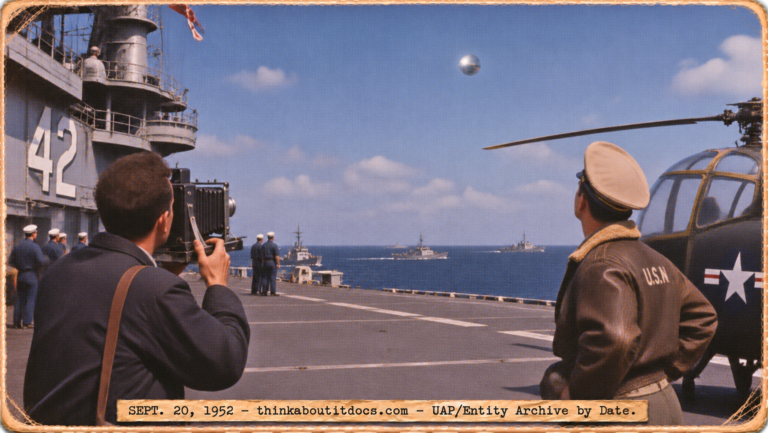
Related Cases: 1952: USS Franklin D. Roosevelt, Operation Mainbrace Sphere | the September 21 North Sea Meteor pursuit entry on the September 17th–30th page
DETAILED REPORT
Operation Mainbrace, the large NATO naval and air exercise in the North Sea and northern Europe in September 1952, put hundreds of trained military observers in the air and at sea. At Topcliffe RAF Station in Yorkshire, two Meteor jet fighters were descending toward landing at 5,000 feet when Flt. Lt. John W. Kilburn and Flt. Lt. Cybulski saw a circular silver (or white) object about five miles behind them at roughly 15,000 feet, on a similar course.
The object began swinging like a “falling sycamore leaf” or pendulum as it descended. As the Meteors turned toward Dishforth the object followed. Then it stopped its falling-leaf motion, began rotating on its axis and suddenly accelerated at what the pilots called incredible speed, faster than a meteor, to the west. It then turned southeast and disappeared. The whole sighting lasted 15 to 20 seconds or a little more.
The sighting was not confined to the aircraft. Flying Officer Paris, Master Signaller Thompson and Higgins, along with five other aircrew, also saw the object. The date and time are not settled: the sources give September 20 (or 19 or 21) and 10:53 a.m. (or possibly 4:14 p.m.).
RESEARCHER’S NOTES
Topcliffe 1952: A Daylight Disc Seen from Two Cockpits and the Ground
- Witness quality: Two RAF fighter pilots, three ground observers and five more aircrew put at least ten trained observers on the object, in daylight, during an exercise that had thousands of military eyes on the sky. That is exceptional for the period.
- The motion: The falling-leaf swing is the most distinctive detail and the one that has kept the case in the literature. It was followed by axial rotation and abrupt acceleration, which are behaviors the cited sources do not tie to any known aircraft or balloon.
- Date and time uncertainty: Sources disagree on September 19, 20 or 21 and on 10:53 a.m. or 4:14 p.m. The archive preserves the disagreement rather than choosing. No Blue Book record card for Topcliffe was available in the upload set, so the entry rests on the sources cited.
- Why Unexplained: The cited sources give no explanation. The archive does not claim one, and the case is listed as Unexplained for that reason alone, not on the strength of any official evaluation.
Topcliffe is the Mainbrace case people remember: a silver disc that swung like a falling leaf behind two Meteor pilots, followed them through a turn, rotated and left at incredible speed, with ground observers and extra aircrew watching. The date and time remain unsettled, but the account of what was seen is consistent across the sources.
“It began swinging like a falling sycamore leaf.”
— Flight Lt. John W. Kilburn, describing the object over Topcliffe RAF Station, Yorkshire, September 1952 (as quoted on the live monthly page)