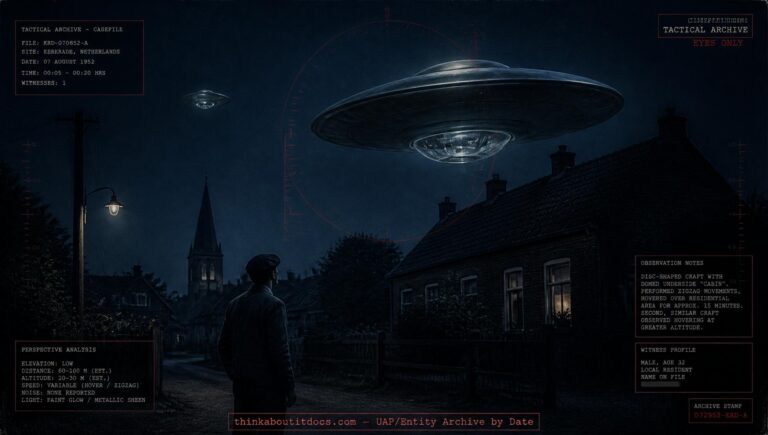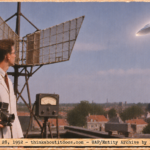
Delft, Netherlands, late August 1952, about 3:35 p.m.
THINK ABOUTIT UFO|UAP SIGHTINGS REPORT
1952: Delft, Netherlands, the Radio Engineer’s Photograph
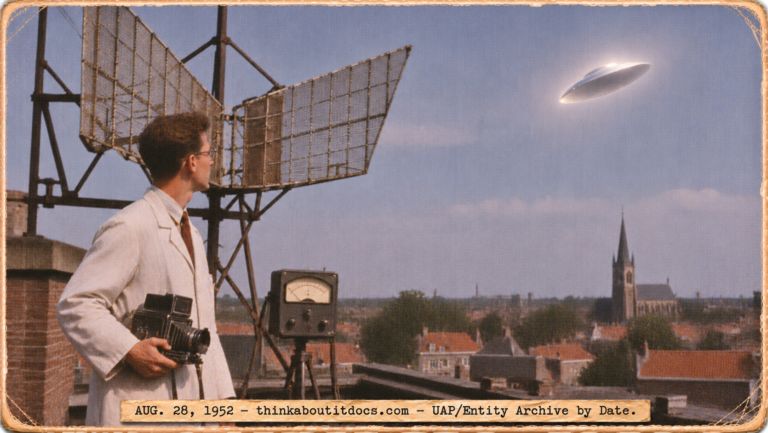
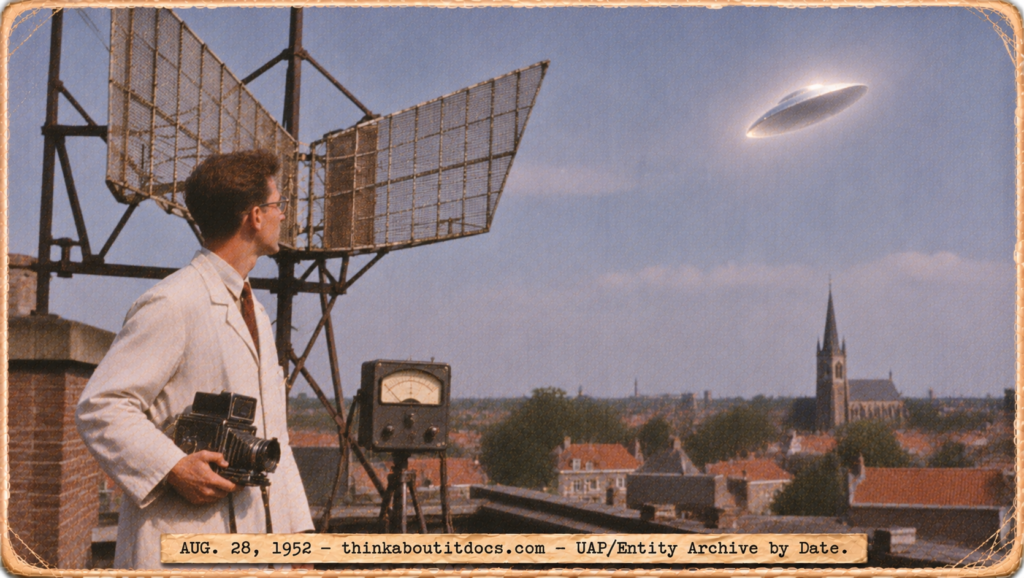
On an afternoon in late August 1952, a Dutch radio engineer testing a VHF antenna on the roof of the Netherlands Cable Factory in Delft saw an extremely bright object come in from the direction of Rotterdam, turn toward him as a silver round plate, and shoot straight up. He pushed the shutter of his plate camera without looking through the viewfinder, then glanced at his field-strength meter and saw the needle had dipped sharply.
The glass negative was developed that evening, run in a leading Dutch newspaper and taken to the Royal Netherlands Meteorological Institute. The Institute’s own letter to him calls the phenomenon “a great query mark.” The U.S. Air Attaché at The Hague forwarded the engineer’s letter, the Institute’s letter and the clipping to Washington.
Date: Thursday, August 28, 1952 (inferred; the Blue Book file is filed under September 1952)
Sighting Time: About 3:35 p.m. Central European time
Day/Night: Day
Location: Delft, Netherlands, on the roof of the Netherlands Cable Factory, between Rotterdam and The Hague
Urban or Rural: Urban, an industrial town
No. of Entity(‘s): None reported
Entity Type: Not applicable
Entity Description: Not applicable
Hynek Classification: DD (Daylight Disc)
Duration: 10–15 seconds
No. of Object(s): 1
Description of the Object(s): A bright silver object that approached at tremendous speed from the right like a “silver V-2 rocket,” turned toward the witness as a bright round plate, tipped over and shot almost perpendicularly upward
Shape of Object(s): Round plate or disc with a bright corona
Size of Object(s): About 9 degrees in apparent diameter by the Meteorological Institute’s measurement (the central part alone about 3 degrees, six times the Sun)
Color of Object(s): Bright silver
Distance to Object(s): Not recorded
Height & Speed: Center 20 degrees above the horizon, 20 degrees south of east; speed “tremendous,” no sound
Number of Witnesses: 1 (the engineer); his assistant had gone downstairs
Special Features/Characteristics: Photographed on a 9 × 12 cm glass plate with a Zeiss Ikon camera (1/250 second, lens wide open, no viewfinder); the field-strength meter needle deflected sharply as the object passed and recovered slowly; no sound; the Meteorological Institute measured its position and size but offered no explanation
Case Status: Unexplained (no explanation offered in the file)
Source: Blue Book file (Air Intelligence Information Report TR-62-52, Air Attaché, The Hague, with the engineer’s letter, the Meteorological Institute letter of September 1, 1952 and a Dutch newspaper clipping)
Summary/Description: A Dutch radio engineer on a factory roof in Delft photographed a bright silver round plate that came from the Rotterdam side and shot straight up at about 3:35 p.m., and his field-strength meter dipped as it passed. The Royal Netherlands Meteorological Institute measured the image and called the phenomenon “a great query mark.”
Related Cases: the late-August Dutch and West European reports on the August 18th–31st page
DETAILED REPORT
The engineer worked in the Physical Laboratory of the Netherlands Cable Factory in Delft. In his own letter he describes testing a VHF corner-reflector antenna on the roof (frequency 119.3 Mc/s) with a field-strength meter. He had his assistant read the instrument while he photographed the dial with a Zeiss Ikon plate camera, then sent the assistant downstairs for a soldering iron.
At 3:15 p.m. by his clock he loaded the camera to photograph the meter again. He then saw an object “moving at a tremendous speed and coming from my right side,” from the south toward Rotterdam, and it “looked like a silver V2 rocket.” There was no sound. As it came closer it turned toward him and looked like a bright silver round plate. He thought it might be a flying saucer, pushed the shutter at 1/250 second without looking in the viewfinder, then looked at the meter and saw a strong dip in the deflection. The object disappeared at tremendous speed perpendicular to the earth, at 3:35 p.m. by his account of the time.
He developed the negative in the factory photographic laboratory and phoned the Telegraaf. The next day he and the editor went to the Meteorological Institute at De Bilt, near Utrecht. The experts thought the bright corona might be ultraviolet or lens deformation since the diaphragm was fully open. Their letter of September 1 puts the center of the disc 20 degrees above the horizon, 20 degrees south of east, with a diameter of 9 degrees (3 degrees for the bright core), and says it is surprising that no stream of inquiries arrived given the dense road traffic between Rotterdam and The Hague, and that, with the Sun not interfering, it should have been seen extremely well.
RESEARCHER’S NOTES
Delft 1952: A Plate Photograph, a Meter Dip and a “Great Query Mark”
- The meter dip: The engineer was measuring field strength at 119.3 Mc/s when the object passed, and the needle deflected sharply and recovered slowly. That is a reading made independently of the photograph, though no one has shown what caused it.
- Date conflict: The newspaper article says “Tuesday morning” and the engineer says “last week.” The Meteorological Institute’s September 1 letter says “last Thursday,” which is August 28. The file is filed under September, so the entry belongs on the August 18th–31st page.
- Time conflict: The engineer gives 3:15 p.m. as loading time and 3:35 p.m. as the sighting, while the article says 3:35 p.m. The OCR also makes one number uncertain.
- The explanation question: The Institute raised an optical corona and the open lens as possible reasons for the halo but offered no explanation for the object itself.
Delft is a single-witness case with unusual support: a glass-plate photograph, a meter deflection recorded at the same moment, an immediate newspaper contact and an official institute that measured the image and admitted it could not explain it.
“For this reason the phenomenon remains for me a great query mark.”
— Royal Netherlands Meteorological Institute, letter of September 1, 1952 (Blue Book file; OCR of a typed copy)