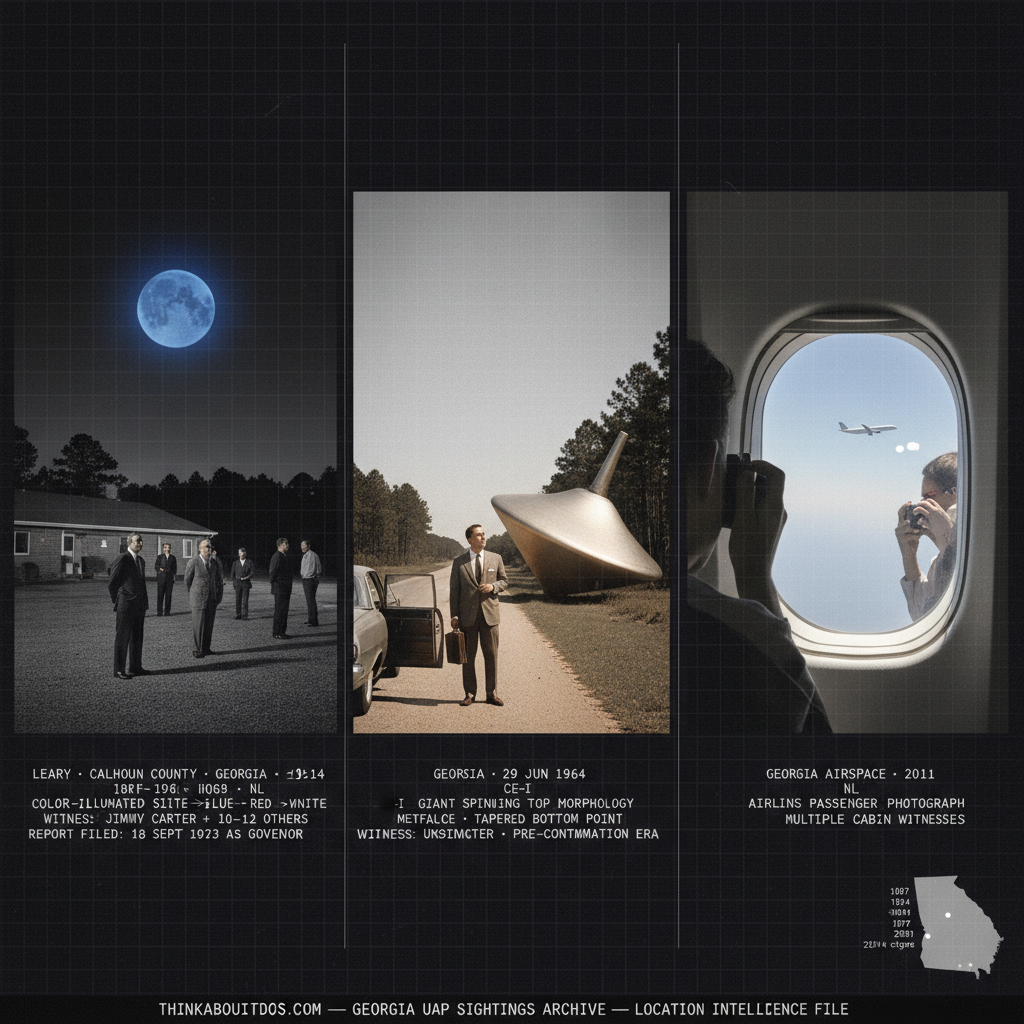
Georgia UAP archive: Jimmy Carter Leary January 1969 self-illuminated color-changing NL with 10-12 corroborating witnesses filed formally as governor in 1973, June 1964 giant spinning top CE-I encountered by a Georgia businessman on a rural road, and 2011 airline passenger photograph of luminous objects trailing a commercial jet. 9 documented cases 1887–2014.
Georgia UFO|UAP & Alien Sightings Archive
Georgia’s nine-case UAP archive carries the distinction of including a sitting U.S. President as a named, documented witness — Jimmy Carter’s January 6, 1969 sighting at Leary,
, filed formally with the International UFO Bureau in 1973 and corroborated by ten to twelve other witnesses at the Lions Club. Carter described a bright white self-illuminated object that appeared in the western sky, moved toward the observers, stopped beyond a stand of pines, changed color from blue to red to white, then appeared to recede and disappear. He filed the report as governor at the Bureau’s request four years after the event, described it as the strangest thing he had ever seen, and stated he would never ridicule anyone who reported a UFO. Carter is one of only two U.S. Presidents to have publicly documented a UAP observation, and his account is notable for its specificity — the color transitions, the angular size compared to the moon, the witnesses present — and for the fact that he filed it under his own name as a sitting governor with no political upside and considerable political exposure in doing so. The 1887 entry — a newspaper account of an object falling from the sky in Georgia, described in the contemporary press as a message from the moon — extends the state’s documented anomalous record into the 19th century and places it alongside the airship wave documentation of the same decade.
The state’s pre-modern record reaches its physical evidence peak in June 1964, when a Georgia businessman encountered a giant spinning-top-shaped craft at close range — one of a small number of pre-1970 CE-I cases in the southeast with a named business professional as the sole witness and a specific craft morphology that does not match any contemporaneous aircraft type. The 1970 military witness who observed a light grow to five times the apparent diameter of the moon adds an institutional observer dimension. The 2011 airline passenger photograph — a commercial airline passenger capturing on camera a formation of lights trailing a commercial jet — adds a modern photographic element. Georgia’s geographic range across the archive spans from Leary in the southwest to Savannah on the coast to metropolitan Atlanta, tracking the state from the rural Deep South corridor to the urban interstate network.
- 1887: Fallen UFO: A Message From The Moon? – Newspaper
- 1964: Giant spinning top encountered by businessman
- 1968: Georgia Abduction
- 1969: Jimmy Carter’s UFO Sighting
- 1970: Military sighting of a light that grew to 5 Xs the moon
- 1977: Man has close encounter with UFO
- 2003: Lighted ‘panel of lights’ gliding silently across sky
- 2011: Airline passenger shoots photos of lights trailing commercial jet
- 2014: Two Cigar-Shaped UFOs Over Georgia
- 1951: The Lt. George Kinmon Pursuit — Near Dearing, Georgia
- 1951: The Fred Reagan Collision — Over Georgia
- 1955: Stockton, Georgia: Four Roadside Entities at 3:30 AM
Executive Summary
The Presidential Witness and the Spinning Top — Georgia’s Credibility Anchors
Georgia’s UAP archive derives its analytical weight from two sources that rarely appear in the same nine-case state record: a U.S. President as a named corroborated witness and a pre-1970 professional businessman as a named CE-I witness. The Carter sighting at Leary in January 1969 is not analytically significant because Carter became president — it is significant because he filed the report under his own name as governor in 1973, described a specific color-changing self-illuminated object with multiple corroborating witnesses, and did so with no conceivable political benefit and with a clear professional risk. The color transition sequence — blue to red to white — and the angular size comparison to the moon are the kind of specific perceptual details that retrospective fabrication tends not to produce. The 1964 spinning-top businessman case adds a different credibility dimension: a business professional in a pre-saucer-culture-saturation era, encountering a craft morphology that has no available cultural source in 1964 Georgia outside of fringe pulp literature, with enough specificity to generate a distinct case report. Together these two cases give Georgia’s small archive a witness credibility profile that many larger state archives cannot match on a per-case basis.