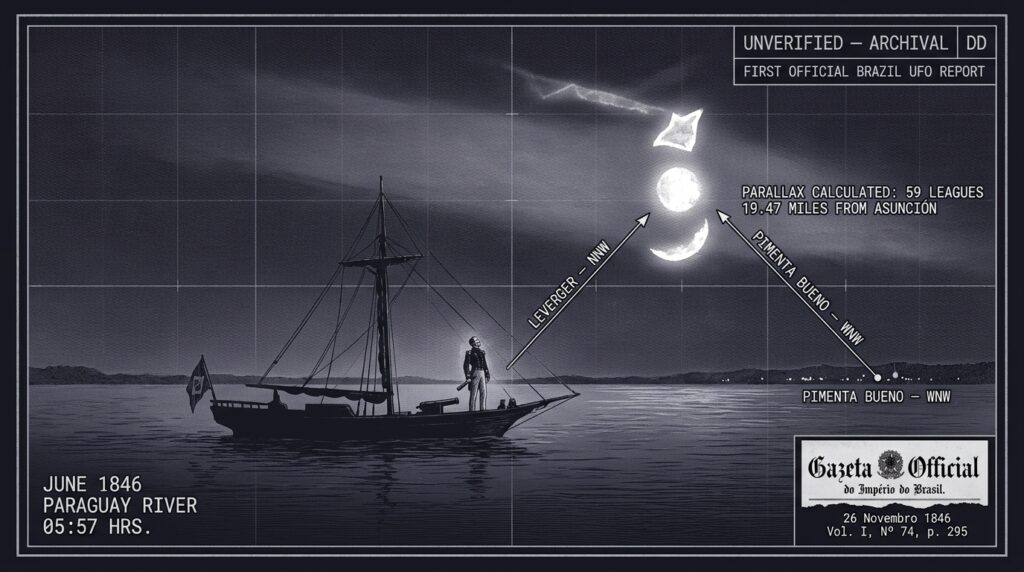
Paraguay River, June 1846 — Frigate Captain Augusto Leverger, future Baron of Melgaço and Rear Admiral of the Brazilian Imperial Navy, observes three superimposed luminous bodies exceeding the brightness of the full moon for 25 minutes at dawn over the Paraguay River. Cross-referenced against the Brazilian Ambassador's independent observation in Asunción and calculated by trigonometric parallax to be 19.47 miles from the city. Published in the Official Gazette of the Empire of Brazil, November 26, 1846 — Brazil's first official UFO report.
THINK ABOUTIT UFO|UAP SIGHTING REPORT
1846: Brazil’s very first official UFO reported near Asunción, Paraguay
On the morning of June 1846, aboard a Brazilian Imperial Navy gunboat on the Paraguay River, Frigate Captain Augusto João Manuel Leverger — hydrographer, explorer, future Baron of Melgaço, future Rear Admiral, future five-time president of the province of Mato Grosso — observed something he had never seen before and wrote it down with the precision of a naval officer trained in astronomy and trigonometric calculation. At 5:57 AM, in a perfectly clear and calm sky, a luminous globe performed a 30-degree curve at instant speed in the NNW direction. It left behind a band of light five to six degrees long in which three distinct luminous bodies were suspended — superimposed, separated, each brighter than a full moon in clear weather. One was nearly circular, one resembled an arc of 120 degrees with broken rays, one was an irregular quadrangle. Above them a ribbon of faint zigzag light. For twenty-five minutes the formation descended slowly without apparent velocity greater than the stars at twilight, the globes changing from sphere to flat ellipse to something resembling small clouds before the entire phenomenon vanished without a trace of atmospheric disturbance. Leverger calculated the parallax trigonometrically against the independent observation of the Brazilian Ambassador in Asunción and determined the phenomenon was located approximately nineteen miles from the city. The Official Gazette of the Empire of Brazil published his report on November 26, 1846. It is the first officially published UFO report in Brazilian history.
Date: June 1846 (exact date unknown; Leverger confirmed to be in Asunción in June 1846)
Sighting Time: 05:57 AM
Day/Night: Dawn — sky described as perfectly clear and calm
Location: On the Paraguay River, approximately 19 miles from Asunción, Paraguay
Urban or Rural: Rural — river expedition
No. of Entity(‘s): 0
Entity Type: None observed
Entity Description: None observed
Hynek Classification: DD (Daylight Disc) — multiple luminous objects observed at dawn in clear sky with defined morphological features
Duration: Approximately 25 minutes
No. of Object(s): Multiple — one primary luminous globe performing initial high-speed maneuver; three distinct luminous bodies visible in residual light band; one zigzag ribbon above
Description of the Object(s): A luminous globe performed a 30-degree curve at instant speed in NNW direction; left a light band 5–6 degrees long and 30–35 degrees wide containing three superimposed separated luminous bodies each exceeding the brightness of a full moon; the middle body was nearly circular; the lower resembled a 120-degree arc with broken rays at the ends; the upper was an irregular quadrangle; a ribbon of faint zigzag light approximately 3 degrees wide and 5–6 degrees long appeared above them; all elements descended slowly over 25 minutes, globes changing from spherical to flat elliptical to cloud-like appearance before vanishing; no atmospheric disturbance afterward
Shape of Object(s): Primary: globe; secondary bodies: circular, arc-shaped, irregular quadrangle
Size of Object(s): Angular diameter of the discs estimated at 20–25 degrees; the light band 30–35 degrees wide
Color of Object(s): Luminous — brightness described as equaling or exceeding a full moon in clear weather
Distance to Object(s): Calculated by trigonometric parallax to be approximately 19 miles (59 leagues) from Asunción
Height & Speed: Initial globe performed movement at “instant speed”; subsequent descent at no apparent velocity greater than stars at twilight
Number of Witnesses: Multiple — Frigate Captain Augusto Leverger (primary); Dr. José Antonio Pimenta Bueno, Marquis of São Vicente (Brazilian Ambassador/Minister to Paraguay); several other unnamed persons in Asunción
Special Features/Characteristics: Two independent observation points (Leverger on river, Ambassador in Asunción) with different directional bearings (NNW vs WNW) allowed trigonometric parallax calculation confirming physical distance; duration of 25 minutes eliminates meteor or atmospheric flash; shape transformation of globes from spherical to elliptical to cloud-like during descent; zigzag light ribbon maintained constant orientation throughout; no atmospheric disturbance after disappearance; report published in the Official Gazette of the Empire of Brazil, November 26, 1846 (Vol. I, No. 74, p. 295) — the first officially published UFO report in Brazilian history
Case Status: Unexplained
Source: Augusto João Manuel Leverger, Baron of Melgaço; Official Gazette of the Empire of Brazil, November 26, 1846; discovered by Edison Boaventura Júnior, Grupo Ufológico de Guarujá; reported by Antonio Huneeus, OpenMinds.tv, October 6, 2010
Summary/Description: Brazilian Imperial Navy Frigate Captain Augusto Leverger observes a luminous globe performing an instant-speed 30-degree curve at dawn over the Paraguay River, leaving behind three superimposed luminous bodies in a light band for 25 minutes before the phenomenon vanishes without atmospheric trace. The Brazilian Ambassador in Asunción independently observes the same phenomenon from a different bearing; Leverger uses trigonometric parallax calculation to determine the object’s location approximately 19 miles from the city. Report published in the Official Gazette of the Empire of Brazil, November 26, 1846 — the first officially published UFO report in Brazilian history.
Related Cases: 1820 Embrun France — François Arago formation report published in scientific journal | 1870 Lady of the Lake Atlantic observation published in Quarterly Journal of the Meteorological Society | 1882 Great Saucer — Royal Observatory Greenwich formal report
DETAILED REPORT
The case begins with the witness. Any analysis of the 1846 Paraguay River sighting must start with who Augusto João Manuel Leverger was, because the institutional weight of this report rests entirely on his credentials and character.
Leverger was born in 1802 in Saint-Malo, France — the port city that produced generations of navigators — and sailed with his father to South America in 1819. After his father’s death in Buenos Aires in 1822, he joined the Brazilian Imperial Navy at the rank of Second Lieutenant in 1824. By 1842 he had been promoted to Frigate Captain — equivalent to a Lieutenant Commander in the American Navy — distinguishing himself particularly through hydrographical work: the systematic survey and charting of the Paraguay River and the then largely unmapped border regions between Mato Grosso and Paraguay. He published scientific papers and navigation charts that were used for decades. He was, in other words, a man trained in precise observation, trigonometric calculation, and the documentation of physical phenomena under field conditions. He was not a man who would confuse a meteor with something requiring a formal report to the Imperial Gazette.
In June 1846, Leverger commanded two gunboats — the Dezoito de Julho and the Vinte e Três de Fevereiro — on a diplomatic-military expedition down the Paraguay River to Asunción. The political context was tension between Brazil and Paraguay that would eventually erupt into the War of the Triple Alliance in 1864. Leverger’s mission was hydrographic survey combined with a demonstration of Brazilian naval presence.
At 05:57 AM, with the sky perfectly clear and calm and the thermometer at 60 degrees Fahrenheit, Leverger observed what he described as a phenomenon he had never seen before. A luminous globe performed, at what he called “instant speed,” a 30-degree curve in the NNW direction — the arc spanning horizon angles of approximately 75 to 105 degrees on a steep western side. The speed of the initial movement was such that it could not have been any known natural aerial phenomenon: no meteor follows a controlled curved arc, no balloon moves at instant speed, no atmospheric optical effect performs a directed 30-degree turn.
What the initial globe left behind was more remarkable than the object itself. A light band five to six degrees long and 30 to 35 degrees wide remained in the sky. Within this band, three distinct luminous bodies were visible — superimposed, separated from each other, each in brightness equaling or exceeding a full moon in clear weather. The middle body appeared nearly circular. The lower body resembled an arc of 120 degrees with broken rays at its ends. The upper body was an irregular quadrangle. Above all three, a ribbon of very faint light in a zigzag form, approximately three degrees wide and five to six degrees long, maintained its orientation throughout the entire event.
Over the course of approximately twenty-five minutes, the entire formation descended — at no apparent velocity greater than the natural movement of stars at twilight — while the globes of light transformed: from spheres to flat ellipses to objects resembling small clouds. The large light band leaned northward until it was nearly horizontal. The zigzag ribbon held constant. Then everything was gone. Leverger noted specifically that afterward “there was not the slightest sign of disturbance in the atmosphere.”
When Leverger reached Asunción he learned that the Brazilian Ambassador — Dr. José Antonio Pimenta Bueno, Marquis of São Vicente, one of the most distinguished Brazilian diplomats of the Imperial era — had also observed the phenomenon from the city. The Ambassador’s observation bore had been WNW, approximately 45 degrees different from Leverger’s NNW. Leverger, applying the trigonometric skills of a professional hydrographer, calculated the parallax between the two independent observation points and their known geographic separation. His result: the phenomenon had been located approximately 59 leagues — 19.47 miles — from Asunción, placing it in the atmospheric region above the stretch of river where Leverger’s gunboats had been sailing.
The report was filed in Leverger’s official capacity and published in the Official Gazette of the Empire of Brazil on November 26, 1846 — Volume I, Number 74, page 295 — under the heading “extraordinary meteorological phenomenon.” It is the first officially published UFO report in Brazilian history. The case was unknown to the UFO research community until it was discovered by Edison Boaventura Júnior of the Grupo Ufológico de Guarujá, who published it as part of an article on pre-1947 Brazilian military UFO sightings.
Leverger went on to be promoted Rear Admiral in 1854 and Vice Admiral in 1856. He served five terms as president of the province of Mato Grosso and led the defense of the province against Paraguayan invasion during the Triple Alliance War in 1865, for which Emperor Pedro II granted him the title Baron of Melgaço. He retired in 1870 and died in Cuiabá in 1880. His UFO report — published in an imperial newspaper, verified by an ambassador, supported by trigonometric calculation, filed in his official capacity as a naval officer — is the most institutionally credentialed anomalous aerial observation in 19th-century South American history.
RESEARCHER’S NOTES
The Admiral’s Report — Leverger’s 1846 Paraguay River Observation and Brazil’s First Official UFO Record
Witness Caliber: Augusto Leverger is among the most credentialed witnesses in the entire pre-modern UFO archive. A trained hydrographer, navigation chart publisher, future Rear Admiral, future Baron, and five-time provincial president, his professional life was defined by precise observation and accurate documentation. His report contains internal cross-checks — trigonometric parallax calculation, thermometer reading, precise time notation, bearing angles — that go beyond what any ordinary witness would record. This is a scientific field report, not a personal account.
Dual Observation Parallax: The independent observation by Ambassador Pimenta Bueno from Asunción on a different bearing (WNW vs Leverger’s NNW) and Leverger’s subsequent trigonometric calculation of the parallax to determine a physical location represents the most sophisticated analytical framework applied to any 19th-century UFO observation in the archive. It is the equivalent of a modern triangulation report. The calculated distance of 19.47 miles places the phenomenon precisely over the stretch of river where Leverger’s vessels were operating.
Duration and Morphology: The 25-minute duration eliminates any meteor, bolide, or atmospheric transient explanation. The shape transformation sequence — sphere to ellipse to cloud-like — combined with the sustained brightness exceeding the full moon, the zigzag ribbon maintaining constant orientation, and the complete absence of atmospheric disturbance afterward presents a morphological profile with no conventional atmospheric explanation.
Publication Record: The Official Gazette of the Empire of Brazil was the primary publication of record for the Brazilian Imperial government — the equivalent of the Federal Register in modern terms. A report published in this gazette by a serving naval officer in his official capacity carries institutional weight that no other 19th-century South American UFO report can match. The case’s absence from the English-language UFO literature until Boaventura Júnior’s discovery is a significant gap in the historical record.
 Augusto Leverger stood on the deck of a Brazilian gunboat on the Paraguay River at dawn in June 1846 and watched something he could not explain for twenty-five minutes. He measured the temperature, noted the exact time, recorded the angular dimensions, observed the shape transformations, waited until he reached Asunción to cross-reference his bearing against the Ambassador’s, then did the trigonometry and calculated where it had been. He filed the report through official channels. The Imperial Gazette published it. He went on to become a Rear Admiral and a Baron and one of Brazil’s most distinguished 19th-century public servants. The observation did not diminish his career, his reputation, or his scientific standing. It is simply part of the record — the first entry in Brazil’s official UFO file, written by the most qualified observer the archive could have asked for, one hundred and one years before Roswell.
Source