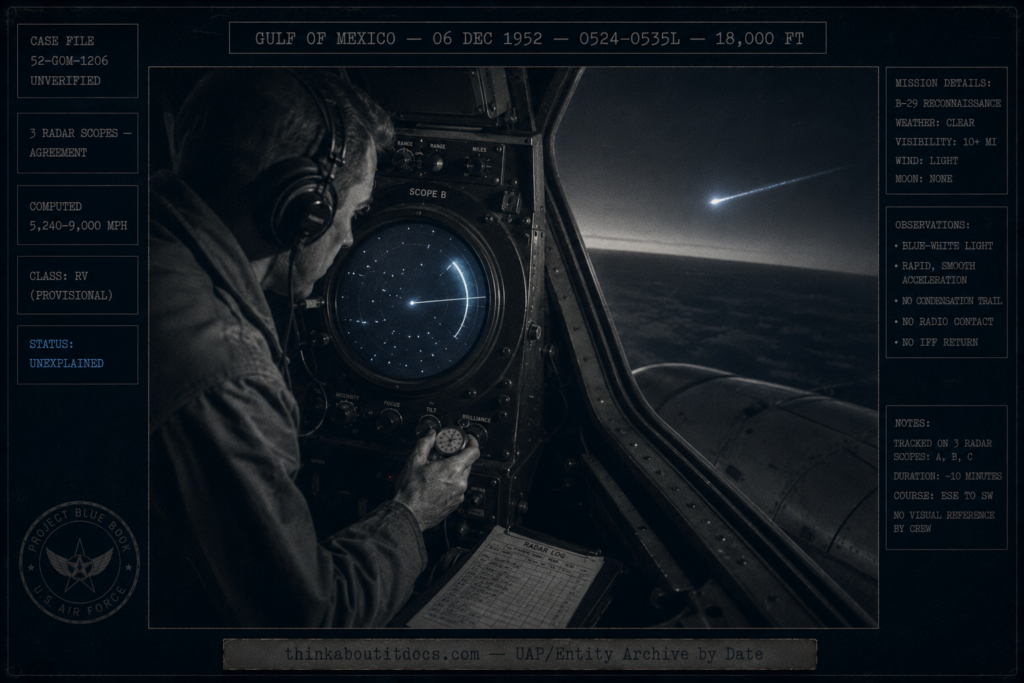
The December 6, 1952 Gulf of Mexico B-29 encounter — three radar scopes and visual confirmation of objects computed at 5,000–9,000 mph, preserved in the Blue Book record and unexplained. (thinkaboutitdocs.com — UAP/Entity Archive by Date)
THINK ABOUTIT UFO|UAP|ENTITY SIGHTINGS REPORT
1952: B-29 Radar-Visual Over the Gulf of Mexico
Just before dawn on December 6, 1952, a US Air Force B-29 finishing a night training flight over the Gulf of Mexico became one of the best-instrumented UFO encounters of the early Cold War. Three radar scopes aboard the bomber — operated independently by trained crew — tracked groups of objects closing head-on at better than 5,000 miles per hour, while crewmen at the waist blisters saw blue-white blurs streak past exactly where the scopes said they were. In the final minute the small returns appeared to merge with one large blip, which then accelerated off the screen at a computed speed above 9,000 miles per hour. The crew filed sworn statements; the case sits in the Project Blue Book record. This is not a rumor or a contactee tale — it is a multi-witness, multi-radar, stopwatch-timed event, and it remains unexplained. The archive’s job here is to keep the documented core intact and strip away the decades of dramatization that have grown over it.
Date: December 6, 1952
Sighting Time: Approximately 0524–0535 local time
Day/Night: Night (before dawn, bright moonlight)
Location: Gulf of Mexico, about 100 miles south of the Louisiana coast (roughly 190 miles from Galveston, Texas)
Urban or Rural: Not applicable — over open water, aircraft at altitude
No. of Entity(‘s): None
Entity Type: Not applicable — no occupants involved
Entity Description: Not applicable
Hynek Classification: RV (Radar-Visual) — visual observation supplemented by radar tracking
Duration: About 10 minutes
No. of Object(s): About 20 small returns seen over the event, in successive groups, plus one large return at the end
Description of the Object(s): Small radar returns, described as small and possibly round, appearing in groups; visually only fast blue-white flashes or streaks could be made out; a final large return shaped on the scope as a half-inch curved arc
Shape of Object(s): Indeterminate (small, possibly round; large object rendered as a curved arc on radar)
Size of Object(s): Small returns plus one much larger return of a size the crew considered impossible for any known aircraft
Color of Object(s): Blue-white (visual)
Distance to Object(s): Closest approach about 20 miles; the large return broke off about 30 miles out
Height & Speed: Bomber at 18,000 ft; objects computed at roughly 5,240 mph, with the final large return exceeding 9,000 mph
Number of Witnesses: The B-29 crew — pilot, radar operator(s), navigator, and flight engineer — with radar and visual confirmation by multiple men
Special Features/Characteristics: Three independent radar scopes in agreement; stopwatch-timed speed computations; visual confirmation at called radar positions; head-on approaches, course reversals, pacing of the bomber, and an apparent merge of small returns into one large return that then accelerated away
Case Status: Unexplained
Source: Project Blue Book case file (sworn crew statements of 1st Lt Norman Karas and 1st Lt William W. Naumann); Donald E. Keyhoe, “Flying Saucers from Outer Space” (1953), via Air Force press officer Albert M. Chop; NICAP / Weinstein catalog
Summary/Description: Before dawn on December 6, 1952, the crew of a USAF B-29 over the Gulf of Mexico tracked successive groups of unidentified targets on three independent radar scopes, computing speeds above 5,000 mph by stopwatch, with crewmen visually confirming fast blue-white objects at the radar-indicated positions. In the final phase the small returns appeared to merge with one large return, which accelerated off the scopes at over 9,000 mph. The crew filed sworn statements and the event is preserved in the Blue Book record. It remains unexplained.
Related Cases: 1951: The Lubbock Lights | 1952: Washington, D.C. National Airport radar-visual sightings (July) | 1957: RB-47 electronic-intelligence radar-visual case
DETAILED REPORT
The aircraft was a B-29 on a night training mission, cruising at 18,000 feet in bright moonlight as it neared the end of its flight, roughly 100 miles south of the Louisiana coast and about 190 miles out from Galveston, Texas. At about 0524 the pilot asked the radar section to bring a set up so he could check the coastline on the auxiliary scope in the cockpit. A minute later the trouble began.
A single fast return appeared on the main scope, approaching head-on. Between sweeps it had advanced roughly 13 nautical miles — a rate no 1952 aircraft could produce. The radar operator timed it with a stopwatch and, with the flight engineer computing, arrived at about 5,240 mph. The pilot’s first reaction was that the reading was impossible and that the set should be recalibrated. As that was done, more returns appeared — and crucially, they showed on all three independently powered scopes at once, the pilot’s, the navigator’s, and the main radar operator’s. Recalibration changed nothing; the equipment was working correctly.
Over the next several minutes successive groups of targets came in, mostly from dead ahead, at comparable speeds. As objects passed on the right, crewmen sprang to the waist blisters and saw them: fast blue-white streaks, too quick at those speeds to resolve into any shape, appearing exactly where the radar had called them. The cross-confirmation between independent scopes and separate visual observers is what gives the case its weight. In the final phase the pilot watched a group of returns about 40 miles behind swing in and pace the bomber for roughly ten seconds before pulling away, after which the smaller returns appeared to merge into a single large return — rendered on the scopes as a half-inch curved arc, a size the crew judged impossible for any known craft. That large return then accelerated and crossed off the scopes at a computed speed above 9,000 mph. Contact was broken off at about 0535.
On landing, the crew were interrogated by intelligence officers and filed written statements, which survive in the Project Blue Book file. Those documentary statements are the bedrock of the case — and they introduce the single most important correction to how the story is usually told. The names that circulate in the popular accounts — Captain Harter, Lieutenant “Sid” Coleman, Sergeants Bailey and Ferris, a navigator “Cassidy” — come from Donald Keyhoe’s 1953 book “Flying Saucers from Outer Space,” which dramatized the event with dialogue. The sworn statements in the Blue Book record are signed by different men: 1st Lt Norman Karas, who described turning on his set, timing the first target by stopwatch at 5,240 mph, alerting the crew, seeing the flashes, and counting about twenty objects in all; and 1st Lt William W. Naumann, who recorded that contact broke off at 0535 as the merged returns formed a half-inch arc about 30 miles out and crossed off the scope at over 9,000 mph. Both name-sets refer to the same incident, but only the second is the documentary record. The archive presents both rather than passing off Keyhoe’s cast as the file.
What the objects were has never been established. The combination of head-on approaches, course reversals, pacing, an apparent rendezvous, and computed speeds from roughly 5,000 to over 9,000 mph does not fit the aircraft, rockets, or meteors of 1952 — meteors do not pace an aircraft or reverse course, and no airframe of the period could survive those speeds at that altitude. That is precisely why the case has endured. It is also why it must be stated carefully: the radar speed computations were made under pressure by stopwatch, and radar can produce spurious or anomalous returns; the visual elements were brief blurs rather than resolved structure. None of that has been shown to explain the event, but it marks the honest boundary of what the instrumentation can prove.
RESEARCHER’S NOTES
The Gulf B-29 Rendezvous — December 1952 and the Two Layers of the Record
- Classification rationale (RV holds): This is a clean Radar-Visual case and the prior classification stands. Trained operators tracked the objects on three independent scopes while separate crewmen visually confirmed them at the called positions — exactly the radar-plus-visual pairing the RV category exists to capture. There is no entity, no landing, and no structure resolved, so no Close Encounter class applies; the prior page’s stray “Humanoid/Occupant” notation was a template error and has been removed.
- Source-chain assessment and the names problem: The case exists in two layers that the prior page conflated. The documentary layer is the Blue Book file, with sworn statements from 1st Lt Norman Karas and 1st Lt William W. Naumann. The popular layer is Donald Keyhoe’s 1953 book, which retold the event with vivid dialogue and the now-famous names Harter, Coleman, Bailey, and Ferris. Keyhoe’s account is valuable and broadly faithful to the sequence, but its cast is not the signed record, and a chronological archive should not present dramatized names as the file. Both are given here, clearly labeled. The prior citation “McDonald; cf. Condon Rpt pp. 148–150” could not be confirmed as matching this case and has been replaced with the verifiable chain.
- Why this case is strong, and the limits of that strength: Compared with the single-witness and rumor cases of the same era, this one is unusually well-grounded — multiple trained observers, three separately powered radar sets in agreement, instrument-timed speed computations, and visual confirmation at predicted positions, all preserved in a contemporaneous government file. Those features make it one of the better-documented radar-visual reports of the 1950s. The countervailing caution is that stopwatch speed estimates under stress carry error, and airborne radar of the period could generate anomalous propagation returns; the visual sightings, while corroborative, were of unresolved blurs. The case is robust enough to resist easy dismissal but not so airtight as to compel a single conclusion — which is the proper meaning of leaving it open.
- Historical context: The encounter falls at the tail end of the great 1952 UFO wave, the year of the Washington National radar-visual sightings and a flood of military reports, and just days after a separate near-collision report at Laredo, Texas. It was released to Keyhoe by Air Force press officer Albert M. Chop during the brief window before the JANAP-146 communications-security framework tightened public reporting by military witnesses. That timing is why the crew statements reached the public at all, and it situates the case within a specific moment when the Air Force was still, intermittently, letting such reports out.
The Gulf of Mexico B-29 case is the kind of report the archive exists to preserve accurately: genuinely documented, instrument-backed, multi-witness, and unresolved. Told straight, it needs no embellishment — three radar scopes and several pairs of eyes recorded something that outran every machine of its age and then, apparently, gathered itself into a single large object and left at nine thousand miles an hour. The names in the sworn file are Karas and Naumann, not the dramatized cast of the retellings; the entities others have penciled in were never there; and the verdict the old page argued for is left, correctly, to the reader. It stands as Unexplained — one of the period’s strongest, on the strength of the record rather than the story told about it.