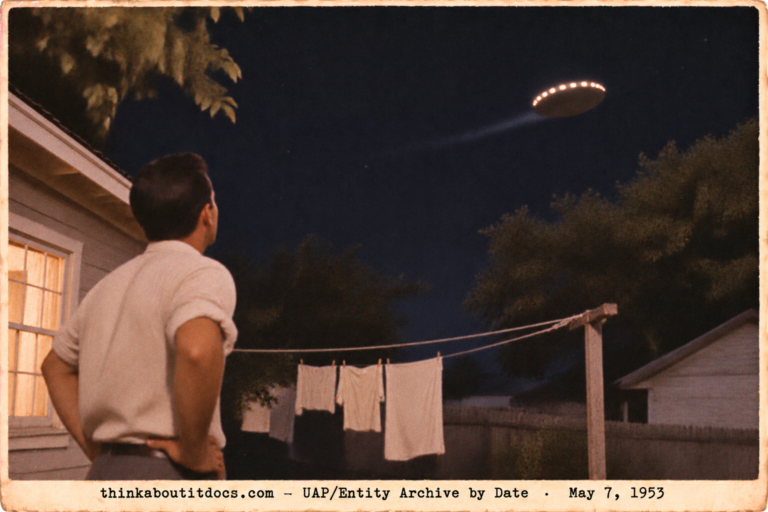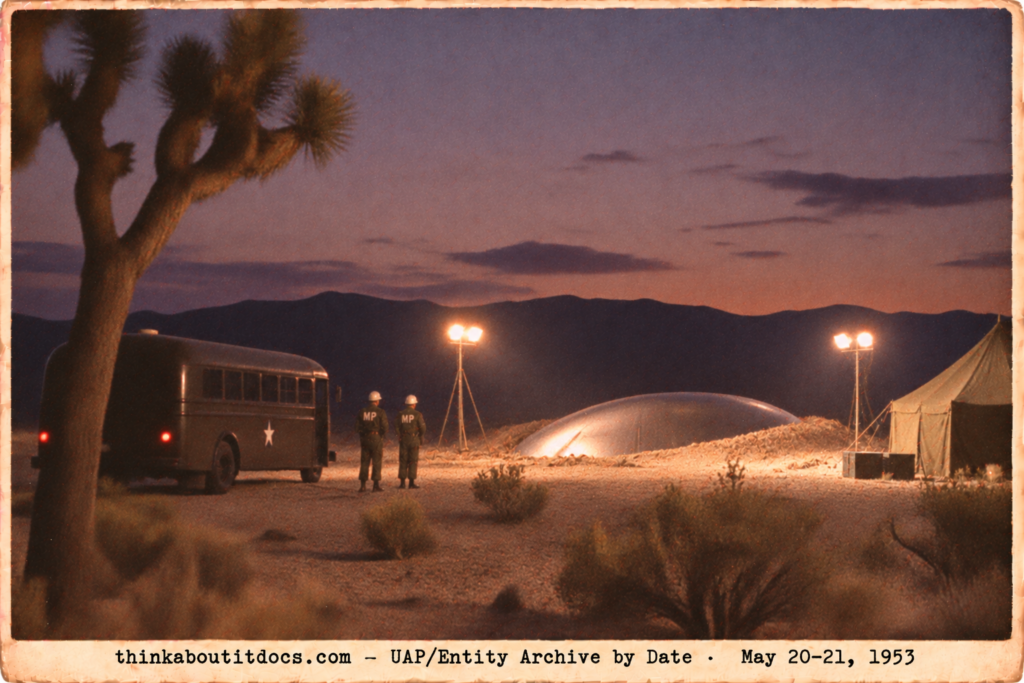
May 1953: the claimed crash site near Kingman, Arizona.
THINK ABOUTIT CRASH REPORT
1953: Kingman, Arizona UFO Crash Claim
Arthur G. Stansel, an engineer on loan to the Atomic Energy Commission for Operation Upshot-Knothole, said he was taken from the Nevada Test Site with fifteen other specialists in a blacked-out bus to a crashed oval craft about thirty feet across near Kingman, Arizona, and shown the body of a four-foot being in a silvery suit.
He first put his name to the account in a signed affidavit dated June 7, 1973, twenty years afterward. That affidavit, obtained by Raymond Fowler, is the only documentary item behind the claim.
WARNING:
UNSUBSTANTIATED CRASH-RETRIEVAL CLAIM.
This case rests on one witness affidavit signed twenty years after the alleged event, with no contemporary documentation, no physical evidence and internal contradictions in the object description. Later additions (a four-member crew, beam weapons, Area 51 and a 1962 test crash) come from problematic sources. It is retained as a documented claim, not a verified event.
Date: May 20-21, 1953 (sources vary: Stansel’s desk calendar shows May 20 at Frenchman Flat with a “strange call” that evening; the affidavit gives May 21)
Sighting Time: About 9:00 p.m. (per one source; not specified in the affidavit)
Day/Night: Night
Location: Desert near Kingman, Arizona, reported as about 8 miles northwest of Kingman Army Air Field
Urban or Rural: Rural (desert)
No. of Entity(‘s): 1 seen by Stansel; later unverified claims say four
Entity Type: Small humanoid, deceased
Entity Description: About 4 ft tall; dark brown skin (Stansel said this may have been caused by exposure to our atmosphere); a silvery metallic one-piece suit and a skullcap of the same material; a small round mouth
Hynek Classification: Not Applicable
Duration: Not specified
No. of Object(s): 1
Description of the Object(s): An oval craft resembling two deep saucers, one inverted on the other, in brushed-aluminum-looking metal; it had impacted 20 inches into the sand with no visible structural damage; an open hatch about 1.5 ft by 3.5 ft; another team member reported two swivel seats, an oval cabin and instruments
Shape/Size/Color of Object(s): Oval or two inverted saucers in the affidavit; teardrop or cigar-shaped, about 20 ft long and 5 ft high, in an earlier informal telling
Distance to Object(s): On site, close range
Height & Speed: Not applicable (on the ground)
Number of Witnesses: 16 specialists per Stansel; none of the other fifteen has come forward or been identified
Special Features/Characteristics: Team members were told to sign a secrecy oath; Operation Upshot-Knothole was real and active at the Nevada Test Site in spring 1953; Stansel’s desk calendar for May 20 partly supports his presence at Frenchman Flat
Case Status: Insufficient Data: unsubstantiated crash-retrieval claim; no Hynek classification is assigned
Source: Arthur G. Stansel (pseudonym “Fritz Werner”) via Raymond E. Fowler, affidavit of June 7, 1973, UFO Magazine April 1976 and “Casebook of a UFO Investigator” (1981); Albert Rosales, Humanoid Sighting Reports 1953; Stringfield (1977); Richard Hall (1964 secondhand mention). Problematic sources: Anton Anfalov and Bill Uhouse
Summary/Description: Engineer Arthur G. Stansel said he was bused with fifteen others to a crash site near Kingman and shown an oval craft about 30 ft across and the body of a 4-ft being. He signed an affidavit for Fowler in 1973. No other team member and no 1953 document has surfaced.
Related Cases: July 1947: Roswell; 1953: Brady, Montana sighting
Detailed Report
Arthur G. Stansel graduated from Ohio University in 1949 with an engineering degree and worked for Air Materiel Command at Wright-Patterson AFB as a mechanical engineer on aircraft engine testing and crash-damage assessment, especially landing gear. In 1953 he was on loan to the Atomic Energy Commission as a project engineer on Operation Upshot-Knothole, the series of eleven nuclear tests at the Nevada Test Site between March 17 and June 4, 1953. His work was assessing blast damage to structures.
By his account, on the evening of May 20, 1953 (his desk calendar places him at Frenchman Flat and notes a “strange call” from a doctor whose name is partly illegible), he was summoned and told to report for a secret assignment of two to three days. He was bused with fifteen other specialists in a vehicle with blacked-out windows to a site near Kingman, escorted by military police.
He described a craft embedded 20 inches into the desert sand with no visible structural damage: oval, about 30 feet across, in a metal resembling brushed aluminum, like two deep saucers joined rim to rim, with an open hatch about 1.5 by 3.5 feet. Another team member who looked inside reported two swivel seats, an oval cabin and many instruments. In a tent nearby he was shown a dead being about four feet tall in a silvery metallic suit and skullcap, with dark brown skin and a small round mouth. His task was to assess the craft’s descent and impact from the sand displacement. The team was bused back and told to sign a secrecy oath.
Stansel stayed silent for twenty years. In 1973 Raymond Fowler interviewed him and obtained an affidavit dated June 7, 1973, in which Stansel, under the pseudonym “Fritz Werner,” swore the account was true. Fowler published it in UFO Magazine in April 1976 and expanded it in his 1981 book. Fowler reported checking Stansel’s background and being satisfied with his credentials.
Researchers later found that Stansel had told the story informally to two young acquaintances, Young and Chetham, describing the object as teardrop- or cigar-shaped, about 20 feet long and 5 feet high. He attributed the difference to casual exaggeration.
Leonard Stringfield reported in 1977 testimony from a Naval Intelligence officer at Wright-Patterson who said he saw five crates arrive by DC-7 at night from an “Arizona crash site,” three holding small bodies packed in dry ice. The link to Kingman is an inference; Stringfield’s source does not name the site. Richard Hall also heard a version in April 1964 from an unnamed future Vietnam commander.
RESEARCHER’S NOTES
The Kingman Retrieval: One Affidavit and Its Limits
- The source chain: The documented evidence is one affidavit from 1973. Hall’s 1964 mention gives no details and an unidentified source, and Stringfield’s account connects to Kingman only by inference.
- No contemporary record: No 1953 orders, transport records, photographs or analysis reports have surfaced despite decades of FOIA requests. None of the other fifteen specialists has been identified.
- The shape discrepancy: The craft is a 30-foot oval disc in the affidavit and a 20-foot teardrop or cigar in the informal telling. That affects the most basic physical description, and Stansel’s own explanation was exaggeration in casual retelling.
- Problematic material: The four-member crew, beam weapons, captured female, Area 51 transfer and 1962 test crash trace to Anton Anfalov and Bill Uhouse. Neither has a documented source chain, and none of it is part of the documented case.
- What does check out: Upshot-Knothole was real and ran from March 17 to June 4, 1953, and the desk calendar partly places Stansel at Frenchman Flat on May 20.
The Kingman claim is one of the most cited alleged recoveries after Roswell, and it carries a signed affidavit that few crash-retrieval stories have. It also carries a shape discrepancy, no identified second witness and no 1953 paper trail, so it is preserved here as a documented claim and not as an established event.
“this may have been caused by exposure to our atmosphere”
— Albert Rosales, Humanoid Sighting Reports 1953 (on the being’s dark skin)