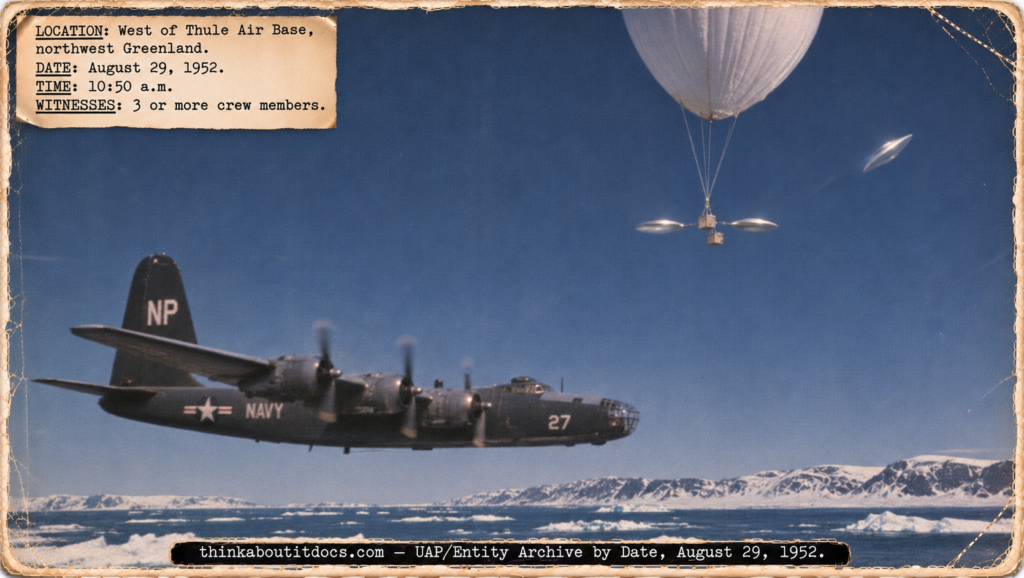
Thule, Greenland, August 29, 1952: three discs and a balloon.
THINK ABOUTIT UFO|UAP SIGHTINGS REPORT
Thule, Greenland:
A Navy Privateer Crew, a Skyhook Balloon and Three Silver Discs, August 29, 1952
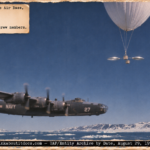
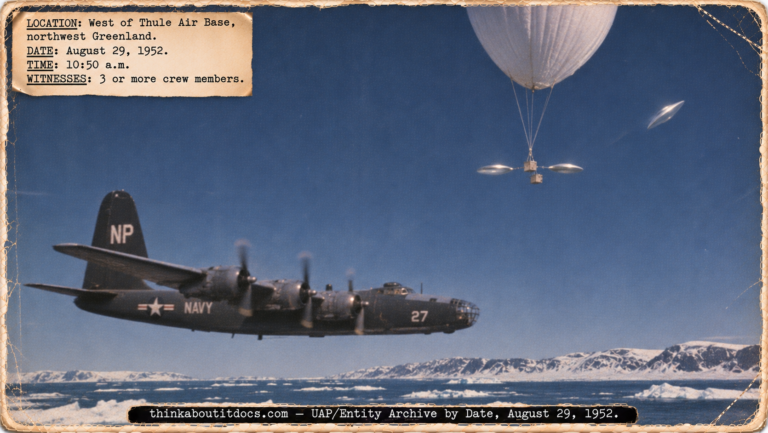
Over northwest Greenland on the morning of August 29, 1952, the crew of a Navy Privateer patrol plane was following a giant Skyhook research balloon when they saw three bright silver discs clustered on the balloon’s instrument package. The discs separated, formed a V, banked steeply to the left and climbed away out of sight. “They’re gone,” the plane commander said slowly, “climbing from 90,000 feet.”
The Thule, Greenland UFO sighting is one of the best-attested Navy reports of 1952: a trained crew, a known object for scale, and a written report sent up the chain to the Office of Naval Intelligence. As Cdr. Edward P. Stafford wrote, “There never has been an explanation, nor even an acknowledgment of the report.”
Date: August 29, 1952
Sighting Time: 10:50 a.m.
Day/Night: Day
Location: West of Thule Air Base, near Qaanaaq, northwest Greenland
Urban or Rural: Rural
No. of Entity(‘s): Not Applicable
Entity Type: Not Applicable
Entity Description: Not Applicable
Hynek Classification: Daylight Disc (DD)
Duration: Between about 3 seconds and 2 to 3 minutes, depending on the source
No. of Object(s): 3
Description of the Object(s): Three bright silver or white discs or globes clustered on a Skyhook balloon’s instrument package; they separated, formed a V or triangle, banked steeply to the left and climbed away
Shape/Size/Color of Object(s): Discs or globes; silver or white; one-half to almost the full apparent size of the balloon (a Skyhook balloon is about 85 feet in diameter)
Distance to Object(s): Not recorded; the aircraft was at about 10,000 feet and the balloon far above
Height & Speed: About 74,000 feet or about 90,000 feet depending on the source; the plane commander estimated tens of thousands of miles per hour and about 100 Gs in the turn (his estimate)
Number of Witnesses: At least 3 in the crew (Lt. John C. Callahan, Lt. (jg) William A. “Bill” O’Flaherty and plane captain Merchant, per Stafford); another source names the navigator Lt. (jg) R. S. Moore
Special Features/Characteristics: A known 85-foot balloon as a size reference; discs on the instrument package; a formation change; a steep bank; a rapid climb; the crew’s written report to the Office of Naval Intelligence and to Air Force authorities at Thule
Case Status: Project Blue Book: Unknown (Sparks Catalogue Case 803). No explanation or acknowledgment of the report is on record
Source: Cdr. Edward P. Stafford, USN (Ret.), “Cosmic Curiosity,” Naval History 18:5 (October 2004); Brad Sparks, Blue Books Unknowns Catalogue, Case 803, p. 170; Journal of UFO History 2:4 (2005); NICAP; Project 1947; Omaha World-Herald, October 18, 1952; Chop Clearance List Item #2
Summary/Description: A Navy patrol plane crew following a Skyhook balloon over northwest Greenland saw three bright silver discs on the balloon’s instrument package. The discs formed a V, banked left and climbed away. The commander wrote a report to the Office of Naval Intelligence, and no explanation was ever given. Blue Book: Unknown.
Related Cases: Colorado Springs, Colorado, August 29, 1952; the January 16, 1951 Artesia, New Mexico Skyhook sighting
Detailed Report
The Thule detachment of three Navy patrol planes under Cdr. Edward P. Stafford had two jobs at the new U.S. air base in northwest Greenland: ice reconnaissance, and support for cosmic-ray balloon flights. On the morning of August 29, 1952, one of the four-engine World War II Privateers was following an 85-foot Skyhook balloon launched from the icebreaker USCGC Eastwind. The aircraft was at 10,000 feet, and the balloon was far above it.
According to Stafford, who was not aboard but heard the account while it was fresh, the plane commander, Lt. John Callahan, first saw the objects. Copilot Lt. (jg) Bill O’Flaherty also saw them, and the plane captain, Merchant, looked through binoculars. O’Flaherty exclaimed that there were “three bright silver discs attached to that instrument pod.” The objects separated from the balloon, formed a compact V and made a steep left bank, then accelerated away. “They’re gone,” Callahan said slowly, “climbing from 90,000 feet.” He later put their speed at tens of thousands of miles per hour and the turn at roughly 100 Gs, estimates rather than measurements.
The Sparks catalogue entry, as summarized by the UAP Discovery group, gives a different version of the details. It names the aircraft a PB4Y-2 Privateer with Lt. (jg) William A. O’Flaherty as pilot and Lt. (jg) R. S. Moore as navigator, and it says that when the parachute instrument package was released from the balloon the crew saw three white discs or globes, one-half to almost the full apparent size of the balloon, in a triangle formation to the right of the package at 74,000 feet. In that version the sighting lasted two to three minutes.
Callahan wrote a report that went through the Navy chain of command to the Office of Naval Intelligence, and a report also went to Air Force authorities at Thule. An Omaha World-Herald story of October 18, 1952 carried the headline “Arctic Navy Pilot Reports Seeing Strange Phenomena.” Stafford wrote that “there never has been an explanation, nor even an acknowledgment of the report.”
RESEARCHER’S NOTES
Two Accounts of One Morning Over Greenland
- One event, two versions: Stafford (a Navy commander writing in 2004 from his memory of the crew’s account) and the Sparks catalogue (from the Blue Book file) agree on the date, the balloon, the three discs and the crew member O’Flaherty. They differ on the aircraft’s commander, the altitude (90,000 or 74,000 feet) and the duration (about 3 seconds or 2 to 3 minutes). Both are given here.
- A scale reference: The balloon was about 85 feet across, so the observers could size the discs against a known object. That gives the report more weight than most sightings.
- Names: Stafford spells the plane commander’s name Callahan; some other summaries spell it Callaghan. The UAP Discovery summary of the Sparks entry names O’Flaherty as pilot and Moore as navigator and does not mention Callahan.
- The estimated speed: Tens of thousands of miles per hour and a 100 G turn are the commander’s own guesses at distance and angular speed. They are not instrument readings.
- Ordinary candidates: Objects near a balloon can be parts of the balloon system, ice crystals or reflections. The sources do not address them, and no Navy conclusion is on record.
Thule is a Navy crew’s report with a known balloon beside it, a written report sent up the chain and no response. Its two versions differ on specifics and agree on the picture: three discs on the balloon, then a V, a bank and a climb.
“They’re gone,” he said slowly, “climbing from 90,000 feet.”
— Lt. John Callahan, Thule Air Base, August 29, 1952, as recounted by Cdr. Edward P. Stafford in Naval History, October 2004