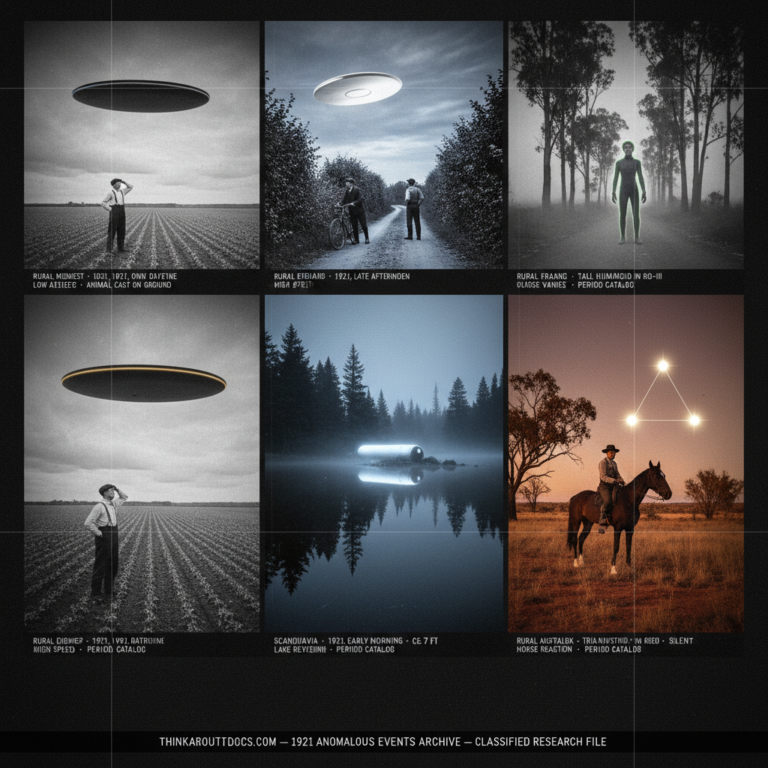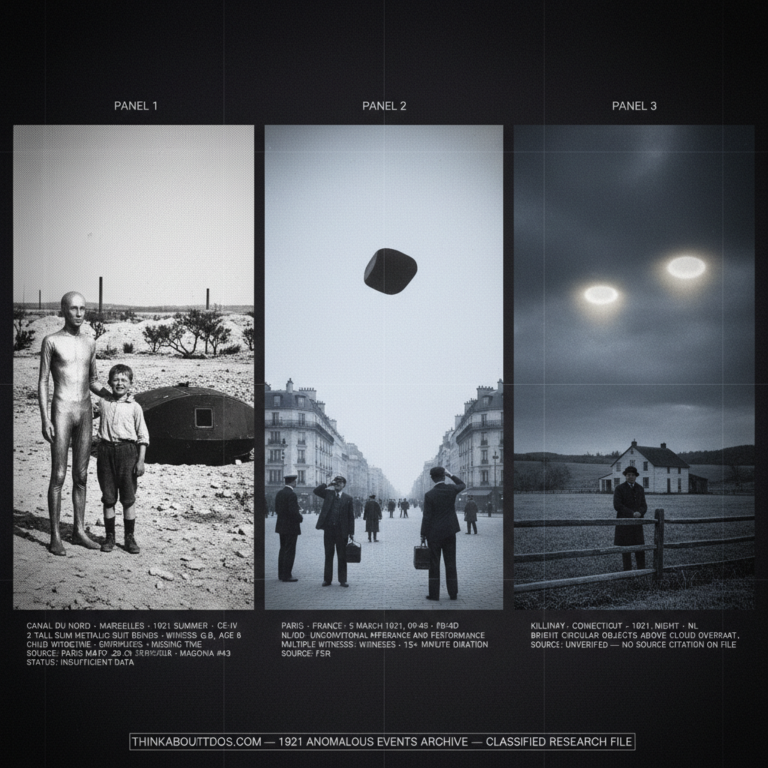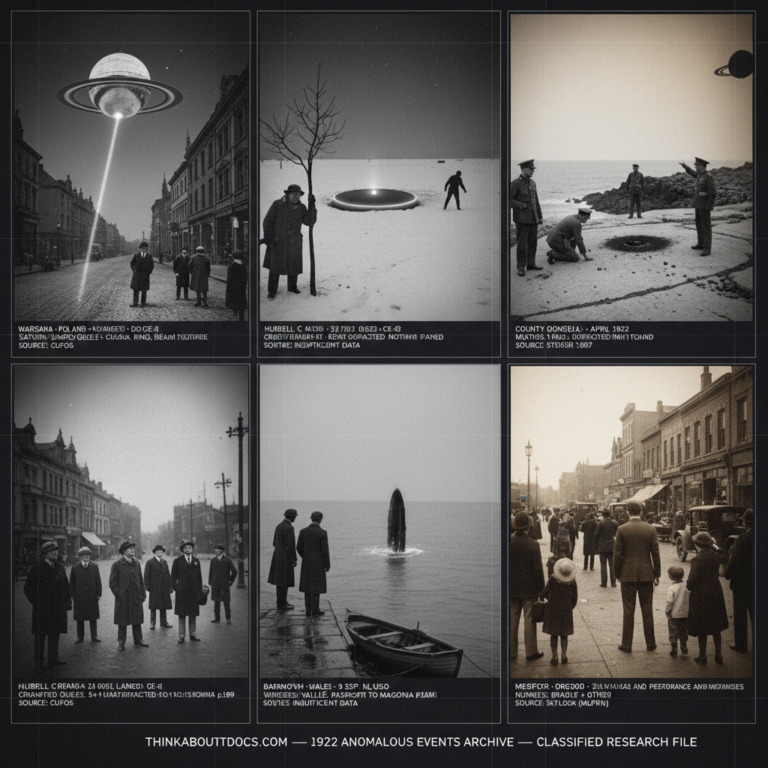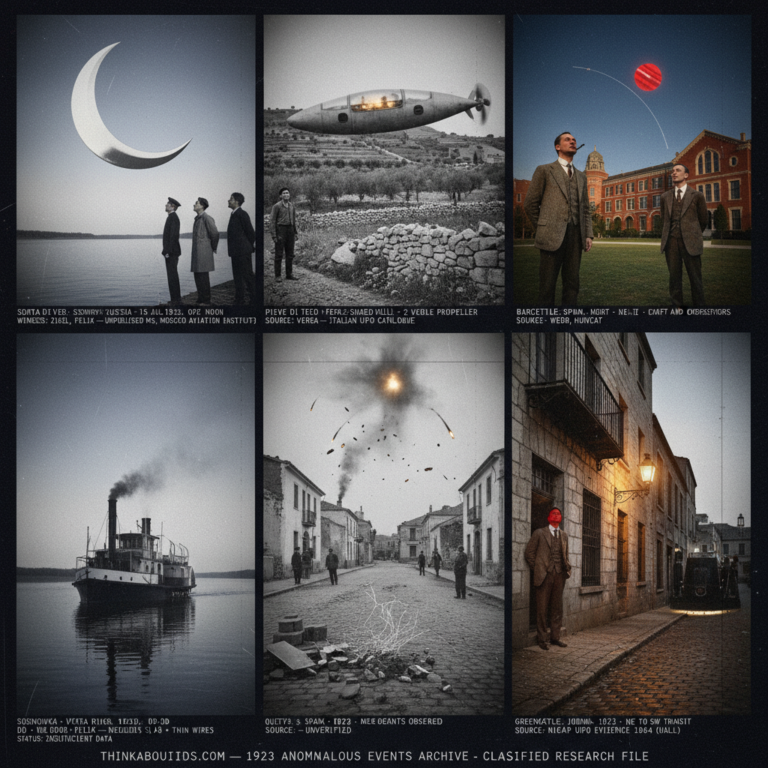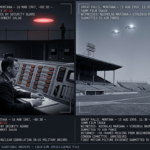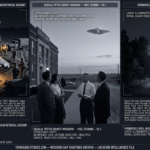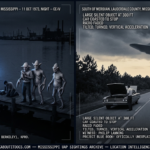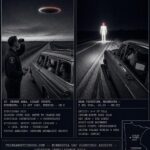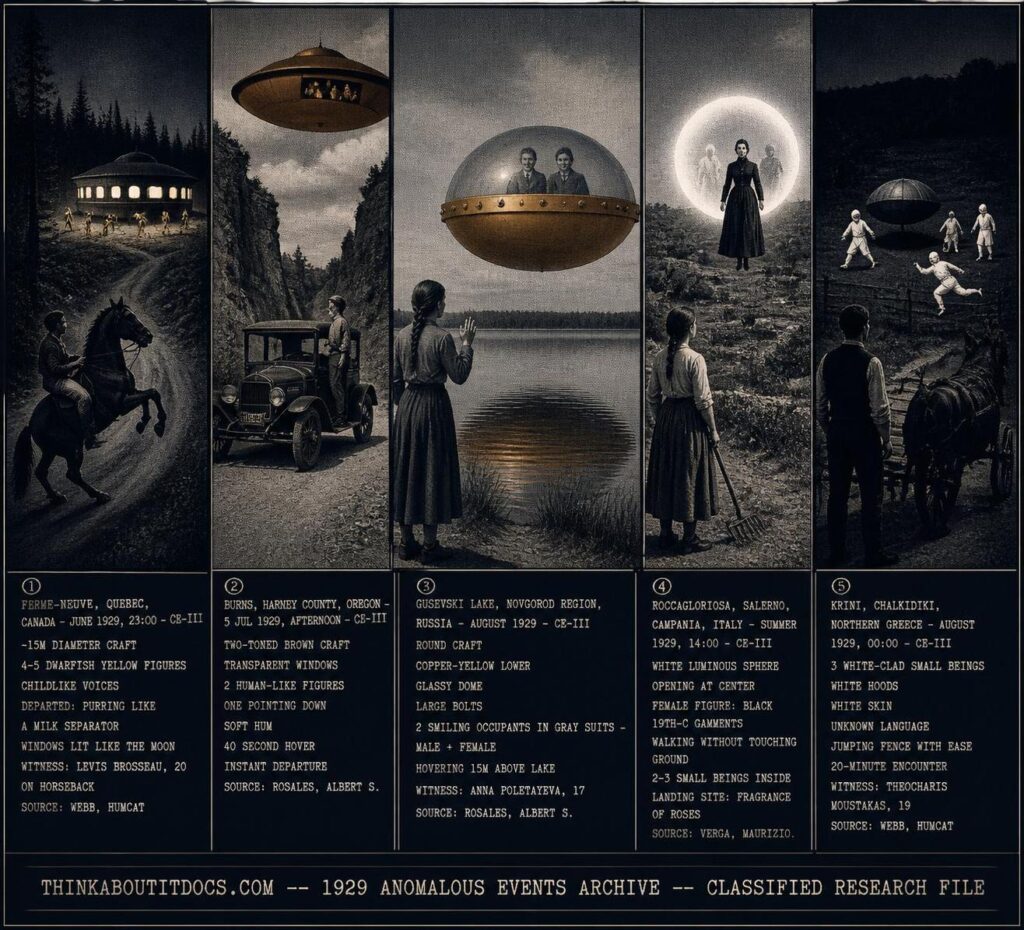
1929 anomalous events archive: Ferme-Neuve Quebec CE-III June 1929 dwarfish figures and milk-separator craft with moon-lit windows (HUMCAT), Burns Oregon CE-III July 5 two human-like occupants pointing at witnesses through brown craft windows (Rosales), Novgorod Russia August copper-bolted dome with smiling male-female pair in gray suits above lake (Rosales), Roccagloriosa Salerno Italy summer floating female figure from white sphere with small interior beings and rose-scented landing site (Verga), and Krini Chalkidiki Greece August CE-III three white-clad fence-jumping beings (HUMCAT). Six CE-III/high-strangeness events in one year — densest entity year of the 1920s.
1929: UFO|UAP & Alien Sightings Archive
The year 1929 closes the 1920s with the densest concentration of occupied-craft CE-III observations in the decade — five separate events across nine months in which witnesses observed humanoid or human-appearing figures inside or beside structured craft, on four continents and in six countries. The Ferme-Neuve, Quebec event in June is the anchor: Levis Brosseau riding home on horseback at 11 PM encountered a dark object 15 meters in diameter and 5 meters high on the ground, with four or five dwarfish figures running back and forth within six meters of it, speaking in sharp childlike voices, before the craft rose and passed over him at about 50 mph with a sound like a milk separator. The Burns, Oregon July 5 case adds an American Pacific Northwest occupied craft — two completely human-like figures visible through a transparent window, one pointing down at the witnesses below, the other moving to a second window as the two-toned brown craft hummed softly and then accelerated and was gone in a blink. The August Novgorod region Russia case (Rosales sourced) gives the year its most detailed occupant description: seventeen-year-old Anna Poletayeva observed a copper-yellow craft with a glassy dome joined by copper bolts above Gusevski Lake, two smiling human-like people in gray tight-fitting suits visible inside — one male, one female — both looking at her before she panicked and ran. The Chalkidiki, Greece August midnight encounter adds three white-clad small beings speaking an odd language, repeatedly jumping over a fence with ease, who vanished when the witness fled to the village.
Against this the year carries the 1929 Hertford, England miniature biplane with a tiny proportionally-correct leather-helmeted pilot who waved as he took off — HUMCAT sourced, two child witnesses, one of the most narratively distinctive pre-modern CE-III reports in the British record. The Roccagloriosa, Salerno, Italy summer case adds a dimension that sits at the intersection of Marian apparition and UAP contact: a white luminous sphere descending vertically into a field, dimming to create an opening, a female figure in sumptuous 19th-century black garments emerging and walking without touching the ground, two or three small beings moving inside the sphere — and when the girl’s father arrived at the landing site, the smell of roses. The Paraguaçu, Minas Gerais, Brazil case — two giant 2.5-meter humanoids in silvery outfits and brown boots beside a shiny white metallic craft with window apertures — adds South America to a year whose global distribution is unmatched in the 1920s series. Taken together, 1929 is the most geographically dispersed and analytically rich year in the entire 1920–1929 decade.
Date: 1929
Location: Hertford, UK
Time: Daytime
Summary: Close encounter with a an unidentified craft and its occupants. One object, about 2 feet across, was observed by two children in a rural area for a few minutes (Goodwin; Priest). A sister, 5, and brother, 8, were playing in the garden one morning, at that date the road was a lane, with just two pairs of houses, one of which was theirs, and behind the houses there was an orchard. As they played, they heard the sound of an engine—years later the sister would likened it to a quiet version of a trainer plane. Her brother and her looked up and saw, coming over the garden fence from the orchard, this small aeroplane (of biplane type) which swooped down and landed briefly, almost striking a dustbin. It remained there for possibly just a few seconds and then took off and was gone, but in that short the girl had a perfect view of the tiny biplane but also of a perfectly proportioned tiny pilot wearing a leather flying helmet, who waved to them as he took off. Neither she nor her brother spoke of the strange sight until years later. She estimated the wing-span of the tiny aircraft at no more than 12-15 inches, with the tiny pilot in perfect proportion thereto. Folkloric entity classification — miniature proportional entities in period-accurate craft. Retain as high strangeness CE-III.
Source : Webb, David HUMCAT: Catalogue of Humanoid Reports | Source Status: VERIFIED
Date: 1929
Location: Chippewa Falls, Wisconsin
Time: Unknown
Summary: [Full Report]
Source: Individual report
Date: April 1929
Location: Ward, Colorado
Time: Afternoon
Summary: Edward Pline, a sawmill operator, photographed an unidentified round object passing at low altitude above his mill operation. Object was approximately the size of a large boulder and passed with sufficient sound and ground vibration to freeze mill workers in place. Corroborated by a letter from his daughter Hetty Pline. Pre-1947 photographic case. [Full Report]
Source: Individual report
Date: June 12 to 15 1929
Location: Ferme-Neuve, Quebec, Canada
Time: 23:00
Summary: Unintelligible language: childlike voices. On horseback when saw dark object with yellow light landed on the ground. Horse became nervous.4-5 small beings running back and forth. Took of with rush of air. Levis Brosseau, age 20, was riding home in Ferme Neuve, Quebec on horseback at 11:00 p.m. when he saw a dark object with a yellow light landed on the ground. His horse became very nervous. The object was estimated to be 15 meters in diameter and 5 meters high, and he witnessed four or five dwarfish figures running back and forth within 6 meters of the object. He heard their sharp, childlike voices. The dark object then took off with a machine-like sound and rush of air. Levis Brosseau, riding home to Ferme Neuve, saw on a hillside a sort of black “cloud” with a yellowish light coming from within. Approaching on foot to within 150 ft, he saw it to be a dark object on the ground; he could indistinctly see, in the darkness, 4 or 5 small “yellowish” colored men running around in a 20-foot radius. The dark object rose & passed over him at about 50 mph, “purring like a milk separator,” with a rush of air; coming from it he heard 2 voices as if in argument. The object was about 50 ft in diameter, with windows “lit like the moon,” and with black protuberances 3 ft apart all around the circumference.
Source : Webb, David HUMCAT: Catalogue of Humanoid Reports | Source Status: VERIFIED
Date: Summer 1929
Location: Roccagloriosa, Salerno, Italy
Time 1400
Summary: A girl was working in a field when she looked up and saw a stationary ball of white light in the sky. This then descended vertically, stopping just a few centimeters above the ground, while descending the ball greatly dimmed creating a sort of “opening” in the center of the sphere. After 5 or 10 seconds, a female figure emerged from the opening wearing sumptuous black garments, “like those from the 19th century”. Inside of the ball, 2 or 3 small beings moved slowly and peered outward. The female figure walked toward the witness, without her feet touching the ground. Thereafter, she turned left and was lost in some trees. The girl was frightened and made the sign of the cross. She then ran to call her father. When he arrived at the landing site, he smelled the fragrance of roses. CE-III/high strangeness — contains elements consistent with both UAP and Marian apparition traditions. The rose fragrance at the landing site is a consistent detail in the Fatima/apparition literature that also appears in several Italian CE-III cases.
Source: “When saucers came to Earth” Italian researcher and author Maurizio Verga
Date: Mid 1929
Location: Spring Valley, New York
Time: Afternoon
Summary: “These people – I call them people, I don’t know what they were – looked like a diving suit with a head shape at the top and very distorted, short-looking body. It was weird.” Early UFO, abduction encounter investigated by New York artist Budd Hopkins. CE-IV implied by “abduction encounter.” The diving-suit-with-distorted-body description is a distinctive pre-modern entity morphology.
Source: UFOs Over New York By Preston Dennett – Schiffer (P.126)
Date: July, 1929
Location: Robsart, Saskatchewan, Canada
Time: Night
Summary: Five persons among them Einar Rostivold, saw a huge ball of light giving off fiery colors, 25 km from Robsart. It landed slowly, vanished gradually after illuminating the whole countryside for 30 min. NL classification; 30-minute illumination duration is notable.
Source: Magonia #47, Fate Jan., 58 | Source Status: VERIFIED
Date: July 5, 1929
Location: Burns, Oregon
Time: afternoon
Summary: The witnesses were traveling east of town climbing up through a cut in the rim rocks when an object, very slowly flew over the top of the car, about 50 ft above the rim rock. The object stopped and through a transparent window the witnesses could see two completely human-like figures that appeared to be pointing down at them using their arms and hands. One of the witnesses stepped out of the car but his mother demanded that he get back in. He stood on the running board observing the craft, which was two tones of brown. The craft, which had windows in the middle section, hovered for about 40 seconds emitting a soft hum. One of the figures then moved to another window and the craft suddenly accelerated and was gone in a blink of an eye. CE-III classification. Named figures (human-like), craft description (two-toned brown, windows), behavioral detail (figures pointing at witnesses) are specific and pre-contamination.
Source: Albert S. Rosales
Date: August 1929
Location: Near Gusevski Lake, Novgorod region, Russia
Time: Unknown
Summary: 17-year old Anna Petrovna Poletayeva was walking on a road on her way to visit her parents. The road passed next to Gusevski Lake and as she glanced at the lake she noticed a flying craft hovering above the lake. The object was round, small, without wings. Its lower part was yellow-reddish in color, resembling copper. The upper part was a glassy cupola. The glass from the cupola was joined to the lower part by large “copper” bolts. The UFO hovered about 15 meters above the water. Anna could see two small sized “people” inside the glassy cupola—one male the other female. They were dressed in gray tight-fitting suits. Both were smiling, looking at the witness. Their faces were very much like ordinary humans. Feeling initial fear she panicked and ran from the area stumbled and injured her elbow. She looked back and the object was still hovering in the same place.
Source: Albert S. Rosales
Date: August 1929
Location: Krini, Chalkidiki, Northern Greece
Time: 00:00
Summary: Greek ufology investigators Constantine Trantafyllou and Homer Carajas reported that in the village of Krini, Chalkidiki, Northern Greece, on Sunday of August 1929, about midnight, Theocharis Moustakas, then aged 19, was carrying flour with his cart, returning home after the grinding of wheat at the Krini mill. Suddenly, he saw an object like a parachute land on a nearby field and three little people speaking a very odd language between them. They were dressed with white clothes with white hoods and their skin was also white. Near them there was a fence, and the small men repeatedly jumped over it, very easily. Terrified, Mr. Moustakas run to the village, and told of his 20 minutes encounter. Some of the villagers told him he saw “devils”, others told him he was crazy. CE-III classification. The fence-jumping behavior and white uniform description are specific markers.
Source : Webb, David HUMCAT: Catalogue of Humanoid Reports | Source Status: VERIFIED
Date: November 1929
Location: Weelde, Belgium
Time: 02:00
Summary: A meteor-like object was observed. One object was observed by two male witnesses.
Source: Unlisted
Date: 1929
Location: North Atlantic
Time: Unknown
Summary: Thomas Stuart, third mate of the SS Coldwater, reported that at 400 mile off the coast of Virginia he saw a light traveling at an estimated 100 mph toward Bermuda. ‘There was something that gave the impression that it was a large, passenger craft,’ he said, though investigation failed to show any airship or airplane on that course at that time.
Source: Unlisted – Maritime NL/USO classification. A ship’s officer is an institutional observer; needs source citation.
Date: 1929
Location: Paraguaçu, Minas Gerais Brazil
Time: night
Summary: One night a large shiny white metallic craft with several window-like apertures was seen on the ground. Two giant humanoid figures about 2.50 meters in height stood next to the object. These wore silvery outfits and brown boots and gloves. CE-III classification. Giant humanoid type (2.5 meters) with silvery outfits and brown accessories is a specific pre-contamination description
Source: Antonio Faleiro
EXECUTIVE SUMMARY
The Occupied Craft Decade Closes — 1929’s Five CE-III Events
The year 1929 ends the 1920s with a concentration of occupied-craft close encounters that reflects the decade’s cumulative anomalous pattern in a single calendar year. Five CE-III events across five countries — Canada, the United States, Russia, Greece, and Brazil — with a sixth in Italy that crosses the CE-III/Marian apparition boundary, give 1929 the highest entity-encounter density of any year in the 1920–1929 series. The Ferme-Neuve Quebec case is the strongest by source quality: HUMCAT-sourced, named witness, horse reaction, specific craft dimensions, dwarfish entities with childlike voices, a milk-separator sound on departure, windows lit like the moon. It carries the complete CE-III evidence package — witness credibility, animal reaction, acoustic phenomenon, entity description, craft description, departure behavior. The Burns, Oregon case adds the human-appearing occupant pointing at witnesses — the interactive behavioral element that appears in a small number of pre-modern occupied-craft cases and which suggests an intelligence engaged with its observers rather than indifferent to them. The Novgorod Russia case’s smiling male-and-female pair in gray suits, looking at the witness from their copper-bolted dome above a lake, carries the same quality: entities who register the witness’s presence and respond to it.
The Roccagloriosa, Italy case is the year’s most ambiguous in classification but arguably its most analytically interesting. A white luminous sphere that creates an opening, from which a female figure emerges floating above the ground in black 19th-century garments, while small beings move inside the sphere — followed by the smell of roses at the landing site — sits in the overlap zone between the UAP and Marian apparition traditions with neither tradition able to claim it exclusively. The Verga source gives it Italian primary research credibility. The Hertford England miniature biplane pilot who waves at two children is at the other end of the strangeness scale — a folkloric entity in a period-accurate craft, perfectly proportioned, completely unaccountable, HUMCAT sourced. Together these cases close the 1920s with the message that the decade’s anomalous record is not a random scatter of lights and shapes but a consistent, geographically distributed pattern of structured craft and humanoid encounters in a period when no cultural framework existed for any of it.
From the Ferme-Neuve, Quebec entry (June 1929), sourced via Webb, David, HUMCAT:
“The dark object rose and passed over him at about 50 mph, ‘purring like a milk separator,’ with a rush of air; coming from it he heard two voices as if in argument. The object was about 50 ft in diameter, with windows ‘lit like the moon,’ and with black protuberances 3 ft apart all around the circumference.”
HUMCAT case summary, describing Levis Brosseau’s June 1929 encounter at Ferme-Neuve, Quebec