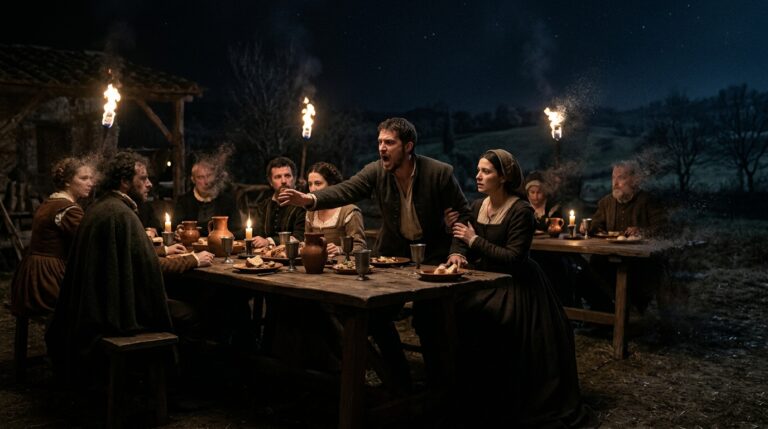
A friendly greeting, then a jet of vapour — artist R.L. Johannis meets two green beings beside a red disc near Villa Santina, August 14, 1947. Likely Europe's first post-Arnold landing.
THINK ABOUTIT UFO|UAP | ENTITY ENCOUNTER REPORT
1947: Villa Santina Encounter
An Italian painter stood at his easel beside a mountain creek in Friuli on the morning of August 14, 1947, and called out a friendly greeting to two small figures standing beside a landed red disc. It was the wrong move. One of the three-foot beings — earthy-green skin, immense yellow-green eyes with vertical cat-like pupils, eight jointless fingers arranged four-against-four — touched the center of its belt, and a thin jet of vapour knocked R.L. Johannis flat and helpless on his back. The creatures, panting heavily, crossed to within two yards of him, picked up his easel and climbing stick, carried them to the disc, and were gone — the craft shooting from the hillside in a shower of stones and dwindling to nothing, followed by a blast of wind that rolled the dazed artist over and over. Recorded just seven weeks after Kenneth Arnold, it is very probably the first “landing with entities” case in post-war Europe — and one of the earliest reports anywhere to describe both small humanoids and a weapon that disables a human witness.
Date: August 14, 1947
Sighting Time: ~9:00 a.m.
Day/Night: Day
Location: Near the Chiarso creek, Villa Santina, Carnia (Friuli), northeastern Italy
Urban or Rural: Rural (mountainous countryside)
No. of Entity(‘s): 2
Entity Type: Small humanoids (“little men” / midget-sized beings)
Entity Description: About 3 feet tall (under 90 cm), in dark blue translucent coveralls with bright red belts, collars, and cuffs. Heads larger than human, wearing spherical helmets/tight caps (faces uncovered). Skin an earthy green; immense round yellow-green (or plum-colored) eyes with a single vertical slit pupil; no eyelashes or eyebrows; a straight, rather large nose; a thin ^-shaped slit of a mouth. Hands claw-like and greenish with eight jointless fingers each (four opposed to four). Observed panting heavily.
Hynek Classification: CE-III (Close Encounter of the Third Kind) — close observation of and interaction with animate beings associated with the craft. Note: the belt-projected vapour produced a physiological effect (paralysis/daze) on the witness, placing this on the CE-III/CE-IV boundary; held at CE-III as there was no abduction.
Duration: Brief (a few minutes)
No. of Object(s): 1 (the landed disc; the live page’s “9” appears to be an erroneous carryover from Arnold’s nine objects)
Description of the Object(s): A disc-shaped craft about 30 feet across, described as bright red, that had alighted (per some versions, partly embedded in the mountainside). After the beings re-entered, it rose from the ground in a shower of stones and earth, hovered, then shot away and rapidly dwindled out of sight, producing a strong blast of wind/air shock.
Shape of Object(s): Disc
Size of Object(s): ~30 ft diameter
Color of Object(s): Bright red (per Bowen/Creighton accounts)
Distance to Object(s): A short distance from the witness (“some little distance”); beings approached to within ~2 yards
Height & Speed: Rose silently/violently from the ground; departed at tremendous speed, appearing to shrink to a point; accompanied by an air-shock blast
Number of Witnesses: Single — Professor R.L. Johannis (artist)
Special Features/Characteristics: Bright red disc; small green humanoids with vertical-slit reptilian/feline pupils and eight opposed fingers; red belts/collars/cuffs; a belt-mounted device projecting a paralyzing vapour (physiological effect on witness); the beings taking the artist’s easel/climbing stick; heavy panting by the entities; violent ground-departure with debris and an air-shock wind; very early post-Arnold European landing-with-entities case
Case Status: Unexplained
Source: Charles Bowen (ed.), “The Humanoids,” Flying Saucer Review Special Issue (1966), p. 188 ff. (Gordon Creighton’s presentation); originally published in Clypeus (Centro Studi Clipeologici, Turin), May 1964; Antonio Ribera, “El Gran Enigma de los Platillos Volantes”; translation/paraphrase by Jacques Vallée and Donald Hanlon
Summary/Description: Italian artist Professor R.L. Johannis was painting near the Chiarso creek at Villa Santina, in the Carnia district of Friuli, at about 9 a.m. on August 14, 1947, when he saw a roughly 30-foot, bright-red disc-shaped craft on the ground a short distance away, with two child-sized beings standing beside it. The beings were about 3 feet tall, green-skinned, with oversized heads, immense vertical-pupiled eyes, and eight-fingered claw-like hands, wearing dark blue translucent coveralls with bright red belts, collars, and cuffs. When Johannis hailed them — brushes still in hand — one touched the center of its belt and projected a thin vapour that knocked him dazed onto his back. The beings approached to within two yards, examined and then took his easel/climbing stick, returned to the craft, and departed in a violent ground-launch with flying debris and an air-shock blast, the disc dwindling to nothing.
Related Cases: 1947 Kenneth Arnold sighting (the wave context, ~7 weeks prior) |1947 Bauru, Brazil (Higgins) — near-contemporaneous early CE-III | 1957 Antônio Villas Boas (red-belted entities — cross-referenced by Creighton) | 1964 Cisco Grove, California (vapour/gas-projecting entity) | broader HUMCAT early-entity corpus
DETAILED REPORT
The Villa Santina case is one of the foundational European entity reports of the modern era, and its strength lies partly in its early date and partly in the unusually disciplined source chain that carried it into the literature. The witness was Professor R.L. Johannis, an Italian artist, who was painting near the Chiarso creek at Villa Santina, in the mountainous Carnia district of Friuli in Italy’s extreme northeast, at about 9 a.m. on August 14, 1947 — just seven weeks after Kenneth Arnold’s sighting and a few weeks after Roswell, at a moment when, by Johannis’s own statement, the Italian press had not yet begun reporting on flying saucers. This claimed pre-publicity timing is a notable credibility marker, suggesting the witness was not primed by the emerging saucer narrative.
By the account, Johannis suddenly noticed a disc-shaped object, roughly 30 feet across and bright red, that had come to rest a short distance away (some versions describe it as partly stuck in the mountainside). Beside it stood two child-sized beings, about three feet tall. His description of them is among the most detailed of the early period: dark blue coveralls of a translucent material with bright red belts, collars, and cuffs; heads larger than human, with spherical helmets or tight caps but uncovered faces; earthy-green skin; immense round eyes (described as yellow-green, or plum-colored) bisected by a single vertical slit pupil, like a reptile or cat; no eyelashes or eyebrows; a straight, rather large nose; and a thin, ^-shaped slit of a mouth. Most distinctively, he reported their hands were claw-like and greenish, with eight jointless fingers each, arranged four opposed to four — so that their precision grip and power grip would be identical.
The interaction was brief and physical. Johannis, brushes still in hand, hailed the creatures — a friendly gesture he speculated may have been read as hostile. One of the beings touched the center of its belt and projected a thin jet of vapour that struck him and dropped him, dazed and weakened, onto his back. The two beings then approached to within about two yards and stood examining his easel (in some renderings, his alpenstock/climbing stick with its ice-axe head, which the entities seemed particularly interested in). The artist, though weak, managed to roll over and watch; he noted the beings were panting heavily, and that the easel was taller than either of them. They carried the object back to the disc and entered it. The craft then rose violently from the ground in a shower of stones and earth, rose silently, and shot away at tremendous speed, appearing to shrink to a point and vanish — immediately after which Johannis was struck by a powerful blast of wind (an apparent air-shock) that rolled him over and over. When he had recovered enough to stand, he found his easel/stick gone.
The case’s documentary lineage is solid for an entity report. It was first published in Clypeus, the journal of the Centro Studi Clipeologici in Turin, in May 1964; recorded by the Spanish researcher Antonio Ribera in his book on flying saucers; translated and paraphrased into English by Jacques Vallée and Donald Hanlon; and presented by Gordon Creighton in Charles Bowen’s influential 1966 Flying Saucer Review special issue “The Humanoids.” Creighton noted the resemblance of the entities’ red belts to those in the 1957 Antônio Villas Boas case and the vapour-weapon parallel to the later 1964 Cisco Grove incident. The limitations are real: it is a single-witness case, first published seventeen years after the event, with no physical evidence beyond the claimed loss of the easel, and the original commentary acknowledges criticism that Johannis recorded an improbable amount of color and detail in a very short time (the FSR editor’s defense — that a trained artist’s eye captures detail faster than a camera — is plausible but not dispositive). Still, the consistency of the description, the witness’s claimed pre-publicity innocence, and the disciplined source chain place it well above the anonymous reports of the period.
RESEARCHER’S NOTES
The Painter and the Vapour — Villa Santina 1947 and Europe’s First Post-Arnold Landing
- Classification Assessment: CE-III is correct and should stand, with an important annotation. The case features close-range observation of and interaction with animate beings directly associated with a landed craft — the core CE-III criterion. However, the belt-projected vapour that paralyzed and dazed the witness constitutes a physiological effect on the observer, which sits at the CE-III/CE-IV boundary; because there was no abduction or onboard experience, CE-III is the correct hold, with the physiological-effect element noted. The live page’s object count of “9” is almost certainly an erroneous import from Arnold’s nine discs and should be corrected to 1.
- Source Chain Assessment: This is a respectable, multiply-attested chain for an early entity case. The lineage runs Clypeus (Turin, May 1964) → Ribera → Vallée/Hanlon translation → Bowen’s “The Humanoids”/FSR special issue (1966) with Gordon Creighton’s analysis — all recognized names in the serious European literature, placing the case in the documented secondary tier. The principal weaknesses are intrinsic rather than chain-based: a single witness, and a seventeen-year gap between event (1947) and first publication (1964). Johannis’s claim to have been unaware of the saucer phenomenon at the time, if accurate, partially offsets the delay by reducing the priming concern. Source field on the live page is adequately populated (Bowen) but could add the Clypeus and Ribera primaries.
- Pattern Context and Comparative Cases: Villa Santina is historically significant as very probably the first post-Arnold “landing with entities” case in Europe, predating the great 1954 European humanoid wave by seven years. Several of its features became recurrent motifs: the small green humanoid type, the bright accent-colored clothing (red belts/collars/cuffs), and especially the belt- or device-projected incapacitating vapour/beam, which recurs notably in the 1964 Cisco Grove case. Creighton’s cross-reference to the red belts of the 1957 Villas Boas entities situates it within a connected descriptive lineage. The eight-fingered, four-against-four hand morphology is an unusual and specific detail not common to the period’s stock imagery, which cuts against simple fabrication. The bright-red disc is itself atypical and memorable.
- Physical Evidence and Evidentiary Weight: There is no surviving physical evidence; the only claimed material trace is the disappearance of the artist’s easel/climbing stick, which is unverifiable. The departure details — a ground-launch throwing stones and earth, plus an air-shock blast that physically rolled the witness — are environmental-effect claims that, if true, would imply a real energetic event, but they rest entirely on the single witness’s testimony. The evidentiary weight therefore rests on the quality and specificity of that testimony, the witness’s professional observational training, his claimed pre-publicity status, and the disciplined source chain. This is insufficient for proof but sufficient, given the absence of any conventional explanation and the case’s standing in the serious literature, to carry it as Unexplained rather than Insufficient Data.

The Villa Santina encounter is a cornerstone of the early European entity record: a trained artist’s vivid, specific account of small green humanoids with reptilian eyes and eight-fingered hands, a bright-red disc, and a belt-weapon that flattened him with a jet of vapour — set down just seven weeks after Arnold, by a witness who said he had not yet heard of flying saucers, and carried into the literature through a credible chain from Clypeus through Vallée and Creighton. It is single-witness and late-published, with no physical evidence beyond a missing easel, and it drew fair criticism for the density of detail recalled in a brief encounter. But the specificity, the witness’s professional eye and claimed innocence of the phenomenon, and the disciplined sourcing lift it above the anecdotal. The archive holds the CE-III classification (noting the physiological-effect element at the CE-IV boundary), corrects the erroneous 9-object count to 1, affirms the Bowen/Creighton/Clypeus sourcing, and assigns Case Status: Unexplained. It stands as very probably Europe’s first post-Arnold landing-with-entities case and a seedbed of motifs — colored belts, incapacitating vapour — that would echo through the decades to come.